Author: provenirmulti

BLOG AutoFinance

Transaction to Relationship: Rethinking the Auto Finance Lifecycle

From Transaction to Relationship:
Rethinking the Auto Finance Lifecycle

Auto lending has always been good at the moment of origination. Lenders have spent decades optimizing the credit decision: faster approvals, tighter risk controls, better fraud detection at the point of application. That work matters, and it shows. But most lenders treat the funded loan as the finish line, when it’s actually the starting point of a customer relationship that can span five, six, or seven years.

The data that accumulates across that relationship: payment patterns, behavioral signals, refinance readiness, and early signs of financial stress, is largely going unused. And in a market where auto loan delinquencies have reached a 15-year high, with the Federal Reserve reporting that the rate of balances at least 30 days past due hit 3.88% in Q3 2025, the cost of that inaction is becoming hard to ignore.

The lenders building durable competitive advantage are the ones building the infrastructure to act on customer intelligence across the entire lifecycle.

The data is there. The action isn’t.

Auto portfolios generate a continuous stream of behavioral signals from the moment a loan is funded. Payment timing, frequency of contact, refinance inquiries, changes in vehicle value relative to outstanding balance — each of these tells a story about where a borrower is headed. Taken together, they can indicate risk trajectory, signal an opportunity for a proactive offer, or flag a customer who needs early intervention before they fall behind.

Most lenders collect this data. Very few use it systematically. The gap between what an auto lender knows about its customers and what it does with that knowledge is one of the most underutilized assets in the business.

The consequences are visible in the numbers. TransUnion projects auto loan delinquencies will reach 1.54% (60+ days past due) by year-end 2026, marking five consecutive years of growth. That persistent pressure isn’t just a macroeconomic story. It reflects, in part, a structural problem in how most lenders manage their portfolios: reactively, and with incomplete information.

Pre-delinquency intervention — reaching a borrower at the first signs of financial stress, before a payment is missed — is one of the highest-leverage moves a lender can make. It preserves the customer relationship, reduces loss severity, and typically costs far less than collections activity after the fact. But it requires acting on signals in real time, not in batch processes run weekly or monthly after the damage is done.

traffic light

The infrastructure is the problem.

Understanding why most lenders aren’t doing this requires looking honestly at how their systems are structured. Origination, fraud, customer management, and collections have historically lived on separate platforms, often owned by separate teams, sometimes built over decades with different vendors and different data models.

Each system sees a slice of the customer. None of them sees the whole picture. When a payment behavior signal surfaces in one system, triggering a meaningful response requires coordinating across multiple tools: manual handoffs, data exports, and workflow processes that slow everything down and introduce the kind of latency that turns a manageable risk into a delinquency.

This fragmentation isn’t a technology shortcoming that can be patched. It’s an architectural problem. Forward-looking lenders are increasingly recognizing that staying competitive requires real-time credit decisioning and dynamic, automated routing based on borrower profile — capabilities that are structurally impossible when the systems feeding those decisions don’t share a common data layer.

The shift toward unified decisioning infrastructure — where origination, portfolio monitoring, customer management, and collections operate from the same customer intelligence — is not a future-state ambition. It’s happening now, driven by lenders who have recognized that fragmentation is a direct cost center.

What consumer fintech figured out.

The model worth studying isn’t theoretical. Consumer fintechs built their entire business logic around the full customer lifecycle, because they had no legacy infrastructure to protect. From day one, they designed their decisioning to be continuous: credit limit adjustments triggered by behavioral signals, proactive refinance offers timed to moments of financial readiness, pre-delinquency engagement that treats early warning signs as an opportunity rather than a problem.

The result is that lifecycle management became a revenue and risk function simultaneously. Proactive refinance offers reduce default risk by lowering monthly payments for borrowers showing early strain. Portfolio-level risk monitoring enables tighter capital allocation. Next-best-action recommendations increase product attachment and lifetime value.

Auto loan originations are recovering, with large lenders seeing substantial growth — Ally Financial grew originations 12.2% year-over-year in Q2 2025, while Wells Fargo reported an 86.5% jump to $6.9 billion. That volume creates opportunity — but it also creates portfolio risk that compounds when lenders lack the visibility to manage it dynamically.

Auto lenders have everything the fintechs had: the customer relationship, the payment data, the behavioral history. What many still lack is the decisioning infrastructure to act on it continuously, rather than episodically.

The shift from transaction to relationship.

Rethinking the auto finance lifecycle starts with a straightforward reframe: the credit decision at origination is one data point in an ongoing relationship, not the defining event. The borrowers who look good at origination can deteriorate. The borrowers who look marginal at origination can perform exceptionally well. What separates lenders who manage this well from those who don’t is the ability to keep learning — and to act on what they learn.

That requires decisioning systems built for continuous intelligence, not periodic review. It requires a unified view of the customer across the lifecycle, not siloed data that tells an incomplete story. And it requires the ability to respond to signals at the moment they surface, not after they’ve become a problem.

The funded loan is not the finish line. For lenders building sustainable, resilient auto finance businesses, it’s where the real work begins.

mike

Mike Shurley

Written By

VP, Product, Provenir

Latest Resources

BLOG AutoFinance
Blog, Auto Financing /

Transaction to Relationship: Rethinki...

Auto lending has always been good at the moment of origination. Lenders ... Read More →
EBOOK KShape
eBook, Financial Services /

One Portfolio, Two Economies

The economic ground is shifting beneath financial institutions in ways that defy ... Read More →
Buy the Engine. Build the Advantage
Blog, Financial Services /

Buy the Engine. Build the Advantage.

The competitive environment in financial services has fundamentally changed. Margins are compressed ... Read More →
BLOG Fraud
Blog, Fraud /

Why Nordic Banks Must Balance Fraud C...

In the digital banking era, customer expectations are measured in milliseconds, not ... Read More →
The Growing Threat of Fraud in UK Auto Lending
Blog, Fraud /

The Growing Threat of Fraud in UK Aut...

Fraud in UK auto lending continues to rise in both scale and ... Read More →
BLOG Mark
Blog, Telco /

Why Telcos Can’t Afford to Think Like...

Most telcos are barely growing faster than inflation. They’re trapped in saturated ... Read More →
BLOG Survey02
Survey, AI, Provenir /

The Fraud-AI Double Bind

Financial institutions face a critical tension. They need AI to combat increasingly ... Read More →
BLOG Survey01
Survey, Decisioning, Provenir /

Why 77% of Financial Institutions See...

The financial services industry is experiencing a fundamental shift. Organizations have spent ... Read More →
BLOG Christian Ball
Blog, Customer Mgmt /

Smarter Acquisition and Customer Mana...

Financial institutions face a straightforward challenge: acquire profitable customers and manage those ... Read More →
Open Banking Expo Toronto
Event, Banking /

Open Banking Expo Toronto

We’re excited to sponsor The Open Banking Expo in Toronto on March ... Read More →
Zero Trust in Digital Banking
Digital Banking /

Zero Trust in Digital Banking

Digital banking has firmly established itself across APAC. From the sophisticated, interconnected ... Read More →
EBOOK Survey2026
eBook, Survey, Decisioning /

Survey: 2026 Global Decisioning Surve...

The financial services industry stands at an inflection point in its adoption ... Read More →
LewisGRP
News, AI, Decisioning, Provenir /

Leading South African Furniture Retai...

South African furniture retailer Lewis Group is migrating its credit decisioning to ... Read More →
carol blog
Blog, Decisioning /

The Generational Shift: Why Banks Are...

Financial institutions are ripping out decisioning infrastructure they spent two decades building ... Read More →
Frederic blog
Blog, AI /

Why AI Requires Enterprise Platforms ...

The narrative around AI replacing enterprise software has gained momentum recently. Driven ... Read More →

Continue reading

BLOG Fraud

Why Nordic Banks Must Balance Fraud Control and Frictionless Onboarding to Protect Trust and Growth 

  • Blog

  • Industry

  • Date

Why Nordic Banks Must Balance Fraud Control and Frictionless Onboarding to Protect Trust and Growth

jason abbott headshot

Jason Abbott

Director, Fraud Solutions

In the digital banking era, customer expectations are measured in milliseconds, not days. Even small amounts of friction during onboarding can push potential customers to abandon the process entirely. For Nordic banks operating in some of the world’s most digitally advanced economies, protecting against increasingly sophisticated application fraud while delivering seamless experiences has become a defining challenge.

Risk decisions are no longer back-office functions. They’re part of the customer experience itself. The most successful banks are unifying fraud detection and onboarding through Decision Intelligence that reveals what’s working and what needs to change.

Application Fraud: Beyond Individual Bad Actors

Application fraud in the Nordic region has evolved significantly. While fraud losses across Nordic banks reached $2.8 billion in 2023, with Sweden and Norway among the larger contributors, the nature of these losses reveals something more concerning than the numbers alone suggest.

Today’s application fraud exploits legitimate-looking structures. Criminal networks orchestrate synthetic identity schemes, mule account networks, and first-party fraud that traditional point-in-time checks struggle to detect. A single application might appear completely clean when viewed in isolation, yet be part of a coordinated network submitting hundreds of variations with slight modifications to evade detection rules.

These organized networks use social engineering, identity theft, and increasingly AI-powered tactics to create applications that pass surface-level verification. Prevention requires more than isolated controls checking identity documents or credit scores at a single moment. Banks need continuous monitoring, behavioral profiling, and modern analytics capable of detecting patterns that didn’t exist six months ago.

The Trust Equation Has Changed

Trust has always been the foundation of banking, yet it’s no longer assumed. According to the 2024 Telesign Trust Index Report, nearly two-thirds of consumers say fraud damages brand trust and loyalty. Perhaps more concerning: 38% will completely sever ties with a brand after a security breach, and 92% believe companies are responsible for protecting their digital privacy.

In the Nordic context, where banks have historically enjoyed high levels of public confidence, this erosion of trust represents more than lost customers. It threatens the stability of the entire financial ecosystem. When a bank fails to protect customers from application fraud or creates friction that suggests insecurity, the damage extends beyond individual relationships to the institution’s reputation in the market.

The Hidden Cost of False Positives

While application fraud demands stronger controls, customer tolerance for poor experiences is at an all-time low. Research shows that 68% of consumers abandon digital financial applications because the process is too long, too confusing, or too intrusive.

Most banks miss a critical dynamic: formal declines represent only part of the abandonment problem. False positives create unnecessary friction that causes silent abandonment. These customers never complete an application, never receive a formal rejection, and never appear in declined application metrics. They simply disappear.

Studies across European markets indicate that only 15-35% of users complete financial onboarding once started, with frustration and complexity cited as primary reasons. Each abandoned application represents wasted acquisition costs and lost lifetime value. The traditional approach of applying heavy-handed, reactive fraud controls to every customer creates a vicious cycle: fraud controls increase false positives, false positives create friction, friction drives silent abandonment, and abandoned applications become invisible losses.

Unnecessary friction also diminishes trust by signaling that the bank lacks confidence in its own security measures. When legitimate customers face slow identity checks, repeated verification requests, or unexplained delays, they begin to question whether their information is truly secure.

From Point-in-Time Checks to Continuous Decisioning

Leading Nordic banks are recognizing that the old model no longer works. Point-in-time checks (verifying identity documents at submission, pulling a credit score, running basic rules) can’t detect application fraud networks or distinguish between legitimate customers who need fast service and coordinated fraud patterns that require deeper scrutiny.

The shift is toward continuous decisioning: real-time analytics and monitoring that detect suspicious activity without creating manual backlogs or customer-facing delays. According to regional fraud surveys, many Nordic banks are already investing in AI-driven monitoring systems designed to reduce both fraud and false positives.

Continuous decisioning alone, however, falls short. What separates the most sophisticated banks is their approach to Decision Intelligence: the layer that executes decisions, reveals what’s working, and provides insights into what to change.

Decision Intelligence: The Strategic Answer

Decision Intelligence transforms the fraud-versus-friction problem from an unsolvable tradeoff into an integrated optimization challenge. Instead of treating application fraud controls and onboarding experience as separate problems managed by separate teams, Decision Intelligence creates a unified system that connects decisions to outcomes and recommends what to change.

Banks using Decision Intelligence can see beyond approval rates and fraud losses to understand the relationship between specific fraud signals and both true fraud detection and false positive rates. They can identify which verification steps are catching actual fraud networks versus which are simply adding friction that drives legitimate customers away. They can simulate the impact of policy changes before implementation, testing whether adjusting a specific threshold will reduce silent abandonment without increasing fraud exposure.

This approach enables dynamic friction that adapts to risk in real-time. Low-risk customers (those with behavioral patterns, device signals, and identity markers consistent with legitimate applications) enjoy fast onboarding. High-risk applications that match network fraud patterns trigger targeted, justifiable controls. The system continuously learns from outcomes. Every decision feeds a learning loop that improves both fraud detection accuracy and false positive reduction.

The most sophisticated banks are using Decision Intelligence to create streaming data feeds that enable instant identity verification, behavioral risk scoring, and graph intelligence that detects connections between applications that appear unrelated at first glance. They add intelligent friction only where needed and remove unnecessary friction where it’s only slowing down legitimate customers.

Making Application Fraud Detection a Competitive Advantage

Customer-centric risk design, powered by Decision Intelligence, is becoming a differentiator. Dynamic checks ask for additional context only when specific risk signals appear. Identity signals like device behavior, biometrics, and historical patterns help lower friction for trusted customers. Predictive models and network detection deter organized application fraud without blocking legitimate users.

This intelligent approach demonstrates transparency and fairness in risk decisions, which enhances trust rather than eroding it. Customers understand that security measures exist for their protection. What they reject is blanket friction that treats everyone as a potential fraudster.

Building Infrastructure for Tomorrow’s Threats

Investment cases should reflect today’s known application fraud tactics and the capability to adapt to tomorrow’s unknowns. Legacy systems (slow, brittle, and fragmented) cannot support the kind of real-time, intelligent risk management that modern banking requires.

Banks that view fraud detection and onboarding as separate problems will continue to struggle with the false choice between security and speed. Those that recognize them as two sides of the same integrated decision problem will find competitive advantage through Decision Intelligence that reveals performance gaps and enables continuous optimization.

The path forward requires building infrastructure that delivers both protection and experience through adaptive, data-driven decisioning where every decision is executed, measured, learned from, and improved. For Nordic banks, this represents an opportunity to transform application fraud management from a cost center into a strategic differentiator that protects customers, preserves trust, and enables growth in an increasingly digital world.

LATEST BLOGS

BLOG AutoFinance

Transaction to Relat...

Auto lending has always been good at the moment
Buy the Engine. Build the Advantage

Buy the Engine. Buil...

The competitive environment in financial services has fundamentally changed.
The Growing Threat of Fraud in UK Auto Lending

The Growing Threat o...

Fraud in UK auto lending continues to rise in
BLOG Christian Ball

Smarter Acquisition ...

Financial institutions face a straightforward challenge: acquire profitable customers
carol blog

The Generational Shi...

Financial institutions are ripping out decisioning infrastructure they spent
Frederic blog

Why AI Requires Ente...

The narrative around AI replacing enterprise software has gained
HyperPersonalization

From Risk Manager to...

From Risk Manager to Revenue Generator:How CROs Are Becoming
Hyper-personalization Myth2

The Hyper-personaliz...

The Hyper-personalization Myth Series #2:The Scorecard Trap: How Traditional

Continue reading

BLOG Mark

Why Telcos Can’t Afford to Think Like Banks

  • Blog

  • Industry

  • Date

Why Telcos Can’t Afford to Think Like Banks –
And Why That’s Their Advantage

mark-jackson

Mark Jackson

Director of Telco

Most telcos are barely growing faster than inflation. They’re trapped in saturated markets where customers churn over minor price differences or the promise of a newer handset. The conventional wisdom says they should adopt the same risk-averse, compliance-heavy decision-making frameworks that banks use. 

But banks and telcos operate in completely different contexts. Unlike banks, telcos are technology companies that built the networks powering global communication. Their teams already understand AI, real-time systems, and technical complexity. The operators winning today—Verizon in the US, Deutsche Telekom in Germany, Etisalat in the Middle East—compete on coverage and reliability, not price. They’ve moved from “cheapest unlimited data plan” to “best customer experience,” and that requires intelligent, real-time decisioning about which customers to serve, how to serve them, and what to offer. 

The advantage belongs to telcos willing to think like telcos, not like banks. 

Not All Churn Is Bad (And Treating It That Way Destroys Margins)

Most operators treat customer retention as a binary success metric, measuring every lost customer as failure. This approach ignores a more sophisticated reality: some customers should leave. 

Consider the different types of churn from the operator’s perspective. Voluntary churn happens when customers leave for better deals, which most operators want to prevent. Involuntary churn occurs when operators cut off customers who don’t pay. Decisioning becomes critical here by identifying at-risk customers before they owe money, potentially downsizing their package to keep them profitable rather than losing them entirely. 

Sophisticated operators diverge from the pack with planned churn, deliberately choosing not to intervene to retain low-value or negative-margin accounts. Others embrace constructive churn, letting high-cost customers leave because they complain constantly, demand credits, or pay late. Losing them actually improves portfolio profitability. 

The real opportunity is profit-optimizing your churn: using data and models to selectively target retention offers to customers you genuinely want—high customer lifetime value, low cost to serve—while letting low or negative CLV customers churn without incentives. This is decisioning at its most strategic, preventing the wrong churn rather than all churn. 

A related opportunity exists in serving customers other operators reject. Better creditworthiness assessment enables profitable service to “riskier” customers. Someone might want the latest iPhone, but traditional credit checks suggest they can’t afford it. Instead of rejecting them outright, offer an older model or lower-spec Android device. You’ve still acquired a customer and you’re still generating revenue. 

Alternative data sources for decisioning beyond financial history – that telcos already have – reveal signals traditional scoring misses: device usage patterns, top-up behavior, payment consistency on other services. This opens entirely new market segments competitors may be ignoring. 

The Build Trap: When Time-to-Value Beats “Not Invented Here”

Telcos are technology companies that built their networks. Their teams include engineers and technologists who’ve already experimented with AI and machine learning, creating both opportunity and risk. 

  • The opportunity:Telcos are more AI-literate and risk-tolerant than banks. They understand technical complexity, they are comfortable with rapid iteration, and they want to see under the hood of any technology they are evaluating.
  • The risk: They often believe they can build decisioning solutions themselves, which stretches delivery cycles as internal IT teams advocate for internally built projects. But business strategies in telecom change constantly based on competitor moves. By the time an 18-month internal build is complete, the strategic context has shifted.

The calculation comes down to time-to-value and core competency. Telcos should focus on what they do best: creating reliable networks for calls and data transmission. Decisioning expertise should come from specialists who do nothing else, because the ability to adapt quickly, test new approaches, and optimize in real-time determines who wins. When your competitor launches a new retention offer, you need to respond in days or hours, not quarters. 

When Scale Makes Small Problems Catastrophic

At 50 million customers, a 1% false positive rate means 500,000 angry customers, which means everything must be automated, explainable, and reversible. But even for a 5 million customer telco, 50,000 angry customers is 1,000 issues per week!

The complexity is twofold. First, system complexity. Very few large telcos are new. Most are legacy operators that have existed for 20-30 years with multiple systems in each domain. They might have separate billing systems for mobile, fixed line, and broadband, or multiple systems from merger and acquisition history. Verizon is the result of 30+ company mergers, each bringing different systems, different customer data structures, and different business rules.

Second, product complexity. Those mergers mean customers are on thousands of different plans with different rates for calls and data, different included features. Most telcos won’t force customers to change plans, but they sometimes have to in order to shut down old systems and networks. This triggers churn, which intelligent decisioning can mitigate by identifying the right migration timing and offers for each customer.

Also at scale, governance becomes non-negotiable: Who approved this model? When was it last validated? What are the rollback procedures? Infrastructure costs don’t scale linearly, and instead of 5 stakeholders, you’re managing alignment across 20+ groups.

The Technical Conversation That Banks Never Have

When telcos evaluate platforms, their questions differ fundamentally from banks.

Banks ask about accuracy, compliance frameworks, and regulatory alignment. Telcos ask about integrations to telco-specific systems, particularly billing data, because access to usage patterns enables better real-time personalization of decisions and offers.

The technical depth telcos demand actually works in favor of platforms with solid architecture. When you can demonstrate real-time performance, clean integrations, and robust data handling, it builds credibility faster than any deck.

But that technical literacy creates a trap. Operations teams want to understand how the technology works, while C-suite executives want to know what it delivers. The right approach anchors to business goals first: Which KPIs actually matter? Then quantify the impact and frame everything in terms of ROI and outcomes. Senior leaders need to hear financial impact, implementation timelines, and risk reduction.

What Separates Winners from Survivors

Three years from now, the winning telcos will have moved from connectivity providers to intelligent service platforms. They’ll have embedded AI decisioning across the entire customer lifecycle and made those decisions in real-time with hyper-personalization. 

More importantly, they’ll have focused on doing right by the customer. Their actions will be customer centric, not operator centric. If a customer has an issue, winning operators will focus everything on fixing it before trying to upsell. Once the issue is resolved, they’ve earned the right to offer additional services. This approach extends customer lifetime, increases total revenue across that lifetime, and reduces price-driven churn because customers are treated as individuals with specific needs. 

The telcos still competing on “unlimited data for $X per month” will continue fighting margin-eroding price wars – if they even still exist! The ones delivering seamless, personalized experiences will capture disproportionate value. 

The data is already flowing through telco systems. The decisioning platforms are mature. The technical talent exists. The only variable is speed: how quickly telcos move from evaluation to implementation, from pilot to production, from feature parity to competitive advantage. 

The operators who win will be the ones who recognize that their engineering culture and risk tolerance are assets, not liabilities. They just need to point them in the right direction. 

LATEST BLOGS
BLOG AutoFinance

Transaction to Relat...

Auto lending has always been good at the moment
Buy the Engine. Build the Advantage

Buy the Engine. Buil...

The competitive environment in financial services has fundamentally changed.
The Growing Threat of Fraud in UK Auto Lending

The Growing Threat o...

Fraud in UK auto lending continues to rise in
BLOG Christian Ball

Smarter Acquisition ...

Financial institutions face a straightforward challenge: acquire profitable customers
carol blog

The Generational Shi...

Financial institutions are ripping out decisioning infrastructure they spent
Frederic blog

Why AI Requires Ente...

The narrative around AI replacing enterprise software has gained
HyperPersonalization

From Risk Manager to...

From Risk Manager to Revenue Generator:How CROs Are Becoming
Hyper-personalization Myth2

The Hyper-personaliz...

The Hyper-personalization Myth Series #2:The Scorecard Trap: How Traditional

Continue reading

BLOG Christian Ball

Smarter Acquisition and Customer Management

Smarter Acquisition and Customer Management:
How Provenir Drives Growth and Reduces Risk

  • christian-ball

    Christian Ball
    Enterprise Account Exec

Financial institutions face a straightforward challenge: acquire profitable customers and manage those relationships effectively over time. The organizations winning this game have figured out how to turn their data into intelligent, real-time decisions. According to a 2024 Deloitte survey of IT and line-of-business executives, 86% of financial services AI adopters said that AI would be very or critically important to their business’s success in the next two years. This brings us to today, where AI adoption continues to increase.

Provenir’s decision engine connects data, AI, and decisioning in a unified, no-code platform. Financial institutions use it to make faster, more accurate credit decisions while continuously optimizing customer relationships beyond the initial onboarding. The platform integrates multiple data sources and allows teams to refine models as new performance insights emerge.

The impact shows up across the customer lifecycle:

Faster decisions, higher conversion

Speed directly affects conversion rates, especially in point-of-sale financing where customers are waiting in-store. Rent-a-Center processes complex lease-to-own approvals—evaluating creditworthiness, rental history, and affordability—in under 10 seconds at the point of sale, while tbi Bank makes decisions in milliseconds. When MTN Group implemented Provenir’s decisioning platform, they saw pre-approvals increase by 130% and conversions jump by 135%.

Reduced risk, protected portfolios:

AI-powered analytics continuously monitor portfolio performance, enabling early detection of credit deterioration. Jeitto achieved a 20% reduction in defaults while simultaneously increasing approval rates by 10%. MTN Group stopped an additional 135% of high-risk transactions through Provenir’s fraud solutions.

Stronger customer relationships:

Data-driven insights enable tailored offers, credit limits, and retention strategies in real time. Jeitto increased their average ticket size by 8% while improving their approval speed by 67%. The result: they achieved ROI on their Provenir investment in less than 12 months.

Operational agility:

A configurable, no-code environment lets teams adapt quickly. NewDay improved their speed of change by 80% and achieved 2.5x faster quote responses while maintaining sub-1 second decision processing times and 99.95% SLA for availability. Provenir helps organizations build a continuous decisioning ecosystem where acquisition, engagement, and retention connect intelligently.

Provenir helps organizations build a continuous decisioning ecosystem where acquisition, engagement, and retention connect intelligently.

In essence, Provenir helps organizations build a continuous decisioning ecosystem—where acquisition, engagement, and retention are intelligently connected. It’s not just smarter decisioning; it’s smarter customer growth.

LATEST BLOGS

BLOG AutoFinance

Transaction to Relat...

Auto lending has always been good at the moment
Buy the Engine. Build the Advantage

Buy the Engine. Buil...

The competitive environment in financial services has fundamentally changed.
The Growing Threat of Fraud in UK Auto Lending

The Growing Threat o...

Fraud in UK auto lending continues to rise in
BLOG Christian Ball

Smarter Acquisition ...

Financial institutions face a straightforward challenge: acquire profitable customers
carol blog

The Generational Shi...

Financial institutions are ripping out decisioning infrastructure they spent
Frederic blog

Why AI Requires Ente...

The narrative around AI replacing enterprise software has gained
HyperPersonalization

From Risk Manager to...

From Risk Manager to Revenue Generator:How CROs Are Becoming
Hyper-personalization Myth2

The Hyper-personaliz...

The Hyper-personalization Myth Series #2:The Scorecard Trap: How Traditional

Continue reading

EBOOK Survey2026

Survey: 2026 Global Decisioning Survey

What are the key challenges and priorities for financial services leaders in 2026 and beyond?

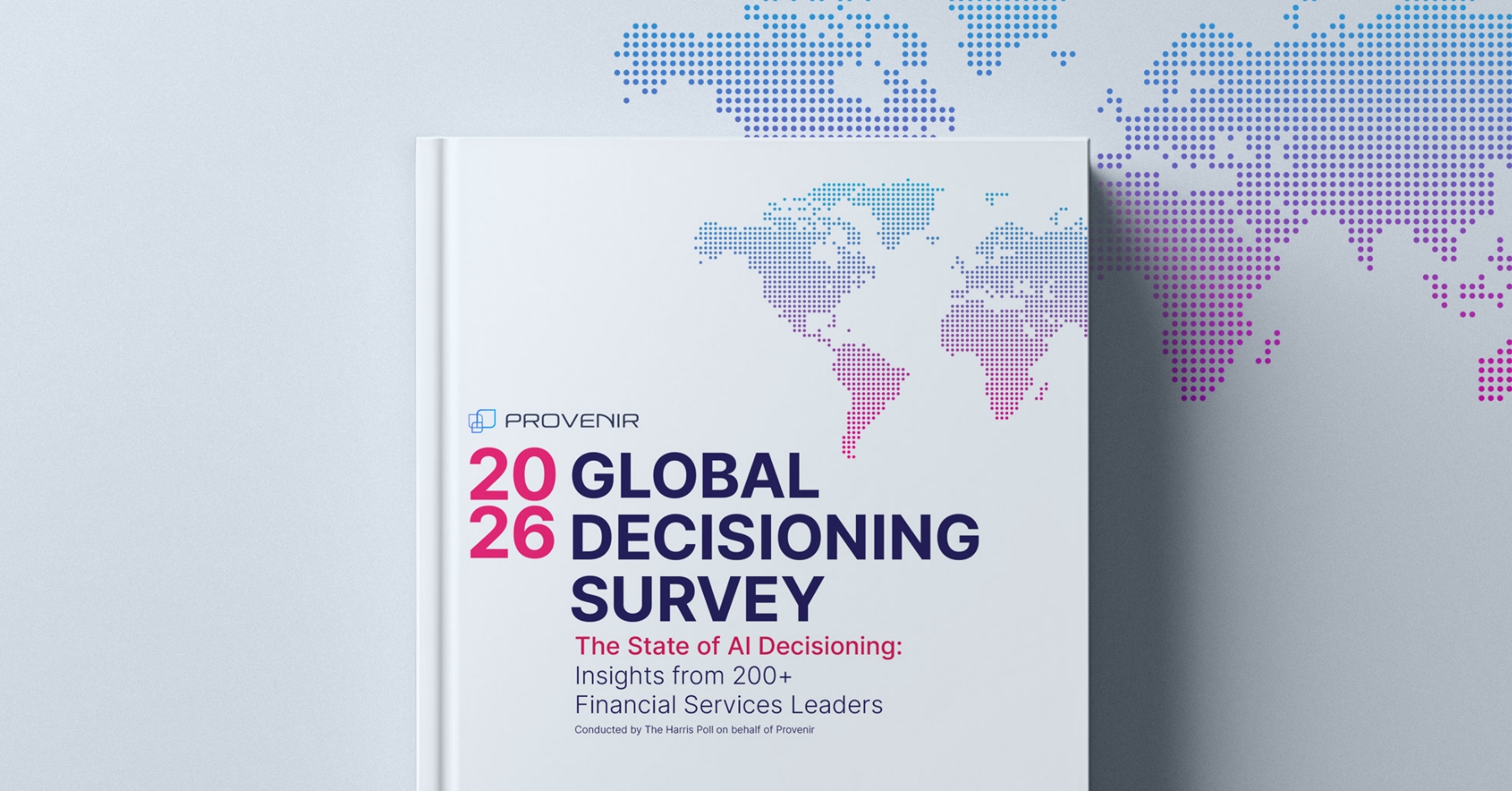
The financial services industry stands at an inflection point in its adoption of artificial intelligence for decisioning. Our 2026 Global Decisioning Survey reveals a sector that recognizes AI’s transformative potential yet struggles with universal implementation challenges.

We surveyed 203 senior decision-makers—including Chief Risk Officers, CEOs, CFOs, and Heads of Risk—across 22 countries spanning banking, fintech, insurance, telecommunications, and other financial services sectors. The findings paint a nuanced picture of an industry in transition.

KEY FINDINGS AT A GLANCE
  • The AI Paradox:

    87% trust AI-driven decisioning outcomes, yet 97% face implementation barriers
  • The Fraud Challenge:

    77% are concerned about AI-enabled fraud threats while needing AI to combat fraud
  • Real-Time Momentum:

    91% have moved beyond static-only models; 52% use hybrid approaches
  • Decision Intelligence:

    77% see it as very valuable for their strategy over the next 2-3 years
  • Investment Priority:

    60% plan to invest in AI or embedded intelligence for decisioning in 2026
  • Governance Gap:

    Only 33% have fully implemented responsible AI frameworks

These findings reveal an industry that knows where it needs to go but faces significant challenges getting there. The organizations that successfully navigate implementation barriers—around compliance, explainability, and integration—will build sustainable competitive advantages through faster, more accurate, and more adaptive decisioning.

ADDITIONAL RESOURCES

BLOG AutoFinance
Blog, Auto Financing /

Transaction to Relationship: Rethinki...

Auto lending has always been good at the moment of origination. Lenders ... Read More →
EBOOK KShape
eBook, Financial Services /

One Portfolio, Two Economies

The economic ground is shifting beneath financial institutions in ways that defy ... Read More →
Buy the Engine. Build the Advantage
Blog, Financial Services /

Buy the Engine. Build the Advantage.

The competitive environment in financial services has fundamentally changed. Margins are compressed ... Read More →
BLOG Fraud
Blog, Fraud /

Why Nordic Banks Must Balance Fraud C...

In the digital banking era, customer expectations are measured in milliseconds, not ... Read More →
The Growing Threat of Fraud in UK Auto Lending
Blog, Fraud /

The Growing Threat of Fraud in UK Aut...

Fraud in UK auto lending continues to rise in both scale and ... Read More →
BLOG Mark
Blog, Telco /

Why Telcos Can’t Afford to Think Like...

Most telcos are barely growing faster than inflation. They’re trapped in saturated ... Read More →
BLOG Survey02
Survey, AI, Provenir /

The Fraud-AI Double Bind

Financial institutions face a critical tension. They need AI to combat increasingly ... Read More →
BLOG Survey01
Survey, Decisioning, Provenir /

Why 77% of Financial Institutions See...

The financial services industry is experiencing a fundamental shift. Organizations have spent ... Read More →
BLOG Christian Ball
Blog, Customer Mgmt /

Smarter Acquisition and Customer Mana...

Financial institutions face a straightforward challenge: acquire profitable customers and manage those ... Read More →
Open Banking Expo Toronto
Event, Banking /

Open Banking Expo Toronto

We’re excited to sponsor The Open Banking Expo in Toronto on March ... Read More →
Zero Trust in Digital Banking
Digital Banking /

Zero Trust in Digital Banking

Digital banking has firmly established itself across APAC. From the sophisticated, interconnected ... Read More →
EBOOK Survey2026
eBook, Survey, Decisioning /

Survey: 2026 Global Decisioning Surve...

The financial services industry stands at an inflection point in its adoption ... Read More →
LewisGRP
News, AI, Decisioning, Provenir /

Leading South African Furniture Retai...

South African furniture retailer Lewis Group is migrating its credit decisioning to ... Read More →
carol blog
Blog, Decisioning /

The Generational Shift: Why Banks Are...

Financial institutions are ripping out decisioning infrastructure they spent two decades building ... Read More →
Frederic blog
Blog, AI /

Why AI Requires Enterprise Platforms ...

The narrative around AI replacing enterprise software has gained momentum recently. Driven ... Read More →

Continue reading

LewisGRP

Leading South African Furniture Retailer Lewis Group Partners with Provenir to Drive AI Credit Decisioning Transformation in the Cloud

Leading South African Furniture Retailer Lewis Group Partners with Provenir to Drive AI Credit Decisioning Transformation in the Cloud

The retailer will deploy Provenir’s AI Decisioning Platform in the cloud to improve agility and operational efficiencies, with the ability to capitalize on greater customer insights

Parsippany, NJ | January 21, 2026 – South African furniture retailer Lewis Group is migrating its credit decisioning to the cloud with Provenir, a global leader in AI risk decisioning, to streamline its onboarding processes and expand customer touchpoints.

Lewis Group is a leading retailer of furniture, home appliances, electronic goods and homeware in South Africa through its brands Lewis, Best Home & Electric, Beares, UFO, Bedzone, Real Beds and Monarch Insurance. The retailer has 813 stores across South Africa and 145 in southern Africa, including Namibia, Botswana, Lesotho and Eswatini.

A Provenir customer for 15 years, Lewis Group is embarking on a cloud-migration strategy on the AWS stack, designed to elevate the customer experience and further drive innovation in credit decisioning. The goal is to enable more personalized customer engagements, further improve the onboarding process, and unlock meaningful productivity gains.

By modernizing and enhancing decisioning capabilities via the cloud, the Provenir AI Decisioning Platform supports Lewis Group’s commitment to responsible and effective customer engagement.

“Our long-standing collaboration with Provenir underscores a shared focus on using technology to deliver better outcomes for our customers… By migrating to the cloud, we are able to realize enhanced speed and agility, scalability, improved security, and faster time-to-market for solutions and services to our valued customers.”

Lambert Fick, Lewis Group’s GM Credit Risk

“After more than 15 years of partnership, we’re proud to support Lewis Group’s move to a modern cloud platform with our AI Decisioning Platform to drive improved business outcomes,” said Ryan Morrison, executive vice president, Provenir. “This migration will give Lewis Group faster, more effective decisioning, a unified customer view across channels, and the ability to leverage advanced analytics to enhance onboarding, fraud prevention, and overall customer management.”

Provenir’s AI Decisioning Platform combines data, decisioning, and decision intelligence to enable smarter, faster decisions across the entire customer lifecycle – from onboarding and application fraud to credit risk, customer management, and collections.

Explore Our AI-Decisioning Platform

Read More

LATEST NEWS

Continue reading

INFOGRAPHIC Hyper-personalization

Hyper-Personalization in Action

Hyper-Personalization in Action: How AI-Driven Decisioning Transforms Every Customer Interaction

Most financial institutions still rely on humans to interpret model predictions and make the final call on offers, terms, and actions. The result? Slower decisions, inconsistent experiences, and missed revenue opportunities.

Hyper-personalization changes this. AI doesn’t just predict outcomes—it prescribes the best action for each individual customer, automatically balancing profitability, risk, and experience in real time.

What You’ll Discover
  • The difference between prediction and prescription in AI decisioning
  • How hyper-personalization delivers individual-level optimization—not segment-based targeting
  • Why prescriptive AI transforms every customer interaction across your lifecycle

Explore hyper-personalization in depth with insights from our experts:

ADDITIONAL RESOURCES

BLOG AutoFinance
Blog, Auto Financing /

Transaction to Relationship: Rethinki...

Auto lending has always been good at the moment of origination. Lenders ... Read More →
EBOOK KShape
eBook, Financial Services /

One Portfolio, Two Economies

The economic ground is shifting beneath financial institutions in ways that defy ... Read More →
Buy the Engine. Build the Advantage
Blog, Financial Services /

Buy the Engine. Build the Advantage.

The competitive environment in financial services has fundamentally changed. Margins are compressed ... Read More →
BLOG Fraud
Blog, Fraud /

Why Nordic Banks Must Balance Fraud C...

In the digital banking era, customer expectations are measured in milliseconds, not ... Read More →
The Growing Threat of Fraud in UK Auto Lending
Blog, Fraud /

The Growing Threat of Fraud in UK Aut...

Fraud in UK auto lending continues to rise in both scale and ... Read More →
BLOG Mark
Blog, Telco /

Why Telcos Can’t Afford to Think Like...

Most telcos are barely growing faster than inflation. They’re trapped in saturated ... Read More →
BLOG Survey02
Survey, AI, Provenir /

The Fraud-AI Double Bind

Financial institutions face a critical tension. They need AI to combat increasingly ... Read More →
BLOG Survey01
Survey, Decisioning, Provenir /

Why 77% of Financial Institutions See...

The financial services industry is experiencing a fundamental shift. Organizations have spent ... Read More →
BLOG Christian Ball
Blog, Customer Mgmt /

Smarter Acquisition and Customer Mana...

Financial institutions face a straightforward challenge: acquire profitable customers and manage those ... Read More →
Open Banking Expo Toronto
Event, Banking /

Open Banking Expo Toronto

We’re excited to sponsor The Open Banking Expo in Toronto on March ... Read More →
Zero Trust in Digital Banking
Digital Banking /

Zero Trust in Digital Banking

Digital banking has firmly established itself across APAC. From the sophisticated, interconnected ... Read More →
EBOOK Survey2026
eBook, Survey, Decisioning /

Survey: 2026 Global Decisioning Surve...

The financial services industry stands at an inflection point in its adoption ... Read More →
LewisGRP
News, AI, Decisioning, Provenir /

Leading South African Furniture Retai...

South African furniture retailer Lewis Group is migrating its credit decisioning to ... Read More →
carol blog
Blog, Decisioning /

The Generational Shift: Why Banks Are...

Financial institutions are ripping out decisioning infrastructure they spent two decades building ... Read More →
Frederic blog
Blog, AI /

Why AI Requires Enterprise Platforms ...

The narrative around AI replacing enterprise software has gained momentum recently. Driven ... Read More →

Continue reading

BBVA

Customer Story: BBVA

BBVA (Banco Bilbao Vizcaya Argentaria) is a leading Spanish multinational banking group and #3 bank in Spain by total assets,founded in 1857. It is headquartered in Madrid, offering a broad range of financial services including retail, commercial, corporate, and investment banking, as well as asset management and digital banking. The bank operates in more than 25 countries with major markets in Spain, Mexico, Turkey, South America. For those countries where it does not have physical presence, it has created “BBVA Digital Banking” , the idea it is to grow globally, the first countries in which it has been launched are Italy and Germany. It is widely recognized for its strong focus on digital innovation, data and AI capabilities, and commitment to sustainability and ESG-driven finance.
  • Industry
  • Region
  • Countries

    Spain, Colombia, Mexico, Peru, Argentina, Turkey

  • Line of Business
  • Solution
  • Module
  • Infrastructure
  • ROI
  • Competition

Customer Timeline
MRRPS
Land$160KTBC
Expand$117KTBC
  • OPPORTUNITY CREATED
    • Pilot Opp created: 02.10.17
    • Pilot Opp Won: 31.10.17
    • Opp Created: 17.03.17
  • OPPORTUNITY WON
    30.06.2018

    • Mexico expansion: 12.07.19
    • Spain expansion: 27.07.20
    • Peru expansion: 22.11.21
    • Client Analysis Corporate: 24.05.22
    • Renewal uplift: 18.07.23
    • Client Analysis Colombia: 12.10.23
    • EWS Colombia: 12.02.24
    • Enterprise agreement: 30.06.24
  • GO-LIVE
    No Information Available
  • EXPANSION
    IN PROGRESS:

    • Cloud Migration all countries
    • App Fraud Retail Banking

    FUTURE:

    • Decisioning platform BBVA Digital Banking: 1 country
    • Decisioning Platform BBVA Digital Banking: 1 country expansion
    • Retail Banking – Global ML models platform deployment & execution
Initial Opportunity Details

Customer Challenge

BBVA wanted to deliver a standardized, world-class digital experience across its global footprint and needed flexible, scalable risk decisioning technology to support consistent processes across thousands of branches and enhance risk decisioning for its commercial and Wholesale business lines. ​

Provenir Impact

  • Standardized Global Decisioning​
    BBVA now deploys a single best-practice process worldwide using Provenir’s platform, able to adjust automatically to local rules and customer variations.
  • Scalable & Automated Risk Processes​
    Provenir supports automated risk decisioning for Wholesale and commercial lending – including analysis, rating, early warning system, limit setting, early warning system and underwriting – replacing manual or inconsistent processes.
  • Operational Efficiency & Flexibility​
    The platform’s microservices architecture gives BBVA autonomy and flexibility to adapt data, models, and processes independently, improving speed and control over decision logic.

Competitors


Existing internal/legacy decisioning systems- lacking flexibility and scalability.

Experian PCO for Retail Banking Globally

Why We Won

BBVA chose Provenir for its flexible, scalable microservices-based decisioning platform that allows BBVA to build standardized global processes that automatically adjust by location, customer type, and business rules, and empowers BBVA to automate client analysis, early warning systems, rating, limit setting, and underwriting. ​

Pain Points

  • Lack of standardized decisioning experience globally
  • Need scalable, flexible technology for risk processes
  • Need automation of decisioning across markets and customer segments
  • Difficulty maintaining consistent customer experience across branches
  • Difficulty to deploy and execute ML models
Customer Growth
  • Current

    BBVA has implemented Provenir’s decisioning engine in all its markets – Spain, Turkey, Mexico, Argentina, Peru & Colombia


    Use cases under current contract in use:

    • Client Analysis
    • Early Warning System
    • Underwriting

    Use cases under current contract not in use:

    • Collections
    • Recovery
  • Expansion

    • Migrate current Provenir Platform to Cloud 2.0 for all countries: We have had several workshops regarding Cloud 2.0 with all the different areas, architecture, engineering, business. We are working internally in a ROI scenario to share with them as per request form the business and engineering. We have done a test along with the engineering team on how to deploy a Python Model in Cloud 2.0 and also form the 12th of Jan they will conduct a POC with access to our sandbox for cloud 2.0. With the results of these POC and ROI we will have all the evidence for the migration. PS Team is actively engaged with the engineering team for BAU, Pythin Model execution testing and POC
    • App Fraud – Retail Business: Current solution at BBVA Feature Space for transactional and app fraud. Information form architecture team that this solution for app fraud is not robust or mature, not enough so they would like to explore different alternatives around this current solution as satellite solution
  • Growth Opportunities

    • Provenir Global Platform for BBVA Digital Banking: We had a meeting with CRO for Digital Banking and a Workshop has already been scheduled for the 2nd of February
    • Provenir Platform – Retail Business ML models deployment & execution. This is a pain that BBVA has shared with us, but we are having difficulties to get to the stakeholders at Retail. We need to get support from the Engineering team after they conduct the POC for Wholesale Business
OTHER CUSTOMER STORIES

Continue reading

FibaFaktoring

Customer Story: Fiba Faktoring

Fiba Faktoring is a leading non-bank financial institution in Turkey, providing factoring and SME financing solutions. The company focuses on delivering fast, data-driven credit decisions to support small and medium-sized businesses while managing risk effectively.
  • Industry
  • Region
  • Countries

    Turkey

  • Line of Business
  • Solution
  • Module
  • Infrastructure
  • ROI
  • Competition
Initial Opportunity Details

  • Customer Challenge

    Fiba Faktoring needed to improve the speed, consistency, and scalability of its credit decisioning processes. Manual and siloed systems limited automation, slowed decision times, and made it difficult to support business growth.
  • Provenir Impact

    • Operational Efficiency Gains
      Provenir’s decisioning solution delivered a 65% automation rate in credit decisions for targeted SME ticket sizes, significantly reducing reliance on manual processes:
      • Automation eliminated manual bottlenecks
      • Decisions are standardized and consistent
      • Staff time redirected from manual tasks to higher-value work

    • Speed & Productivity Improvements
      Credit decision processing became five times faster, dramatically accelerating service delivery for SME customers and improving internal throughput.
      • Faster time-to-decision improves customer experience
      • Shorter wait times support SME cash flow needs
      • The company can handle higher volumes without additional headcount

    • Workload Reduction & Customer Experience
      The platform delivered a 40% reduction in workload across credit decision processes, enabling strategic risk assessment and improving satisfaction through quicker outcomes.
      • Streamlined workflows reduced operational strain
      • Faster processing led to improved client satisfaction
      • Competitive advantage in the SME financing market
  • Competitors

    Legacy in-house systems
    Manual decisioning processes
  • Why We Won

    • Single, unified decisioning platform
    • Fast time to value and implementation
    • High flexibility and business-user configurability
  • Pain Points

    • Slow credit decision turnaround times
    • Limited automation and scalability
    • Difficulty adapting decision rules quickly
Customer Growth

Growth Opportunities

  • Scalable Operations and Expansion of Offerings
  • The automation foundation positions Fiba Faktoring to scale operations efficiently across higher volumes and broader product sets.
  • Advanced Analytics for Competitive Advantage
  • By integrating advanced predictive models and AI workflows, the company can strengthen risk insights and enhance differentiation in the SME lending market.
  • Enhanced Customer Experience as a Strategic Growth Lever
  • Shorter decision times and data-driven service delivery enable improved customer acquisition and retention.

Expansion

With the core decisioning platform successfully implemented and delivering measurable value, Fiba Faktoring is now progressing toward expanding the use of Provenir’s capabilities to additional strategic areas: ​

  • Predictive Early Warning Systems: Leveraging analytics to detect risk trends proactively
  • Marketing & Pricing Optimization: Using AI insights to refine pricing strategies and product targeting
  • Additional Decisioning Use Cases: Exploring automation across broader internal decision workflows beyond credit decisions
OTHER CUSTOMER STORIES

Continue reading