Most risk organizations are facing a similar problem: they need to move faster. More decisions, more channels, more pressure to approve in seconds rather than days. So the instinct is to buy for speed. Faster engines, faster models, faster onboarding.
However, speed is not the problem most of these organizations actually have.
Visibility is.
At Provenir, we’ve had risk leaders who can tell us exactly how fast their systems approve an application but aren’t clear on why a given decision was made, whether it would hold up under regulatory review, or how a policy change three systems ago is still affecting today’s approval rate. That is not a speed gap. That is a control gap, and it’s the one that gets expensive.
How the Gap Forms
It rarely happens on purpose. A credit engine gets bought to solve credit. A separate fraud tool gets added when fraud becomes the priority. Collections gets its own system when recovery rates slip. Each decision made sense in isolation. None of them were made with the others in the room.
Years later, the risk organization is running on a stack of tools that were never designed to share a data model, a decision log, or a governance framework. Authority over decisioning becomes diffuse: spread across systems, vendors, and teams, with no single place to see the whole picture. Strategy gets constrained by what the architecture can support, instead of the architecture supporting the strategy the business actually wants to run.
This is what flying blind looks like in practice. Not a lack of data. Too much data, scattered across systems that do not talk to each other, with no consolidated view of how a decision was actually made.
Picture a single customer moving through that environment. Credit approves them based on the data available at onboarding. Weeks later, the fraud system flags unusual activity on the account, working from a different data set and a different scoring logic, with no visibility into the credit decision that already happened. By the time the account reaches collections, the treatment strategy is built without either of those earlier signals. Three systems, three partial views, and no single place where a risk leader can see the full picture of that one relationship. Multiply that by a portfolio of millions of customers, and the visibility gap stops being an inconvenience. It becomes the reason risk teams get surprised by numbers that a connected system would have surfaced months earlier.
Why This Is The Moment It Matters Most
Three forces are converging on risk organizations right now, and each one raises the cost of staying fragmented.
AI adoption is outpacing AI governance. Risk teams are under pressure to bring AI and machine learning into decisioning faster than ever, but a model added to one system in isolation is a model nobody can fully explain across the customer’s full journey. The more AI gets layered onto a fragmented stack, the harder it becomes to answer a simple question: what, exactly, made this decision, and can we defend it.
Regulators are asking harder questions. Explainability and auditability are no longer boxes to check once a year. Examiners want to see, on demand, why a specific decision was made for a specific customer, and fragmented systems make that request expensive to fulfill even when the answer is defensible. The cost is not just the audit itself. It is the time risk teams spend reconstructing decisions after the fact instead of having the answer ready.
Vendor sprawl has stopped paying for itself. Every additional point solution came with its own contract, its own integration cost, and its own maintenance burden. Individually, each one looked justified. Collectively, they have become expensive to run and slow to change, and that cost shows up twice: once on the budget, and again in how long it takes to respond when the business needs to move.
Risk organizations that consolidate onto a single, governed decisioning environment are the ones positioned to manage risk deliberately rather than reactively. That is a different posture than moving fast. It is moving with your eyes open.
What Visibility Actually Buys You
A governed decisioning environment does not trade control for speed. It gets you both, in the right order.
When every decision is traceable and explainable by design, risk teams can calibrate exposure on purpose instead of discovering problems in a post-mortem. When strategy changes can be simulated and tested against real production data before they go live, business teams can move quickly because they have already validated the outcome, not because they are hoping for the best. When the full customer lifecycle runs through one system instead of four, a policy change made in one place shows up consistently everywhere it should, and nowhere it shouldn’t.
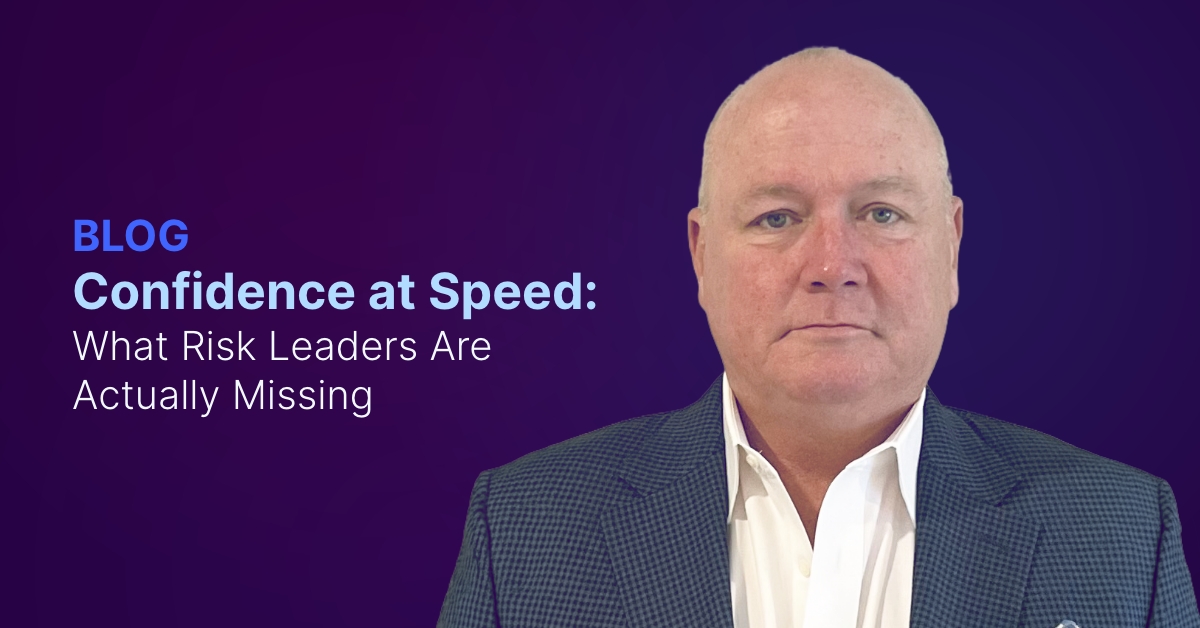
This is the shift I would ask every risk leader to consider: the goal was never speed for its own sake. It was confidence at speed. Those only coexist when the organization can see, end to end, exactly how and why every decision gets made.
Where This Leaves Risk Leaders
The organizations that will separate from the pack over the next few years are not the ones with the fastest single decision engine. They are the ones that closed the visibility gap first, and can move fast because they have full control over the decision layer, not in spite of it.



Beyond Detection: Cl...