CS-Industry: Financial

BLOG Fraud

Why Nordic Banks Must Balance Fraud Control and Frictionless Onboarding to Protect Trust and Growth 

  • Blog

  • Industry

  • Date

Why Nordic Banks Must Balance Fraud Control and Frictionless Onboarding to Protect Trust and Growth

jason abbott headshot

Jason Abbott

Director, Fraud Solutions

In the digital banking era, customer expectations are measured in milliseconds, not days. Even small amounts of friction during onboarding can push potential customers to abandon the process entirely. For Nordic banks operating in some of the world’s most digitally advanced economies, protecting against increasingly sophisticated application fraud while delivering seamless experiences has become a defining challenge.

Risk decisions are no longer back-office functions. They’re part of the customer experience itself. The most successful banks are unifying fraud detection and onboarding through Decision Intelligence that reveals what’s working and what needs to change.

Application Fraud: Beyond Individual Bad Actors

Application fraud in the Nordic region has evolved significantly. While fraud losses across Nordic banks reached $2.8 billion in 2023, with Sweden and Norway among the larger contributors, the nature of these losses reveals something more concerning than the numbers alone suggest.

Today’s application fraud exploits legitimate-looking structures. Criminal networks orchestrate synthetic identity schemes, mule account networks, and first-party fraud that traditional point-in-time checks struggle to detect. A single application might appear completely clean when viewed in isolation, yet be part of a coordinated network submitting hundreds of variations with slight modifications to evade detection rules.

These organized networks use social engineering, identity theft, and increasingly AI-powered tactics to create applications that pass surface-level verification. Prevention requires more than isolated controls checking identity documents or credit scores at a single moment. Banks need continuous monitoring, behavioral profiling, and modern analytics capable of detecting patterns that didn’t exist six months ago.

The Trust Equation Has Changed

Trust has always been the foundation of banking, yet it’s no longer assumed. According to the 2024 Telesign Trust Index Report, nearly two-thirds of consumers say fraud damages brand trust and loyalty. Perhaps more concerning: 38% will completely sever ties with a brand after a security breach, and 92% believe companies are responsible for protecting their digital privacy.

In the Nordic context, where banks have historically enjoyed high levels of public confidence, this erosion of trust represents more than lost customers. It threatens the stability of the entire financial ecosystem. When a bank fails to protect customers from application fraud or creates friction that suggests insecurity, the damage extends beyond individual relationships to the institution’s reputation in the market.

The Hidden Cost of False Positives

While application fraud demands stronger controls, customer tolerance for poor experiences is at an all-time low. Research shows that 68% of consumers abandon digital financial applications because the process is too long, too confusing, or too intrusive.

Most banks miss a critical dynamic: formal declines represent only part of the abandonment problem. False positives create unnecessary friction that causes silent abandonment. These customers never complete an application, never receive a formal rejection, and never appear in declined application metrics. They simply disappear.

Studies across European markets indicate that only 15-35% of users complete financial onboarding once started, with frustration and complexity cited as primary reasons. Each abandoned application represents wasted acquisition costs and lost lifetime value. The traditional approach of applying heavy-handed, reactive fraud controls to every customer creates a vicious cycle: fraud controls increase false positives, false positives create friction, friction drives silent abandonment, and abandoned applications become invisible losses.

Unnecessary friction also diminishes trust by signaling that the bank lacks confidence in its own security measures. When legitimate customers face slow identity checks, repeated verification requests, or unexplained delays, they begin to question whether their information is truly secure.

From Point-in-Time Checks to Continuous Decisioning

Leading Nordic banks are recognizing that the old model no longer works. Point-in-time checks (verifying identity documents at submission, pulling a credit score, running basic rules) can’t detect application fraud networks or distinguish between legitimate customers who need fast service and coordinated fraud patterns that require deeper scrutiny.

The shift is toward continuous decisioning: real-time analytics and monitoring that detect suspicious activity without creating manual backlogs or customer-facing delays. According to regional fraud surveys, many Nordic banks are already investing in AI-driven monitoring systems designed to reduce both fraud and false positives.

Continuous decisioning alone, however, falls short. What separates the most sophisticated banks is their approach to Decision Intelligence: the layer that executes decisions, reveals what’s working, and provides insights into what to change.

Decision Intelligence: The Strategic Answer

Decision Intelligence transforms the fraud-versus-friction problem from an unsolvable tradeoff into an integrated optimization challenge. Instead of treating application fraud controls and onboarding experience as separate problems managed by separate teams, Decision Intelligence creates a unified system that connects decisions to outcomes and recommends what to change.

Banks using Decision Intelligence can see beyond approval rates and fraud losses to understand the relationship between specific fraud signals and both true fraud detection and false positive rates. They can identify which verification steps are catching actual fraud networks versus which are simply adding friction that drives legitimate customers away. They can simulate the impact of policy changes before implementation, testing whether adjusting a specific threshold will reduce silent abandonment without increasing fraud exposure.

This approach enables dynamic friction that adapts to risk in real-time. Low-risk customers (those with behavioral patterns, device signals, and identity markers consistent with legitimate applications) enjoy fast onboarding. High-risk applications that match network fraud patterns trigger targeted, justifiable controls. The system continuously learns from outcomes. Every decision feeds a learning loop that improves both fraud detection accuracy and false positive reduction.

The most sophisticated banks are using Decision Intelligence to create streaming data feeds that enable instant identity verification, behavioral risk scoring, and graph intelligence that detects connections between applications that appear unrelated at first glance. They add intelligent friction only where needed and remove unnecessary friction where it’s only slowing down legitimate customers.

Making Application Fraud Detection a Competitive Advantage

Customer-centric risk design, powered by Decision Intelligence, is becoming a differentiator. Dynamic checks ask for additional context only when specific risk signals appear. Identity signals like device behavior, biometrics, and historical patterns help lower friction for trusted customers. Predictive models and network detection deter organized application fraud without blocking legitimate users.

This intelligent approach demonstrates transparency and fairness in risk decisions, which enhances trust rather than eroding it. Customers understand that security measures exist for their protection. What they reject is blanket friction that treats everyone as a potential fraudster.

Building Infrastructure for Tomorrow’s Threats

Investment cases should reflect today’s known application fraud tactics and the capability to adapt to tomorrow’s unknowns. Legacy systems (slow, brittle, and fragmented) cannot support the kind of real-time, intelligent risk management that modern banking requires.

Banks that view fraud detection and onboarding as separate problems will continue to struggle with the false choice between security and speed. Those that recognize them as two sides of the same integrated decision problem will find competitive advantage through Decision Intelligence that reveals performance gaps and enables continuous optimization.

The path forward requires building infrastructure that delivers both protection and experience through adaptive, data-driven decisioning where every decision is executed, measured, learned from, and improved. For Nordic banks, this represents an opportunity to transform application fraud management from a cost center into a strategic differentiator that protects customers, preserves trust, and enables growth in an increasingly digital world.

LATEST BLOGS

BLOG AutoFinance

Transaction to Relat...

Auto lending has always been good at the moment
Buy the Engine. Build the Advantage

Buy the Engine. Buil...

The competitive environment in financial services has fundamentally changed.
The Growing Threat of Fraud in UK Auto Lending

The Growing Threat o...

Fraud in UK auto lending continues to rise in
BLOG Christian Ball

Smarter Acquisition ...

Financial institutions face a straightforward challenge: acquire profitable customers
carol blog

The Generational Shi...

Financial institutions are ripping out decisioning infrastructure they spent
Frederic blog

Why AI Requires Ente...

The narrative around AI replacing enterprise software has gained
HyperPersonalization

From Risk Manager to...

From Risk Manager to Revenue Generator:How CROs Are Becoming
Hyper-personalization Myth2

The Hyper-personaliz...

The Hyper-personalization Myth Series #2:The Scorecard Trap: How Traditional

Continue reading

BLOG Survey01

Why 77% of Financial Institutions See Decision Intelligence as Their 2026 Priority

Why 77% of Financial Institutions See Decision Intelligence as Their 2026 Priority

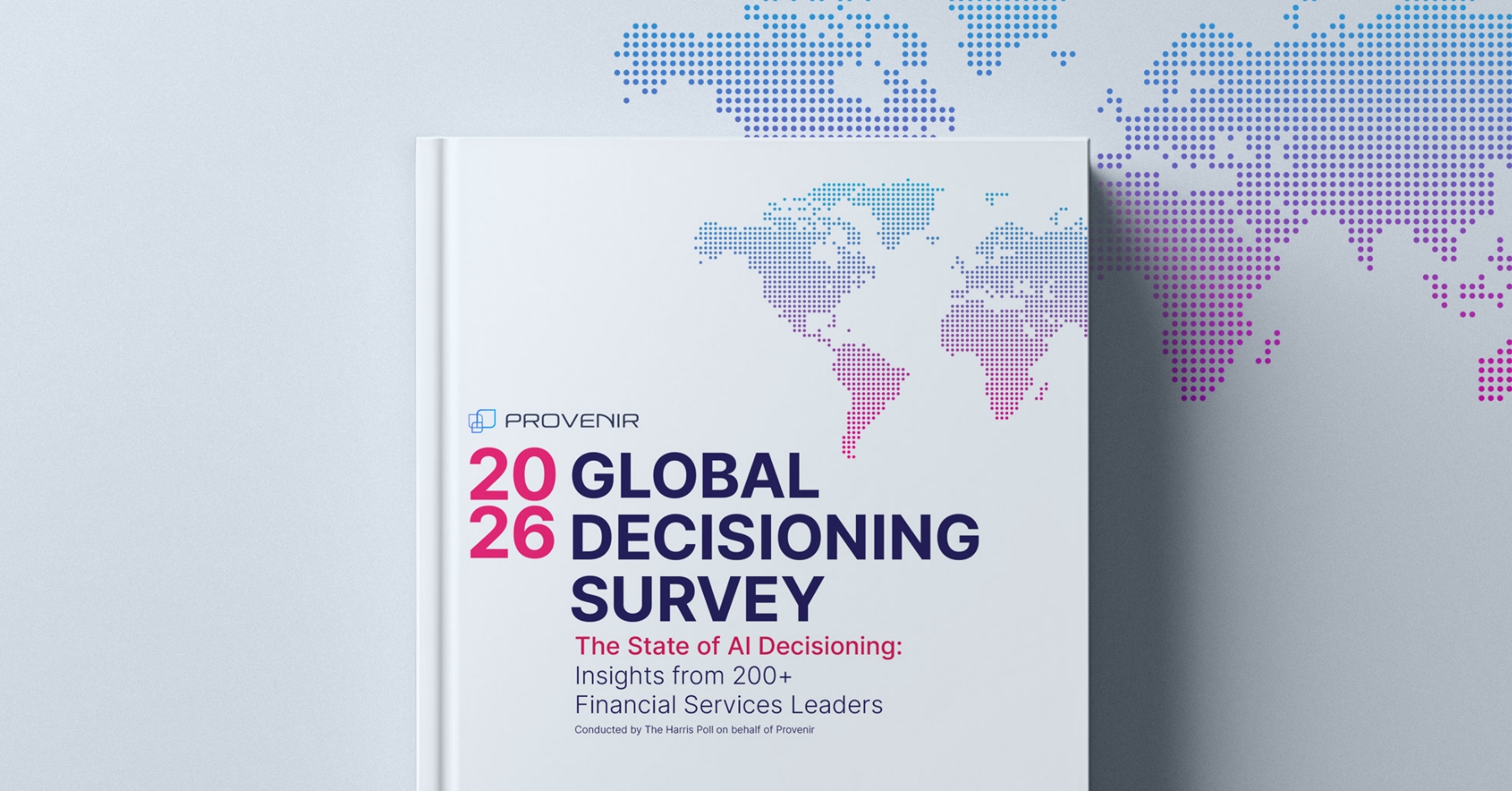
The financial services industry is experiencing a fundamental shift. Organizations have spent years automating decisions. Now they need those decisions to get smarter.

Our 2026 Global Decisioning Survey reveals the scope of this transition: 77% of senior decision-makers see Decision Intelligence as very valuable for their strategy over the next 2-3 years.

What Decision Intelligence Actually Means

Decision Intelligence represents the evolution from automated decisioning to continuously optimized, AI-driven decision-making that learns and improves.

THE DIFFERENCE:

  • The Traditional Approach:

    Deploy AI models, measure results periodically, update quarterly, manage explainability and governance separately
  • Decision Intelligence Approach:

    Execute decisions at scale, measure outcomes continuously, learn from performance, optimize in real-time within unified platforms that provide transparency, governance, and integration
Organizations are moving quickly:
  • 75%

    are already collaborating on AI-driven decision intelligence
  • 18%

    are exploring partnerships
  • 66%

    are very interested in using AI for strategy implementation and optimization
  • 60%

    plan to invest in AI or embedded intelligence for decisioning in 2026 (making it the top investment priority)

What Organizations Value Most

When we asked which AI features provide the most value, organizations prioritized capabilities that go beyond basic automation:

51%

Ability to leverage generative AI for natural language queries
The democratization of AI insights through conversational interfaces transforms who can access and act on decisioning data. Business users, executives, operations teams, and compliance staff can all interact directly with AI systems using natural language.

92%

of organizations find it important to interact with data quickly using natural language queries.
(62% find it very important, 30% moderately important).
  • 49%

    Real-time decisioning across customer touchpoints:
    Speed and consistency across channels create better customer experiences and reduce operational complexity.
  • 50%

    Transparency and explainability of AI models:
    Organizations need AI they can understand and defend to regulators and stakeholders.
  • 47%

    Integration with existing systems and data sources:
    AI must work with existing infrastructure rather than requiring complete replacement.

The Business Impact

Organizations cite four primary benefits from improved Decision Intelligence:
  • 62%

    cite operational efficiency:

    Automated decision-making reduces manual review, accelerates processes, and lowers costs while improving consistency.
  • 52%

    cite better customer experience:

    Faster decisions, reduced friction, and personalized interactions create superior customer journeys.
  • 58%

    cite improved accuracy of models and strategies:

    Continuous learning and optimization improve predictive performance and business outcomes over time.
  • 56%

    cite faster deployment of new decision strategies:

    Rapid testing and iteration enable organizations to adapt quickly to market changes and competitive pressure.
These benefits compound over time. Organizations that deploy Decision Intelligence don’t just get better decisions today. They build systems that continuously improve.

The Intelligence Loop in Practice

Decision Intelligence creates a continuous cycle:
  • chess

    Shape Strategy

    Design and evolve decision strategy by learning from how decisions actually perform. Strategy is measured through outcomes and continuously refined to balance risk exposure and revenue opportunity.
  • rocket

    Execute Decisions

    Make real-time, data-driven decisions at every customer touchpoint using deep customer understanding, data, context, and decision history.
  • dashboard

    Measure Outcomes

    Connect decisions to business outcomes to see what actually drives risk, revenue, and profitability.
  • learning

    Learn and Optimize

    Get specific recommendations to improve performance based on actual results. Learn from the results over time and continuously refine strategies.
This loop transforms decisioning from a periodic batch process into a continuous optimization system.

The Natural Language Revolution

92% of organizations find it important to interact with data quickly using natural language queries. This represents a fundamental shift.

When business users can interact directly with AI systems using conversation, they build intuition about how these systems work. That understanding improves their ability to provide governance oversight and makes the entire organization more comfortable with AI-driven decisioning.

Natural language querying enables:

  • Business users to explore decisioning data without SQL knowledge
  • Executives to get instant answers to strategic questions
  • Operations teams to investigate anomalies in real-time
  • Compliance teams to audit decisions conversationally
This democratization helps address one of the top implementation barriers: explainability. When more people in the organization can interact with and understand AI systems, those systems become more transparent by design.

Addressing Implementation Barriers

Decision Intelligence approaches help address the barriers preventing AI adoption:
  • Explainability

    Platforms provide visibility into what decisions were made, how they perform, and why. This makes it easier to explain outcomes to regulators and stakeholders.
  • Governance

    Connecting decisions to business outcomes (risk, revenue, customer experience) makes governance more manageable. You measure results and learn from performance rather than monitoring models in isolation.
  • Integration

    Decision Intelligence platforms orchestrate data and decisions across existing infrastructure without requiring wholesale system replacement.
  • Speed

    Organizations can learn from every decision and optimize continuously, addressing the speed challenge that 50% cite as their biggest fraud detection obstacle.

Looking Ahead

The survey reveals clear momentum:
  • 77%

    see Decision Intelligence as very valuable
  • 75%

    are already implementing it
  • 66%

    want AI for strategy optimization
  • 60%

    are investing in 2026 (top priority)
Traditional decisioning optimizes for speed. Decision Intelligence optimizes for outcomes. Organizations that build systems capable of continuous learning will create advantages that compound over time.

EBOOK Survey2026

Download the full 2026 Global Decisioning Survey:

Download Survey

LATEST BLOGS

BLOG AutoFinance

Transaction to Relat...

Auto lending has always been good at the moment
Buy the Engine. Build the Advantage

Buy the Engine. Buil...

The competitive environment in financial services has fundamentally changed.
The Growing Threat of Fraud in UK Auto Lending

The Growing Threat o...

Fraud in UK auto lending continues to rise in
BLOG Christian Ball

Smarter Acquisition ...

Financial institutions face a straightforward challenge: acquire profitable customers
carol blog

The Generational Shi...

Financial institutions are ripping out decisioning infrastructure they spent
Frederic blog

Why AI Requires Ente...

The narrative around AI replacing enterprise software has gained
HyperPersonalization

From Risk Manager to...

From Risk Manager to Revenue Generator:How CROs Are Becoming
Hyper-personalization Myth2

The Hyper-personaliz...

The Hyper-personalization Myth Series #2:The Scorecard Trap: How Traditional

Continue reading

BBVA

Customer Story: BBVA

BBVA (Banco Bilbao Vizcaya Argentaria) is a leading Spanish multinational banking group and #3 bank in Spain by total assets,founded in 1857. It is headquartered in Madrid, offering a broad range of financial services including retail, commercial, corporate, and investment banking, as well as asset management and digital banking. The bank operates in more than 25 countries with major markets in Spain, Mexico, Turkey, South America. For those countries where it does not have physical presence, it has created “BBVA Digital Banking” , the idea it is to grow globally, the first countries in which it has been launched are Italy and Germany. It is widely recognized for its strong focus on digital innovation, data and AI capabilities, and commitment to sustainability and ESG-driven finance.
  • Industry
  • Region
  • Countries

    Spain, Colombia, Mexico, Peru, Argentina, Turkey

  • Line of Business
  • Solution
  • Module
  • Infrastructure
  • ROI
  • Competition

Customer Timeline
MRRPS
Land$160KTBC
Expand$117KTBC
  • OPPORTUNITY CREATED
    • Pilot Opp created: 02.10.17
    • Pilot Opp Won: 31.10.17
    • Opp Created: 17.03.17
  • OPPORTUNITY WON
    30.06.2018

    • Mexico expansion: 12.07.19
    • Spain expansion: 27.07.20
    • Peru expansion: 22.11.21
    • Client Analysis Corporate: 24.05.22
    • Renewal uplift: 18.07.23
    • Client Analysis Colombia: 12.10.23
    • EWS Colombia: 12.02.24
    • Enterprise agreement: 30.06.24
  • GO-LIVE
    No Information Available
  • EXPANSION
    IN PROGRESS:

    • Cloud Migration all countries
    • App Fraud Retail Banking

    FUTURE:

    • Decisioning platform BBVA Digital Banking: 1 country
    • Decisioning Platform BBVA Digital Banking: 1 country expansion
    • Retail Banking – Global ML models platform deployment & execution
Initial Opportunity Details

Customer Challenge

BBVA wanted to deliver a standardized, world-class digital experience across its global footprint and needed flexible, scalable risk decisioning technology to support consistent processes across thousands of branches and enhance risk decisioning for its commercial and Wholesale business lines. ​

Provenir Impact

  • Standardized Global Decisioning​
    BBVA now deploys a single best-practice process worldwide using Provenir’s platform, able to adjust automatically to local rules and customer variations.
  • Scalable & Automated Risk Processes​
    Provenir supports automated risk decisioning for Wholesale and commercial lending – including analysis, rating, early warning system, limit setting, early warning system and underwriting – replacing manual or inconsistent processes.
  • Operational Efficiency & Flexibility​
    The platform’s microservices architecture gives BBVA autonomy and flexibility to adapt data, models, and processes independently, improving speed and control over decision logic.

Competitors


Existing internal/legacy decisioning systems- lacking flexibility and scalability.

Experian PCO for Retail Banking Globally

Why We Won

BBVA chose Provenir for its flexible, scalable microservices-based decisioning platform that allows BBVA to build standardized global processes that automatically adjust by location, customer type, and business rules, and empowers BBVA to automate client analysis, early warning systems, rating, limit setting, and underwriting. ​

Pain Points

  • Lack of standardized decisioning experience globally
  • Need scalable, flexible technology for risk processes
  • Need automation of decisioning across markets and customer segments
  • Difficulty maintaining consistent customer experience across branches
  • Difficulty to deploy and execute ML models
Customer Growth
  • Current

    BBVA has implemented Provenir’s decisioning engine in all its markets – Spain, Turkey, Mexico, Argentina, Peru & Colombia


    Use cases under current contract in use:

    • Client Analysis
    • Early Warning System
    • Underwriting

    Use cases under current contract not in use:

    • Collections
    • Recovery
  • Expansion

    • Migrate current Provenir Platform to Cloud 2.0 for all countries: We have had several workshops regarding Cloud 2.0 with all the different areas, architecture, engineering, business. We are working internally in a ROI scenario to share with them as per request form the business and engineering. We have done a test along with the engineering team on how to deploy a Python Model in Cloud 2.0 and also form the 12th of Jan they will conduct a POC with access to our sandbox for cloud 2.0. With the results of these POC and ROI we will have all the evidence for the migration. PS Team is actively engaged with the engineering team for BAU, Pythin Model execution testing and POC
    • App Fraud – Retail Business: Current solution at BBVA Feature Space for transactional and app fraud. Information form architecture team that this solution for app fraud is not robust or mature, not enough so they would like to explore different alternatives around this current solution as satellite solution
  • Growth Opportunities

    • Provenir Global Platform for BBVA Digital Banking: We had a meeting with CRO for Digital Banking and a Workshop has already been scheduled for the 2nd of February
    • Provenir Platform – Retail Business ML models deployment & execution. This is a pain that BBVA has shared with us, but we are having difficulties to get to the stakeholders at Retail. We need to get support from the Engineering team after they conduct the POC for Wholesale Business
OTHER CUSTOMER STORIES

Continue reading

FNBO

Customer Story: FNBO

First National Bank of Omaha (FNBO) is a privately owned financial institution headquartered in Omaha, Nebraska. Founded in 1857 by brothers Herman and Augustus Kountze, it is the oldest national bank in the United States west of the Missouri River. FNBO operates as a subsidiary of First National of Nebraska, Inc., a bank holding company primarily owned by the Lauritzen family.

FNBO has over $32 billion in assets and employs approximately 4,500 people across eight states: Nebraska, Colorado, Illinois, Iowa, Kansas, South Dakota, Texas, and Wyoming.

  • Industry
  • Region
  • Countries

    United States

  • Line of Business
  • Solution
  • Module
  • Infrastructure
  • ROI
  • Competition

Customer Timeline
Land MRR: $61,341.90
Land PS: $400K
Expand MRR: $24,204
Expand PS: $360K
  • Opportunity Created
    October 2023
  • Opportunity Won
    May 2024
  • Go-Live
    Unsecured Consumer Loans, April 2025

    Consumer Credit Card, November 2025

  • Customer Expansion
    • NEXT: Small Business Credit Card,
      Customer Management
    • FUTURE:
      • Auto Loans
      • Home Equity Loans & Lines of Credit
      • Collections
      • Multi-bureau Waterfall
      • Application Re-decisioning
      • Fraud Risk Decisioning Waterfall
      • Document Verification
      • Zest Migration/ AI Model Support
      • Payment Verification
Initial Opportunity Details

  • Customer Challenge

    • Migrating from legacy platforms that required frequently updates, upgrades, patches and maintenance costs
    • Testing capabilities were very limited
    • Onboarding and testing new data sources difficult, time consuming and costly
    • Complex decisioning strategies were impractical given solution design, requiring inefficient workarounds that weighed on SLAs
  • Provenir Impact

    • Return to Growth: After the challenges brought on by COVD-19 and the inflationary and high-interest rate environments that resulted, FNBO can now invest for growth by more rapidly testing and deploying multi-faceted risk strategies for their high-growth unsecured credit card product lines that are sold through strong retail partnerships through the USA, optimizing price and controlling for credit and fraud risk
    • Improve Lending Efficiency: Limitations of legacy systems prevented FNBO from intelligently waterfalling through alternative bureau, fraud & other data sources, decisioning on multiple applicants, & re-processing applications upon receipt of new information. Now lending operations are streamlined, false positives reduced, & automation increased, leading to higher volumes that exceed pricing & lending standards.
    • Full 360º View of Lending Operations: The Provenir unified platform now allows administrative governance of risk strategies across lines of business, allowing shared components to be deployed for multiple products and enhanced in a more agile fashion, allowing FNBO to move faster than previously and re-deploy human resources to higher return activities vs. on maintenance of credit risk decisioning systems.
  • Competitors

    Experian
  • Why We Won

    • Cloud-native solution reduced / eliminated costly maintenance
    • Strong testing and deployment capabilities
    • Object-oriented solution design enabled more complex, multi-threaded decisioning strategies
    • Unified platform for all decisioning made customer management, collections and other lines of business easy to migrate onto the platform
  • Pain Points

    • Migrating from legacy platforms that required frequently updates, upgrades, patches and maintenance costs
    • Testing capabilities were very limited
    • Onboarding and testing new data sources difficult, time consuming and costly
    • Complex decisioning strategies were impractical given solution design, requiring inefficient workarounds that weighed on SLAs
Customer Growth

Growth Opportunities

FNBO plans to expand the platform into Account Management and Collections as its two near-term strategic initiatives, and will expand its use into new lines of business including small business credit card, auto lending, home equity and other lines of business.

Additionally, several areas of opportunity for optimization have arisen in re-evaluating certain business workflows and decisioning strategies, including but not limited to multi-bureau waterfalls that features a new primary bureau, fraud risk decisioning waterfalls to support stronger onboarding with less friction and more fraud assurances, migration from Zest for ML scoring to internal use of advanced analytics, document verification in new account opening processes for consumer and small business banking, and others.

Expansion

The collaborative, on-demand relationship developed between FNBO and Provenir to implement products and consult on a wide-range of topics necessitate a more flexible support model. As a result, Provenir is proposing a bespoke support subscription that includes implementation resources, training, data science and business consulting to both expand the product and maximize its impact on the bank’s top- and bottom lines.

The bespoke support subscription adds $24,000+ in MRR and allows FNBO to tap into up to 4,000 hours over 42 months to tackle a broad range initiatives that directors at the bank have indicated are its top priorities.

Example Decisioning Flows
  • Initialize Data

    Step 1

    • Initialize Data
    • Initial Trasnformation
    • Initial Calculations
  • Critical Field Check

    Step 2

    • Require field checks
    • Checking Missing or Null
  • Eligibility Check

    Step 3

    • Product Eligibiltiy Check
    • Knockout Rules
  • Fetch Acct Data

    Step 4

    • Call FNBO to get Acct Data
  • Duplicate Application Check

    Step 5

    • Check if duplicate app
  • Duplicate Account Check

    Step 6

    • Check for duplicate accounts
  • Delinquency Check

    Step 7

    • Check for delinquency
  • Aggregate Exposure Check

    Step 8

    • Calculate Aggregate Exposure
  • Internal Fraud Check

    Step 9

    • Run a check against internal fraud database
  • External Fraud Check

    Step 10

    • Call Iovation, Socure Fraud
    • Check for Fraud
  • KYC Check

    Step 11

    • Call Socure KYC
    • Verify Applicant
  • Final Decision

    Step 12

    • Final Decision
    • Final Trasnformation
  • Save Data Model to DB

    Step 13

    • Save Data Model to DB
  • Initialize Data

    Step 1

    • Initialize Data
    • Initial Trasnformation
    • Initial Calculations
OTHER CUSTOMER STORIES

Continue reading

atom

Customer Story: Atom

Founded in 2014, Atom bank is the UK’s first app-based bank and the first digital-only bank to be granted a full regulatory licence. Headquartered in the North East of England, Atom has grown to a team of over 500 people, united by a mission to change banking for good.

As one of the fastest-growing lenders in the UK, Atom leverages cutting-edge technology to deliver simple, transparent, and customer-first financial products. The bank’s strategic focus spans key areas including tackling affordability concerns, improving business efficiency, and driving a centralised technology vision. Alongside robust delinquency management and a strong emphasis on Net Interest Margin (NIM), Atom is committed to embedding Environmental, Social, and Governance (ESG) principles at the heart of its operations.

Atom bank continues to challenge the status quo, combining innovation with purpose to build a better, fairer banking experience.

  • Industry
  • Region
  • Countries

    UK & Ireland

  • Line of Business
  • Solution
  • Module
  • Infrastructure
  • ROI
  • Competition

Customer Timeline
Land MRR: $30,260
Land PS: $384K
Expand MRR: $60K
  • Opportunity Created
    March 2023/RFP March 2024
  • Opportunity Won
    October 2024
  • Go-Live
    End April 2025
  • Customer Expansion
    • Subscription Service (Presented Option)
    • Collections (Discussed not costed)
    • Account Management/Upsell
    • Future Products – Loans/Cards
Initial Opportunity Details

  • Customer Challenge

    • Existing solution due to be EOL
    • Looking for technology enabler to support planned growth in scale and markets
    • Option to deploy new products and services without dependency on 3rd party vendors
    • Keen to explore the value of new and emerging data sources
    • Want to deploy the latest analytics innovation
    • Simplify Underwriting process
    • Improve customer experience
    • Reduce Operational Cost to Serve
  • Provenir Approach

    • Heavy face to face investment
    • Nurtured 4 primary contacts, 2 Coaches
    • Challenged to expand set of requirements
    • Focused on perceived concerns – Migration Risk/ Ownership
    • Upsold Vision of the future
    • The Team – Delivery/Product/Pre-Sales/Sales
  • Provenir Impact

    • Enhanced Decisioning
    • Dynamic reassignment
    • Improved business efficiency
    • Increased automation
    • Simplified Architecture
    • Improved Customer Experience
    • Extensible solution for Affordability
  • Competitors

    TU & GDS, Experian, FICO, SAS, Lending Metrics
  • Why We Won

    • Best RFP – Clear, concise and challenged our thinking
    • Addressed Concerns – Loved the Hands on Workshop
    • Understanding – Nobody understood us better than you
    • Pricing – not cheapest but clear on the value add
    • Demo’s – You made them relevant and tailored to us
    • Engagement – Coached us versus pushing back
      “Biggest, highest risk project they have ever done, became the easiest decision they have had to make” Procurement
  • Pain Points

    • TBD
OTHER CUSTOMER STORIES

Continue reading

powerpay

Customer Story: PowerPay

powerpay

Powerpay, headquartered in Lima, Peru, operates as part of the BBVA Group, a leading global financial institution. Founded in 2022, the company was launched with the goal of providing flexible payment solutions to consumers. As a pioneer in the Peruvian market, Powerpay aims to become the first payment provider to offer Buy Now, Pay Later (BNPL) services, enabling users to split their purchases into installments. Customers can choose to pay in three interest-free installments or opt for six- or twelve-month plans with a small fee, using any credit card.

Beyond consumer benefits, Powerpay also supports merchants by helping them increase sales through financing options that attract new customers. The company is committed to innovation, ensuring users have greater control over their finances while making essential purchases. With an omnichannel approach, Powerpay seamlessly integrates with both physical stores and e-commerce platforms, adapting to the diverse needs of businesses in Peru.

  • Industry
  • Region
  • Countries

    Peru

  • Line of Business
  • Solution
  • Module
  • Infrastructure
  • ROI
  • Competition

Customer Timeline
Land MRR: $10,185
Land PS: $34,670
  • Opportunity Created
    January 17, 2024
  • Opportunity Won
    February 2025
  • Go-Live
    April 15, 2025
  • Customer Expansion
    • Application Fraud
    • Use of advanced analytics
    • Use of alternative data sources
    • Expansion to other countries
Initial Opportunity Details

  • Customer Challenge

    • Five-year aggressive growth plan focuses on automating consumer financing
    • Strict risk exposure control
    • The strategy includes AI-driven underwriting, enabling instant approvals and personalized loan offers
    • Expanding partnerships with retailers, while risk assessment ensures sustainable growth
    • Looking for scale operations efficiently, expanding its business while keeping default rates low and portfolio quality high
  • Provenir Approach

    N/A
  • Why it is Strategic for Provenir

    • First new logo in Perú
    • First BNPL project in the region
    • First opportunity in retail banking in the BBVA group
    • First project in cloud 2.0 in BBVA
  • Competitors

    Uflow – Decision Engine
  • Why We Won

    • Provenir’s enterprise capabilities
    • Support and good relationship with the BBVA group
    • Our flexibility and attempts to align ourselves with their current needs and limitations
    • Projecting a long-term relationship
    • Value selling approach
  • Pain Points

    • Lack of technology that allows automating the onboarding process.
    • Unable to scale international business
    • Lack of risk control
    • Struggling to operationalize advanced analytics model
OTHER CUSTOMER STORIES

Continue reading

instabank

Customer Story: Instabank

instabank

Instabank, the Nordic challenger bank, has been redefining the banking experience since its full digital launch in Autumn 2016. Their passionate team is dedicated to improving banking for both corporate and private customers, challenging established norms, and providing flexible solutions that simplify complexity.

  • Industry
  • Region
  • Countries

    Nordics

  • Line of Business
  • Solution
  • Module
  • Infrastructure
  • ROI
  • Competition

Customer Timeline
Land MRR: $5,500
Land PS: 0
Expand MRR: $18,045
Expand PS: $22,500
  • Opportunity Created
    December 2016
  • Opportunity Won
    2017
  • Go-Live
    June 2017
  • Customer Expansion
    • Originations SME
    • Consumer Loans, 26-6-2017
    • Cloud 1, 2017
    • Cloud 1 expansion -2021
    • Cloud 2.0 Migration – 2022
    • Cloud 2.0 Expansion – 2024
Initial Opportunity Details

  • Customer Challenge

    Since opening its digital doors in 2016, Instabank has become a disrupter in the Nordic banking community. One of its key products is instantly approved, direct-to-consumer, unsecured loans. The bank also partners with retailers to provide real-time point-of-sale loans to their customers. Initially, the bank used a traditional lending solution with thousands of lines of code. As a digital “challenger” bank, Instabank needed a platform that would not only enable instant decisioning, but also offer the flexibility and scalability to support the company’s rapid growth.

  • Provenir Approach

    Provenir provided some key benefits from implementing the platform.

    • The Provenir Risk Decisioning Platform delivers a flexible solution for Instabank’s digital banking services.
    • Automated process gathers data from multiple sources and decisions each loan application in a minute.
    • Flexible, business-focused design tools substantially reduce time and costs for developing country-specific banking solutions.
    • Pre-configured integration adaptors enable real-time data gathering from Experian and a European property data provider.
    • Cloud-based implementation enables rapid deployment with controlled costs.
  • Provenir Impact

  • Competitors

    Experian
  • Why We Won

    • Ease of use
    • Data integration
    • Ability to onboard new product lines
  • Pain Points

    • Current solution is mainly hard coded
    • Data integration is cumbersome
    • Lack of in-market support
Customer Growth

Growth Opportunities

  • Looking to grow and expand the business lines
  • Deposit account
  • Financing of cars and boats
  • Credit cards +
  • Debit Cards
  • Sales Financing
  • Factoring

Expansion

Cloud 2 Expansion

Example Decisioning Flows
  • New Application

    Decisioning

  • Identity & Verification Checks

    Decisioning

    • Experian
    • emailage
  • Enrichment

    Decisioning

    • nudata
    • IDology
    • SentiLink
  • High Risk Patterns & Scoring

    Decisioning

    Application fraud
    Rules and AI Model

    Auto Accept
    Auto Decline
    Referrals

  • Fraud Investigation

    Decisioning

    Case Management
OTHER CUSTOMER STORIES

Continue reading

Marginalen bank

Customer Story: Marginalen

Marginalen bank

Improving margins for our customers is in our DNA, we are passionate about seeing people and businesses grow. Our roots go back to 1979, and since Marginalen was formed in the early 90s, we have grown by our own power. In connection with Marginalen acquiring Citibank’s Swedish consumer bank in 2010, Marginalen Bank was formed.

Large Mortgage lender covering the Nordic market, formed in early 1990s and acquired Citibank’s Swedish consumer business in 2010.

  • Industry
  • Region
  • Countries

    Nordics

  • Line of Business
  • Solution
  • Module
  • Infrastructure
  • ROI
  • Competition

Customer Timeline
Land MRR: $22,500
Land PS: N/A
Expand MRR: $35,500
Expand PS: $9,000
  • Opportunity Created
    2016
  • Opportunity Won
    May 2017
  • Go-Live
    2018
  • Customer Expansion
    • Originations
    • Private, Mortgage, Consumer, Corporate, Credit Cards
    • Expansion 2021
    • Cloud 2.0 2024
Initial Opportunity Details

  • Customer Challenge

    Marginalen offers multiple credit products, each with their own credit originations process. Response time was a major issue and almost all mortgages had extensive manual review. Current technology and 3rd party vendor reliance restricted speed of change and flexibility to meet new and emerging product needs. Limited ability to scale constrained company growth.

  • Provenir Approach

    • Utilized Provenir’s business-user driven decision engine to increase self-sufficiency and reduce 3rd party costs.
    • Made extensive use of Provenir’s configurable adaptors to allow Marginalen Bank to connect to multiple data sources efficiently.
    • Increased self-reliance enabled rapid deployment of new decision services, increasing decision confidence and decision automation.
  • Provenir Impact

    • 90% automation across all products’ credit approval processes, resulting in 25% operational staff reduction
    • 30% + automation in larger value commercial lending
    • Fastest response times in the market placed them at the top of the broker funnel
    • Achieved self sufficiency for all credit policy changes. Credit committee approved changes are live in less then 72 hours.
  • Competitors

  • Why We Won

    • Ease of use
    • Speed of change
    • Self-sufficiency
    • Simple integration approach
  • Pain Points

    • Slow pace of change
    • Overreliance on vendors
    • Restrictive technology
    • Data integration restrictions
Customer Growth

Growth Opportunities

Expansion

Example Decisioning Flows
  • New Application

    Decisioning

  • Identity & Verification Checks

    Decisioning

    • Experian
    • Emailage
  • Enrichment

    Decisioning

    • nudata
    • IDology
    • SentiLink
  • High Risk Patterns & Scoring

    Decisioning

    Application fraud
    Rules and AI Model

    Auto Accept
    Auto Decline
    Referrals

  • Fraud Investigation

    Decisioning

    Case Management
OTHER CUSTOMER STORIES

Continue reading

Loan Options

Customer Story: LoanOptions.ai

Loan Options

LoanOptions.ai is an intelligent loan comparison marketplace, with AI-assisted loan matching to find customers the best offers for car loans, personal loans, business loans and asset financing.

Using a combination of AI and dynamic logic, they are able to provide customers with predictive pre-approval and accurate lender rates for hundreds of financial products from over 70 different banks and lenders.

  • Industry
  • Region
  • Country

    Australia

  • Line of Business
  • Solution
  • Module
  • Infrastructure
  • ROI
  • Competition

Customer Timeline
Land MRR: $57K
Land PS: $35K
Expand MRR/PS: N/A
  • Opportunity Created
    27 Feb 2024
  • Opportunity Won
    4 April 2024
  • Go-Live
    May 2024
  • Customer Expansion
    • Provenir is guiding client to set up the first 10 lenders policy on the platform.
    • Client plans to launch more lenders policy independently on the Provenir platform.
Initial Opportunity Details

  • Customer Challenge

    They were looking to expand their business globally and saw limitations in their current processes; changes to credit policies require technical IT, so were looking for a more flexible and scalable solution.

    The CEO had been aware of Provenir’s solutions and had spoken with us in 2018, but now believes it is the right time to implement our tool.

    Their in-house developer left the business, and they were evaluating whether to build or buy.

  • Provenir Approach

    We were highly engaged in the opportunity’s early stages, actioning quickly in response to the customer’s urgency.

    We configured a comphrehensive demo to address their pain points around multiple lenders and multiple products offering, re-engineered the versatile lenders’ requirements with configuration on the fly, and offered a sandbox trial with frequent guidance follow-ups.

  • Provenir Impact

    Potential metrics after client’s go-live:

    • Time savings
    • Cost reductions
    • Improved customer satisfaction
    • Higher approval rates
    • Business expansion to multiple countries
  • Competitors

    In-house development
  • Why We Won

    • Flexible and scalable solution.
    • Compelling configured demo to targeted pain points.
    • Close relationship with CEO and working team.
    • Expedited and high engagement in early stages, after qualifying customer’s needs and urgency.
  • Pain Points

    • High code maintenance
    • Inflexibility with multiple product offerings
    • Slow to implement new lender policy and existing lenders’ policy changes
Customer Growth

Growth Opportunities

Upcoming opportunities:

  • Volume: 70+ lenders
  • Geographies: Philippines, New Zealand, Canada, etc.

Expansion

The client has not only agreed to a press release but also committed to being a reference client and facilitating introductions to their extensive network of 70 lenders.
Example Decisioning Flows
  • New Application Lead

    Decisioning

  • Bureau Data Enrichment

    Decisioning

    • Equifax
    • CreditorWatch
    • Illion
  • Eligible Lenders and Products Filtering

    Decisioning

    Product offering and Policy from different lenders
  • High Risk Patterns & Scoring

    Decisioning

    Application Score Model

    High Risk
    Low Risk

  • Loan Offer

    Decisioning

    Send qualified leads to eligible lenders for loan approval

    Present multiple loan offers to customer

OTHER CUSTOMER STORIES

Continue reading

banco promerica

Customer Story: Banco Promerica

Banco Promerica Costa Rica is part of Grupo Promerica that boasts an impressive presence across eight Central & South American countries, serving over 2.6 million clients with a robust network of branches and ATMs. With total assets exceeding US$18 billion and equity surpassing US$1.45 billion, they represent a valuable addition to our growing client base in the banking industry.

  • Industry
  • Region
  • Country

    Costa Rica

  • Line of Business
  • Solution
  • Module
  • Infrastructure
  • ROI
  • Competition

Customer Timeline
Land MRR: $18K
Land PS: $91,140
Expand MRR/PS: N/A
  • Opportunity Created
    August 4, 2023
  • Opportunity Won
    February 13, 2024
  • Go-Live
    In Implementation
  • Customer Expansion
    • Expansion planned for additional countries
Initial Opportunity Details

  • Customer Challenge

    To support their ambitious plans, Promerica needed a more flexible decision engine solution to manage their credit policies and decision-making. Their current process is highly manual, lacking the flexibility required to support their digital lending goals. A gap existed between their strategic objectives and the technical capabilities necessary to quickly implement decision rules tailored to their risk appetite and data requirements, and to scale as needed.

    The transition to a robust digital onboarding offering is a strategic imperative.

  • Provenir Approach

    Through process automation, our platform will enable a new era of efficiency. With simplified data access at its core, we ensure that decision-makers have immediate access to the right data, empowering them to make smarter credit risk decisions with confidence and precision.

    Furthermore, our low-code intuitive UI represents a paradigm shift, placing the power of customization and adaptation firmly in the hands of Promerica’s business users. Together, these pillars form the foundation upon which our solution will deliver unparalleled value, driving success and growth for Promerica in the dynamic landscape of modern business.

  • Provenir Impact

    After the implementation is completed, the internal objectives that we have set for ourselves include:

    • To streamline the digital onboarding process, allowing consumers to apply in real-time with a significant improvement in underwriting speed, reducing processing time from days or hours to minutes or seconds.
    • To enable rapid, low-effort access to any data source for improved accuracy and efficiency in Promerica’ s credit risk decision-making. The initial milestone will focus on real-time integration with Equifax. Currently, this integration operates through a manual approach.
  • Competitors

    GDS Link, FICO, In-House.
  • Why We Won

    • External Data augmentation via Marketplace and APIs
    • Integrations to Internal Databases
    • Flexibility: “On-the-fly” changes
    • User friendly visual interface
    • Ability to manage real time and batch mode for applications
  • Pain Points

    • Streamlining digital onboarding
    • Data integration
    • Flexibility to adapt credit policies
Customer Growth

Growth Opportunities

The current priority is focused on completing the implementation of this first phase in Costa Rica. After this implementation, the objective is to replicate the experience in the rest of geographies to standardize the Digital Onboarding initiative.

Expansion

The plan not only considers expansion through the incorporation of additional use cases but also focuses on standardization across the eight countries where Promerica has presence in Central and South America. This initiative will strengthen our collaboration and ensure sustainable joint growth throughout the region.
Example Decisioning Flows
  • New Application

    Decisioning

  • Validation

    Decisioning

    Internal Database
  • Aggregate & Orchestrate

    Decisioning

    equifax
    sugef
    Internal Databases
  • Exclusion Rules

    Decisioning

  • Decisioning

    Decisioning

    Application Rules
OTHER CUSTOMER STORIES

Continue reading