260722 - ARTICLE Mike - FeatureIMG - 60958

AI governance in financial services

AI governance in financial services:
What “governed” means in practice

Artificial intelligence has reached the point where its presence is assumed. Every software platform is adding AI capabilities, established technology providers are layering intelligence onto products that have existed for decades, and entirely new companies are emerging with AI at their core. For financial institutions, however, this technological acceleration creates a different conversation. The question is no longer whether AI can be adopted; it is whether it can be adopted without losing control of the decisions that matter most.

Banking has always been built on trust. Every lending decision, fraud investigation, affordability assessment or customer interaction carries consequences that extend far beyond technology. They affect customers’ financial lives, an institution’s reputation, and confidence in the financial system itself. AI undoubtedly has the potential to improve these outcomes, but the same capability that creates value can just as easily amplify poor decisions if it is introduced without the discipline to govern it properly.

What Lies Beneath the Surface

At Provenir, we often think of AI adoption as an iceberg. Above the surface sit the capabilities that attract the headlines: automation, personalisation, natural language interfaces and dramatically faster decision-making. Beneath the surface lies the work that determines whether those capabilities create sustainable value or introduce new operational risks: bias that only emerges at scale, model drift, over-reliance on AI recommendations, and systems that perform well in pilots but struggle under the complexity of production. These are rarely failures of AI itself; they are failures of governance.

For Tier 1 financial institutions, this matters because they are not trying to become AI companies. They have spent decades building resilient decisioning infrastructure capable of supporting millions of customers under demanding regulatory standards. Their challenge is to strengthen that foundation with AI, not replace it. The objective is to improve customer outcomes without compromising the control, resilience and accountability that already exist.

Regulation as an Enabler

Regulation, including the EU AI Act, can be an enabler rather than a barrier. Good regulation defines the conditions under which innovation can scale responsibly. By requiring traceability, human oversight, documentation and accountability, it gives organisations a framework for deploying AI safely in the processes that matter most.

Ultimately, the conversation should never begin with the technology. It should begin with the outcome. Customers never experience a large language model. They experience whether a loan was approved fairly, whether fraud was detected quickly, whether a complaint was handled appropriately, or whether they were treated with empathy during financial difficulty. The technology only has value if those customer outcomes improve.

What “Governed AI” Really Means

Governance is not simply connecting an LLM into a workflow. It encompasses everything that surrounds it: how the solution was designed, how it was tested, how fairness was assessed, how performance is monitored, how drift is detected, whether every decision can be traced, explained and audited, and how long the supporting evidence is retained. These are the questions that compliance officers, auditors and regulators increasingly need institutions to answer with confidence.

Perhaps the most important principle is that accountability never transfers to the technology. AI may generate recommendations and automate increasingly sophisticated tasks, but it is never accountable for the outcomes it produces. That responsibility always remains with people. As AI becomes more capable, human accountability becomes more important, not less.

Balancing Value and Risk

Every AI decision is ultimately a balance between value and risk. Governance is what allows organisations to shift that balance, reducing risk while increasing the value that AI can safely deliver. It provides the confidence to introduce AI where it creates meaningful improvements while recognising that, in some situations, a more traditional approach may still be the better choice.

This is why it’s important to think of governance as a conscious series of design choices rather than a checklist of controls. There are situations where a human should remain directly involved in every decision, such as managing vulnerable customers, because judgement and accountability extend beyond what AI should provide independently. There are others, such as transaction monitoring, where automation can safely operate at scale, provided robust monitoring, alerting and escalation mechanisms remain in place.

The objective should never be to maximise automation for its own sake. It should be to maximise customer outcomes while managing risk appropriately. In some situations, AI should support a person in making the final decision, keeping a human firmly in the loop. In others, it can safely automate routine decisions, provided robust monitoring and governance remain in place. And there will always be situations where AI is not the right technology at all. The decision should always reflect the balance between value, risk and the controls available to manage that risk.

The Next Stage of AI Literacy

In many respects, this is simply the next stage of a journey that financial services has travelled before. Banks first developed risk literacy, then data literacy, and now AI literacy. The institutions that succeed will not necessarily be those deploying the most AI, but those that understand where it creates genuine value, where traditional approaches remain more appropriate, and how to combine both within a governance framework that customers, regulators and boards can trust.

Mike Holmes

Mike Holmes

Written By

Head of Data Science, Provenir

Latest Blogs

260726 - BLOG eyeDP - FeatureIMG - 61058

Beyond Data: Why Dec...

Beyond Data:Why Decisioning Needs Document Intelligence Financial services providers
Fraud in Telco: Provenir Experts Answer Frequently Asked Questions

Fraud in Telco: Prov...

Fraud in Telco:Provenir Experts Answer Frequently Asked Questions 1.
260722 - ARTICLE Mike - FeatureIMG - 60958

AI governance in fin...

AI governance in financial services:What "governed" means in practice
Latam Compliance Challenge for Decisioning

LATAM Next Complianc...

From Data Protection to Decisioning Accountability:What LATAM Regulation Means
Banks Architecture Gap - Provenir

The Architecture Gap...

Decisioning ArchitectureThe Architecture Gap: Banking's Next Competitive Battleground Banks
BLOG Andy

The Real Cost of Ven...

The Real Cost of Vendor Dependency in Credit Decisioning
260617 - BLOG Matthew Nutt - FeatureIMG - 60431

What Does a Good Dat...

What Does a Good Data Provider Review Actually Look
Ebook CM

AI-Powered Customer ...

AI-Powered Customer Management:How Leading Institutions Turn Intelligence Into Revenue

Continue reading

Data Providers Blog

Practical Guide to Reviewing Your Data Providers

Ebook

What’s Missing from Your Decision Stack? Smarter decisions start with the right data. Are you seeing the full picture?

Most organizations aren’t lacking data—they’re lacking the right data, at the right time, from the right sources. Relying on limited inputs creates costly blind spots: missed revenue from thin-file customers, increased fraud exposure, slower decisions, and delayed innovation.

The challenge isn’t volume. It’s access, integration, and flexibility.

Provenir’s Data Marketplace solves this by giving you instant access to a global ecosystem of 130+ trusted data providers—all through a single API and low-code integration. From identity and fraud signals to credit, alternative data, and real-time financial insights, you can quickly plug in, test, and scale the data sources that power better decisions across the entire customer lifecycle. The result?

Faster decisions. Lower risk. Higher approvals. Greater agility.

The question isn’t whether you need more data. It’s whether your current decision stack is holding you back.

Practicle Guide

Please Fill Out the Form to Download the Guide

LATEST EBOOKS

Data Providers Blog

Practical Guide to Reviewing Your Data Providers

Ebook What’s Missing from Your Decision Stack? Smarter decisions ...
EBOOK KShape

One Portfolio, Two Economies

One Portfolio, Two Economies: Model Drift, Consumer Divergence, and ...
EBOOK Survey2026

Survey: 2026 Global Decisioning Survey

What are the key challenges and priorities for financial ...
Survey: 2025 Global Risk Decisioning Survey

Survey: 2025 Global Risk Decisioning Survey

Survey: 2025 Global Risk Decisioning Survey What are the ...
EBOOK: How Telcos Can Boost Revenue Without the Risk

EBOOK: How Telcos Can Boost Revenue Without the Risk

Dial Into Profit: How Telcos Can Boost Revenue Without ...
Vendor Report: Chartis Research Names Provenir a Global Leader

Vendor Report: Chartis Research Names Provenir a Global Leader

Chartis Research Names Provenir a Global Leader Credit and ...
Mind the Gap: The Need for Speedy, Accessible SME Lending in EMEA

Mind the Gap: The Need for Speedy, Accessible SME Lending in EMEA

EBOOK Mind the Gap: The Need for Speedy, Accessible ...

Continue reading

AML & CFT Readiness Report for Canadian Credit Unions (2026)

AML & CFT Readiness Report for Canadian Credit Unions (2026): Preparing for Risk-Based, Effectiveness-Driven Regulation

Introduction

Canadian credit unions are facing the most significant AML/CFT regulatory shift in decades, forcing a move from traditional compliance to demonstrable, risk-based effectiveness.

New 2026 legislation and FINTRAC guidance require institutions to continuously assess risk across the member lifecycle, justify decisions, and prove program impact—or face penalties up to $4 million. Yet many credit unions remain constrained by siloed data, manual processes, and static risk models that make meeting these expectations difficult.

This report outlines exactly where current AML programs fall short, and what regulators now expect. It provides a practical readiness framework to help Canadian credit unions evaluate their capabilities across risk assessment, data integration, decisioning, and auditability.

Provenir helps credit unions close this readiness gap by transforming AML from a reactive compliance function into an intelligent, risk‑based decisioning capability. By unifying data, analytics, and decision orchestration on a single platform, credit unions can continuously assess risk, align resources dynamically, and respond to regulatory change with confidence.

ADDITIONAL RESOURCES

260726 - BLOG eyeDP - FeatureIMG - 61058
Blog, Data, Fraud /

Beyond Data: Why Decisioning Needs Do...

Beyond Data:Why Decisioning Needs Document Intelligence Financial services providers now have access ... Read More →
Fraud in Telco: Provenir Experts Answer Frequently Asked Questions
Blog, Fraud, Telco /

Fraud in Telco: Provenir Experts Answ...

Fraud in Telco:Provenir Experts Answer Frequently Asked Questions 1. Regarding the 1st ... Read More →
260722 - ARTICLE Mike - FeatureIMG - 60958
Blog, AI /

AI governance in financial services

AI governance in financial services:What "governed" means in practice Artificial intelligence has ... Read More →
Data Providers Blog
eBook, Data /

Practical Guide to Reviewing Your Dat...

Ebook What’s Missing from Your Decision Stack? Smarter decisions start with the ... Read More →
Latam Compliance Challenge for Decisioning
Blog, Data /

LATAM Next Compliance Challenge: Deci...

From Data Protection to Decisioning Accountability:What LATAM Regulation Means for Enterprise Lenders ... Read More →
Banks Architecture Gap - Provenir
Blog, Banking /

The Architecture Gap: Banking’s Next ...

Decisioning ArchitectureThe Architecture Gap: Banking's Next Competitive Battleground Banks have spent the ... Read More →
BLOG Andy
Blog, Decisioning /

The Real Cost of Vendor Dependency in...

The Real Cost of Vendor Dependency in Credit Decisioning One pattern comes ... Read More →
260617 - BLOG Matthew Nutt - FeatureIMG - 60431
Blog, Data /

What Does a Good Data Provider Review...

What Does a Good Data Provider Review Actually Look Like? Most financial ... Read More →
WEBINAR telco
Webinar, Fraud /

Revenue to Reputation

Fraud targeting telcos has always existed. What's changed is how it's executed, ... Read More →
provenir_norlys
News, Decisioning, Provenir /

Provenir Partners with Norlys to Powe...

Provenir Partners with Norlys to Power Next-Generation Credit Decisioning Across Energy and ... Read More →
Ebook CM
Blog, AI /

AI-Powered Customer Management: How L...

AI-Powered Customer Management:How Leading Institutions Turn Intelligence Into Revenue What this guide ... Read More →
Hyper-Personalization - FeatureIMG-EN
Blog, Hyper-Personalization /

From Personalization to Hyper-persona...

From Personalization to Hyper-personalization:An Executive Playbook Executive Summary Financial institutions using hyper-personalization ... Read More →
memphis
Event, Banking /

Banking Innovation Summit in Memphis

Banking Innovation Summit Join Provenir at The Banking Innovation Summit in Memphis ... Read More →
The Revenue Hiding in Your Customer Base
Blog, Case Mgmt, Customer Mgmt /

The Revenue Hiding in Your Customer B...

New market expansion. Unbanked populations. Fintech partnerships. Meanwhile, the biggest revenue opportunity ... Read More →
BLOG CXO
Blog, Decisioning /

What It Really Takes to Build AI Deci...

Building a Decision Intelligence platform for financial services sounds straightforward until you're ... Read More →

Continue reading

Webinar - Navigating Auto Lending

Navigating Auto Lending in 2026

On-Demand Webinar

Navigating Auto Lending in 2026: Speed, Agility, Visibility, at Your Fingertips

If you’re a technology or risk leader in the auto lending industry, your world can often feel like you’re living in a constant state of quickly shifting gears. Everything from markets, fraud risks, and customer expectations are constantly in motion.

Join us in this on-demand webinar to hear from industry expert, Christopher Mahanna, CISSP, for a practical and casual conversation on the reality of auto lending today. We’ll dig into where technology can provide a lift in operations and risk.

You’ll learn:
  • How to build a faster, smarter, more adaptive decisioning process
  • How to strengthen risk and fraud controls
  • How to future-proof operations with modular technology modernizations
We’re looking forward to sharing how you can supercharge your decisioning engine which will enable you to make fast (not furious) decisions.
Please Fill Out the Form to View the Video

Speakers
  • Christopher

    Christopher Mahannah

    Agora

    EVP & Head of Technology
  • sam

    Jeff Ward

    Provenir

    Senior Sales Executive
  • Jack

    Jack Darby

    Provenir

    Enterprise Solutions Consultant

LATEST WEBINARS

WEBINAR telco

Revenue to Reputatio...

Fraud targeting telcos has always existed. What's changed
WEBINAR Fraud

What if you could sp...

First-party fraud has rapidly evolved from isolated organised
Webinar - Navigating Auto Lending

Navigating Auto Lend...

On-Demand Webinar Navigating Auto Lending in 2026: Speed,
fraud alert

Stop Fraudsters in T...

Stop Fraudsters in Their Tracks – Before They
fraud

Rethinking Fraud Pre...

On-Demand Webinar Rethinking Fraud Prevention in the Middle
webinar collections

Webinar: Optimizing ...

On-Demand Webinar Optimizing Collections with Advanced Decisioning Solutions
AFN webinar

Webinar: Mitigating ...

Mitigating Application Fraud in Africa: A Holistic Approach
the fullerton hotel singapore

Striking the Balance...

Provenir Financial Services Club: Strategies for Excellence in

Continue reading

EBOOK KShape

One Portfolio, Two Economies

One Portfolio, Two Economies: Model Drift, Consumer Divergence, and the Case for Decision Intelligence

How Financial Institutions Can Stay Agile, Precise, and Profitable in the 2026 K-Shaped Economy

Executive Summary 
  • Model drift is no longer a theoretical risk. In a K-shaped economy, the assumptions baked into your AI and ML models are often eroding in real time, often invisibly. 
  • The speed-to-change gap is getting wider. Institutions that can detect a shift and act on it in days rather than months have a competitive advantage 
  • Advanced decisioning orchestration — the ability to connect data, models, and strategy across your existing environment without rip-and-replace — is the defining infrastructure decision of this cycle 
Introduction

The economic ground is shifting beneath financial institutions in ways that defy conventional risk models. Interest rate trajectories remain unpredictable. Consumer vulnerability is rising. And perhaps most challenging of all, the divergence in financial outcomes across customer segments has created a market where a single strategy can no longer serve a diverse portfolio.

This is the reality of the K-shaped economy, and it demands a fundamentally different approach to risk management and decisioning.

This paper explores the dynamics shaping the 2026 financial services landscape, the unique pressures they create for institutions of every size, and how Decision Intelligence platforms give forward-thinking organizations the speed, precision, and adaptability to turn volatility into competitive advantage.

ADDITIONAL RESOURCES

260726 - BLOG eyeDP - FeatureIMG - 61058
Blog, Data, Fraud /

Beyond Data: Why Decisioning Needs Do...

Beyond Data:Why Decisioning Needs Document Intelligence Financial services providers now have access ... Read More →
Fraud in Telco: Provenir Experts Answer Frequently Asked Questions
Blog, Fraud, Telco /

Fraud in Telco: Provenir Experts Answ...

Fraud in Telco:Provenir Experts Answer Frequently Asked Questions 1. Regarding the 1st ... Read More →
260722 - ARTICLE Mike - FeatureIMG - 60958
Blog, AI /

AI governance in financial services

AI governance in financial services:What "governed" means in practice Artificial intelligence has ... Read More →
Data Providers Blog
eBook, Data /

Practical Guide to Reviewing Your Dat...

Ebook What’s Missing from Your Decision Stack? Smarter decisions start with the ... Read More →
Latam Compliance Challenge for Decisioning
Blog, Data /

LATAM Next Compliance Challenge: Deci...

From Data Protection to Decisioning Accountability:What LATAM Regulation Means for Enterprise Lenders ... Read More →
Banks Architecture Gap - Provenir
Blog, Banking /

The Architecture Gap: Banking’s Next ...

Decisioning ArchitectureThe Architecture Gap: Banking's Next Competitive Battleground Banks have spent the ... Read More →
BLOG Andy
Blog, Decisioning /

The Real Cost of Vendor Dependency in...

The Real Cost of Vendor Dependency in Credit Decisioning One pattern comes ... Read More →
260617 - BLOG Matthew Nutt - FeatureIMG - 60431
Blog, Data /

What Does a Good Data Provider Review...

What Does a Good Data Provider Review Actually Look Like? Most financial ... Read More →
WEBINAR telco
Webinar, Fraud /

Revenue to Reputation

Fraud targeting telcos has always existed. What's changed is how it's executed, ... Read More →
provenir_norlys
News, Decisioning, Provenir /

Provenir Partners with Norlys to Powe...

Provenir Partners with Norlys to Power Next-Generation Credit Decisioning Across Energy and ... Read More →
Ebook CM
Blog, AI /

AI-Powered Customer Management: How L...

AI-Powered Customer Management:How Leading Institutions Turn Intelligence Into Revenue What this guide ... Read More →
Hyper-Personalization - FeatureIMG-EN
Blog, Hyper-Personalization /

From Personalization to Hyper-persona...

From Personalization to Hyper-personalization:An Executive Playbook Executive Summary Financial institutions using hyper-personalization ... Read More →
memphis
Event, Banking /

Banking Innovation Summit in Memphis

Banking Innovation Summit Join Provenir at The Banking Innovation Summit in Memphis ... Read More →
The Revenue Hiding in Your Customer Base
Blog, Case Mgmt, Customer Mgmt /

The Revenue Hiding in Your Customer B...

New market expansion. Unbanked populations. Fintech partnerships. Meanwhile, the biggest revenue opportunity ... Read More →
BLOG CXO
Blog, Decisioning /

What It Really Takes to Build AI Deci...

Building a Decision Intelligence platform for financial services sounds straightforward until you're ... Read More →

Continue reading

BLOG Fraud

Why Nordic Banks Must Balance Fraud Control and Frictionless Onboarding to Protect Trust and Growth 

  • Blog

  • Industry

  • Date

Why Nordic Banks Must Balance Fraud Control and Frictionless Onboarding to Protect Trust and Growth

jason abbott headshot

Jason Abbott

Director, Fraud Solutions

In the digital banking era, customer expectations are measured in milliseconds, not days. Even small amounts of friction during onboarding can push potential customers to abandon the process entirely. For Nordic banks operating in some of the world’s most digitally advanced economies, protecting against increasingly sophisticated application fraud while delivering seamless experiences has become a defining challenge.

Risk decisions are no longer back-office functions. They’re part of the customer experience itself. The most successful banks are unifying fraud detection and onboarding through Decision Intelligence that reveals what’s working and what needs to change.

Application Fraud: Beyond Individual Bad Actors

Application fraud in the Nordic region has evolved significantly. While fraud losses across Nordic banks reached $2.8 billion in 2023, with Sweden and Norway among the larger contributors, the nature of these losses reveals something more concerning than the numbers alone suggest.

Today’s application fraud exploits legitimate-looking structures. Criminal networks orchestrate synthetic identity schemes, mule account networks, and first-party fraud that traditional point-in-time checks struggle to detect. A single application might appear completely clean when viewed in isolation, yet be part of a coordinated network submitting hundreds of variations with slight modifications to evade detection rules.

These organized networks use social engineering, identity theft, and increasingly AI-powered tactics to create applications that pass surface-level verification. Prevention requires more than isolated controls checking identity documents or credit scores at a single moment. Banks need continuous monitoring, behavioral profiling, and modern analytics capable of detecting patterns that didn’t exist six months ago.

The Trust Equation Has Changed

Trust has always been the foundation of banking, yet it’s no longer assumed. According to the 2024 Telesign Trust Index Report, nearly two-thirds of consumers say fraud damages brand trust and loyalty. Perhaps more concerning: 38% will completely sever ties with a brand after a security breach, and 92% believe companies are responsible for protecting their digital privacy.

In the Nordic context, where banks have historically enjoyed high levels of public confidence, this erosion of trust represents more than lost customers. It threatens the stability of the entire financial ecosystem. When a bank fails to protect customers from application fraud or creates friction that suggests insecurity, the damage extends beyond individual relationships to the institution’s reputation in the market.

The Hidden Cost of False Positives

While application fraud demands stronger controls, customer tolerance for poor experiences is at an all-time low. Research shows that 68% of consumers abandon digital financial applications because the process is too long, too confusing, or too intrusive.

Most banks miss a critical dynamic: formal declines represent only part of the abandonment problem. False positives create unnecessary friction that causes silent abandonment. These customers never complete an application, never receive a formal rejection, and never appear in declined application metrics. They simply disappear.

Studies across European markets indicate that only 15-35% of users complete financial onboarding once started, with frustration and complexity cited as primary reasons. Each abandoned application represents wasted acquisition costs and lost lifetime value. The traditional approach of applying heavy-handed, reactive fraud controls to every customer creates a vicious cycle: fraud controls increase false positives, false positives create friction, friction drives silent abandonment, and abandoned applications become invisible losses.

Unnecessary friction also diminishes trust by signaling that the bank lacks confidence in its own security measures. When legitimate customers face slow identity checks, repeated verification requests, or unexplained delays, they begin to question whether their information is truly secure.

From Point-in-Time Checks to Continuous Decisioning

Leading Nordic banks are recognizing that the old model no longer works. Point-in-time checks (verifying identity documents at submission, pulling a credit score, running basic rules) can’t detect application fraud networks or distinguish between legitimate customers who need fast service and coordinated fraud patterns that require deeper scrutiny.

The shift is toward continuous decisioning: real-time analytics and monitoring that detect suspicious activity without creating manual backlogs or customer-facing delays. According to regional fraud surveys, many Nordic banks are already investing in AI-driven monitoring systems designed to reduce both fraud and false positives.

Continuous decisioning alone, however, falls short. What separates the most sophisticated banks is their approach to Decision Intelligence: the layer that executes decisions, reveals what’s working, and provides insights into what to change.

Decision Intelligence: The Strategic Answer

Decision Intelligence transforms the fraud-versus-friction problem from an unsolvable tradeoff into an integrated optimization challenge. Instead of treating application fraud controls and onboarding experience as separate problems managed by separate teams, Decision Intelligence creates a unified system that connects decisions to outcomes and recommends what to change.

Banks using Decision Intelligence can see beyond approval rates and fraud losses to understand the relationship between specific fraud signals and both true fraud detection and false positive rates. They can identify which verification steps are catching actual fraud networks versus which are simply adding friction that drives legitimate customers away. They can simulate the impact of policy changes before implementation, testing whether adjusting a specific threshold will reduce silent abandonment without increasing fraud exposure.

This approach enables dynamic friction that adapts to risk in real-time. Low-risk customers (those with behavioral patterns, device signals, and identity markers consistent with legitimate applications) enjoy fast onboarding. High-risk applications that match network fraud patterns trigger targeted, justifiable controls. The system continuously learns from outcomes. Every decision feeds a learning loop that improves both fraud detection accuracy and false positive reduction.

The most sophisticated banks are using Decision Intelligence to create streaming data feeds that enable instant identity verification, behavioral risk scoring, and graph intelligence that detects connections between applications that appear unrelated at first glance. They add intelligent friction only where needed and remove unnecessary friction where it’s only slowing down legitimate customers.

Making Application Fraud Detection a Competitive Advantage

Customer-centric risk design, powered by Decision Intelligence, is becoming a differentiator. Dynamic checks ask for additional context only when specific risk signals appear. Identity signals like device behavior, biometrics, and historical patterns help lower friction for trusted customers. Predictive models and network detection deter organized application fraud without blocking legitimate users.

This intelligent approach demonstrates transparency and fairness in risk decisions, which enhances trust rather than eroding it. Customers understand that security measures exist for their protection. What they reject is blanket friction that treats everyone as a potential fraudster.

Building Infrastructure for Tomorrow’s Threats

Investment cases should reflect today’s known application fraud tactics and the capability to adapt to tomorrow’s unknowns. Legacy systems (slow, brittle, and fragmented) cannot support the kind of real-time, intelligent risk management that modern banking requires.

Banks that view fraud detection and onboarding as separate problems will continue to struggle with the false choice between security and speed. Those that recognize them as two sides of the same integrated decision problem will find competitive advantage through Decision Intelligence that reveals performance gaps and enables continuous optimization.

The path forward requires building infrastructure that delivers both protection and experience through adaptive, data-driven decisioning where every decision is executed, measured, learned from, and improved. For Nordic banks, this represents an opportunity to transform application fraud management from a cost center into a strategic differentiator that protects customers, preserves trust, and enables growth in an increasingly digital world.

LATEST BLOGS

260726 - BLOG eyeDP - FeatureIMG - 61058

Beyond Data: Why Dec...

Beyond Data:Why Decisioning Needs Document Intelligence Financial services providers
Fraud in Telco: Provenir Experts Answer Frequently Asked Questions

Fraud in Telco: Prov...

Fraud in Telco:Provenir Experts Answer Frequently Asked Questions 1.
260722 - ARTICLE Mike - FeatureIMG - 60958

AI governance in fin...

AI governance in financial services:What "governed" means in practice
Latam Compliance Challenge for Decisioning

LATAM Next Complianc...

From Data Protection to Decisioning Accountability:What LATAM Regulation Means
Banks Architecture Gap - Provenir

The Architecture Gap...

Decisioning ArchitectureThe Architecture Gap: Banking's Next Competitive Battleground Banks
BLOG Andy

The Real Cost of Ven...

The Real Cost of Vendor Dependency in Credit Decisioning
260617 - BLOG Matthew Nutt - FeatureIMG - 60431

What Does a Good Dat...

What Does a Good Data Provider Review Actually Look
Ebook CM

AI-Powered Customer ...

AI-Powered Customer Management:How Leading Institutions Turn Intelligence Into Revenue

Continue reading

BLOG Mark

Why Telcos Can’t Afford to Think Like Banks

  • Blog

  • Industry

  • Date

Why Telcos Can’t Afford to Think Like Banks –
And Why That’s Their Advantage

mark-jackson

Mark Jackson

Director of Telco

Most telcos are barely growing faster than inflation. They’re trapped in saturated markets where customers churn over minor price differences or the promise of a newer handset. The conventional wisdom says they should adopt the same risk-averse, compliance-heavy decision-making frameworks that banks use. 

But banks and telcos operate in completely different contexts. Unlike banks, telcos are technology companies that built the networks powering global communication. Their teams already understand AI, real-time systems, and technical complexity. The operators winning today—Verizon in the US, Deutsche Telekom in Germany, Etisalat in the Middle East—compete on coverage and reliability, not price. They’ve moved from “cheapest unlimited data plan” to “best customer experience,” and that requires intelligent, real-time decisioning about which customers to serve, how to serve them, and what to offer. 

The advantage belongs to telcos willing to think like telcos, not like banks. 

Not All Churn Is Bad (And Treating It That Way Destroys Margins)

Most operators treat customer retention as a binary success metric, measuring every lost customer as failure. This approach ignores a more sophisticated reality: some customers should leave. 

Consider the different types of churn from the operator’s perspective. Voluntary churn happens when customers leave for better deals, which most operators want to prevent. Involuntary churn occurs when operators cut off customers who don’t pay. Decisioning becomes critical here by identifying at-risk customers before they owe money, potentially downsizing their package to keep them profitable rather than losing them entirely. 

Sophisticated operators diverge from the pack with planned churn, deliberately choosing not to intervene to retain low-value or negative-margin accounts. Others embrace constructive churn, letting high-cost customers leave because they complain constantly, demand credits, or pay late. Losing them actually improves portfolio profitability. 

The real opportunity is profit-optimizing your churn: using data and models to selectively target retention offers to customers you genuinely want—high customer lifetime value, low cost to serve—while letting low or negative CLV customers churn without incentives. This is decisioning at its most strategic, preventing the wrong churn rather than all churn. 

A related opportunity exists in serving customers other operators reject. Better creditworthiness assessment enables profitable service to “riskier” customers. Someone might want the latest iPhone, but traditional credit checks suggest they can’t afford it. Instead of rejecting them outright, offer an older model or lower-spec Android device. You’ve still acquired a customer and you’re still generating revenue. 

Alternative data sources for decisioning beyond financial history – that telcos already have – reveal signals traditional scoring misses: device usage patterns, top-up behavior, payment consistency on other services. This opens entirely new market segments competitors may be ignoring. 

The Build Trap: When Time-to-Value Beats “Not Invented Here”

Telcos are technology companies that built their networks. Their teams include engineers and technologists who’ve already experimented with AI and machine learning, creating both opportunity and risk. 

  • The opportunity:Telcos are more AI-literate and risk-tolerant than banks. They understand technical complexity, they are comfortable with rapid iteration, and they want to see under the hood of any technology they are evaluating.
  • The risk: They often believe they can build decisioning solutions themselves, which stretches delivery cycles as internal IT teams advocate for internally built projects. But business strategies in telecom change constantly based on competitor moves. By the time an 18-month internal build is complete, the strategic context has shifted.

The calculation comes down to time-to-value and core competency. Telcos should focus on what they do best: creating reliable networks for calls and data transmission. Decisioning expertise should come from specialists who do nothing else, because the ability to adapt quickly, test new approaches, and optimize in real-time determines who wins. When your competitor launches a new retention offer, you need to respond in days or hours, not quarters. 

When Scale Makes Small Problems Catastrophic

At 50 million customers, a 1% false positive rate means 500,000 angry customers, which means everything must be automated, explainable, and reversible. But even for a 5 million customer telco, 50,000 angry customers is 1,000 issues per week!

The complexity is twofold. First, system complexity. Very few large telcos are new. Most are legacy operators that have existed for 20-30 years with multiple systems in each domain. They might have separate billing systems for mobile, fixed line, and broadband, or multiple systems from merger and acquisition history. Verizon is the result of 30+ company mergers, each bringing different systems, different customer data structures, and different business rules.

Second, product complexity. Those mergers mean customers are on thousands of different plans with different rates for calls and data, different included features. Most telcos won’t force customers to change plans, but they sometimes have to in order to shut down old systems and networks. This triggers churn, which intelligent decisioning can mitigate by identifying the right migration timing and offers for each customer.

Also at scale, governance becomes non-negotiable: Who approved this model? When was it last validated? What are the rollback procedures? Infrastructure costs don’t scale linearly, and instead of 5 stakeholders, you’re managing alignment across 20+ groups.

The Technical Conversation That Banks Never Have

When telcos evaluate platforms, their questions differ fundamentally from banks.

Banks ask about accuracy, compliance frameworks, and regulatory alignment. Telcos ask about integrations to telco-specific systems, particularly billing data, because access to usage patterns enables better real-time personalization of decisions and offers.

The technical depth telcos demand actually works in favor of platforms with solid architecture. When you can demonstrate real-time performance, clean integrations, and robust data handling, it builds credibility faster than any deck.

But that technical literacy creates a trap. Operations teams want to understand how the technology works, while C-suite executives want to know what it delivers. The right approach anchors to business goals first: Which KPIs actually matter? Then quantify the impact and frame everything in terms of ROI and outcomes. Senior leaders need to hear financial impact, implementation timelines, and risk reduction.

What Separates Winners from Survivors

Three years from now, the winning telcos will have moved from connectivity providers to intelligent service platforms. They’ll have embedded AI decisioning across the entire customer lifecycle and made those decisions in real-time with hyper-personalization. 

More importantly, they’ll have focused on doing right by the customer. Their actions will be customer centric, not operator centric. If a customer has an issue, winning operators will focus everything on fixing it before trying to upsell. Once the issue is resolved, they’ve earned the right to offer additional services. This approach extends customer lifetime, increases total revenue across that lifetime, and reduces price-driven churn because customers are treated as individuals with specific needs. 

The telcos still competing on “unlimited data for $X per month” will continue fighting margin-eroding price wars – if they even still exist! The ones delivering seamless, personalized experiences will capture disproportionate value. 

The data is already flowing through telco systems. The decisioning platforms are mature. The technical talent exists. The only variable is speed: how quickly telcos move from evaluation to implementation, from pilot to production, from feature parity to competitive advantage. 

The operators who win will be the ones who recognize that their engineering culture and risk tolerance are assets, not liabilities. They just need to point them in the right direction. 

LATEST BLOGS

260726 - BLOG eyeDP - FeatureIMG - 61058

Beyond Data: Why Dec...

Beyond Data:Why Decisioning Needs Document Intelligence Financial services providers
Fraud in Telco: Provenir Experts Answer Frequently Asked Questions

Fraud in Telco: Prov...

Fraud in Telco:Provenir Experts Answer Frequently Asked Questions 1.
260722 - ARTICLE Mike - FeatureIMG - 60958

AI governance in fin...

AI governance in financial services:What "governed" means in practice
Latam Compliance Challenge for Decisioning

LATAM Next Complianc...

From Data Protection to Decisioning Accountability:What LATAM Regulation Means
Banks Architecture Gap - Provenir

The Architecture Gap...

Decisioning ArchitectureThe Architecture Gap: Banking's Next Competitive Battleground Banks
BLOG Andy

The Real Cost of Ven...

The Real Cost of Vendor Dependency in Credit Decisioning
260617 - BLOG Matthew Nutt - FeatureIMG - 60431

What Does a Good Dat...

What Does a Good Data Provider Review Actually Look
Ebook CM

AI-Powered Customer ...

AI-Powered Customer Management:How Leading Institutions Turn Intelligence Into Revenue

Continue reading

EBOOK Survey2026

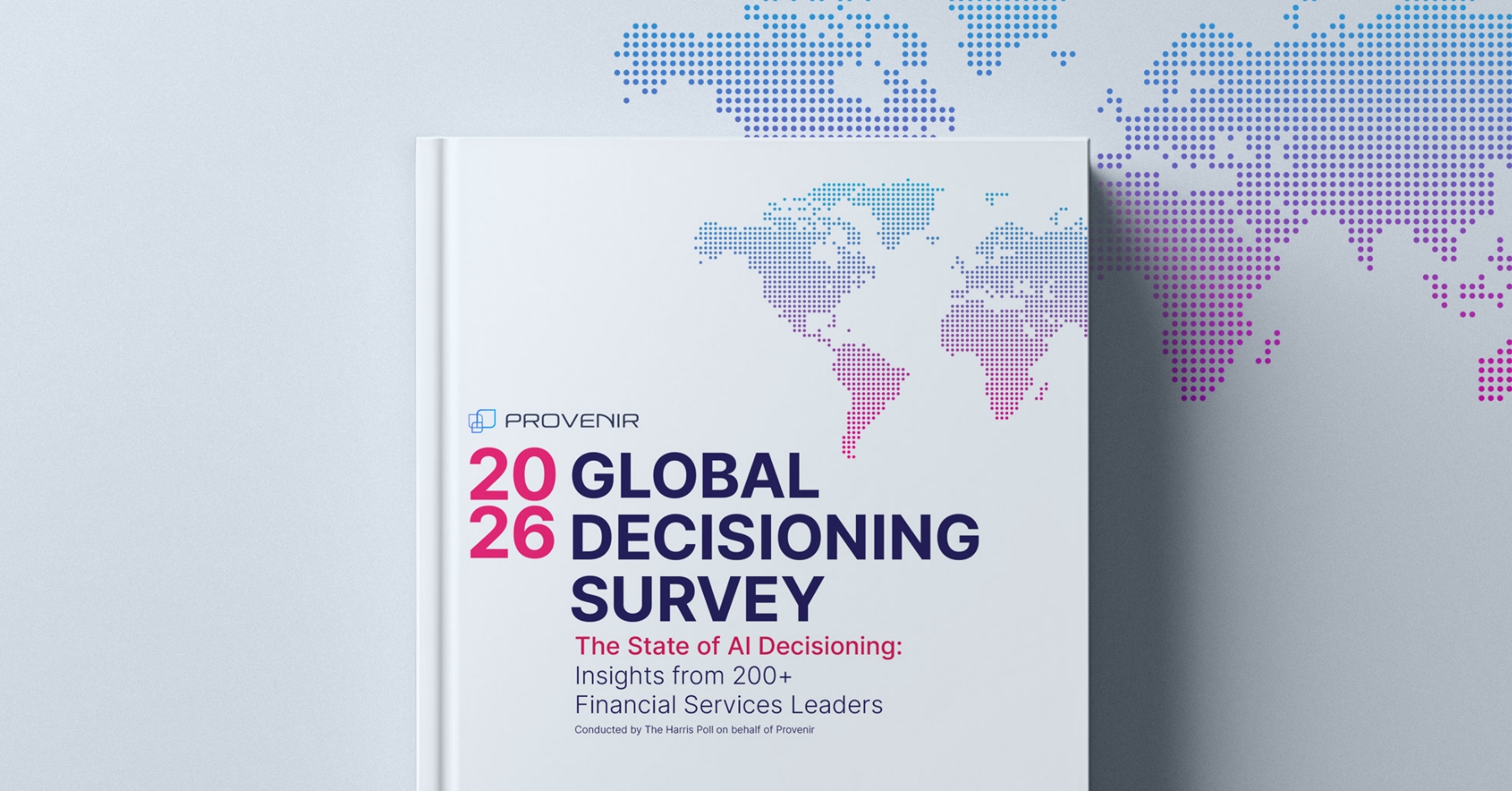
Survey: 2026 Global Decisioning Survey

What are the key challenges and priorities for financial services leaders in 2026 and beyond?

The financial services industry stands at an inflection point in its adoption of artificial intelligence for decisioning. Our 2026 Global Decisioning Survey reveals a sector that recognizes AI’s transformative potential yet struggles with universal implementation challenges.

We surveyed 203 senior decision-makers—including Chief Risk Officers, CEOs, CFOs, and Heads of Risk—across 22 countries spanning banking, fintech, insurance, telecommunications, and other financial services sectors. The findings paint a nuanced picture of an industry in transition.

KEY FINDINGS AT A GLANCE
  • The AI Paradox:

    87% trust AI-driven decisioning outcomes, yet 97% face implementation barriers
  • The Fraud Challenge:

    77% are concerned about AI-enabled fraud threats while needing AI to combat fraud
  • Real-Time Momentum:

    91% have moved beyond static-only models; 52% use hybrid approaches
  • Decision Intelligence:

    77% see it as very valuable for their strategy over the next 2-3 years
  • Investment Priority:

    60% plan to invest in AI or embedded intelligence for decisioning in 2026
  • Governance Gap:

    Only 33% have fully implemented responsible AI frameworks

These findings reveal an industry that knows where it needs to go but faces significant challenges getting there. The organizations that successfully navigate implementation barriers—around compliance, explainability, and integration—will build sustainable competitive advantages through faster, more accurate, and more adaptive decisioning.

ADDITIONAL RESOURCES

260726 - BLOG eyeDP - FeatureIMG - 61058
Blog, Data, Fraud /

Beyond Data: Why Decisioning Needs Do...

Beyond Data:Why Decisioning Needs Document Intelligence Financial services providers now have access ... Read More →
Fraud in Telco: Provenir Experts Answer Frequently Asked Questions
Blog, Fraud, Telco /

Fraud in Telco: Provenir Experts Answ...

Fraud in Telco:Provenir Experts Answer Frequently Asked Questions 1. Regarding the 1st ... Read More →
260722 - ARTICLE Mike - FeatureIMG - 60958
Blog, AI /

AI governance in financial services

AI governance in financial services:What "governed" means in practice Artificial intelligence has ... Read More →
Data Providers Blog
eBook, Data /

Practical Guide to Reviewing Your Dat...

Ebook What’s Missing from Your Decision Stack? Smarter decisions start with the ... Read More →
Latam Compliance Challenge for Decisioning
Blog, Data /

LATAM Next Compliance Challenge: Deci...

From Data Protection to Decisioning Accountability:What LATAM Regulation Means for Enterprise Lenders ... Read More →
Banks Architecture Gap - Provenir
Blog, Banking /

The Architecture Gap: Banking’s Next ...

Decisioning ArchitectureThe Architecture Gap: Banking's Next Competitive Battleground Banks have spent the ... Read More →
BLOG Andy
Blog, Decisioning /

The Real Cost of Vendor Dependency in...

The Real Cost of Vendor Dependency in Credit Decisioning One pattern comes ... Read More →
260617 - BLOG Matthew Nutt - FeatureIMG - 60431
Blog, Data /

What Does a Good Data Provider Review...

What Does a Good Data Provider Review Actually Look Like? Most financial ... Read More →
WEBINAR telco
Webinar, Fraud /

Revenue to Reputation

Fraud targeting telcos has always existed. What's changed is how it's executed, ... Read More →
provenir_norlys
News, Decisioning, Provenir /

Provenir Partners with Norlys to Powe...

Provenir Partners with Norlys to Power Next-Generation Credit Decisioning Across Energy and ... Read More →
Ebook CM
Blog, AI /

AI-Powered Customer Management: How L...

AI-Powered Customer Management:How Leading Institutions Turn Intelligence Into Revenue What this guide ... Read More →
Hyper-Personalization - FeatureIMG-EN
Blog, Hyper-Personalization /

From Personalization to Hyper-persona...

From Personalization to Hyper-personalization:An Executive Playbook Executive Summary Financial institutions using hyper-personalization ... Read More →
memphis
Event, Banking /

Banking Innovation Summit in Memphis

Banking Innovation Summit Join Provenir at The Banking Innovation Summit in Memphis ... Read More →
The Revenue Hiding in Your Customer Base
Blog, Case Mgmt, Customer Mgmt /

The Revenue Hiding in Your Customer B...

New market expansion. Unbanked populations. Fintech partnerships. Meanwhile, the biggest revenue opportunity ... Read More →
BLOG CXO
Blog, Decisioning /

What It Really Takes to Build AI Deci...

Building a Decision Intelligence platform for financial services sounds straightforward until you're ... Read More →

Continue reading

INFOGRAPHIC Hyper-personalization

Hyper-Personalization in Action

Hyper-Personalization in Action: How AI-Driven Decisioning Transforms Every Customer Interaction

Most financial institutions still rely on humans to interpret model predictions and make the final call on offers, terms, and actions. The result? Slower decisions, inconsistent experiences, and missed revenue opportunities.

Hyper-personalization changes this. AI doesn’t just predict outcomes—it prescribes the best action for each individual customer, automatically balancing profitability, risk, and experience in real time.

What You’ll Discover
  • The difference between prediction and prescription in AI decisioning
  • How hyper-personalization delivers individual-level optimization—not segment-based targeting
  • Why prescriptive AI transforms every customer interaction across your lifecycle

Explore hyper-personalization in depth with insights from our experts:

ADDITIONAL RESOURCES

260726 - BLOG eyeDP - FeatureIMG - 61058
Blog, Data, Fraud /

Beyond Data: Why Decisioning Needs Do...

Beyond Data:Why Decisioning Needs Document Intelligence Financial services providers now have access ... Read More →
Fraud in Telco: Provenir Experts Answer Frequently Asked Questions
Blog, Fraud, Telco /

Fraud in Telco: Provenir Experts Answ...

Fraud in Telco:Provenir Experts Answer Frequently Asked Questions 1. Regarding the 1st ... Read More →

260722 - ARTICLE Mike - FeatureIMG - 60958
Blog, AI /

AI governance in financial services

AI governance in financial services:What "governed" means in practice Artificial intelligence has ... Read More →
Data Providers Blog
eBook, Data /

Practical Guide to Reviewing Your Dat...

Ebook What’s Missing from Your Decision Stack? Smarter decisions start with the ... Read More →
Latam Compliance Challenge for Decisioning
Blog, Data /

LATAM Next Compliance Challenge: Deci...

From Data Protection to Decisioning Accountability:What LATAM Regulation Means for Enterprise Lenders ... Read More →
Banks Architecture Gap - Provenir
Blog, Banking /

The Architecture Gap: Banking’s Next ...

Decisioning ArchitectureThe Architecture Gap: Banking's Next Competitive Battleground Banks have spent the ... Read More →
BLOG Andy
Blog, Decisioning /

The Real Cost of Vendor Dependency in...

The Real Cost of Vendor Dependency in Credit Decisioning One pattern comes ... Read More →
260617 - BLOG Matthew Nutt - FeatureIMG - 60431
Blog, Data /

What Does a Good Data Provider Review...

What Does a Good Data Provider Review Actually Look Like? Most financial ... Read More →
WEBINAR telco
Webinar, Fraud /

Revenue to Reputation

Fraud targeting telcos has always existed. What's changed is how it's executed, ... Read More →
provenir_norlys
News, Decisioning, Provenir /

Provenir Partners with Norlys to Powe...

Provenir Partners with Norlys to Power Next-Generation Credit Decisioning Across Energy and ... Read More →
Ebook CM
Blog, AI /

AI-Powered Customer Management: How L...

AI-Powered Customer Management:How Leading Institutions Turn Intelligence Into Revenue What this guide ... Read More →
Hyper-Personalization - FeatureIMG-EN
Blog, Hyper-Personalization /

From Personalization to Hyper-persona...

From Personalization to Hyper-personalization:An Executive Playbook Executive Summary Financial institutions using hyper-personalization ... Read More →
memphis
Event, Banking /

Banking Innovation Summit in Memphis

Banking Innovation Summit Join Provenir at The Banking Innovation Summit in Memphis ... Read More →
The Revenue Hiding in Your Customer Base
Blog, Case Mgmt, Customer Mgmt /

The Revenue Hiding in Your Customer B...

New market expansion. Unbanked populations. Fintech partnerships. Meanwhile, the biggest revenue opportunity ... Read More →
BLOG CXO
Blog, Decisioning /

What It Really Takes to Build AI Deci...

Building a Decision Intelligence platform for financial services sounds straightforward until you're ... Read More →

Continue reading

AI infographic

5 AI Use Cases Digital Banks Must Govern by 2025

5 AI Use Cases Digital Banks Must Govern by 2025

Digital banks across APAC are accelerating their AI adoption—but core use cases like credit scoring, fraud detection, AML/KYC, customer targeting, and compliance automation are now considered “high-risk” under evolving regulatory regimes. This infographic shows how to scale with confidence, balancing growth, compliance, and customer trust.
What You’ll Discover
  • The five critical AI use cases your digital bank must govern by 2025
  • Why regulators are classifying them as high-risk
  • Key governance controls and decisioning capabilities that turn risk into advantage
Want more in-depth info on how Provenir implements AI?

Learn More

ADDITIONAL RESOURCES

260726 - BLOG eyeDP - FeatureIMG - 61058
Blog, Data, Fraud /

Beyond Data: Why Decisioning Needs Do...

Beyond Data:Why Decisioning Needs Document Intelligence Financial services providers now have access ... Read More →
Fraud in Telco: Provenir Experts Answer Frequently Asked Questions
Blog, Fraud, Telco /

Fraud in Telco: Provenir Experts Answ...

Fraud in Telco:Provenir Experts Answer Frequently Asked Questions 1. Regarding the 1st ... Read More →
260722 - ARTICLE Mike - FeatureIMG - 60958
Blog, AI /

AI governance in financial services

AI governance in financial services:What "governed" means in practice Artificial intelligence has ... Read More →
Data Providers Blog
eBook, Data /

Practical Guide to Reviewing Your Dat...

Ebook What’s Missing from Your Decision Stack? Smarter decisions start with the ... Read More →
Latam Compliance Challenge for Decisioning
Blog, Data /

LATAM Next Compliance Challenge: Deci...

From Data Protection to Decisioning Accountability:What LATAM Regulation Means for Enterprise Lenders ... Read More →
Banks Architecture Gap - Provenir
Blog, Banking /

The Architecture Gap: Banking’s Next ...

Decisioning ArchitectureThe Architecture Gap: Banking's Next Competitive Battleground Banks have spent the ... Read More →
BLOG Andy
Blog, Decisioning /

The Real Cost of Vendor Dependency in...

The Real Cost of Vendor Dependency in Credit Decisioning One pattern comes ... Read More →
260617 - BLOG Matthew Nutt - FeatureIMG - 60431
Blog, Data /

What Does a Good Data Provider Review...

What Does a Good Data Provider Review Actually Look Like? Most financial ... Read More →
WEBINAR telco
Webinar, Fraud /

Revenue to Reputation

Fraud targeting telcos has always existed. What's changed is how it's executed, ... Read More →
provenir_norlys
News, Decisioning, Provenir /

Provenir Partners with Norlys to Powe...

Provenir Partners with Norlys to Power Next-Generation Credit Decisioning Across Energy and ... Read More →
Ebook CM
Blog, AI /

AI-Powered Customer Management: How L...

AI-Powered Customer Management:How Leading Institutions Turn Intelligence Into Revenue What this guide ... Read More →
Hyper-Personalization - FeatureIMG-EN
Blog, Hyper-Personalization /

From Personalization to Hyper-persona...

From Personalization to Hyper-personalization:An Executive Playbook Executive Summary Financial institutions using hyper-personalization ... Read More →
memphis
Event, Banking /

Banking Innovation Summit in Memphis

Banking Innovation Summit Join Provenir at The Banking Innovation Summit in Memphis ... Read More →
The Revenue Hiding in Your Customer Base
Blog, Case Mgmt, Customer Mgmt /

The Revenue Hiding in Your Customer B...

New market expansion. Unbanked populations. Fintech partnerships. Meanwhile, the biggest revenue opportunity ... Read More →
BLOG CXO
Blog, Decisioning /

What It Really Takes to Build AI Deci...

Building a Decision Intelligence platform for financial services sounds straightforward until you're ... Read More →

Continue reading