Industry: Hyper-Personalization

Hyper-Personalization - FeatureIMG-EN

From Personalization to Hyper-personalization

From Personalization to Hyper-personalization:
An Executive Playbook

Executive Summary

Financial institutions using hyper-personalization are achieving 10-15% revenue increases and 20% customer satisfaction improvements by moving beyond traditional segmentation to individual-level optimization. This playbook outlines the strategic shift from descriptive analytics (rules and scorecards) through predictive analytics (machine learning models) to prescriptive analytics (optimization algorithms that determine optimal actions for each customer).
  • Key Investment Opportunity

    Unlike traditional approaches that predict what will happen, hyper-personalization determines how it should happen. For example, in Collections: what discount, channel, or time of day is best to contact the customer; and in Onboarding: not just a yes/no decision, but what credit limits and interest rates are appropriate for each customer.
  • Implementation Reality

    Success requires more than technology—it demands data infrastructure, organizational change management, and the intellectual property to combine predictive models with optimization engines. The most successful implementations focus on specific use cases (customer management, pricing optimization) before scaling across the enterprise.
  • Strategic Urgency

    Early adopters are establishing sustainable competitive advantages through superior customer experiences and enhanced profitability. The gap between leaders and laggards is widening rapidly, making this a strategic imperative rather than an optional enhancement.

The Strategic Imperative

The financial services industry faces a critical decision point. While most institutions rely on broad customer segmentation and generic offers, forward-thinking organizations are achieving higher customer satisfaction improvements through hyper-personalization.

Institutions that continue operating with yesterday’s analytics will find themselves increasingly disadvantaged against competitors who deliver precisely tailored experiences at scale. The question isn’t whether to embrace hyper-personalization, but how quickly you can make the transition.

The Evolution: From Descriptive to Prescriptive

Many financial institutions today still operate in a “crawling” phase, using rules-based systems and broad segmentation. Customers fall into perhaps five segments, with everyone receiving similar treatment. This worked in less competitive markets but leaves enormous value on the table today.

The “walking” phase introduces traditional machine learning and predictive analytics. Institutions generate individual risk scores and probabilities—Customer A has a 15% default probability, Customer B has 30%. This represents significant advancement, but the output remains descriptive: “Here’s what we think will happen.”

The “running” phase—true hyper-personalization—combines predictive capabilities with prescriptive optimization. Rather than simply predicting outcomes, systems determine optimal actions for each customer while considering multiple business objectives and constraints simultaneously. The algorithm might determine that while Customer A appears to be a better credit risk, offering a specific product to Customer B generates higher overall profitability when factoring in marketing budgets, inventory constraints, and strategic objectives.

This distinction is critical: traditional personalized models give you individual predictions. Hyper-personalization gives you individual optimal decisions.

The Technical Reality

Consider the complexity of real-world financial decision-making. When deciding what product to offer a customer, banks must simultaneously consider profitability targets, marketing budgets, inventory constraints, regulatory requirements, customer lifetime value, competitive positioning, and dozens of interacting variables.

Traditional approaches handle this complexity poorly. Credit scorecards identify good risks but cannot optimize for profitability while respecting budget constraints. Marketing models predict interest but cannot balance that against risk appetite and resource limitations.

Hyper-personalization systems process all variables simultaneously through optimization algorithms. They determine not just that Customer A would accept a credit card offer, but that offering a personal loan instead would generate 23% higher profit while staying within risk parameters and budget constraints. They make sure several customers characteristics and constraints are evaluated simultaneously, optimizing the entire customer portfolio.

Organizational Readiness: What It Takes

  • Data Infrastructure Requirements

    Success demands more than traditional analytics data. Organizations need comprehensive historical customer data spanning 12+ months, transaction and behavioral data, and the ability to integrate external data sources. Data quality becomes paramount—optimization algorithms are only as good as the data they process.

    Many institutions lack this data foundation today. Rather than viewing hyper-personalization as unattainable, use it as a strategic driver for data infrastructure investment. Organizations in this position should focus on two parallel tracks: implementing simpler predictive models that work with existing data while simultaneously building the comprehensive data infrastructure hyper-personalization requires.

  • Technology Prerequisites

    The technology stack must handle complex calculations at scale while maintaining flexibility to adjust strategies quickly. As organizations mature, real-time processing becomes essential—moving from overnight batch optimization to decisions made during customer interactions.

    Modern integration capabilities allow hyper-personalization systems to access data across multiple sources and deploy decisions across channels. Whether on-premise or cloud-based, the architecture must support optimization algorithms processing multiple variables simultaneously for individual customers.

  • Cultural Transformation

    Hyper-personalization requires moving beyond “that’s how we’ve always done it” mentalities. Organizations need executive sponsorship at the C-level, cross-functional teams spanning risk, marketing, and IT, and willingness to challenge existing decision-making processes. Most importantly, they need support for iterative improvement and data-driven experimentation.

Implementation Roadmap

  • PHASE 1: Foundation Building

    (Months 1-2)

    Begin with comprehensive data auditing and quality assessment. Form cross-functional teams and identify initial use cases—customer management or pricing optimization typically offer the best starting points. Establish success metrics and begin platform evaluation.
  • PHASE 2: Proof of Concept

    (Months 3-5)

    Implement a single use case to demonstrate value. Develop optimization algorithms. Focus on measuring tangible improvements and gaining user adoption.
  • PHASE 3: Scaled Deployment

    (Months 6-7)

    Expand to multiple use cases across the full customer base. Integrate with existing systems and implement automated decision-making workflows. This phase typically delivers the most significant business impact as optimization reaches scale.
  • PHASE 4: Production Monitoring and Optimization

    (Months 8-14)

    Implement real-time optimization and cross-product integration. Advanced analytics and predictive model enhancement become the focus, establishing sustainable competitive advantage.

Managing Implementation Risks

  • Technical Challenges

    Data quality issues can derail optimization efforts. Implement comprehensive data governance and consider external data sources to fill gaps. Algorithm explainability remains crucial for regulatory compliance—ensure you can explain why specific decisions were made.
  • Securing Early Stakeholder Buy-In

    Unite commercial and risk leaders around shared optimization goals from day one. Demonstrate through pilot programs how prescriptive analytics maximizes both revenue and risk management objectives. Early cross-functional alignment transforms potential resistance into advocacy as stakeholders recognize mutual benefits.
  • Performance Expectations

    Set realistic expectations and measure progress incrementally. Not every optimization will deliver immediate results, but the cumulative effect should be significant. Regular communication about progress and challenges maintains organizational support.

Success Metrics That Matter

  • icon-money

    Financial Performance

    Track revenue per customer, conversion rate improvements, and profitability optimization. The most important metric is often profit per customer rather than traditional measures like approval rates or volumes.

  • Operational Excellence

    Monitor decision consistency, time to implement strategy changes, and the ratio of automated versus manual decisions. System reliability and user adoption rates indicate whether the implementation is sustainable.

  • customer satisfaction

    Customer Experience

    Customer satisfaction scores, retention rates, and complaint levels reveal whether optimization is truly creating value or merely extracting it at customer expense.

The Path Forward

Hyper-personalization represents a fundamental shift from reactive, segment-based decision-making to proactive, individual-optimized strategies. Organizations that successfully implement prescriptive analytics achieve significant competitive advantages through improved customer experiences and enhanced profitability.

The key insight is that hyper-personalization isn’t advanced analytics—it’s the combination of predictive capabilities with optimization engines that balance multiple business objectives while respecting operational constraints. Investment in these capabilities is becoming a competitive necessity rather than a strategic option.

Immediate Next Steps:

Secure executive sponsorship and budget approval, identify cross-functional project team members, evaluate technology platforms, and select an initial use case with high ROI potential. The organizations that begin this journey now will establish sustainable advantages in customer acquisition, retention, and profitability.

The future belongs to institutions that can treat every customer interaction as an opportunity to optimize value while managing risk. The question is whether you’ll lead this transformation or be disrupted by it.

Key Takeaways

  • icon-money

    Hyper-personalization Is Prescriptive, Not Just Predictive:

    Traditional analytics tells you what will happen (Customer A has 15% default risk). Hyper-personalization determines what you should do about it (offer Customer A a personal loan at specific terms while staying within budget and risk constraints). This fundamental distinction drives the measurable improvements institutions achieve.

  • Data Infrastructure Drives—and Benefits From—Implementation:

    Comprehensive historical data, behavioral patterns, and profitability metrics are essential for optimization algorithms. Organizations lacking this foundation should pursue two parallel tracks: implementing simpler predictive models with existing data while building the infrastructure hyper-personalization requires. The pursuit of optimization capabilities itself improves data governance and quality across the institution.

  • customer satisfaction

    Start Specific, Then Scale:

    The most successful implementations focus on a single use case—customer management or pricing optimization—before expanding enterprise-wide. This approach demonstrates value, builds organizational confidence, and allows teams to learn before tackling more complex applications.

  • customer satisfaction

    Technology Must Support Scale and Speed:

    Whether on-premise or cloud-based, systems must handle complex calculations for individual customers and support the shift from overnight batch processing to real-time decision-making during customer interactions.

  • customer satisfaction

    Organizational Readiness Matters as Much as Technology:

    Success requires C-level executive sponsorship, cross-functional teams spanning risk, marketing, and IT, and willingness to challenge existing decision-making processes. Cultural resistance to “how we’ve always done it” can derail even the best technical implementations.

  • rocket

    The Competitive Gap Is Widening:

    Early adopters achieving 10-15% revenue increases and 20% customer satisfaction improvements are establishing sustainable advantages. The question isn’t whether to pursue hyper-personalization, but how quickly you can make the transition before the gap becomes insurmountable.
LATEST BLOGS

Ebook CM

AI-Powered Customer ...

AI-Powered Customer Management:How Leading Institutions Turn Intelligence Into Revenue
Hyper-Personalization - FeatureIMG-EN

From Personalization...

From Personalization to Hyper-personalization:An Executive Playbook Executive Summary Financial
The Revenue Hiding in Your Customer Base

The Revenue Hiding i...

New market expansion. Unbanked populations. Fintech partnerships. Meanwhile, the
BLOG CXO

What It Really Takes...

Building a Decision Intelligence platform for financial services sounds
BLOG AutoFinance

Transaction to Relat...

Auto lending has always been good at the moment
Buy the Engine. Build the Advantage

Buy the Engine. Buil...

The competitive environment in financial services has fundamentally changed.
The Growing Threat of Fraud in UK Auto Lending

The Growing Threat o...

Fraud in UK auto lending continues to rise in
BLOG Christian Ball

Smarter Acquisition ...

Financial institutions face a straightforward challenge: acquire profitable customers

Continue reading

INFOGRAPHIC Hyper-personalization

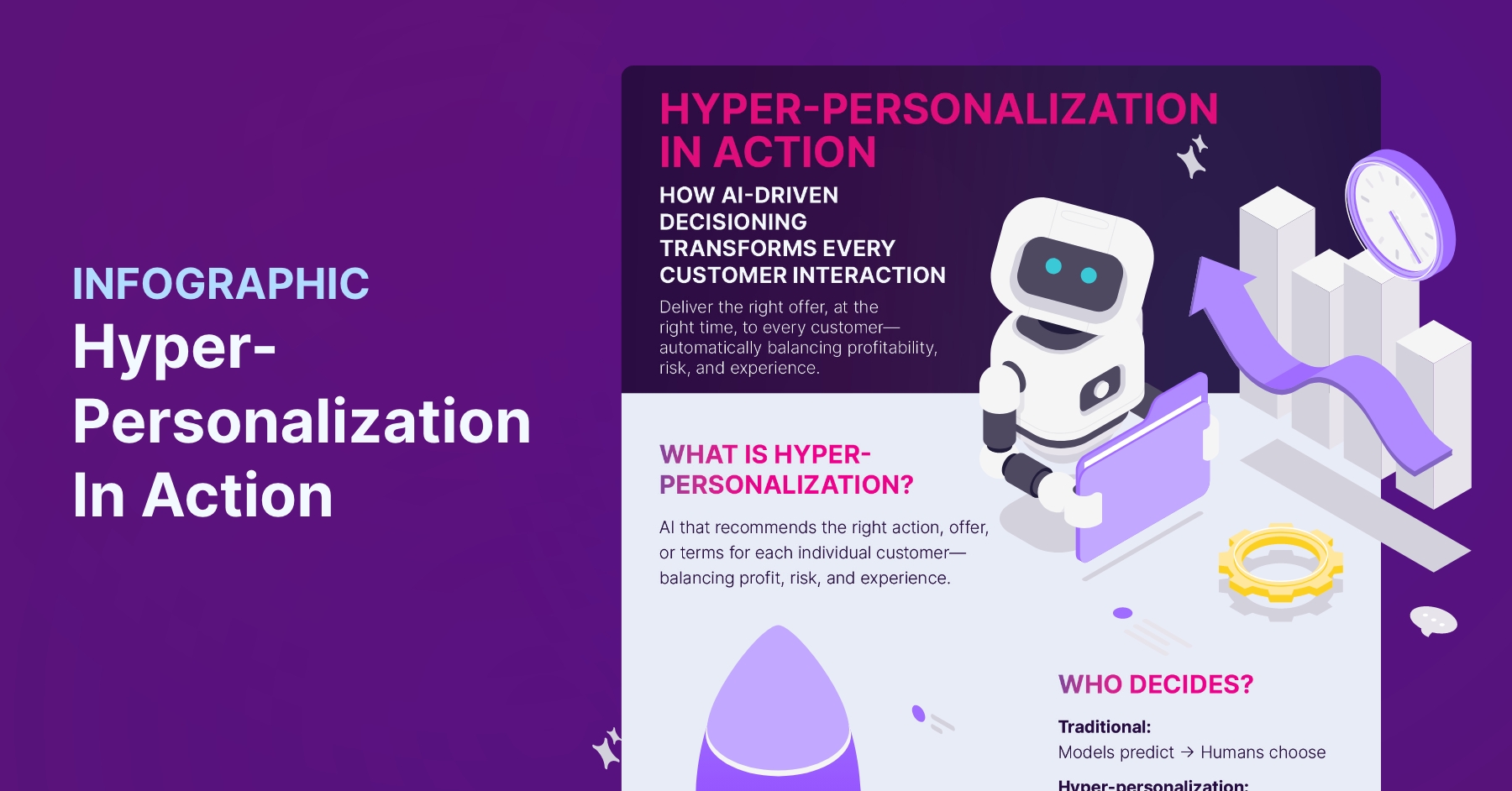
Hyper-Personalization in Action

Hyper-Personalization in Action: How AI-Driven Decisioning Transforms Every Customer Interaction

Most financial institutions still rely on humans to interpret model predictions and make the final call on offers, terms, and actions. The result? Slower decisions, inconsistent experiences, and missed revenue opportunities.

Hyper-personalization changes this. AI doesn’t just predict outcomes—it prescribes the best action for each individual customer, automatically balancing profitability, risk, and experience in real time.

What You’ll Discover
  • The difference between prediction and prescription in AI decisioning
  • How hyper-personalization delivers individual-level optimization—not segment-based targeting
  • Why prescriptive AI transforms every customer interaction across your lifecycle

Explore hyper-personalization in depth with insights from our experts:

ADDITIONAL RESOURCES

WEBINAR telco
Webinar, Fraud /

Revenue to Reputation

Fraud targeting telcos has always existed. What's changed is how it's executed, ... Read More →
provenir_norlys
News, Decisioning, Provenir /

Provenir Partners with Norlys to Powe...

Provenir Partners with Norlys to Power Next-Generation Credit Decisioning Across Energy and ... Read More →
Ebook CM
Blog, AI /

AI-Powered Customer Management: How L...

AI-Powered Customer Management:How Leading Institutions Turn Intelligence Into Revenue What this guide ... Read More →
Hyper-Personalization - FeatureIMG-EN
Blog, Hyper-Personalization /

From Personalization to Hyper-persona...

From Personalization to Hyper-personalization:An Executive Playbook Executive Summary Financial institutions using hyper-personalization ... Read More →
memphis
Event, Banking /

Banking Innovation Summit in Memphis

Banking Innovation Summit Join Provenir at The Banking Innovation Summit in Memphis ... Read More →
The Revenue Hiding in Your Customer Base
Blog, Case Mgmt, Customer Mgmt /

The Revenue Hiding in Your Customer B...

New market expansion. Unbanked populations. Fintech partnerships. Meanwhile, the biggest revenue opportunity ... Read More →
BLOG CXO
Blog, Decisioning /

What It Really Takes to Build AI Deci...

Building a Decision Intelligence platform for financial services sounds straightforward until you're ... Read More →
WEBINAR Fraud
Webinar, Fraud /

What if you could spot first-party fr...

First-party fraud has rapidly evolved from isolated organised crime into a social ... Read More →
When Did You Review Your Third-Party Data Providers?
Data /

When Did You Last Review Your Third-P...

When Did You Last ReviewYour Third-Party Data Providers? Third-party data sits at ... Read More →
BLOG AutoFinance
Blog, Auto Financing /

Transaction to Relationship: Rethinki...

Auto lending has always been good at the moment of origination. Lenders ... Read More →
Webinar - Navigating Auto Lending
Webinar, Auto Financing /

Navigating Auto Lending in 2026

On-Demand Webinar Navigating Auto Lending in 2026: Speed, Agility, Visibility, at Your ... Read More →
EBOOK KShape
eBook, Financial Services /

One Portfolio, Two Economies

The economic ground is shifting beneath financial institutions in ways that defy ... Read More →
Buy the Engine. Build the Advantage
Blog, Financial Services /

Buy the Engine. Build the Advantage.

The competitive environment in financial services has fundamentally changed. Margins are compressed ... Read More →
BLOG Fraud
Blog, Fraud /

Why Nordic Banks Must Balance Fraud C...

In the digital banking era, customer expectations are measured in milliseconds, not ... Read More →
The Growing Threat of Fraud in UK Auto Lending
Blog, Fraud /

The Growing Threat of Fraud in UK Aut...

Fraud in UK auto lending continues to rise in both scale and ... Read More →

Continue reading

HyperPersonalization

From Risk Manager to Revenue Generator

From Risk Manager to Revenue Generator:
How CROs Are Becoming the New Growth Heroes

As a Chief Risk Officer or senior executive, you’ve likely defended your risk budget in countless board presentations. You’ve explained loss ratios, regulatory compliance costs, and the value of preventing defaults. But here’s a question that might change how you position your department forever:

What if your risk team doesn’t just protect profit, but creates it.

The most profitable financial institutions have already discovered this truth. While their competitors view risk management as a necessary cost center, these organizations have transformed their risk functions into revenue engines that optimize every customer decision for maximum profitability.

Consider the numbers: McKinsey research shows that true personalization can boost revenue by 10-15% while increasing customer satisfaction by 20%. Yet when we analyze how most institutions actually make decisions, we find that most organizations believe they’re hyper-personalizing customer experiences when in reality they haven’t moved past applying predictive analytics with human judgment overlays.

The gap between perception and reality represents the difference between incremental improvements and transformational competitive advantage.

Your risk department sits on the most valuable asset in your organization: the ability to make profit-optimizing decisions for every customer interaction. While commercial teams bring customers through the door, risk teams determine whether those relationships generate sustainable returns or catastrophic losses.

The fintech graveyard is littered with companies that prioritized customer acquisition over sophisticated risk decision-making. They built beautiful user experiences, raised hundreds of millions in venture capital, and acquired millions of customers. They also gave away billions in capital because they never understood that sustainable revenue generation requires prescriptive risk management, not just predictive analytics.

Smart CROs are recognizing this inflection point. When we present this revenue-generation paradigm to risk leaders, the response is immediate recognition: “We’ve been saying this for years, but nobody listened.”

The conversation is changing. The question for your organization is whether you’ll lead this transformation or follow competitors who recognize risk management’s true revenue potential.

The Hyper-personalization Myth

Industry buzzwords create dangerous illusions. The same pattern that affects AI adoption – where everyone claims advanced capabilities while few achieve true implementation – applies directly to hyper-personalization.

Many organizations describe their approach as hyper-personalized because they use customer data to inform product recommendations. The critical distinction lies in execution methodology. Traditional approaches use predictive analytics to calculate probabilities, then apply human judgment to make final decisions about customer treatment.

This approach falls short of true hyper-personalization, which requires algorithmic decision-making without human interpretation layers.

  • Collections:

    The Decision-Making Divide

    Traditional collections processes illustrate this distinction perfectly. Standard approaches predict customer payment probabilities and delinquency risks, then rely on human judgment to determine contact timing, communication channels, and messaging approaches.

    Collections teams decide when to contact customers, whether to use phone calls, texts, or emails, and what tone to employ. These represent the when, how, and what of collections strategy – all determined by human analysis of predictive data.

    True hyper-personalization eliminates human decision-making. Advanced algorithms determine optimal contact timing for each customer, identify the most effective communication channel based on individual success probabilities, and prescribe specific messaging approaches. The system drives strategy execution based on optimization algorithms, not human interpretation of predictive analytics.

  • Credit Line Management:

    From Standard to Optimal

    Credit card portfolio management demonstrates another critical application. Effective credit limit optimization drives transaction volume and revenue generation through both interest income and interchange fees.

    Traditional approaches apply standardized credit limit policies, often resulting in customers preferentially using competitors’ cards with more suitable limits. This creates revenue leakage and reduces share-of-wallet performance.

    Hyper-personalized credit line management determines optimal limits for individual customers, ensuring specific cards become primary payment methods. The algorithm optimizes for usage frequency while maintaining payment capacity, maximizing profitability for each customer relationship.

  • Product Recommendations:

    Machine vs. Human Decision Authority

    Standard cross-sell processes predict customer preferences and acceptance probabilities for various products. Human analysts interpret these predictions to select specific products and terms for individual customers.

    True hyper-personalization requires algorithmic product selection with specific terms. The optimization engine makes complete decisions by balancing multiple factors: profitability, conversion likelihood, and long-term customer loyalty. The machine prescribes the right product with optimal terms for each customer based on what will generate the best total relationship value over time.

Your Internal Data Goldmine

The best decisions come from understanding your customers deeply. You already have the information you need.

Your existing customers are your biggest advantage. You’ve seen how they bank with you: their spending patterns, how they manage credit, when they make payments, and which products they use. This history tells you what each customer actually needs.

Even more valuable is understanding how customers react to your decisions. When you increase a credit limit, does the customer use it or ignore it? When you offer a new product, do they engage or opt out? This reaction data helps you predict how individual customers will respond next time.

For customers you don’t know as well, smart analytics can help. By studying customers you understand deeply, you can identify patterns that apply to similar customers with less history. You learn from your best relationships to improve your newest ones.

Looking ahead:

Beyond your walls. Right now, most personalization uses data you already own. There’s a largely untapped opportunity in bringing together different types of information beyond credit scores: broader signals that reveal customer needs and behaviors.

Making the Transformation Real

Historical financial services decision-making relies heavily on human judgment. Even when institutions can accurately predict customer behaviors, final decisions about loan amounts, pricing, and terms often depend on subjective analysis and competitive market reactions.

Competitive positioning doesn’t necessarily optimize profitability for specific customer relationships. True optimization requires maximizing profitability for every decision rather than simply maintaining market-competitive offerings.

  • The Technology Foundation

    Prescriptive analytics platforms provide the technological infrastructure needed to optimize individual decisions at institutional scale. These systems integrate predictive capabilities with optimization algorithms, enabling profit-maximizing decisions for every customer interaction.

    Advanced platforms process multiple constraints simultaneously: regulatory requirements, risk appetite parameters, profitability targets, and customer experience objectives. The technology enables real-time optimization across thousands of decision variables.

  • Success Measurement Evolution

    Revenue-generating risk functions require new measurement frameworks that capture both traditional risk metrics and financial performance indicators. Organizations must develop comprehensive measurement approaches that evaluate revenue generation, profit optimization, and sustainable growth alongside risk management effectiveness.

    Key performance indicators should include revenue per customer, profit margins by customer segment, lifetime value optimization, and cross-sell success rates. These metrics demonstrate risk management’s direct contribution to organizational financial performance.

  • Organizational Alignment

    Effective optimization frameworks unite commercial and risk stakeholders around shared objectives, eliminating traditional conflicts between revenue growth and risk management. Properly implemented optimization serves both revenue goals and risk management requirements simultaneously.

The Strategic Imperative

Implementation separates leaders from followers. Organizations ready to begin this transformation should start with three concrete steps:
  • Audit current decision-making processes.
    Map where human judgment currently overrides data in credit decisions, collections strategies, and product recommendations. These are your optimization opportunities.
  • Establish baseline metrics.
    Measure current performance on revenue per customer, lifetime value, and cross-sell conversion rates. You need to quantify the improvement as you shift to algorithmic optimization.
  • Start with one high-impact use case.
    Don’t attempt a full transformation immediately. Choose credit line management or collections optimization where you can demonstrate results within quarters, not years. Success in one area builds organizational support for broader implementation.

The technology exists.
The data exists in your systems.
What’s required now is leadership commitment to move from predictive analytics to prescriptive action.

LATEST BLOGS

Ebook CM

AI-Powered Customer ...

AI-Powered Customer Management:How Leading Institutions Turn Intelligence Into Revenue
Hyper-Personalization - FeatureIMG-EN

From Personalization...

From Personalization to Hyper-personalization:An Executive Playbook Executive Summary Financial
The Revenue Hiding in Your Customer Base

The Revenue Hiding i...

New market expansion. Unbanked populations. Fintech partnerships. Meanwhile, the
BLOG CXO

What It Really Takes...

Building a Decision Intelligence platform for financial services sounds
BLOG AutoFinance

Transaction to Relat...

Auto lending has always been good at the moment
Buy the Engine. Build the Advantage

Buy the Engine. Buil...

The competitive environment in financial services has fundamentally changed.
The Growing Threat of Fraud in UK Auto Lending

The Growing Threat o...

Fraud in UK auto lending continues to rise in
BLOG Christian Ball

Smarter Acquisition ...

Financial institutions face a straightforward challenge: acquire profitable customers

Continue reading

Hyper-personalization Myth2

The Hyper-personalization Myth Series 2

The Hyper-personalization Myth Series #2:
The Scorecard Trap: How Traditional Models Are Leaving Money on the Table

Your institution has invested millions in analytics. You’ve built scorecards, deployed predictive models, and segmented your customer base into carefully defined groups. Your risk teams use these tools daily. Your data science team maintains them diligently.

And yet, you’re still losing to competitors who seem to make better decisions faster. Your customer satisfaction scores aren’t improving despite all this sophistication. Your profit per customer remains stubbornly flat.

Here’s why: scorecards and traditional segmentation models (the backbone of financial services decisioning for decades) were designed for a different era. They’re leaving enormous value on the table because they fundamentally cannot deliver what today’s market demands: truly individualized treatment at scale.

The Scorecard Legacy

Scorecards became ubiquitous in financial services for good reason. They’re transparent, explainable to regulators, and relatively simple to implement. A credit scorecard might use 10-15 variables to generate a risk score. Customers above a certain threshold get approved; those below get declined. Some institutions have dozens of scorecards for different products, channels, and customer segments.

The problem isn’t that scorecards don’t work—it’s that they’re fundamentally limited by their simplicity. Consider what a scorecard actually does: it takes a handful of variables, applies predetermined weights, and outputs a single number. That number then gets used to make a binary or simple categorical decision.

This approach made perfect sense when computational power was limited and data was scarce. But in today’s environment, where institutions have access to hundreds of data points per customer and virtually unlimited processing capability, scorecards are like using an abacus in the age of supercomputers.

The mathematical reality is stark: a scorecard might consider 15 variables. Modern machine learning models can process hundreds or thousands of variables, identifying complex patterns and interactions that scorecards miss entirely. More critically, optimization algorithms can then use those insights to determine individual optimal actions while balancing multiple business objectives simultaneously.

The Segmentation Illusion

Most institutions have evolved beyond single scorecards to sophisticated segmentation strategies. They might have different models or rules for:
  • High-income vs. low-income customers

  • Young professionals vs. retirees

  • Urban vs. rural customers

  • High credit scores vs. marginal credit

  • Long-tenure vs. new customers

This feels like personalization. An institution might have 20, 50, or even 100 different segments, each with tailored strategies. But this is still fundamentally a bucketing approach, and buckets, no matter how numerous, cannot capture individual-level optimization.

Consider two customers in the same segment: both are 35-year-old professionals with $80,000 income, 720 credit scores, and $50,000 in deposits. By any reasonable segmentation logic, they should receive identical treatment. But look closer:

  • Customer A:

    • Has been with the institution for 8 years
    • Holds checking, savings, and an auto loan
    • Uses digital channels 90% of the time
    • Has never called customer service
    • Lives in a competitive market with three other branches nearby
    • Recently searched for mortgage rates online
  • Customer B:

    • Opened an account 6 months ago
    • Has only a checking account with direct deposit
    • Visits branches frequently
    • Has called customer service three times about fees
    • Lives in a rural area with limited banking options
    • Just paid off student loans

The optimal product, pricing, and engagement strategy for these two customers is completely different, but segmentation treats them identically because they fit the same demographic and credit profile.

True Hyper-personalization recognizes that Customer A is at risk of moving their mortgage business to a competitor and should receive a proactive, digitally-delivered, competitively-priced mortgage offer. Customer B is a safe customer who values in-person service and should receive education about additional products delivered through branch interactions.

No segmentation strategy, no matter how sophisticated, can capture these nuances at scale across thousands of customers.

The Evolution:

Rules → Predictive → Prescriptive

The journey from scorecards to Hyper-personalization isn’t a single leap—it’s an evolution through three distinct stages:
  • STAGE 1:

    Rules and Scorecards

    This is where most institutions still operate for many decisions. Fixed rules and simple scorecards determine actions: “If credit score > 700 AND income > $50K, approve up to $10K.” These provide consistency and explainability but leave massive value on the table because they cannot adapt to individual circumstances or balance multiple objectives.
  • STAGE 2:

    Predictive Analytics

    Institutions deploy machine learning models that generate probabilities: “This customer has a 23% probability of default, 67% propensity to purchase, and 15% likelihood of churn in 90 days.” This is a significant improvement—the predictions are more accurate and can consider many more variables than scorecards.

    But here’s the trap: many institutions stop here and think they’ve achieved personalization. They have better predictions, but humans still make the decisions based on those predictions. A product manager reviews the propensity scores and decides which customers get which offers. This is still segmentation with extra steps.

  • STAGE 3:

    Prescriptive Optimization

    This is true hyperpersonalization: algorithms determine the optimal action for each individual customer while simultaneously considering:

    • Multiple predictive models (risk, propensity, lifetime value)
    • Business objectives (profitability, growth, risk-adjusted returns)
    • Operational constraints (budget, inventory, capacity)
    • Strategic priorities (market share, customer satisfaction, competitive positioning)
    • Regulatory requirements

    The output isn’t a prediction or a score—it’s a specific decision: “Offer Customer 1,547 a $12,000 personal loan at 8.2% APR with 36-month terms, delivered via email on Tuesday morning.”

Why Individual Treatment Isn’t Optional Anymore

The shift from segmentation to individual optimization isn’t just about squeezing out marginal improvements—it’s about remaining competitive in a market where customer expectations have been fundamentally reset.

Consider what your customers experience in their daily digital lives:

  • Netflix doesn’t show the same content recommendations to everyone aged 25-34 with similar viewing history—it creates individual recommendations for each user
  • Amazon doesn’t display the same products to everyone in the same demographic segment—it personalizes down to the individual
  • Spotify doesn’t create the same playlists for everyone who likes rock music—it generates unique mixes for each listener

Your customers experience this level of personalization dozens of times per day. Then they interact with their financial institution and receive the same generic offers as thousands of other customers in their segment.

The disconnect creates real business impact:

  • Offers that aren’t relevant get ignored, wasting marketing spend

  • Products that don’t match individual needs generate low engagement and high attrition

  • Generic credit decisions either take excessive risk or miss profitable opportunities

  • Customers increasingly expect better and defect to competitors who deliver it

The Structural Limitations of Segmentation

Even sophisticated segmentation approaches have fundamental mathematical limitations:
  • Constraint Blindness:
    Segments cannot optimize resource allocation. If you have 10,000 customers in a segment and budget for 3,000 offers, which 3,000 should receive them? Segmentation can’t answer this; it requires optimization.
  • Multi-Objective Failure:
    Should you prioritize profitability or customer lifetime value? Risk minimization or growth? Segments force you to choose. Optimization can balance multiple objectives simultaneously.
  • Inflexibility:
    Market conditions change, but segments are relatively static. Rebuilding segmentation strategies takes weeks or months. Re-running optimization takes minutes.
Lost Interactions: Variables don’t just add; they interact in complex ways. Income matters differently depending on debt levels, which matter differently depending on payment history, which matters differently depending on life stage. Segments capture some of this; machine learning captures much more; optimization leverages all of it.

The Path Forward

The transition from scorecards and segmentation to true Hyper-personalization requires honest assessment of where you are versus where the market is heading.

Ask yourself these diagnostic questions:

  • Are you still using scorecards for primary decisions?
    If yes, you’re operating with 1990s technology in a 2025 market. Scorecards provide consistency but cannot compete with approaches that consider hundreds of variables and complex interactions.
  • Do you rely on segmentation strategies with fixed rules per segment?
    If yes, you’re leaving money on the table even if you have sophisticated segments. No bucketing approach can optimize individual decisions while balancing multiple objectives and constraints.
  • After generating predictions, do humans decide actions?
    If yes, you’re stuck in Stage 2—you have better information but aren’t leveraging optimization to determine what to do with it.
  • Can you explain why Customer A received one offer while Customer B received a different offer, beyond “they’re in different segments”?
    If not, you’re not doing individual-level optimization.

The institutions winning in today’s market have moved beyond asking “What segment is this customer in?” to “What is the optimal action for this specific customer given all our objectives and constraints?”

That shift—from classification to optimization—is what separates leaders from laggards. Scorecards and segments were brilliant solutions for their time. But that time has passed.

The question is whether your institution will evolve before your competitors do, or whether you’ll spend the next decade wondering why your sophisticated analytics aren’t translating into business results.

LATEST BLOGS

Ebook CM

AI-Powered Customer ...

AI-Powered Customer Management:How Leading Institutions Turn Intelligence Into Revenue
Hyper-Personalization - FeatureIMG-EN

From Personalization...

From Personalization to Hyper-personalization:An Executive Playbook Executive Summary Financial
The Revenue Hiding in Your Customer Base

The Revenue Hiding i...

New market expansion. Unbanked populations. Fintech partnerships. Meanwhile, the
BLOG CXO

What It Really Takes...

Building a Decision Intelligence platform for financial services sounds
BLOG AutoFinance

Transaction to Relat...

Auto lending has always been good at the moment
Buy the Engine. Build the Advantage

Buy the Engine. Buil...

The competitive environment in financial services has fundamentally changed.
The Growing Threat of Fraud in UK Auto Lending

The Growing Threat o...

Fraud in UK auto lending continues to rise in
BLOG Christian Ball

Smarter Acquisition ...

Financial institutions face a straightforward challenge: acquire profitable customers

Continue reading

Hyper-personalization Myth1

The Hyper-personalization Myth Series 1

The Hyper-personalization Myth Series #1:
Why Banks Think They’re Doing Hyper-personalization (But Aren’t)

Walk into most financial institutions today and ask about their Hyper-personalization strategy, and you’ll hear impressive claims. Banks, credit unions, fintechs, and lenders have deployed machine learning models. They can predict which customers will default, respond to offers, or churn. Their data science teams run sophisticated analyses daily.

But here’s the uncomfortable truth: most of what financial services providers call “Hyper-personalization” is actually just prediction with manual decision-making. And that gap—between prediction and prescription—is costing them millions in lost revenue and customer satisfaction.

This article explores the distinction between predictive analytics (what most organizations have) and true prescriptive optimization (what actually drives results). You’ll learn how to identify whether your institution is doing real Hyper-personalization or just sophisticated guesswork—and why that difference determines whether you’re building competitive advantage or burning through analytics budgets with minimal return.

The Critical Distinction Most Banks Miss

The difference between real Hyper-personalization and what most banks are doing comes down to a simple question: Who makes the final decision—the human or the machine?

In most organizations today, the process looks like this:

  • Machine learning models generate predictions (probability of default, propensity to buy, likelihood of churn)
  • These predictions are packaged into reports or dashboards
  • A human—a collections manager, marketing director, or risk officer—reviews the predictions
  • That human decides what action to take based on the predictions plus their judgment

This is predictive analytics, not Hyper-personalization. It’s sophisticated, certainly. But it’s fundamentally limited by human cognitive capacity.

True Hyper-personalization flips this model: the machine determines the optimal action for each individual customer while considering all business objectives and constraints simultaneously. The human sets the goals and guardrails; the algorithm makes the decisions.

The Collections Reality Check

Consider a typical collections scenario that reveals why this distinction matters. A bank has 10,000 accounts that are 30 days past due. Their analytics team has built impressive models predicting propensity to pay, likelihood of self-cure, and probability of default for each customer.

  • The Traditional Approach:

    The collections manager reviews dashboard reports showing these probabilities, grouped into segments: high propensity to pay, medium, low. Based on this information and years of experience, they design treatment strategies. High-propensity customers get gentle email reminders. Medium-propensity customers receive phone calls. Low-propensity accounts go to external agencies.

    This seems logical. But here’s what’s actually happening:

    The manager can realistically evaluate perhaps 5-10 different strategy combinations. They cannot simultaneously optimize across 10,000 individual customers while considering budget constraints, staff availability, channel costs, regulatory requirements, time zone differences, and strategic customer retention objectives.

    Customer 1,547 and Customer 3,891 might have identical propensity-to-pay scores but dramatically different optimal approaches based on their complete behavioral history, communication preferences, product holdings, and lifetime value potential. The segmentation treats them identically.

    The manager knows the collection center has limited capacity, but they cannot precisely calculate which specific customers should receive which interventions to maximize recovery within that constraint.

  • The Hyper-personalization Reality:

    True optimization algorithms determine the exact approach for each customer: Email or phone? Morning or evening? Firm or empathetic tone? Settlement offer of how much? Payment plan of what structure?

    The system makes these determinations by simultaneously considering:

    • Individual customer characteristics and history
    • Propensity models for various outcomes
    • Cost of each intervention approach
    • Staff and budget constraints
    • Regulatory requirements
    • Strategic priorities (customer retention vs. immediate recovery)
    • Portfolio-level objectives

    No human can balance dozens of objectives across thousands of customers simultaneously while respecting multiple business constraints. The machine can—and it can do so in seconds rather than weeks.

The Credit Line Management Example

The distinction becomes even clearer in credit line management. One institution we worked with wanted to optimize credit line increases and decreases across their portfolio. They had sophisticated predictive models for probability of default at various limits, propensity to utilize additional credit, likelihood of balance transfers, and customer lifetime value projections.

  • Their Original Process:

    Product managers reviewed these predictions and created rules: “Customers with probability of default below 5% and utilization above 60% are eligible for line increases up to $10,000.” They had perhaps a dozen rules covering different customer segments.
  • What Hyper-personalization Delivered:

    Instead of segment-based rules, the optimization engine determined individual credit limits for each customer. Two customers with identical risk scores might receive different credit decisions based on their complete profiles, the competitive landscape, and the bank’s current portfolio composition.

The system simultaneously maximized profitability while ensuring portfolio-level risk stayed within targets, marketing budgets were respected, and regulatory capital requirements were met. When the bank’s risk appetite changed or market conditions shifted, the system re-calculated optimal decisions across the entire portfolio in minutes.

  • Results:

    15% higher portfolio profitability with no increase in default rates, 23% improvement in customer satisfaction as customers received credit access that better matched their actual needs.
  • The key insight:

    Customer A and Customer B might have the same probability of default, but Customer A’s optimal credit line might be $8,500 while Customer B’s is $12,000—because the optimization considers dozens of factors beyond risk, including profitability potential, competitive threats, portfolio composition, and strategic objectives.
No human analyst reviewing prediction reports could make these individualized determinations across thousands of customers while balancing portfolio-level constraints.

What Real Hyper-personalization Actually Requires

The gap between prediction and prescription isn’t just semantic—it requires fundamentally different technology:
  • Optimization Engines, Not Just Models
    You need algorithms that determine optimal actions while balancing multiple objectives and respecting numerous constraints. These are sophisticated mathematical solvers, not traditional machine learning models. They take predictions as inputs but produce decisions as outputs.
  • Integrated Decision-Making
    The human doesn’t sit between prediction and action, translating probabilities into decisions. Instead, humans set objectives (“maximize profitability while keeping portfolio default rate below 3%”) and constraints (“stay within marketing budget of $2M”), then the system optimizes within those parameters.
  • Constraint Management
    The system must handle real business limitations: budget caps, risk thresholds, inventory levels, regulatory requirements, staff capacity, operational constraints. These aren’t nice-to-haves—they’re fundamental to determining what the optimal decision actually is.
  • Goal Function Definition
    Organizations must explicitly define what they’re optimizing: Maximize profitability? Minimize defaults? Maximize customer lifetime value? Optimize customer satisfaction? Usually it’s some combination, and the weighting matters enormously.
  • Multi-Objective Balancing
    Here’s where traditional approaches completely break down. A collections manager might maximize recovery rates, but at what cost to customer retention? A marketing manager might maximize campaign response, but at what cost to profitability? Optimization engines can balance competing objectives mathematically rather than through human judgment.

Why the Distinction Matters Now

The gap between prediction and prescription might seem technical, but it has profound business implications. Consider what happens when you rely on human judgment to translate predictions into decisions:
  • Limited Optimization Scope:
    Humans can consider perhaps 5-10 variables simultaneously. Hyper-personalization algorithms can consider hundreds while respecting dozens of constraints.
  • Suboptimal Resource Allocation:
    Even excellent managers cannot allocate limited resources (budget, staff time, inventory) to maximize outcomes across thousands of customers simultaneously.
  • Slow Adaptation:
    When market conditions change, updating human-driven decision rules takes weeks. Re-running optimization takes minutes.
  • Local Optimization:
    Each department optimizes for their objectives—collections maximizes recovery, marketing maximizes response rates, risk minimizes defaults. True Hyper-personalization optimizes across the entire customer lifecycle.
The financial institutions implementing real Hyper-personalization are achieving 10-15% revenue increases and 20% customer satisfaction improvements, according to McKinsey research. More importantly, they’re building competitive advantages that compound over time through accumulated learning and organizational capability.

The Uncomfortable Question

Here’s how to tell if you’re really doing Hyper-personalization or just sophisticated prediction:

Ask yourself: “After our models generate predictions, does a human decide what action to take?”

If the answer is yes—if someone reviews reports and determines which customers get which offers, which collections approach to use, which credit limits to assign—you’re not doing Hyper-personalization.

You’re doing predictive analytics with human judgment. It’s better than rules alone, certainly. But it’s leaving enormous value on the table.

Moving Beyond the Myth

The organizations that figure out true Hyper-personalization first will define the competitive landscape for the next decade. The ones that remain stuck in prediction-plus-judgment will spend that decade wondering why their sophisticated analytics aren’t translating into business results.

True Hyper-personalization means the machine determines the optimal action for each customer, considering all your business objectives and constraints simultaneously. The human’s role shifts from making decisions to setting strategy: defining objectives, establishing constraints, and continuously refining what “optimal” means for your organization.

Anything less is just prediction with extra steps—no matter how sophisticated your models are.


Continue exploring hyper-personalization in the second article of our series “The Scorecard Trap: How Traditional Models Are Leaving Money on the Table”.

LATEST BLOGS

Ebook CM

AI-Powered Customer ...

AI-Powered Customer Management:How Leading Institutions Turn Intelligence Into Revenue
Hyper-Personalization - FeatureIMG-EN

From Personalization...

From Personalization to Hyper-personalization:An Executive Playbook Executive Summary Financial
The Revenue Hiding in Your Customer Base

The Revenue Hiding i...

New market expansion. Unbanked populations. Fintech partnerships. Meanwhile, the
BLOG CXO

What It Really Takes...

Building a Decision Intelligence platform for financial services sounds
BLOG AutoFinance

Transaction to Relat...

Auto lending has always been good at the moment
Buy the Engine. Build the Advantage

Buy the Engine. Buil...

The competitive environment in financial services has fundamentally changed.
The Growing Threat of Fraud in UK Auto Lending

The Growing Threat o...

Fraud in UK auto lending continues to rise in
BLOG Christian Ball

Smarter Acquisition ...

Financial institutions face a straightforward challenge: acquire profitable customers

Continue reading