Thank You – The New Face of First-Party Fraud
Thank You
Webinar on demand: The New Face of First-Party Fraud: Three Personas Every Lender Needs to Know

How Accessing 1datapipe on the Provenir Marketplace Can Unlock Device Financing and Microlending in Emerging Markets
Telcos across emerging markets are hitting a ceiling with their traditional business. Voice and SMS revenue keeps eroding and mobile data plans have become a commodity that gets re-priced downward whenever a new entrant undercuts on tariffs. Average Revenue Per User (ARPU) is flat or falling in market after market.
Ultimately, as a telco operator, there are two ways to grow revenue: – add more subscribers or generate more revenue from your existing subscriber base.
In emerging markets, the greater challenge is attracting and onboarding new subscribers, most of whom have no credit bureau record. This article explores how telcos can reliably identify and onboard applicants quickly and cost-effectively without unknowingly admitting fraudsters or adding unnecessary delays and inconvenience to genuine customers.
Every device-financing or microlending program in an emerging market runs into the same wall: how do you verify the individual or assess the onboarding risk when oftentimes there’s no mortgage history, revolving credit line, or credit bureau record. Traditional underwriting assumes a paper trail that a huge share of the addressable market in emerging markets simply doesn’t have.
The instinct is to reach for alternative data. The problem is that microloans and device financing — often $30 to $300 — cannot absorb a heavy per-applicant onboarding bill. A $2 all-in IDV call on a $50 handset loan isn’t a rounding error; it can be the entire margin. So, the real design question is where to use cost-effective alternative data, and where in the workflow it should sit.
1datapipe is an identity intelligence partner recently added to the Provenir Data Marketplace, specializing in emerging markets. It builds on a deterministic identity graph across 30 emerging markets and describes its “Living Identity” approach as resolving fragmented data into persistent, verified identity entities maintained over time with full provenance, auditability and explainability, — as opposed to traditional providers who offer point-in-time verification as part of a broader, more expensive all-in IDV check typically including document authentication.
As well as asking “does this name, ID, and phone combination match the applicant’s submitted details right now?,” its ID Graph capability asks, “has this identity been stable and coherent over time, across multiple authoritative sources?” Coverage runs across markets in LATAM, Southeast Asia, MENA and Africa with over two billion verified profiles — precisely the geography where credit bureaus are patchy or absent.
Even if a credit bureau exists in a region, accessing a credit report presents a significant cost of acquisition; — often one that can wipe out much of the profit. Additionally, they can’t help with thin-file applicants, because there’s no credit history. So, the key questions are “is this person who they say they are, and have they existed consistently long enough to be a trustworthy counterparty?” Identity persistence becomes a proxy for stability when repayment history doesn’t exist.
Consequently, the more cost-effective approach treats identity verification as a waterfall. Placing deterministic identity resolution high in the waterfall, before credit bureau reports and/or extensive IDV checks, means you’re not paying for these checks — or an agent’s time — on an application that’s fraudulent, synthetic or duplicated.
1datapipe’s identity intelligence is a key factor in reducing fraudulent applications that erode the margins of telco and other microfinanciers, an issue growing in emerging markets where historically accurate and comprehensive identity data has been very challenging to access. Additionally, housing it within Provenir’s Data Marketplace allows lenders to leverage 1datapipe’s identity intelligence along with other data sources covering identity, fraud, credit risk, open banking and affordability without building and maintaining separate integrations. That “pick and mix” architecture is the difference between a six-month integration project per country and a configuration change in a decision flow.
Larger loans can absorb a $5–$15 all-in verification cost because the ticket size and interest income justify it. Microloans and device financing can’t absorb that cost, which is exactly why they’re the products most often declined outright to avoid onboarding fraudulent applicants. In the process, however, genuine, thin-file applicants are declined, and the associated subscription revenue is lost. Accessing cost-effective data sources first and only accessing a credit report or IDV check for the applicants on which additional checks are warranted — is what turns “we can’t afford to know this customer” into “we can afford to serve this customer at a sustainable margin.” In markets where the credit data is thin, absent, or simply too expensive for a $75 handset loan, that sequencing decision is arguably more important than the underwriting model itself.
If these challenges resonate with you, learn more about 1datapipe® and how it enhances the Provenir ecosystem at the link below:

Written By

Written By


Implementing a new Decision Management platform is a significant undertaking for any enterprise bank, involving cross-functional teams, careful planning, and a shared commitment to getting it right. The following FAQs address the questions banks most often raise as they prepare for a Provenir implementation, from initial scope and governance to testing, go-live, and future expansion. Whether you’re evaluating what the process involves or preparing your team for a project already underway, these answers offer a practical look at what to expect at each stage.
A Decision Management implementation goes beyond configuring decision rules. A typical Provenir implementation can include defining the initial decisioning scope and workflows, integrating and orchestrating data, configuring case management and reporting, supporting model design and deployment, completing user acceptance testing, and preparing the solution for production go-live.
The exact scope is defined around the bank’s initial objectives, with Provenir Professional Services supporting the journey from initial implementation through future expansion.
Enterprise implementations typically require participation from business, technical, quality assurance, project management, and executive stakeholders.
Business users help define and maintain requirements, participate in workshops and design reviews, execute business testing, and provide sign-off on design and go-live readiness. Technical teams support architecture, integrations, networking, security, encryption, request/response structures, and non-functional requirements. QA resources develop and execute test plans, while executive sponsors and steering committees provide governance and escalation oversight.
Implementation is a joint delivery effort rather than a vendor working independently and handing over a finished system.
The bank owns its business requirements, provides subject-matter expertise, participates in solution and design reviews, supports integrations and technical architecture, develops or executes relevant testing, and ultimately signs off on readiness. Provenir works alongside those teams to manage delivery, configure the solution, support testing, identify dependencies, manage issues, and prepare for production deployment.
Provenir uses a structured governance framework covering onboarding, resource planning, communications, escalation, scope control, assumptions, risk mitigation, change requests, timelines, deliverables, and advisory requirements.
Governance can include daily scrum calls where needed, weekly project-management meetings and status reporting, and monthly executive or steering-committee reviews. A central project plan, milestone tracking, action logs, risk and issue registers, and formal change-management processes provide visibility throughout delivery.
Implementation planning starts by aligning on the finalized scope, requirements, assumptions, dependencies, critical milestones, design components, resources, testing cycles, communication plans, and escalation processes.
Provenir maintains these through project-management tools such as the integrated project plan, requirements and project checklists, milestone tracking, action-item management, risk and issue logs, and a formal change-request process. This gives both teams a common source of truth as the project progresses.
A structured enterprise implementation typically includes a Business Requirements Document, Technical Design Document, high-level project plan, and a jointly agreed sprint breakdown.
Before build activities progress, the teams review the finalized scope, requirements, assumptions and dependencies, critical milestones, design components, resource availability, testing and validation cycles, planned holidays or blackout periods, and communication and escalation plans.
This upfront alignment helps ensure that business, technology, and delivery teams are working against the same requirements and implementation plan.
Testing is performed progressively throughout the implementation rather than being left until the end.
The approach described by Provenir includes unit testing, integration testing, end-to-end workflow testing, QA and user acceptance testing, regression testing, and performance stress testing. Individual components are tested before being integrated into the overall decision workflow, and regression testing is performed throughout delivery to identify issues earlier and reduce the effort required during final validation.
Performance testing is included as a specific validation activity.
Provenir can use performance-testing tools such as JMeter to simulate large volumes of applications and measure system performance against the bank’s required service levels. This provides evidence that processing performance is meeting agreed expectations before the solution moves into production.
Go-live is not the end of the relationship.
Provenir offers ongoing support subscriptions that can include training, configuration reviews, performance assessments, expert consultations, data and integration assessments, model and analytics reviews, and decision-strategy reviews. Training is also available through live sessions and Provenir Academy so internal teams can continue building their platform knowledge after implementation.
The objective is to support both stable day-to-day operation and continued optimization of the platform over time.
Yes. Provenir’s implementation approach is designed to support expansion after the initial launch.
Follow-on projects can introduce additional products, regions, integrations, decisioning capabilities, or analytics requirements. Provenir can help define the scope and timeline of each expansion, prepare systems and teams for regional or product launches, and extend existing integration frameworks and platform configurations rather than treating each new initiative as an entirely separate implementation.
This allows the initial Decision Management deployment to become a foundation for broader decisioning transformation across the bank.

Written By

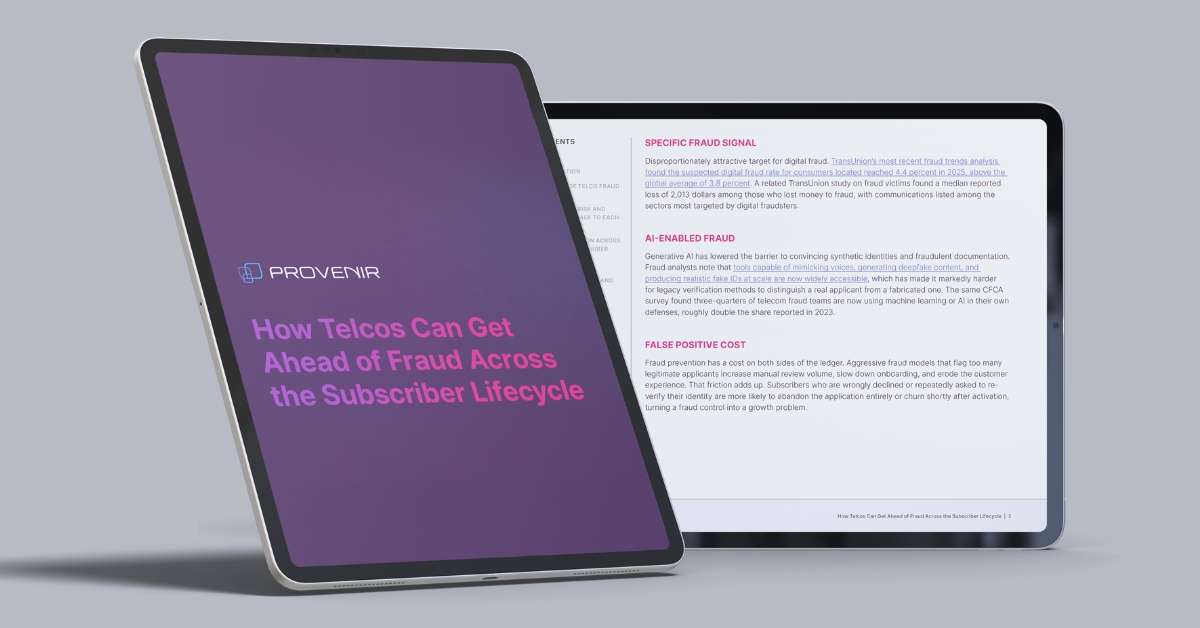
From first-party fraud and synthetic identities to SIM swap attacks and account takeovers, telecom fraud is growing more sophisticated and costly every year. Fraudsters are exploiting gaps between onboarding, activation, and ongoing account monitoring, while many telecom providers still rely on disconnected fraud and credit risk systems.
This eBook explores why traditional “one-and-done” fraud screening is no longer enough and how telcos can build a unified, lifecycle-based approach to risk management.
Whether you’re responsible for fraud prevention, risk management, credit operations, customer acquisition, or digital transformation, this guide provides practical insights for building a more resilient and effective fraud strategy.




Stockholm, Sweden – [25/08/2026] – Provenir, a global leader in Decision Intelligence software, today announced that Marginalen Bank is modernizing its decisioning capabilities through the migration to Provenir Cloud2, the latest generation of Provenir’s cloud-native decisioning platform.
Marginalen Bank has been a Provenir customer since 2017 and is leveraging the platform across multiple lending products, including consumer lending, mortgages, credit cards, and corporate lending.
The move to Cloud2 enables Marginalen Bank to modernize and simplify decisioning operations, increase agility, and create a stronger foundation for future innovation and automation.
“We are continuously focused on improving efficiency, agility, and the customer experience across our lending operations,” said Ludmilla Åttingsberg, Head of Digital Operations. “The migration to Provenir Cloud2 supports our ambition to modernize our decisioning capabilities and gives us greater flexibility moving forward.”
“Marginalen Bank has taken an important step in modernizing its decisioning infrastructure,” said Fredrik Flodberg, Senior Sales Executive, Nordics. “We are proud to continue supporting the bank as they build a more agile and future-ready decisioning environment.”
Marginalen Bank is a Swedish digital bank offering consumer loans, mortgages, corporate lending, savings products, and payment solutions to individuals and businesses across Sweden.
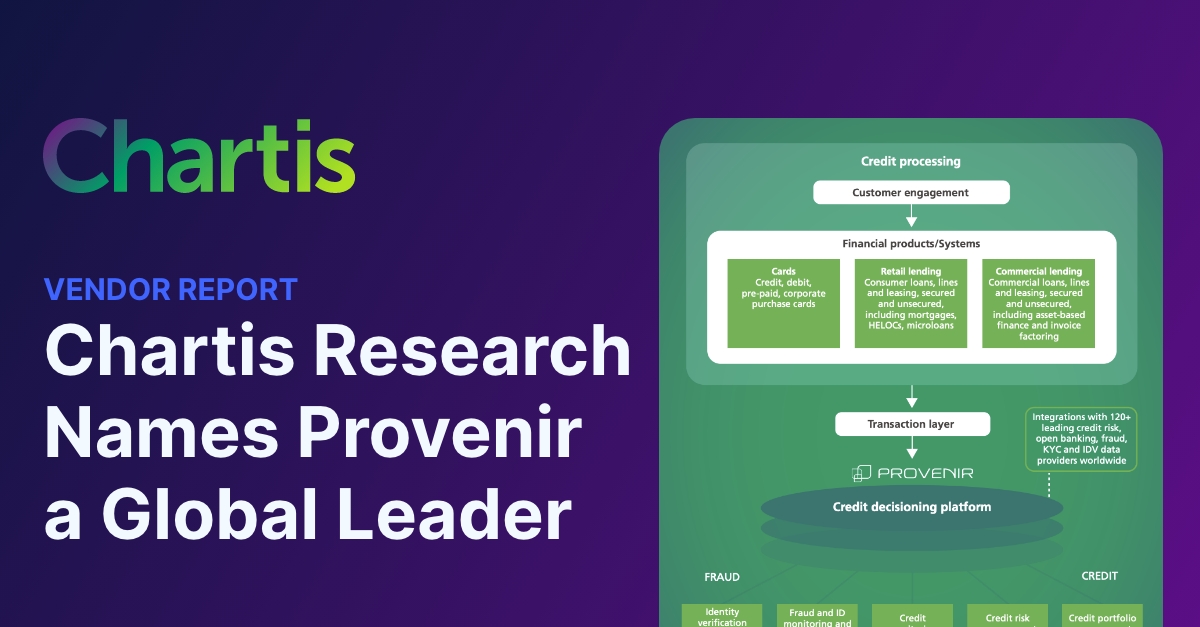
Provenir is the unified Decision Intelligence Platform for enterprises and institutions. One decisioning environment consolidating data, AI models, intelligence, agents and governance. Business-configured. Enterprise-grade reliability. Trusted by 120+ institutions processing 4+ billion decisions annually across 60+ countries.
Discover intelligent risk decisioning across the customer journey, with dynamic data orchestration, flexible analytics deployment, and real-time approvals.

Financial services providers have more data, more models, and more fraud technology than at any point in the industry’s history. Fraud losses are still climbing. In 2024, consumers reported losing $12.5 billion to fraud, a 25% jump from the year before, according to the FTC’s Consumer Sentinel Network Data Book. Imposter scams alone accounted for over 847,000 reports.
It’s worth asking why more technology alone hasn’t closed the gap.
Most fraud programs aren’t short on tools. They’re running point solutions for identity verification, device risk, watchlist screening, and behavioral analytics, each bolted onto the last, each with its own data feed and its own blind spots. Teams end up reacting to threats one system at a time instead of seeing the full picture in real time, while fraudsters move across channels and products, testing whatever gap opens first. A fragmented defense is always a step behind an adaptive attacker.
The teams making real progress on fraud have a narrower data footprint, not a bigger one. What they have is matched precisely to the decisioning problem in front of them, and it plugs in without a six-month integration project.
The pattern shows up constantly: companies without a strong data foundation try to stitch one together after the fact, pulling in sources that weren’t built to work together and weren’t vetted for the decision at hand. The result creates the appearance of coverage while functioning as noise.
Fraud prevention runs on the same principle as any other decision: the data matters more than the volume of data collected. Access to the right source, at the right moment, beats access to more sources.
Provenir’s Application Fraud solution brings identity signals, device intelligence, behavioral data, and watchlists into a single, governed decisioning environment instead of a stack of disconnected tools.
The result is a single, governed view of risk that gets sharper with every decision it processes.
Book a meeting to see Provenir’s fraud decisioning in action

Written By









First-party fraud is becoming one of the toughest challenges facing banks and lenders today. Traditional fraud controls are struggling to keep pace as fraudsters leverage technology, social media, and increasingly sophisticated tactics to exploit gaps across the customer lifecycle.
The challenge is that first-party fraud is no longer a single problem. It has evolved into three distinct behavioral types: Criminal Operators, Opportunists, and Intentional Misrepresentation. Each have their own unique motivations, risk signals, and detection challenges. Treating them the same can leave institutions exposed to unnecessary losses while creating friction for legitimate customers.
In this Provenir-hosted webinar, Jason Abbott and Jason Gunther will break down these three first-party fraud personas, exploring how they operate, the warning signs they leave behind, and how organizations can use AI-driven approaches to identify and address risk earlier and more effectively.



We’re excited to sponsor the PowerSports Finance Summit this September in Atlanta, and we invite you to stop by Booth #1 to meet the team.
At Provenir, we help lenders make smarter, faster decisions across the customer lifecycle with AI-powered risk decisioning. From credit underwriting and fraud prevention to customer acquisition and portfolio management, our Decision Intelligence Platform enables organizations to automate decisions, optimize risk strategies, and deliver seamless customer experiences.
Whether you’re focused on improving application approvals, streamlining dealer financing, reducing fraud losses, or adapting to changing credit conditions, we’d love to show you how Provenir can help.
See you in Atlanta!
Reserve dedicated 1:1 time with the Provenir team to take a test drive of our platform and explore how we can support your specific initiatives.

VP Sales for US East and Canada, Provenir

Southeast Sales Director, Provenir







Pre-fill: Automatically populates trusted business data at the point of entry, reducing friction, improving accuracy, and accelerating business onboarding and verification.
Business Health: Indicators that reflect the operational stability or financial condition of a business. May include status flags, activity indicators, risk signals, operational tenure, and other metrics used to gauge overall business viability.
Business Verification: verify the legitimacy and existence of a business. Includes Markaaz ID, and firmographics such as Registered Address, registration status, known identifiers such as Registration Number, Tax ID, hierarchy, and more.
Business Hierarchy: Records that contain parent–child business relationships. Hierarchy data identifies whether an entity is a headquarters, branch, subsidiary, or part of a larger corporate structure.
Compliance: Information used to assess regulatory risk and ensure legal compliance. Includes politically exposed persons (PEP) status, sanctions screening, beneficial ownership, business registration status, licensing information, and more.
P2B (Person-to-Business Linkage): Data connecting individuals to the businesses they own or manage. P2B includes beneficial owners, officers, directors, shareholders, and governance relationships that support due diligence and risk assessment.information, and more.

We’re excited to sponsor the Datos Financial Crime and Cybersecurity Forum this September in Charlotte, and we invite you to stop by Booth #24 to meet the team.
At Provenir, we’re helping financial institutions stay ahead of evolving threats with AI-powered decisioning across fraud, identity, and risk. Book a meeting with us onsite to discover how our Decision Intelligence Platform enables financial institutions and organizations to make faster, smarter decisions throughout the entire customer lifecycle.
Whether you’re focused on streamlining onboarding, managing risk more effectively, or creating personalized customer experiences, let’s talk about what’s possible when you combine intelligence with execution.
See you in Charlotte!
“When Seeing Isn’t Believing: How to Combat Deepfake Driven Fraud”
Product Director, Fraud

Director of Strategic Sales

VP Business Operations
Reserve dedicated 1:1 time with the Provenir team to take a test drive of our platform and explore how we can support your specific initiatives.
Product Director, Fraud, Provenir

Senior Sales Executive, Provenir
VP Solutions Consulting, Provenir