CS-Industry: Financial Services

Banks Architecture Gap - Provenir

The Architecture Gap: Banking’s Next Competitive Battleground

Decisioning Architecture
The Architecture Gap: Banking’s Next Competitive Battleground

Banks have spent the last decade chasing digital transformation. Mobile apps, cloud migration, digital onboarding, and a wave of AI pilots have dominated the agenda, and the investment has been real. Yet many institutions are still dealing with the problems they started with: slow product launches, fragmented customer journeys, rising operating costs, and pressure from leaner digital challengers.

What sits underneath all of this is architecture – the growing distance between what a bank wants to do commercially and what its underlying technology and data can actually support.

Call it the architecture gap. It rarely shows up in a strategy document or a transformation roadmap. It shows up in execution: a product that should take six weeks takes six months, a routine application needs manual review, an AI pilot can’t move past the single use case it was built for. Across African banking, and globally, this gap is widening.

How growth widens the gap

Much of this comes down to growth. Many banks have expanded through acquisition and regional diversification, and commercially, that strategy holds up. But every acquisition brings its own core banking system, its own data model, its own decisioning logic. A few rounds of this, and an institution isn’t running one platform but a loose federation of partially connected systems, each with its own rules and its own version of the customer.

None of this reflects bad strategy – it’s simply what happens to architecture at scale, and the gap widens with every deal.

Even the strongest banks aren’t immune

This isn’t limited to banks that grow by acquisition. Groups as established and well-run as Absa and Standard Bank have absorbed real costs tied to legacy modernisation, including technology impairments linked to platform replacement and strategic reprioritisation.

These aren’t isolated accounting items – they’re a signal that banking architecture has become a moving target, where legacy systems depreciate faster than the investment cycles built to support them.

Digital-native banks will meet it too

Digital-native banks sit on the other side of this. TymeBank, Salt Bank, BankZero and Revolut to name a few, were built with cloud-native infrastructure, API-first design, and real-time data from day one.

But as they scale, take on more regulatory complexity, and expand their product range, they’ll meet their own version of the same constraint. The architecture gap isn’t a legacy problem – it’s a scale problem, and every bank eventually runs into it.

Why the gap matters now

Historically, banks could treat business strategy and technology execution as separate conversations. That’s no longer realistic. A bank’s ability to compete now comes down to how fast it can launch new products, how well it can orchestrate decisions in real time, how effectively it can move AI from pilot to production, how quickly it can adapt to new regulation, and how consistent the experience is across channels.

All of it depends on architecture, not on digital capability in the traditional sense.

AI will amplify the gap

Most banks are now investing heavily in AI across fraud, credit risk, collections, and customer engagement. But AI doesn’t operate independently of the systems around it. It depends on clean, connected, real-time data, a single view of the customer, decisioning embedded into the business rather than bolted on afterward, and orchestration that works across the enterprise.

Where the underlying architecture is fragmented, AI inherits that fragmentation too: effective in a pilot, hard to scale anywhere else.

Closing the banking architecture gap

The most important question facing banking leaders is no longer whether to modernise, digitise, or adopt AI.

It is whether their current architecture can support the institution they are trying to become. Because the next generation of winners in banking will not be defined purely by scale or speed.

They will be defined by how effectively they close the Banking Architecture Gap – combining trust, capital strength, and regulatory sophistication with architectural agility and intelligence.

In the age of intelligent banking, architecture is no longer an implementation detail.

It is the strategy itself.

Giovanni Hofmayer

Giovanni Hofmayer

Written By

Senior Sales Executive, Provenir

Latest Resources

Banks Architecture Gap - Provenir
Blog, Banking /

The Architecture Gap: Banking’s Next ...

Decisioning ArchitectureThe Architecture Gap: Banking's Next Competitive Battleground Banks have spent the ... Read More →

BLOG Andy
Blog, Decisioning /

The Real Cost of Vendor Dependency in...

The Real Cost of Vendor Dependency in Credit Decisioning One pattern comes ... Read More →
260617 - BLOG Matthew Nutt - FeatureIMG - 60431
Blog, Data /

What Does a Good Data Provider Review...

What Does a Good Data Provider Review Actually Look Like? Most financial ... Read More →
WEBINAR telco
Webinar, Fraud /

Revenue to Reputation

Fraud targeting telcos has always existed. What's changed is how it's executed, ... Read More →
provenir_norlys
News, Decisioning, Provenir /

Provenir Partners with Norlys to Powe...

Provenir Partners with Norlys to Power Next-Generation Credit Decisioning Across Energy and ... Read More →
Ebook CM
Blog, AI /

AI-Powered Customer Management: How L...

AI-Powered Customer Management:How Leading Institutions Turn Intelligence Into Revenue What this guide ... Read More →
Hyper-Personalization - FeatureIMG-EN
Blog, Hyper-Personalization /

From Personalization to Hyper-persona...

From Personalization to Hyper-personalization:An Executive Playbook Executive Summary Financial institutions using hyper-personalization ... Read More →
memphis
Event, Banking /

Banking Innovation Summit in Memphis

Banking Innovation Summit Join Provenir at The Banking Innovation Summit in Memphis ... Read More →
The Revenue Hiding in Your Customer Base
Blog, Case Mgmt, Customer Mgmt /

The Revenue Hiding in Your Customer B...

New market expansion. Unbanked populations. Fintech partnerships. Meanwhile, the biggest revenue opportunity ... Read More →
BLOG CXO
Blog, Decisioning /

What It Really Takes to Build AI Deci...

Building a Decision Intelligence platform for financial services sounds straightforward until you're ... Read More →
WEBINAR Fraud
Webinar, Fraud /

What if you could spot first-party fr...

First-party fraud has rapidly evolved from isolated organised crime into a social ... Read More →
When Did You Review Your Third-Party Data Providers?
Data /

When Did You Last Review Your Third-P...

When Did You Last ReviewYour Third-Party Data Providers? Third-party data sits at ... Read More →
BLOG AutoFinance
Blog, Auto Financing /

Transaction to Relationship: Rethinki...

Auto lending has always been good at the moment of origination. Lenders ... Read More →
Webinar - Navigating Auto Lending
Webinar, Auto Financing /

Navigating Auto Lending in 2026

On-Demand Webinar Navigating Auto Lending in 2026: Speed, Agility, Visibility, at Your ... Read More →
EBOOK KShape
eBook, Financial Services /

One Portfolio, Two Economies

The economic ground is shifting beneath financial institutions in ways that defy ... Read More →

Continue reading

Buy the Engine. Build the Advantage

Buy the Engine. Build the Advantage.

  • Blog

  • Industry

  • Date

Buy the Engine.
Build the Advantage.

christian-ball

Christian Ball

Enterprise Account Executive

Why the smartest capital allocation decision in financial services risk infrastructure isn’t build vs. buy, it’s knowing what’s actually worth building. 

The competitive environment in financial services has fundamentally changed. Margins are compressed. Regulatory complexity is accelerating. Customer acquisition costs are at historic highs. And the fintechs gaining ground aren’t necessarily the ones with the most sophisticated technology, they’re the ones deploying it fastest. 

That context matters when you’re evaluating whether to build proprietary risk decisioning infrastructure from scratch. 

The Real Cost of Building

The true cost of building a decisioning platform compounds over time. 

The upfront capex is significant: architecture design, engineering resources, data integration across bureau and alternative data providers, security infrastructure, compliance frameworks. Organisations that have gone through this report 18 to 36 months before a production-ready system is operational. In a market where a competitor can launch a new credit product in weeks, that gap carries direct revenue implications. 

The ongoing opex picture is frequently underestimated at approval stage. Maintaining data integrations as providers update APIs. Rebuilding model deployment pipelines as cloud infrastructure evolves. Keeping pace with regulatory change across markets. Resourcing the support function so the decisioning engine doesn’t become a bottleneck to every product iteration. These aren’t exceptional costs. They’re structural, recurring, and they scale with complexity. 

McKinsey research consistently shows that large-scale internal technology builds in financial services exceed budget in many cases, with five-year total cost of ownership frequently running 40–60% above initial projections. The resource drag on engineering teams is harder to quantify but equally real. Senior talent allocated to infrastructure maintenance is senior talent not working on competitive differentiation. 

Speed is Now a Strategic Variable

Digital-native lenders are entering established segments with lower cost bases and faster decisioning cycles. Embedded finance is putting credit products inside customer journeys that traditional institutions don’t own. Open banking and alternative data are changing what good underwriting looks like. Regulators are demanding more explainability and auditability. 

The organisations gaining ground can test, launch, and iterate on new products in weeks, not quarters. That agility is very difficult to sustain when the decisioning infrastructure itself requires lengthy development cycles every time the business wants to change something. 

What Provenir Changes in the Capital Equation

Provenir’s Decision Intelligence Platform is built for exactly this trade-off. The infrastructure is already built, maintained, and continuously updated: cloud-native deployment, a marketplace of integrated data providers, model management, compliance and auditability frameworks. What organisations configure on top of it is entirely their own. 

Rather than funding a multi-year infrastructure build, capital goes into configuration, integration, and the proprietary decisioning logic that actually differentiates the business. Time to production is measured in weeks, not years. 

The opex shift is equally significant. Data provider integrations, infrastructure scaling, security patching, regulatory update cycles all move from internal cost centres to the platform’s responsibility. Engineering resource shifts from maintaining infrastructure to building product. The ongoing cost base is predictable, subscription-based, and scales with usage rather than requiring constant reinvestment just to stand still. 

BBVA, Atom Bank, and SoFi each deployed Provenir to run fundamentally different business models: global commercial lending, retail digital banking, consumer refinancing, at different scales and in different regulatory environments. The underlying platform is common. The decisioning logic, risk models, and customer strategies are not. 

The IP Question

The executive concern about IP is legitimate and worth addressing directly. Competitive advantage in financial services credit sits in the credit policy, the data strategy, the risk appetite calibration, and the customer relationships built on top of the engine. On Provenir’s platform, all of that remains entirely proprietary. Scoring models are deployed inside the platform, not exposed. Decision logic is configured by your team to reflect your underwriting philosophy. Two organisations on the same infrastructure share no more of their competitive advantage than two companies hosting on AWS share their code. 

What Provenir removes is the infrastructure layer: the part that costs the most, delivers the least competitive differentiation, and consumes the most ongoing resource to maintain. 

There’s also value that’s difficult to replicate internally. The R&D investment across Provenir’s global client base creates platform capabilities that no single organisation, building in isolation, could justify on its own. 

The Bottom Line

The build option carries significant upfront commitment, multi-year timelines, and a structural opex burden that compounds over time. In a market where speed and adaptability are increasingly decisive, it also means slower product iteration and delayed competitive response. 

Provenir reframes the question from build vs. buy to where you deploy your capital and your talent. The platform provides the infrastructure. Your team builds the advantage. Your IP, your models, your risk strategy are fully proprietary, executing faster and at materially lower total cost than the build alternative. 

That’s a strategic decision, not just a procurement one. 

LATEST BLOGS

Banks Architecture Gap - Provenir

The Architecture Gap...

Decisioning ArchitectureThe Architecture Gap: Banking's Next Competitive Battleground Banks
BLOG Andy

The Real Cost of Ven...

The Real Cost of Vendor Dependency in Credit Decisioning
260617 - BLOG Matthew Nutt - FeatureIMG - 60431

What Does a Good Dat...

What Does a Good Data Provider Review Actually Look
Ebook CM

AI-Powered Customer ...

AI-Powered Customer Management:How Leading Institutions Turn Intelligence Into Revenue
Hyper-Personalization - FeatureIMG-EN

From Personalization...

From Personalization to Hyper-personalization:An Executive Playbook Executive Summary Financial
The Revenue Hiding in Your Customer Base

The Revenue Hiding i...

New market expansion. Unbanked populations. Fintech partnerships. Meanwhile, the
BLOG CXO

What It Really Takes...

Building a Decision Intelligence platform for financial services sounds
BLOG AutoFinance

Transaction to Relat...

Auto lending has always been good at the moment

Continue reading

BLOG Survey01

Why 77% of Financial Institutions See Decision Intelligence as Their 2026 Priority

Why 77% of Financial Institutions See Decision Intelligence as Their 2026 Priority

The financial services industry is experiencing a fundamental shift. Organizations have spent years automating decisions. Now they need those decisions to get smarter.

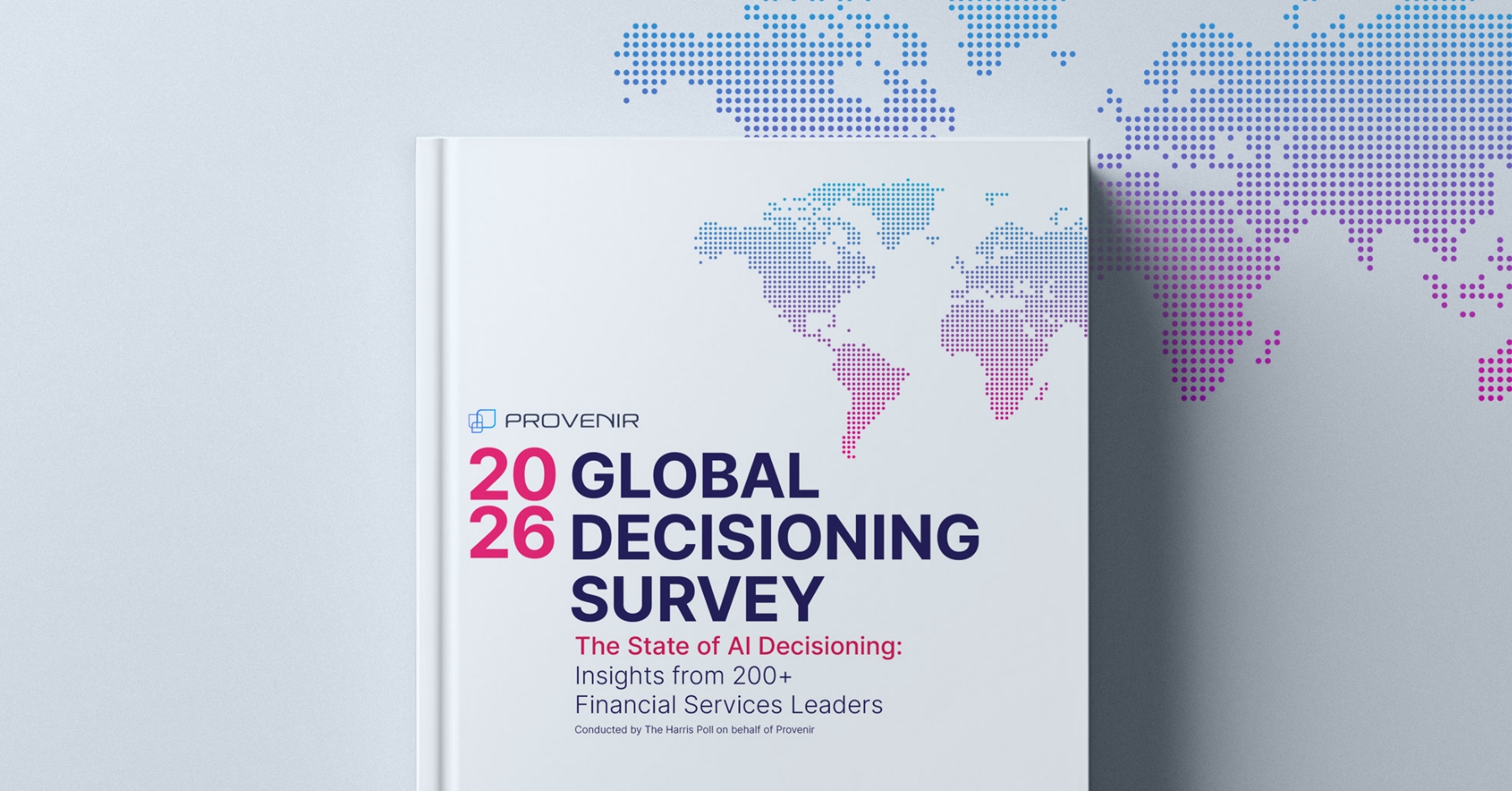
Our 2026 Global Decisioning Survey reveals the scope of this transition: 77% of senior decision-makers see Decision Intelligence as very valuable for their strategy over the next 2-3 years.

What Decision Intelligence Actually Means

Decision Intelligence represents the evolution from automated decisioning to continuously optimized, AI-driven decision-making that learns and improves.

THE DIFFERENCE:

  • The Traditional Approach:

    Deploy AI models, measure results periodically, update quarterly, manage explainability and governance separately
  • Decision Intelligence Approach:

    Execute decisions at scale, measure outcomes continuously, learn from performance, optimize in real-time within unified platforms that provide transparency, governance, and integration
Organizations are moving quickly:
  • 75%

    are already collaborating on AI-driven decision intelligence
  • 18%

    are exploring partnerships
  • 66%

    are very interested in using AI for strategy implementation and optimization
  • 60%

    plan to invest in AI or embedded intelligence for decisioning in 2026 (making it the top investment priority)

What Organizations Value Most

When we asked which AI features provide the most value, organizations prioritized capabilities that go beyond basic automation:

51%

Ability to leverage generative AI for natural language queries
The democratization of AI insights through conversational interfaces transforms who can access and act on decisioning data. Business users, executives, operations teams, and compliance staff can all interact directly with AI systems using natural language.

92%

of organizations find it important to interact with data quickly using natural language queries.
(62% find it very important, 30% moderately important).
  • 49%

    Real-time decisioning across customer touchpoints:
    Speed and consistency across channels create better customer experiences and reduce operational complexity.
  • 50%

    Transparency and explainability of AI models:
    Organizations need AI they can understand and defend to regulators and stakeholders.
  • 47%

    Integration with existing systems and data sources:
    AI must work with existing infrastructure rather than requiring complete replacement.

The Business Impact

Organizations cite four primary benefits from improved Decision Intelligence:
  • 62%

    cite operational efficiency:

    Automated decision-making reduces manual review, accelerates processes, and lowers costs while improving consistency.
  • 52%

    cite better customer experience:

    Faster decisions, reduced friction, and personalized interactions create superior customer journeys.
  • 58%

    cite improved accuracy of models and strategies:

    Continuous learning and optimization improve predictive performance and business outcomes over time.
  • 56%

    cite faster deployment of new decision strategies:

    Rapid testing and iteration enable organizations to adapt quickly to market changes and competitive pressure.
These benefits compound over time. Organizations that deploy Decision Intelligence don’t just get better decisions today. They build systems that continuously improve.

The Intelligence Loop in Practice

Decision Intelligence creates a continuous cycle:
  • chess

    Shape Strategy

    Design and evolve decision strategy by learning from how decisions actually perform. Strategy is measured through outcomes and continuously refined to balance risk exposure and revenue opportunity.
  • rocket

    Execute Decisions

    Make real-time, data-driven decisions at every customer touchpoint using deep customer understanding, data, context, and decision history.
  • dashboard

    Measure Outcomes

    Connect decisions to business outcomes to see what actually drives risk, revenue, and profitability.
  • learning

    Learn and Optimize

    Get specific recommendations to improve performance based on actual results. Learn from the results over time and continuously refine strategies.
This loop transforms decisioning from a periodic batch process into a continuous optimization system.

The Natural Language Revolution

92% of organizations find it important to interact with data quickly using natural language queries. This represents a fundamental shift.

When business users can interact directly with AI systems using conversation, they build intuition about how these systems work. That understanding improves their ability to provide governance oversight and makes the entire organization more comfortable with AI-driven decisioning.

Natural language querying enables:

  • Business users to explore decisioning data without SQL knowledge
  • Executives to get instant answers to strategic questions
  • Operations teams to investigate anomalies in real-time
  • Compliance teams to audit decisions conversationally
This democratization helps address one of the top implementation barriers: explainability. When more people in the organization can interact with and understand AI systems, those systems become more transparent by design.

Addressing Implementation Barriers

Decision Intelligence approaches help address the barriers preventing AI adoption:
  • Explainability

    Platforms provide visibility into what decisions were made, how they perform, and why. This makes it easier to explain outcomes to regulators and stakeholders.
  • Governance

    Connecting decisions to business outcomes (risk, revenue, customer experience) makes governance more manageable. You measure results and learn from performance rather than monitoring models in isolation.
  • Integration

    Decision Intelligence platforms orchestrate data and decisions across existing infrastructure without requiring wholesale system replacement.
  • Speed

    Organizations can learn from every decision and optimize continuously, addressing the speed challenge that 50% cite as their biggest fraud detection obstacle.

Looking Ahead

The survey reveals clear momentum:
  • 77%

    see Decision Intelligence as very valuable
  • 75%

    are already implementing it
  • 66%

    want AI for strategy optimization
  • 60%

    are investing in 2026 (top priority)
Traditional decisioning optimizes for speed. Decision Intelligence optimizes for outcomes. Organizations that build systems capable of continuous learning will create advantages that compound over time.

EBOOK Survey2026

Download the full 2026 Global Decisioning Survey:

Download Survey

LATEST BLOGS

Banks Architecture Gap - Provenir

The Architecture Gap...

Decisioning ArchitectureThe Architecture Gap: Banking's Next Competitive Battleground Banks
BLOG Andy

The Real Cost of Ven...

The Real Cost of Vendor Dependency in Credit Decisioning
260617 - BLOG Matthew Nutt - FeatureIMG - 60431

What Does a Good Dat...

What Does a Good Data Provider Review Actually Look
Ebook CM

AI-Powered Customer ...

AI-Powered Customer Management:How Leading Institutions Turn Intelligence Into Revenue
Hyper-Personalization - FeatureIMG-EN

From Personalization...

From Personalization to Hyper-personalization:An Executive Playbook Executive Summary Financial
The Revenue Hiding in Your Customer Base

The Revenue Hiding i...

New market expansion. Unbanked populations. Fintech partnerships. Meanwhile, the
BLOG CXO

What It Really Takes...

Building a Decision Intelligence platform for financial services sounds
BLOG AutoFinance

Transaction to Relat...

Auto lending has always been good at the moment

Continue reading

FibaFaktoring

Customer Story: Fiba Faktoring

Fiba Faktoring is a leading non-bank financial institution in Turkey, providing factoring and SME financing solutions. The company focuses on delivering fast, data-driven credit decisions to support small and medium-sized businesses while managing risk effectively.
  • Industry
  • Region
  • Countries

    Turkey

  • Line of Business
  • Solution
  • Module
  • Infrastructure
  • ROI
  • Competition
Initial Opportunity Details

  • Customer Challenge

    Fiba Faktoring needed to improve the speed, consistency, and scalability of its credit decisioning processes. Manual and siloed systems limited automation, slowed decision times, and made it difficult to support business growth.
  • Provenir Impact

    • Operational Efficiency Gains
      Provenir’s decisioning solution delivered a 65% automation rate in credit decisions for targeted SME ticket sizes, significantly reducing reliance on manual processes:
      • Automation eliminated manual bottlenecks
      • Decisions are standardized and consistent
      • Staff time redirected from manual tasks to higher-value work

    • Speed & Productivity Improvements
      Credit decision processing became five times faster, dramatically accelerating service delivery for SME customers and improving internal throughput.
      • Faster time-to-decision improves customer experience
      • Shorter wait times support SME cash flow needs
      • The company can handle higher volumes without additional headcount

    • Workload Reduction & Customer Experience
      The platform delivered a 40% reduction in workload across credit decision processes, enabling strategic risk assessment and improving satisfaction through quicker outcomes.
      • Streamlined workflows reduced operational strain
      • Faster processing led to improved client satisfaction
      • Competitive advantage in the SME financing market
  • Competitors

    Legacy in-house systems
    Manual decisioning processes
  • Why We Won

    • Single, unified decisioning platform
    • Fast time to value and implementation
    • High flexibility and business-user configurability
  • Pain Points

    • Slow credit decision turnaround times
    • Limited automation and scalability
    • Difficulty adapting decision rules quickly
Customer Growth

Growth Opportunities

  • Scalable Operations and Expansion of Offerings
  • The automation foundation positions Fiba Faktoring to scale operations efficiently across higher volumes and broader product sets.
  • Advanced Analytics for Competitive Advantage
  • By integrating advanced predictive models and AI workflows, the company can strengthen risk insights and enhance differentiation in the SME lending market.
  • Enhanced Customer Experience as a Strategic Growth Lever
  • Shorter decision times and data-driven service delivery enable improved customer acquisition and retention.

Expansion

With the core decisioning platform successfully implemented and delivering measurable value, Fiba Faktoring is now progressing toward expanding the use of Provenir’s capabilities to additional strategic areas: ​

  • Predictive Early Warning Systems: Leveraging analytics to detect risk trends proactively
  • Marketing & Pricing Optimization: Using AI insights to refine pricing strategies and product targeting
  • Additional Decisioning Use Cases: Exploring automation across broader internal decision workflows beyond credit decisions
OTHER CUSTOMER STORIES

Continue reading

newday

Customer Story: NewDay

NewDay Ltd is a UK-based financial services company focused on responsible consumer credit who have just been acquired by KKR (private equity). Serving over 3.6 million customers, it offers products such as credit cards, instalment finance, and Buy Now Pay Later through brands like Aqua, Marbles, and Fluid, as well as co-branded solutions with major retailers. With £15.5 billion annual spend, 4.4 billion gross receivables, and advanced digital platforms, NewDay combines data-driven underwriting and technology to widen access to credit. Headquartered in London, regulated by the Financial Conduct Authority, and employing over 1,200 staff, NewDay’s mission is simple: help people move forward with credit.​
  • Industry
  • Region
  • Countries

    UK

  • Line of Business
  • Solution
  • Module
  • Infrastructure
  • ROI
  • Competition

Customer Timeline
Projected MRR: $150K
Projected ARR: £1.8m
Expand MRR: £27k
Expand PS: £324k


TCV: $5.4m
  • Renewal Created
    • Relationship since 2019
    • Cloud 2 positioning from early 2024
    • Long time users of Cloud 1 processing ~100 million trns per month
    • Originations / Collections / Customer Management
  • Renewal Result
    • Natural compelling event, however KKR Funding Challenge highlighted
    • Summer 2025
  • Go-Live
    October and November 2025
  • Customer Expansion
    • NEXT: Roll-Out: Fraud, DI, Cloud 2, Simulation
    • FUTURE:
      • Profiling
      • Case Management
      • NewDay Technology Clients
Initial Opportunity Details

  • Customer Challenge

    • Legacy decisioning systems were slow and costly to update.
    • Needed faster processing & delivery cycles (market changes, releases, tests).
    • Required greater internal control over credit decisioning logic and data sources.
    • Aimed for sub-second decisions and more product flexibility.
  • Provenir Impact

    • Speed & Agility:
      • Speed of Change Reduced by 80%
      • NewDay can now implement multiple credit decisioning changes within the same sprint.
      • Sub-Second Decisioning
      • Credit decisions are now delivered in under 1 second, enabling rapid customer feedback and better experience.
      • Impact: Faster market response and improved competitiveness.
    • Internal Control & Cost Efficiency: Enhanced Internal Control​
      • Business users can add data sources and update strategy without reliance on external vendors.
      • Reduced Operational Costs
      • Lower external costs for managing data items and system changes.
      • Quicker Onboarding
      • New hires familiarize faster due to intuitive decisioning UI.
      • Impact: More self-sufficiency, faster internal execution, and better resource allocation.
    • Competitive Advantage & Customer Experience:
      • Improved Customer Management & Collections
      • More control over limit strategy changes and refined customer decisioning.
      • Award-Winning Implementation
      • NewDay won the 2024 FSTech Award for Best Use of IT in Consumer Finance for tech innovation – powered by Provenir.
      • Impact: Enhanced customer experience, strategic differentiation, and industry recognition.
  • Competitors

  • Why We Won

    Provenir was chosen because its flexible AI-powered decisioning platform met all of NewDay’s requirements:

    • Enabled faster delivery cycles and autonomous configuration.
    • Integrated seamlessly with NewDay’s extensive data lake.
    • Supported full lifecycle decisioning from origination → collections.
  • Pain Points

    • Long release cycles and slow system updates.
    • Heavy reliance on external teams for change implementation.
    • Limited real-time testing and model deployment capabilities.
    • Inefficient credit decision support with big data sources.
Customer Growth

Growth Opportunities & Expansion

  • Fraud expansion through fraud profiling and 3rd party data integration (Focus in a future session)
  • Professional Services and Analytics opportunities – support for migration and beyond
  • Case Management
  • NewDay Technology Platform – Provenir White labelling for 3rd party use – LBG, Debenhams are live today, working towards more growth.
OTHER CUSTOMER STORIES

Continue reading

RytBank

Customer Story: Ryt Bank

Ryt Bank is a Malaysia-based digital bank backed by YTL Group and Sea Limited. It positions itself as the first AI-powered bank, using its Ryt AI assistant (built on Malaysia’s ILMU LLM) to let you chat to pay bills, transfer money, and manage your account, targeting young professionals and frequent travelers with a simple, app-driven experience and transparent fees.
  • Industry
  • Region
  • Country

    Malaysia

  • Line of Business
  • Solution
  • Module
  • Infrastructure
  • ROI
  • Competition

Customer Timeline
Land MRR: $6,500 USD
Land PS: $16K USD
Expand MRR: ~$10K USD
Expand PS: $80K USD
  • Opportunity Created
    26th May 2023
  • Opportunity Won
    12th May 2025
  • Go-Live
    20th July 2025
    Technical Go-Live


    30 th August 2025
    Full Go-Live

  • Customer Expansion
    • Future: Property & Infrastructure-Linked Products
Initial Opportunity Details

  • Customer Challenge

    As a newly launched AI-powered digital bank, Ryt Bank needs to onboard and serve customers in seconds while maintaining robust risk controls and regulatory compliance. Early processes rely on a mix of internal systems, manual reviews, and hard-coded rules, making it difficult to support rapid product launches, dynamic pricing, and personalised credit decisions. This fragmentation slows time-to-yes, drives up operational effort, and limits the bank’s ability to fully leverage data and AI across the customer lifecycle. Ultimately, this impacts Ryt Bank’s ambition to scale quickly and deliver a seamless digital experience.
  • Provenir Impact

    • Smarter, AI-Driven Risk Decisions
      By combining Provenir’s decisioning platform with Ryt’s own AI models, Ryt Bank can assess creditworthiness in real time using a broader set of data points. This delivers more accurate approvals, reduces risk exposure, and supports consistent, data-driven decisions across the retail portfolio.
    • Faster Turnaround and Fully Digital Journeys
      End-to-end automation – from KYC and fraud checks to bureau calls and decision execution – has significantly reduced manual intervention, enabling near-instant decisions for onboarding and credit requests. This improves straight-through-processing rates, shortens time-to-yes, and enhances customer conversion in Ryt’s mobile-first channels.
    • Policy Compliance and Scalable Decisioning
      The solution enforces Ryt Bank’s credit, risk, and regulatory policies through configurable rules and strategies, ensuring consistent compliance with internal standards and Malaysian regulations. At the same time, it provides a flexible, scalable foundation to rapidly introduce new products and tweak policies as the bank grows.
  • Competitors

    FICO
  • Why We Won

    • Digital-Bank Ready, Cloud-Native Platform
      Provenir provides a modern, cloud-native decisioning platform designed for high-growth digital banks, supporting real-time decisions for onboarding, cards, and PayLater in a single environment.
    • Speed to Market and Business User Autonomy
      Our low-code configuration and reusable components allow Ryt Bank’s teams to rapidly design, test, and deploy strategies without heavy IT dependency, accelerating product launches and change cycles.
  • Pain Points

    • Need for instant, consistent decisions across onboarding
    • Difficulty orchestrating multiple data sources and analytics in one place
    • Limited agility to test and roll out new strategies, products, and risk policies
    • High operational overhead from manual reviews and fragmented workflows
Customer Growth

Growth Opportunities

Data Science Initiative: Collaboration with ILMU

Initial discussions have commenced between Ryt Bank, ILMU (YTL’s AI lab) and Provenir’s Data Science team to explore how ILMU’s LLM can be embedded into Provenir decisioning. This early collaboration focuses on use cases such as conversational credit applications, smarter risk insights, and automated policy explanations, laying the foundation for future AI-powered decision intelligence across Ryt Bank’s products.

Expansion

Property & Infrastructure-Linked Products

As YTL expands its townships, transport, and utilities footprint, Ryt Bank can create embedded financial products that are tightly linked to YTL’s property and infrastructure ecosystem. This includes tailored financing for YTL developments, bundled offerings that combine housing, utilities, connectivity, and banking, as well as subscription-style payments for transport and community services—all managed through the Ryt app. Such offerings deepen ecosystem stickiness, unlock new recurring revenue streams, and position Ryt Bank as the primary financial layer across YTL’s integrated developments.

OTHER CUSTOMER STORIES

Continue reading

Event WFIS

WFIS Indonesia 2025

Event

WFIS Indonesia 2025

The Premier Financial Services Innovation Event

  • November 25–26, 2025
  • Booth P13

Provenir is proud to be a Gold Sponsor at WFIS Indonesia 2025 – The Premier Financial Services Innovation Event 

The two-day event will unite C-suite leaders, VPs, Directors, and decision-makers from over 200 banks, insurers, and fintechs across Indonesia. Together, they’ll explore how data, AI, and intelligent decisioning are reshaping the region’s financial ecosystem. 

Discover Intelligent Decisioning @ Booth P13 

Join us at Booth P13 on November 25–26, 2025, to experience how Provenir enables intelligent, data-driven decisions for financial services providers. 

As a global leader in AI decisioning, Provenir empowers organizations to automate, predict, and personalize every customer interaction – driving growth and trust across the financial lifecycle. 

Why Meet Us at WFIS Indonesia 2025? 

  • Smarter Risk Decisions – Automated in Real Time – Manage losses and approve more good customers with adaptive, AI-driven decisioning that learns continuously from data.
  • Predict Customer Needs with Behavioural Insights – Leverage contextual and behavioural data to anticipate customer intent and deliver proactive, relevant offers.
  • Hyper-Personalize Customer Experiences – Use AI-powered decisioning to personalize onboarding, engagement, and servicing at every touchpoint – driving loyalty and lifetime value.
  • End-to-End Financial Decisioning Solutions – Credit Risk Onboarding: Fast, accurate approvals with intelligent automation
    Application Fraud & Compliance: Detect, prevent, and stay compliant in real time
    Customer Management & Hyper-Personalization: Understand, engage, and retain with data-driven intelligence
    Collections Optimization: Recover smarter, faster, and more empathetically
  • Scalable, Cloud-Native Platform – Accelerate innovation with a configurable, low-code environment that scales effortlessly with your business.

Join our Session at 9.25 am | Day 2 – 26th Nov

Balancing Innovation and Trust: How AI Decisioning is Redefining Risk, Inclusion, and Customer Experience

  • How Provenir helps financial institutions embrace AI innovation responsibly by balancing automation, transparency, and compliance
  • Exploring how real-time decision intelligence detects social engineering and safeguards digital trust across customer interactions
  • Using Provenir’s AI and data marketplace to promote financial inclusiveness and expand access to underserved customer segments
  • Delivering hyper-personalized financial experiences that remain compliant, secure, and customer-centric
  • Uncovering how GenAI and agentic AI are shaping the next generation of intelligent, ethical, and inclusive financial ecosystems
Register your interest here

Speaker:

Wana Sedayu

Wana Sedayu

Senior Presales Consultant, APAC – Provenir

Wana is a Senior Presales Consultant at Provenir, supporting clients across the APAC region in driving digital transformation within the financial services sector. With over 15 years of experience in the industry, Wana brings deep expertise in loan origination, core leasing, credit decisioning, and customer management solutions.

Beginning his career as a software developer, Wana later transitioned into business consulting before dedicating the past decade to presales and value engineering roles. He has worked with prominent institutions such as Citibank, SMBC Indonesia, Bank Danamon, Bank of America, the Indonesia Stock Exchange, and the Ministry of Finance, contributing to numerous high-impact technology initiatives. OnlinePajak as Senior Manager Presales, and Fujitsu Indonesia as Presales Manager.

Combining his technical foundation with a strong business perspective, Wana is passionate about helping financial institutions accelerate innovation, optimize their decisioning processes, and achieve measurable business outcomes through data-driven solutions.

Why Provenir:

At Provenir, we help financial institutions automate smarter risk decisions, use behavioral insights to drive growth, and personalize every interaction with contextual intelligence all from a single, unified platform. 

Let’s Connect:

Meet our team at Raffles Jakarta to discover how Provenir’s AI Decisioning Platform can help your organization accelerate approvals, prevent fraud, and deliver personalized customer experiences that build trust and profitability. 

LATEST WEBINARS

WEBINAR telco

Revenue to Reputatio...

Fraud targeting telcos has always existed. What's changed
WEBINAR Fraud

What if you could sp...

First-party fraud has rapidly evolved from isolated organised
Webinar - Navigating Auto Lending

Navigating Auto Lend...

On-Demand Webinar Navigating Auto Lending in 2026: Speed,
fraud alert

Stop Fraudsters in T...

Stop Fraudsters in Their Tracks – Before They
fraud

Rethinking Fraud Pre...

On-Demand Webinar Rethinking Fraud Prevention in the Middle
webinar collections

Webinar: Optimizing ...

On-Demand Webinar Optimizing Collections with Advanced Decisioning Solutions
AFN webinar

Webinar: Mitigating ...

Mitigating Application Fraud in Africa: A Holistic Approach
the fullerton hotel singapore

Striking the Balance...

Provenir Financial Services Club: Strategies for Excellence in

Continue reading

Columbia Credit Union

Customer Story: Columbia Credit Union

Columbia Credit Union is a member owned financial co-op serving over 100K members and managing over $2 billion in assets. Founded in 1952, CCU provides a full suite of personal & business financial services, including checking/savings, consumer + auto loans, credit cards, Home services, and SMB lending. CCU is known for their strong community focus & are recognized for their deep commitment to member services. Credit Unions like CCU are focus on strong member experiences and financial inclusion for the geography and members they serve.
  • Industry
  • Region
  • Countries

    United States

  • Line of Business
  • Solution
  • Module
  • Infrastructure
  • ROI
  • Competition

Customer Timeline
Land MRR: $13,200
Land PS: $170K
Land DS: $0
Expand MRR: ~$17.5K
Expand PS: $84K
Expand DS: $71K
  • Opportunity Created
    August 6, 2020
  • Opportunity Won
    June 24, 2021
  • Go-Live
    Late 2020, Technical Go-Live

    Unknown Full Go-Live

  • Customer Expansion
    • In Progress:
      • Deposits New Account Opening – Fraud Checks
      • Account Management
      • Deposits New Account Opening Cross-Sell Model (Data Science)
      • Indirect Auto loan portfolio analysis and optimization (Data Science)
    • Future:
      Collections, SMB Lending, HELOC, Case Management
Initial Opportunity Details

  • Customer Challenge

    • Digital transformation, move to automated underwriting to reduce cumbersome onboarding and loan process and create a more frictionless experience for Members
    • Auto, Personal Loans, and Credit Cards will be focus 1st.
    • 4,500 apps / month, where only 20% / 900 are auto approved. 40% approved, with around 425 approvals per month. Biggest channel is auto dealer indirect channel.
    • Improved and enhanced member communication
      • Ability to automatically send “notifications” and/or “text messages”
      • Ability for two way communication with applicant via text messages
  • Provenir Impact

    • Automated Underwriting Process By implementing Provenir solutions in conjunction with incumbent Meridian Link, CCU could greatly increase their automated approval rates. This improved customer satisfcation, removed unnecessary friction for good users, and streamlined the UW process.
    • Reporting The ability to Easily generate “out of policy” reports to include the reason the loan was approved/declined was a significant piece for CCU.Ingesting the decision information based on where loan failed in the auto decision process provided insights for future improvement within the workflow
    • Member Communication Utilizing decisioning and data insights from Provenir to communicate value to their member community. Ability to automatically send “notifications” and/or “text messages” Ability for two way communication with applicant via text messages​
  • Competitors

    Meridian Link, NCINO
  • Why We Won

    • Speed to change / time to market.
    • The ability to auto decision based on numerous “if-then” scenarios – Ease of updating auto decision criteria
    • Object-oriented solution design enabled more complex, multi-threaded decisioning strategies
    • Reporting:
      • Easily generate “out of policy” report to include reason the loan was approved/declined
      • Decision information based on where loan failed in the auto decision process
  • Pain Points

    • Current automated approval at 20%; wants to get to 70%.
    • Limited member communication
    • Incumbent vendor’s slow and friction-filled delivery experience
Customer Growth

Growth Opportunities

TBD

Expansion

TBD

OTHER CUSTOMER STORIES

Continue reading

Dotz

Customer Story: Dotz

Dotz was founded in 2000 with the goal of connecting consumers and retailers through a points-based loyalty program. Over the years, the company expanded its customer base and diversified its services, becoming a digital platform that delivers benefits directly to users.

In April 2022, Dotz announced the acquisition of 49% of the credit fintech Noverde, which specializes in credit solutions for individuals through B2B2C partnerships. This acquisition strengthened Dotz’s financial services strategy and expanded its product portfolio, including personal credit, cards and BNPL solutions.

  • Industry
  • Region
  • Countries

    São Paulo​ Brazil​

  • Line of Business
  • Solution
  • Module
  • Infrastructure
  • ROI
  • Competition

Customer Timeline
Land MRR: $16,289
Land PS: $137,905
Expand MRR: ~$21K
Expand PS: $70K
  • Opportunity Created
    July 6, 2024
  • Opportunity Won
    April 30, 2025
  • Go-Live
    Last week of October Technical Go-Live

    1st week of November Full Go-Live

  • Customer Expansion
    • In Progress: DS – Ongoing discussions (risk model, fraud and offer hyper-personalization)
    • Future: Case management for suspected and investigated fraud
    • Future: Credit recovery initiatives (collection)
Initial Opportunity Details

  • Customer Challenge

    The company currently operates with a legacy solution that requires significant effort from the technology team while providing minimal autonomy to business areas. This setup limits agility, hinders the achievement of strategic goals and reduces alignment with corporate directives.

    There is a need to enhance customer portfolio management by channeling clients into the Financial Services funnel to drive profitability. In addition, the company plans to expand its portfolio with the launch of new products, such as Personal Loan, BNPL (Buy Now, Pay Later) and a proprietary Credit Card, strengthening its growth strategy and revenue diversification.

  • Provenir Impact

    • Accelerating Customer Base Monetization Provenir enables the integration and orchestration of data from multiple sources, allowing greater personalization of financial product offers to Dotz customers. With faster and more accurate decision-making, Dotz can expand cross-sell and up-sell opportunities, increasing conversion into higher-margin products such as BNPL and proprietary credit cards. The platform becomes a cornerstone of Dotz’s strategy to transform into a Financial Services Hub, positioning the company as a leader in customer loyalty with strong monetization through financial services.
    • Risk Reduction and Improved Credit Quality The use of AI and machine learning enables more precise credit decisions, with greater ability to assess risk profiles in real time. This translates into lower delinquency rates, improved operational efficiency, and greater predictability of results. Dotz will strengthens its credibility with financial partners and investors, consolidating its position as a reliable and sustainable platform in the medium and long term.
    • Agility and Innovation in Product Launches Provenir’s low-code solution enables agile workflow development, providing autonomy for rapid adjustments without heavy reliance on IT. Dotz gains speed in testing, adapting, and launching new financial products, staying aligned with market trends and consumer needs. This positions Dotz as an innovative and competitive player, capable of scaling new business models and creating differentiation against traditional banks and emerging fintechs.
  • Competitors

    Oscilar
  • Why We Won

    • Strength and Strategic Alignment
      Provenir has distinguished itself through its robustness as a company, with extensive international experience and a comprehensive solution that is fully aligned with the client’s current needs and prepared to sustain long-term growth.
    • Robust Solution with AI
      Provenir’s decisioning platform is fully scalable, enabling the agile development of workflows, integrated orchestration with internal systems, databases, alternative data sources, and bureaus—ensuring greater efficiency, operational flexibility and agility in addressing new demands.
  • Pain Points

    • Pricing
    • Fast implementation
    • Flexibility in building strategies
    • Easy integration with other systems and databases
    • AI functionality
Customer Growth

Growth Opportunities

Case Management for Suspected Fraud

We are organizing a meeting with Dotz’s new Head of Fraud Prevention to explore the adoption of Provenir’s Case Management solution to support the investigation of suspected fraud cases. With this initiative, Dotz will benefit from faster and more automated processes, greater accuracy in risk identification, a significant reduction in financial losses and strengthened governance and customer trust, creating a stronger foundation for sustainable business growth.

Credit Recovery Initiatives (Collection)

Our expansion project includes the development of new debt collection use cases supported by Provenir’s decisioning platform. This initiative will enable greater automation and intelligence in credit recovery processes, with personalized strategies, dynamic customer prioritization, increased recovery rates, reduced operational costs and stronger customer relationships.

Expansion

Data Science Initiative

We are in discussions with Dotz regarding the development of customized models for credit, fraud and offer personalization. The Provenir Data Science team conducted preliminary studies using historical customer data to challenge the current model. The results were satisfactory and very promising.

This initiative aims to improve decision intelligence, automate insight extraction and drive smarter, data-driven strategies.

Example Decisioning Flows
  • Application

    Step 1

    • Portal/App
    • Core Systems and Data
    • Application Submission/Amendment
  • Eligibility

    Step 2

    • Blacklist Data
    • Fraud & ID Data
  • Credit Checks

    Step 3

    • History Data
    • Bureau Data
    • Alternative Data
  • Analytics

    Step 4

    • PD Model Analytics
  • Decisioning

    Step 5

    • Recommend & Highlight
    • Eligibility/Rules/Affordability
OTHER CUSTOMER STORIES

Continue reading

MFG

Customer Story: MFG

Management Financial Group. It’s a group of companies uniting leading providers of non-bank financial services in Europe since 2005. HQ is in Bulgaria. Operating in Ukraine, Romania, Poland, Spain, North Macedonia and Croatia. MFG has more than 8300 employees and associates in over 450 offices.

MFG provides short-term, flexible B2C and B2B loans, revolving and instalment plan credit cards, and other financial and insurance services to underserved and underbanked sectors, as well as the general public. They believe in providing financial access for everyone.

MFG targets to expand the territory and Provenir to continue to be the backbone of entering in new countries.

  • Industry
  • Region
  • Countries

    Sweden, Finland, Denmark, Norway

  • Line of Business
  • Solution
  • Module
  • Infrastructure
  • ROI
  • Competition

Customer Timeline
Land MRR: Avg €30K
Land PS: N/A
Expand MRR: Avg €3-5K
Expand PS: €55K
  • Opportunity Created
    2019
  • Opportunity Won
    March 2019
  • Go-Live
    July 2019
    Renewed 5yrs June 2024
  • Customer Expansion
    • In Progress: Cloud 2.0 Migration
    • Future: Data Science Services
OTHER CUSTOMER STORIES

Continue reading