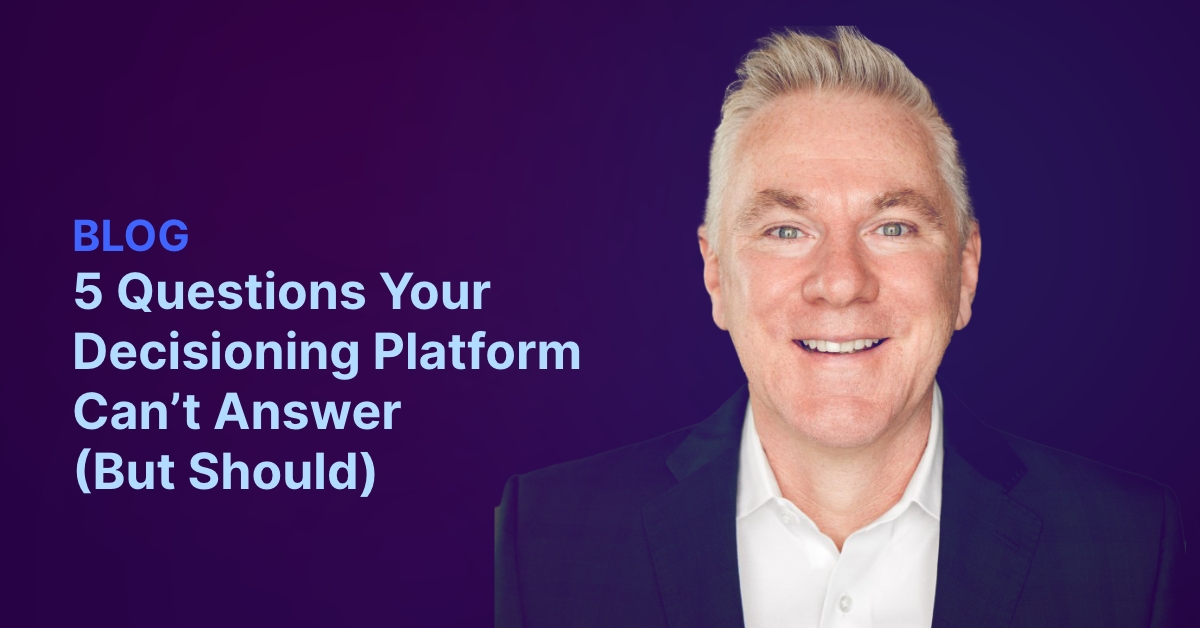
Most decisioning platforms can tell you what happened. Fewer can tell you why, and fewer still can tell you what to do next. That distinction rarely shows up in a demo. It shows up six months later, when a regulator asks for an explanation, a policy change produces an unexpected result, or a risk team spends a week reconstructing a decision that should have taken a search bar and thirty seconds.
The five questions below come up constantly in conversations with risk and fraud teams evaluating their current setup. They are simple to ask and, for a lot of platforms, surprisingly hard to answer. If your platform can’t answer them, that’s worth a closer look, not because the platform is broken, but because it may have been built to execute decisions rather than to give you visibility and control over them.
1. Why was this specific decision made?
Not the rule that fired. The full picture: which data, which model, which policy version, and which override, if any, produced this exact outcome for this exact customer. If the honest answer takes a support ticket and two days to reconstruct, that’s not an explainability problem you can solve after the fact. It’s a governance gap baked into the architecture.
Picture an audit request for a decision made eight months ago. The team that fielded it needs to pull the policy version live at the time, the data inputs available in that moment, and any manual override applied along the way, often from three different systems that were never designed to be queried together. That reconstruction effort is the tell. A platform built for governance answers the question at the moment it’s asked, not after a week of forensic work.
2. What would happen if we changed this policy, before we change it?
Most teams find out what a policy change does by shipping it and watching the numbers move. That’s a live experiment run on real customers and real risk exposure. A platform built for control lets you simulate a strategy change against production data first, so the decision to deploy is based on evidence rather than confidence.
Tightening a fraud threshold is a good example. Do it live, and you find out in real time whether you also blocked a wave of legitimate customers, usually after the complaints start coming in. Simulate it first against actual production traffic, and you know the approval and fraud-catch tradeoff before a single real customer is affected by the change.
3. How consistent is this decision across every channel and product?
If credit, fraud, and collections run on separate systems, the honest answer is often “we’re not sure.” A policy tightened in one system doesn’t automatically show up in the others, which means the same customer can get inconsistent treatment depending on which system happened to touch their file. Consistency across the lifecycle isn’t a reporting exercise. It’s a structural property of whether decisioning runs on one governed environment or several disconnected ones.
4. How is this model performing right now, not last quarter?
Model monitoring on a monthly or quarterly cadence means degraded performance can run for weeks before anyone notices. Continuous monitoring closes that gap, and it also closes a harder one: knowing not just that performance dropped, but what changed and what to do about it, in time to act rather than explain after the fact.
5. Can the business make this change, or does it need to wait on IT?
This is often the real bottleneck. A risk team identifies a needed change, and then waits weeks or months for engineering capacity to implement it. If every strategy adjustment requires a development cycle, decisioning speed is capped by IT throughput, not by risk appetite or market opportunity. A platform that lets business teams configure and deploy strategy changes directly removes that ceiling, without removing the governance that has to stay in place.
A risk team that spots a fast-moving fraud pattern on a Monday and can’t get the fix into production until an IT sprint clears in three weeks isn’t a risk-appetite problem. It’s a build queue problem wearing a risk-appetite costume. The gap between when a team knows what needs to change and when that change actually reaches customers is usually the clearest sign of where control actually sits.
Where does your team stand?
If your organization can answer all five of these without a delay, a workaround, or a shrug, your decisioning platform is likely already doing its job. If not, the gap is usually architectural rather than a training issue: it’s what happens when decisioning logic is spread across systems that were never designed to be one thing.



Beyond Detection: Cl...