CS-Region: APAC

Claire Hartley - APAC Compliance Challenge

APAC’s New Compliance Challenge

APAC’s New Compliance Challenge:
Managing Innovation Across a Fragmented Regulatory Region

Asia-Pacific is entering a more demanding phase of compliance, regulatory and data protection oversight.

The challenge is no longer simply keeping pace with new legislation. Organisations must now manage an increasingly complex combination of national privacy laws, data localisation requirements, international transfer restrictions, artificial intelligence governance and sector-specific regulation.

Unlike the European Union, APAC does not operate under one harmonised regulatory framework. Each jurisdiction has its own legal requirements, regulatory priorities and enforcement approach. A control that is appropriate in Singapore may not be sufficient in Australia, China, India, Indonesia or New Zealand.

This fragmentation creates a significant challenge for organisations operating across multiple APAC markets.

AI and Automated Decision-Making

Artificial intelligence is becoming inseparable from data protection and regulatory compliance.

In July 2026, Singapore’s Personal Data Protection Commission published guidance addressing how personal data should be collected and used throughout the generative AI lifecycle. This includes web scraping, reusing existing customer data, allocating responsibilities between AI providers and users, managing retention and responding to individual rights requests.

Australia is also introducing new transparency requirements for automated decision-making. From 10 December 2026, regulated organisations will need to disclose certain uses of personal information in computer-generated decisions that could significantly affect an individual’s rights or interests.

For financial services organisations, these developments create particular challenges. AI and automated models may influence credit, fraud, identity, affordability and customer-management decisions. Organisations must therefore be able to explain not only what a model does, but also how data is selected, how risk is assessed and where human oversight is applied.

Biometrics and Identity Data

Biometric information is also receiving greater regulatory attention.

New Zealand’s Biometric Processing Privacy Code introduces specific rules governing the collection and use of facial, fingerprint, voice, behavioural and other biometric information. Organisations already using biometric processing must transition to the new requirements by 3 August 2026.

This reflects a wider regional trend. Identity verification and fraud-prevention technology can deliver substantial benefits, but regulators increasingly expect organisations to demonstrate necessity, proportionality, transparency, security and appropriate retention.

Data Transfers and Local Requirements

Cross-border data transfers remain another major area of complexity.

APAC organisations frequently rely on global cloud infrastructure, regional service providers and international data sources. However, the legal mechanisms for transferring personal data differ significantly between jurisdictions.

Some countries require contractual safeguards. Others may require regulatory assessments, certifications, local storage or additional controls for particular categories of information. Organisations therefore cannot rely on one global transfer mechanism without first assessing the law, data and processing activity in each relevant market.

The practical challenge is knowing where information is located, how it moves, which providers can access it and which organisation is accountable at every stage.

How Provenir Meets These Demands

Provenir addresses these challenges through a global Compliance, Regulatory and Data Protection, or CRDP, framework that combines central governance with jurisdiction-specific regulatory analysis.

CRDP provides independent oversight and challenge across Provenir’s platform and works alongside Information Security, Product, Engineering, Technology and Legal. This enables regulatory requirements to be considered throughout product development, contracting, implementation and ongoing customer support rather than only at the final compliance review stage.

Provenir’s approach includes:

  • – privacy and data protection assessments for new technologies, products and processing activities;
  • – governance of international transfers, subprocessors and regional data flows;
  • – due diligence and risk assessment for vendors and data providers;
  • – defined incident identification, escalation, investigation and notification processes;
  • – data-minimisation, retention and access-control requirements;
  • – regulatory monitoring across the countries in which Provenir and its customers operate;
  • – documented accountability for AI, model governance and automated decision-making.

Provenir also uses a structured lines-of-defence model. Operational teams own and manage their controls, CRDP provides policy, advice, monitoring and challenge, and independent certification and assurance activity provides further scrutiny.

Privacy governance is embedded within how Provenir designs, deploys and operates its platform. This includes clear controller and processor role allocation, data-processing agreements, privacy impact assessments, international transfer safeguards, subprocessor oversight and breach-management procedures.

AI governance is similarly integrated across CRDP, Product, Engineering and Information Security. Provenir’s framework addresses purpose, accountability, data governance, fairness, transparency, human oversight, security and continuing monitoring, with reference to ISO/IEC 42001 and emerging regulatory requirements.

The platform itself supports this governance approach by bringing data, models and decisioning into a controlled environment. This gives customers greater visibility over decision strategies, testing, deployment and performance, while allowing them to apply their own regulatory policies and risk controls.

From Compliance Obligation to Market Confidence

The most successful organisations in APAC will not be those that attempt to apply one policy everywhere.

They will be those that establish consistent global governance while retaining the flexibility to respond to local laws, regulatory expectations and customer requirements.

For Provenir, strong CRDP governance is not separate from innovation or commercial growth. It provides the structure required to deploy data and AI responsibly, support customers across different regulatory environments and enter new markets with greater confidence.

In a region defined by rapid technological development and regulatory diversity, this ability to combine innovation with demonstrable control is becoming a significant competitive advantage.

Claire Hartley, Chief Compliance Officer Group DPO, Provenir

Claire Hartley

Written By

Chief Compliance Officer Group DPO, Provenir

Latest Resources

Verifying the Invisible Subscriber

Verifying the Invisi...

Verifying the Invisible Subscriber How Accessing 1datapipe on the
FAQ

Decision Management ...

Decision Management Implementation FAQs for Enterprise Banks Implementing a
260817 - BLOG Closing Fraud Gap - FeatureIMG - EN 61409

Beyond Detection: Cl...

Beyond Detection:Closing the Fraud Prevention Gap Financial services providers
260726 - BLOG eyeDP - FeatureIMG - 61058

Beyond Data: Why Dec...

Beyond Data:Why Decisioning Needs Document Intelligence Financial services providers
Fraud in Telco: Provenir Experts Answer Frequently Asked Questions

Fraud in Telco: Prov...

Fraud in Telco:Provenir Experts Answer Frequently Asked Questions 1.
260722 - ARTICLE Mike - FeatureIMG - 60958

AI governance in fin...

AI governance in financial services:What "governed" means in practice
Latam Compliance Challenge for Decisioning

LATAM Next Complianc...

From Data Protection to Decisioning Accountability:What LATAM Regulation Means
Banks Architecture Gap - Provenir

The Architecture Gap...

Decisioning ArchitectureThe Architecture Gap: Banking's Next Competitive Battleground Banks

Continue reading

BLOG Survey01

Why 77% of Financial Institutions See Decision Intelligence as Their 2026 Priority

Why 77% of Financial Institutions See Decision Intelligence as Their 2026 Priority

The financial services industry is experiencing a fundamental shift. Organizations have spent years automating decisions. Now they need those decisions to get smarter.

Our 2026 Global Decisioning Survey reveals the scope of this transition: 77% of senior decision-makers see Decision Intelligence as very valuable for their strategy over the next 2-3 years.

What Decision Intelligence Actually Means

Decision Intelligence represents the evolution from automated decisioning to continuously optimized, AI-driven decision-making that learns and improves.

THE DIFFERENCE:

  • The Traditional Approach:

    Deploy AI models, measure results periodically, update quarterly, manage explainability and governance separately
  • Decision Intelligence Approach:

    Execute decisions at scale, measure outcomes continuously, learn from performance, optimize in real-time within unified platforms that provide transparency, governance, and integration
Organizations are moving quickly:
  • 75%

    are already collaborating on AI-driven decision intelligence
  • 18%

    are exploring partnerships
  • 66%

    are very interested in using AI for strategy implementation and optimization
  • 60%

    plan to invest in AI or embedded intelligence for decisioning in 2026 (making it the top investment priority)

What Organizations Value Most

When we asked which AI features provide the most value, organizations prioritized capabilities that go beyond basic automation:

51%

Ability to leverage generative AI for natural language queries
The democratization of AI insights through conversational interfaces transforms who can access and act on decisioning data. Business users, executives, operations teams, and compliance staff can all interact directly with AI systems using natural language.

92%

of organizations find it important to interact with data quickly using natural language queries.
(62% find it very important, 30% moderately important).
  • 49%

    Real-time decisioning across customer touchpoints:
    Speed and consistency across channels create better customer experiences and reduce operational complexity.
  • 50%

    Transparency and explainability of AI models:
    Organizations need AI they can understand and defend to regulators and stakeholders.
  • 47%

    Integration with existing systems and data sources:
    AI must work with existing infrastructure rather than requiring complete replacement.

The Business Impact

Organizations cite four primary benefits from improved Decision Intelligence:
  • 62%

    cite operational efficiency:

    Automated decision-making reduces manual review, accelerates processes, and lowers costs while improving consistency.
  • 52%

    cite better customer experience:

    Faster decisions, reduced friction, and personalized interactions create superior customer journeys.
  • 58%

    cite improved accuracy of models and strategies:

    Continuous learning and optimization improve predictive performance and business outcomes over time.
  • 56%

    cite faster deployment of new decision strategies:

    Rapid testing and iteration enable organizations to adapt quickly to market changes and competitive pressure.
These benefits compound over time. Organizations that deploy Decision Intelligence don’t just get better decisions today. They build systems that continuously improve.

The Intelligence Loop in Practice

Decision Intelligence creates a continuous cycle:
  • chess

    Shape Strategy

    Design and evolve decision strategy by learning from how decisions actually perform. Strategy is measured through outcomes and continuously refined to balance risk exposure and revenue opportunity.
  • rocket

    Execute Decisions

    Make real-time, data-driven decisions at every customer touchpoint using deep customer understanding, data, context, and decision history.
  • dashboard

    Measure Outcomes

    Connect decisions to business outcomes to see what actually drives risk, revenue, and profitability.
  • learning

    Learn and Optimize

    Get specific recommendations to improve performance based on actual results. Learn from the results over time and continuously refine strategies.
This loop transforms decisioning from a periodic batch process into a continuous optimization system.

The Natural Language Revolution

92% of organizations find it important to interact with data quickly using natural language queries. This represents a fundamental shift.

When business users can interact directly with AI systems using conversation, they build intuition about how these systems work. That understanding improves their ability to provide governance oversight and makes the entire organization more comfortable with AI-driven decisioning.

Natural language querying enables:

  • Business users to explore decisioning data without SQL knowledge
  • Executives to get instant answers to strategic questions
  • Operations teams to investigate anomalies in real-time
  • Compliance teams to audit decisions conversationally
This democratization helps address one of the top implementation barriers: explainability. When more people in the organization can interact with and understand AI systems, those systems become more transparent by design.

Addressing Implementation Barriers

Decision Intelligence approaches help address the barriers preventing AI adoption:
  • Explainability

    Platforms provide visibility into what decisions were made, how they perform, and why. This makes it easier to explain outcomes to regulators and stakeholders.
  • Governance

    Connecting decisions to business outcomes (risk, revenue, customer experience) makes governance more manageable. You measure results and learn from performance rather than monitoring models in isolation.
  • Integration

    Decision Intelligence platforms orchestrate data and decisions across existing infrastructure without requiring wholesale system replacement.
  • Speed

    Organizations can learn from every decision and optimize continuously, addressing the speed challenge that 50% cite as their biggest fraud detection obstacle.

Looking Ahead

The survey reveals clear momentum:
  • 77%

    see Decision Intelligence as very valuable
  • 75%

    are already implementing it
  • 66%

    want AI for strategy optimization
  • 60%

    are investing in 2026 (top priority)
Traditional decisioning optimizes for speed. Decision Intelligence optimizes for outcomes. Organizations that build systems capable of continuous learning will create advantages that compound over time.

EBOOK Survey2026

Download the full 2026 Global Decisioning Survey:

Download Survey

LATEST RESOURCES

BLOG Survey02

The Fraud-AI Double ...

Financial institutions face a critical tension. They need AI to combat increasingly sophisticated fraud. Yet
BLOG Survey01

Why 77% of Financial...

The financial services industry is experiencing a fundamental shift. Organizations have spent years automating decisions.
EBOOK Survey2026

Survey: 2026 Global ...

The financial services industry stands at an inflection point in its adoption of artificial intelligence
The State of AI, Risk, and Fraud in Financial Services

The State of AI, Ris...

The State of AI, Risk, and Fraud in Financial Services 2025: A Year of Transformation

Continue reading

Zero Trust in Digital Banking

Zero Trust in Digital Banking

Zero Trust in Digital Banking: Why Risk Leaders Need a Bridge Between Legacy and Next-Gen Systems

Digital banking has firmly established itself across APAC From the sophisticated, interconnected financial hubs of Singapore and Australia to the rapidly expanding, mobile-first markets of Indonesia and Malaysia, financial institutions are reinventing how consumers engage with their money. Yet, beneath the sleek apps and instant transfers lies a complex and often contradictory challenge: how to operate at lightning speed without inviting catastrophic risk. 

The prevailing mindset, often rooted in traditional banking, is “trust but verify.” But as cyber threats escalate and financial fraud becomes more sophisticated, a new paradigm is emerging from the cybersecurity world that risk leaders must adopt: Zero Trust. 

What “Zero Trust” Means for Digital Banking Risk

In cybersecurity, Zero Trust dictates: never trust, always verify. Applied to financial risk, it means moving beyond static rules and blanket assumptions. It’s about:
  • Continuous Verification

    Every transaction, every application, every customer interaction is assessed in real-time, regardless of past approvals.
  • Contextual Decisioning

    Decisions aren’t just based on who the customer is, but what they are doing, where, and how.
  • Micro-segmentation of Risk

    Isolating and evaluating each risk factor independently, preventing a single point of failure or an assumed “safe” interaction from becoming a vulnerability.
This is a profound shift from traditional “gatekeeper” approaches. But here’s the challenge, most digital banks are built on a patchwork of legacy infrastructure and shiny new AI tools, creating a chasm between ambition and execution.

The Chasm: Legacy vs. Next-Gen

Many digital banks, even the “challengers,” find themselves in a precarious position:
  • Legacy Constraints

    Core banking systems, built for a different era, struggle to ingest diverse, real-time data streams essential for a Zero Trust approach. Updating them is costly, slow, and disruptive.
  • Data Silos

    Customer data, fraud intelligence, and credit history often reside in disparate systems, making a holistic, continuous view impossible. How can you “verify everything” if you can’t see everything?
  • Rigid Rules Engines

    Traditional decisioning systems are often hard-coded with static rules, incapable of adapting to emerging fraud patterns or rapidly changing market conditions (like new regulatory directives in Malaysia or evolving credit needs in Indonesia).
  • “Black Box” AI

    While next-gen AI/ML models offer unparalleled predictive power, their lack of transparency can be a non-starter in highly regulated environments like Singapore and Australia, where “Explainable AI” isn’t just a buzzword—it’s a compliance mandate.
This chasm doesn’t just slow down innovation; it creates vulnerabilities. A “Zero Trust” vision cannot be achieved if your decisioning systems inherently “trust” data that’s old, isolated, or incomprehensible.

Building the Bridge: Unified Decisioning Platforms

The solution lies in creating a strategic bridge: a unified, agile decisioning platform that sits between your legacy systems and your customer-facing innovations. This bridge allows risk leaders to implement a true Zero Trust framework without a rip-and-replace overhaul of their core infrastructure.

Such a platform must offer: 

  • Real-time Data Orchestration

    The ability to seamlessly ingest, cleanse, and unify data from all sources  traditional credit bureaus, alternative data (e.g., telco, utility), internal transaction histories, and third-party fraud signals  in real-time. This is the foundation for continuous verification.

  • Agile AI/ML and Rules Engines

    A low-code/no-code environment where risk teams can build, test, and deploy sophisticated AI models and dynamic business rules independently, adapting to new threats and opportunities within minutes, not months. This empowers contextual decisioning.

  • Explainable AI (XAI)

    Critically, the platform must provide clear, auditable insights into why an AI model made a particular decision. This satisfies regulatory scrutiny (MAS, APRA) and builds confidence in automated decisions, supporting the “always verify” principle.

  • Unified Risk View

    Consolidating credit risk, fraud prevention, and compliance on a single platform creates a 360-degree view of each customer interaction, enabling holistic risk assessment and micro-segmentation.

The APAC Imperative

For digital banks across Singapore, Malaysia, Indonesia, and Australia, adopting a Zero Trust approach to risk isn’t merely about preventing losses; it’s about unlocking growth. It enables: 

  • Faster, Smarter Onboarding

    Instantly verify new applicants, reducing abandonment rates.

  • Personalized Lending

    Offer tailored products to underserved segments (especially critical in Indonesia and Malaysia) with confidence.

  • Proactive Fraud Prevention

    Detect and mitigate emerging threats before they impact customers or capital.

  • Regulatory Confidence

    Demonstrate robust, auditable risk management to meet increasingly stringent local requirements.

The digital banking revolution in APAC demands more than just speed; it demands intelligent speed grounded in unwavering trust. By building a robust bridge with a unified decisioning platform, risk leaders can truly embrace the Zero Trust paradigm, transforming risk from a barrier into a powerful catalyst for sustainable growth. 

  • Analogy for the Whole Blog:

  • If a digital bank is a high-speed rail network, your legacy systems are the old tracks and the Zero Trust model is the advanced safety protocol. You don’t need to rebuild every mile of track to increase speed; you need a unified signaling and control center (the decisioning platform). This center monitors every train’s position and speed in real-time, allowing them to travel faster and closer together than ever before, because the system never assumes the track is clear – it verifies it every second.

Discover Provenir for Digital Banking

Contact Us

LATEST BLOGS

Verifying the Invisible Subscriber

Verifying the Invisi...

Verifying the Invisible Subscriber How Accessing 1datapipe on the
FAQ

Decision Management ...

Decision Management Implementation FAQs for Enterprise Banks Implementing a
260817 - BLOG Closing Fraud Gap - FeatureIMG - EN 61409

Beyond Detection: Cl...

Beyond Detection:Closing the Fraud Prevention Gap Financial services providers
260726 - BLOG eyeDP - FeatureIMG - 61058

Beyond Data: Why Dec...

Beyond Data:Why Decisioning Needs Document Intelligence Financial services providers
Fraud in Telco: Provenir Experts Answer Frequently Asked Questions

Fraud in Telco: Prov...

Fraud in Telco:Provenir Experts Answer Frequently Asked Questions 1.
260722 - ARTICLE Mike - FeatureIMG - 60958

AI governance in fin...

AI governance in financial services:What "governed" means in practice
Latam Compliance Challenge for Decisioning

LATAM Next Complianc...

From Data Protection to Decisioning Accountability:What LATAM Regulation Means
Banks Architecture Gap - Provenir

The Architecture Gap...

Decisioning ArchitectureThe Architecture Gap: Banking's Next Competitive Battleground Banks

Continue reading

RytBank

Customer Story: Ryt Bank

Ryt Bank is a Malaysia-based digital bank backed by YTL Group and Sea Limited. It positions itself as the first AI-powered bank, using its Ryt AI assistant (built on Malaysia’s ILMU LLM) to let you chat to pay bills, transfer money, and manage your account, targeting young professionals and frequent travelers with a simple, app-driven experience and transparent fees.
  • Industry
  • Region
  • Country

    Malaysia

  • Line of Business
  • Solution
  • Module
  • Infrastructure
  • ROI
  • Competition

Customer Timeline
Land MRR: $6,500 USD
Land PS: $16K USD
Expand MRR: ~$10K USD
Expand PS: $80K USD
  • Opportunity Created
    26th May 2023
  • Opportunity Won
    12th May 2025
  • Go-Live
    20th July 2025
    Technical Go-Live


    30 th August 2025
    Full Go-Live

  • Customer Expansion
    • Future: Property & Infrastructure-Linked Products
Initial Opportunity Details

  • Customer Challenge

    As a newly launched AI-powered digital bank, Ryt Bank needs to onboard and serve customers in seconds while maintaining robust risk controls and regulatory compliance. Early processes rely on a mix of internal systems, manual reviews, and hard-coded rules, making it difficult to support rapid product launches, dynamic pricing, and personalised credit decisions. This fragmentation slows time-to-yes, drives up operational effort, and limits the bank’s ability to fully leverage data and AI across the customer lifecycle. Ultimately, this impacts Ryt Bank’s ambition to scale quickly and deliver a seamless digital experience.
  • Provenir Impact

    • Smarter, AI-Driven Risk Decisions
      By combining Provenir’s decisioning platform with Ryt’s own AI models, Ryt Bank can assess creditworthiness in real time using a broader set of data points. This delivers more accurate approvals, reduces risk exposure, and supports consistent, data-driven decisions across the retail portfolio.
    • Faster Turnaround and Fully Digital Journeys
      End-to-end automation – from KYC and fraud checks to bureau calls and decision execution – has significantly reduced manual intervention, enabling near-instant decisions for onboarding and credit requests. This improves straight-through-processing rates, shortens time-to-yes, and enhances customer conversion in Ryt’s mobile-first channels.
    • Policy Compliance and Scalable Decisioning
      The solution enforces Ryt Bank’s credit, risk, and regulatory policies through configurable rules and strategies, ensuring consistent compliance with internal standards and Malaysian regulations. At the same time, it provides a flexible, scalable foundation to rapidly introduce new products and tweak policies as the bank grows.
  • Competitors

    FICO
  • Why We Won

    • Digital-Bank Ready, Cloud-Native Platform
      Provenir provides a modern, cloud-native decisioning platform designed for high-growth digital banks, supporting real-time decisions for onboarding, cards, and PayLater in a single environment.
    • Speed to Market and Business User Autonomy
      Our low-code configuration and reusable components allow Ryt Bank’s teams to rapidly design, test, and deploy strategies without heavy IT dependency, accelerating product launches and change cycles.
  • Pain Points

    • Need for instant, consistent decisions across onboarding
    • Difficulty orchestrating multiple data sources and analytics in one place
    • Limited agility to test and roll out new strategies, products, and risk policies
    • High operational overhead from manual reviews and fragmented workflows
Customer Growth

Growth Opportunities

Data Science Initiative: Collaboration with ILMU

Initial discussions have commenced between Ryt Bank, ILMU (YTL’s AI lab) and Provenir’s Data Science team to explore how ILMU’s LLM can be embedded into Provenir decisioning. This early collaboration focuses on use cases such as conversational credit applications, smarter risk insights, and automated policy explanations, laying the foundation for future AI-powered decision intelligence across Ryt Bank’s products.

Expansion

Property & Infrastructure-Linked Products

As YTL expands its townships, transport, and utilities footprint, Ryt Bank can create embedded financial products that are tightly linked to YTL’s property and infrastructure ecosystem. This includes tailored financing for YTL developments, bundled offerings that combine housing, utilities, connectivity, and banking, as well as subscription-style payments for transport and community services—all managed through the Ryt app. Such offerings deepen ecosystem stickiness, unlock new recurring revenue streams, and position Ryt Bank as the primary financial layer across YTL’s integrated developments.

OTHER CUSTOMER STORIES

Continue reading

traton

Customer Story: Traton

Traton Financial Services operates as a finance provider for the wider Traton Group, one of the world’s largest commercial vehicle manufactures. Traton comprises of 4 major brands – Scania, MAN, International Financial and VW Bus & Trucking.

Traton Financial Services’ primary role is to provide financial options that help drive the growth and strategic goals of each business unit.

Today, Traton Group has circa 105 thousand employees, spread over 100 countries globally.

  • Industry
  • Region
  • Countries

    Sweden, Finland, Denmark, Norway

  • Line of Business
  • Solution
  • Module
  • Infrastructure
  • ROI
  • Competition

Customer Timeline
Land MRR: €10K
Land PS: €194K
Expansion MRR: €29K
Expansion PS: €500K
Future MRR: ~€ 20K (TFS)
Future PS: €250K
  • Opportunity Created
    April 2020
  • Opportunity Won
    February 2021
  • Go-Live
    Scania Italy January 2024
    Scania Australia May 2024
    MAN Italy May 2024
    MAN Spain Jan 2025
    MAN Portugal June 2025
  • Customer Expansion

    In Progress

    • Discussions around Cloud 2 and adoption in other geographies
    • Subscription Services – driving self sufficiency.

    Future

    • Broaden discussions into Fraud
    • Leverage success to drive across the wider VW Group
Initial Opportunity Details

  • Customer Challenge

    Our journey began with Scania who were looking to replace a fractured legacy of disparate systems across their global business units with a modernized singular decisioning platform to support their TOM. They were focusing on removing customer friction from the sales process and supporting a move towards a single Global Customer View.

    Following the merger into Traton FS, Provenir was selected as the group standard as they looked to address a larger problem: how to create a unified, consistent customer experience across the group. We are now in the process of supporting the central team drive this standard to the global business units.

  • Provenir Impact

    • Improve operational efficiency through Digitalization & Automation of the customer onboarding and credit processes
    • Improve CX and conversion rates through customization and real time decisioning
    • Provide better overview, control and risk governance through a structured global platform
    • Support growth through improved flexibility, speed and scalability
  • Competitors

    Experian, FICO
  • Why We Won

    Data-Orchestration / Integration:

    • We demonstrated the ease in which we can automate 3rd party calls to provide a single view of the customers data, integrating into various systems globally.

    Re-Use for accelerated value:

    • Traton’s ambition for a global harmonisation of their credit systems meant re-use was essential for their business to scale. This was a clear differentiator for us in the process.
  • Pain Points

    • Slow transactions with too much customer friction
    • No Consistency – bad global standard
    • Lack of Global and Local Customisation
Customer Growth

Short-Term Growth Opportunities

Self-Sufficiency:

  • Driving the adoption of a subscription service that will provide their centralised team with access to enablement materials and collaboration with wider PS / DS teams.

New Business Units

  • Expansion into Thailand & Malaysia. These units are run by the team in Australia, where we are already live, and provide us the opportunity to consolidate the APJ triton business units onto a single instance, separate from the existing global infrastructure.

Expansion

We are engaging with Traton on expansion into other regions, where Data Residency laws are making it challenging for the local business units to leverage the existing global solution. Each deployment across into new regions ensures that the Provenir solution becomes a more integral component of their global architecture.

OTHER CUSTOMER STORIES

Continue reading

Enabling Responsible Growth and Customer Trust in Malaysia’s Digital Lending Landscape through Data-Driven Insights

ProvenirNext Roundtable

Enabling Responsible Growth and Customer Trust in Malaysia’s Digital Lending Landscape through Data-Driven Insights

Bringing together visionary minds from the financial sector to spark dialogue and innovation

  • 06th Aug 2025
  • 4:30 PM – 7:30 PM MYT
  • Sofitel Kuala Lumpur Damansara | Malaysia

As digital transformation accelerates across Southeast Asia, Malaysia stands at a pivotal point driven by innovation, increasing regulatory expectations, and evolving customer demands.

This executive roundtable will convene thought leaders from banks, fintechs, digital lenders, and regulators to explore how financial institutions can meet growing expectations for responsible lending, deliver exceptional digital experiences, and build enduring customer trust.

We’ll dive into how intelligent decisioning, low-code orchestration, and real-time data are transforming onboarding and credit decisioning, empowering institutions to drive sustainable growth, reduce risk exposure, and enhance the overall customer lifecycle—from acquisition to long-term retention.

We’re also hosting a special fireside chat featuring Kavines Karthigasan, Head of APAC, Provenir and Shawn Loh, Director, LifeTech Group. They’ll dive into how data security, collaboration, and customer experience intersect to drive trust at scale in modern finance.

Discussion Highlights

  • Responsible Lending in a Regulated Landscape How Malaysian lenders can align with BNM’s expectations using real-time affordability insights and intelligent decisioning.
  • From Acquisition to Customer Lifetime ValueStrategies to foster long-term loyalty and profitability through lifecycle decisioning.
  • Trust Through TransparencyUsing consent-driven data and explainable decisioning to enhance digital trust.
  • Frictionless Digital Journeys – Delivering seamless onboarding and lending experiences with low-code, intelligent orchestration.
  • Malaysia’s Financial Outlook – Navigating fraud risks, credit growth, and rising consumer expectations in a dynamic digital lending environment.
Why Attend?
  • Learn from local and regional success stories

  • Engage in off-the-record dialogue with industry peers
  • Grow your professional network over a curated three-course meal
  • Walk away with fresh insights to drive trust and customer growth

Who Should Attend?

This session is curated for senior executives and decision-makers across:

  • Retail & Digital Banking
  • Risk, Fraud & Compliance
  • Customer Experience & Product Strategy
  • Data Science & Decisioning
  • Fintech, BNPL & Lending Platforms

ProvenirNEXT

Register your interest here

  • Kavinesswaran Karthigasan

    Head of APAC, Provenir

    Kavines is the Principal Consultant driving business-value propositions for Provenir across the APAC Region. With a decade of experience in credit risk management solutions in the financial services sector, Kavines has worked with major banks and lenders in Southeast Asia, assisting them in optimising their business processes, automating their workflows, and complying with regulatory standards through the use of risk and decision management applications. Prior to joining Provenir, he spent nearly a decade as a key member of Experian’s Southeast Asia Decision Analytics group. Throughout his career, he has held a variety of positions, beginning as an implementation analyst, progressing to consultant, then pre-sales consultant, and finally customer success manager for the Southeast Asia region. He was born in Malaysia and graduated from Monash Australia. Kavines’ aim is to help his clients achieve customer-level consistency, digital transformation, and data-driven decision making across their products and channels.

  • Shawn Loh

    Director of Business Development, LifeTech Group

    Shawn leads the business division at LifeTech Group, a leading provider of Managed Security Services delivering next generation AI-Powered Security Operations Centre (SOC) solutions and global cybersecurity services. With years of expertise in cybersecurity and fintech, Shawn plays an instrumental role in supporting national critical industries – such as financial, healthcare, utilities and manufacturing – enhance their digital resilience, adopt proactive security operations, and strengthen their brand reputation. His mission is to ensure that organizations are safeguarded with precision and agility, so that they can focus on what matters most – growing their business.

The Provenir Thought Leadership Roundtable Series brings together industry visionaries, C-level executives, and thought leaders for insightful discussions on redefining risk decisioning strategies. The series fosters a collaborative environment for sharing forward-thinking perspectives, exploring innovative approaches, and shaping the future of fraud prevention in an era of rapid technological evolution and increasing digital risk.

LATEST EVENTS

GA_Atlanta

PowerSports Finance ...

PowerSports Finance Summit Join Provenir at the PowerSports Finance Summit in Atlanta September 16-17 Atlanta,
Datos Financial Crime and Cybersecurity Forum

Datos Financial Crim...

Datos Financial Crime and Cybersecurity Forum Join Provenir at the Datos Financial Crime and Cybersecurity
memphis

Banking Innovation S...

Banking Innovation Summit Join Provenir at The Banking Innovation Summit in Memphis Monday, June 1
Open Banking Expo Toronto

Open Banking Expo To...

We’re excited to sponsor The Open Banking Expo in Toronto on March 5 at the
Event WFIS

WFIS Indonesia 2025

Event WFIS Indonesia 2025 The Premier Financial Services Innovation Event November 25–26, 2025 Booth P13
stockholm

Nordic User Forum 20...

Event Nordic User Forum 2025 Bringing Together the Provenir Community in Northern Europe 24, September
Jakarta-Ritz

Bringing together vi...

ProvenirNext Roundtable Enabling Responsible Growth and Customer Trust in Indonesia’s Digital Lending Landscape through Data-Driven
ritz carlton dubai

Customer Lifetime Va...

Roundtable Customer Lifetime Value – Unlocking Growth Through Intelligent Customer Management 13th November 2025 6:30

Continue reading

Metro Finance

Customer Story: Metro Finance

Metro Finance Pty Limited is an Australian-owned, independent finance provider specializing in vehicle and equipment loans. Since 2011, they have financed over $3 billion in loans, assisting over 50,000 customers. The company operates through a trusted broker network, offering both commercial and consumer finance solutions.
  • Industry
  • Region
  • Countries

    Sydney, New South Wales, Australia

  • Line of Business
  • Solution
  • Module
  • Infrastructure
  • ROI
  • Competition

Customer Timeline
Land MRR: USD 7,415
Land PS: $80K
Expand MRR: ~$15K
Expand PS: $300K
  • Opportunity Created
    2nd April 2024
  • Opportunity Won
    30th July 2024
  • Go-Live
    17th Feb 2025
    Technical Go-Live


    14th April 2025
    Full Go-Live

  • Customer Expansion
    • In Progress: PS – Novated Leases which is currently being scoped internally within MF
    • In Progress: DS – LLM solution discussions initiated
    • Future: PS – Consumer Vehicle Finance
Initial Opportunity Details

  • Customer Challenge

    Current underwriting processes are hampered by extended turnaround times, leading to low conversion rates and missed revenue opportunities. The existing solution, powered by Experian, is both costly and operationally heavy, limiting the organization’s ability to respond quickly to market demands. Additionally, delays in data retrieval from the Equifax Commercial Bureau in Australia further impact the speed and efficiency of credit decisioning, ultimately affecting the customer experience.
  • Provenir Impact

    • Smarter Risk Decisions with Greater Accuracy
      By integrating cumulative PD scoring and minimum Veda score logic, MetroFinance can better assess creditworthiness, reduce risk exposure, and ensure consistent, data-driven decisions across commercial vehicle finance.
    • Faster Turnaround with Automated Workflows The end-to-end automation — from exposure checks to bureau validation and model execution — has significantly reduced manual intervention, enhancing underwriting speed and improving customer conversion rates.
    • Policy Compliance and Scalable Decisioning
      The solution enforces internal credit policies through configurable rules (e.g., asset types, loan amount thresholds, applicant type), ensuring compliance at scale while remaining flexible to accommodate future requirements.
  • Competitors

    Experian & Ui Path
  • Why We Won

    • Proven Success Through an Extensive PoV and Sandbox Trial MetroFinance’s in-depth PoC validated Provenir’s system flexibility for rapid configurations, business-user autonomy, and improved underwriting speed. The platform demonstrated clear value in reducing friction and adapting quickly to changing requirements.
    • Integrated and Orchestrated by Design Provenir seamlessly connected with MetroFinance’s systems and data sources, enabling a unified and scalable decisioning infrastructure.
    • Strategic Alignment and Industry Expertise Provenir served as a trusted advisor, bringing deep financial services expertise and a strong understanding of commercial vehicle lending to align with MetroFinance’s long-term goals.
  • Pain Points

    • Complex rules, calculations and multi-applicants requirements
    • Incumbent solution’s inflexibility of interfacing with MetroFinance’s ecosystem, including broker portal, model services and data connections
    • Incumbent vendor’s slow and irresponsible delivery experience
Customer Growth

Growth Opportunities

  • Data Science Initiative: LLM Solution Discussions Initiated
    Initial discussions have commenced between MetroFinance and Provenir’s Data Science (DS) team to explore the application of Large Language Model (LLM) solutions. This initiative aims to identify use cases where LLMs can enhance decision intelligence, automate insights extraction, and drive smarter data-driven strategies. The collaborative dialogue marks an important step in extending advanced analytics capabilities across the organization, with a focus on innovation, scalability, and long-term business value.
  • Professional Services Engagement – Consumer Vehicle Finance
    As part of the ongoing strategic roadmap, Provenir’s Professional Services (PS) team is set to support the future implementation of a tailored decisioning solution for Consumer Vehicle Finance. This planned engagement will extend Provenir’s capabilities across a broader product suite, enabling MetroFinance to leverage a unified platform for both commercial and consumer lending. The initiative underscores Provenir’s long-term commitment to delivering scalable, flexible, and business-aligned decisioning solutions that support MetroFinance’s growth and diversification objectives.

Expansion

Professional Services Engagement – Novated Lease Workflow
Provenir’s Professional Services (PS) team is actively engaged with MetroFinance on scoping a tailored decisioning workflow for Novated Leases. This initiative is currently in the Statement of Work (SoW) discussion phase, with MetroFinance in the process of finalizing the agreement. It reflects the ongoing partnership and adaptability of Provenir’s platform to support emerging business needs. The PS team remains committed to co-designing a scalable and efficient solution that aligns with MetroFinance’s operational and strategic objectives in the novated lease space.

Metro flow

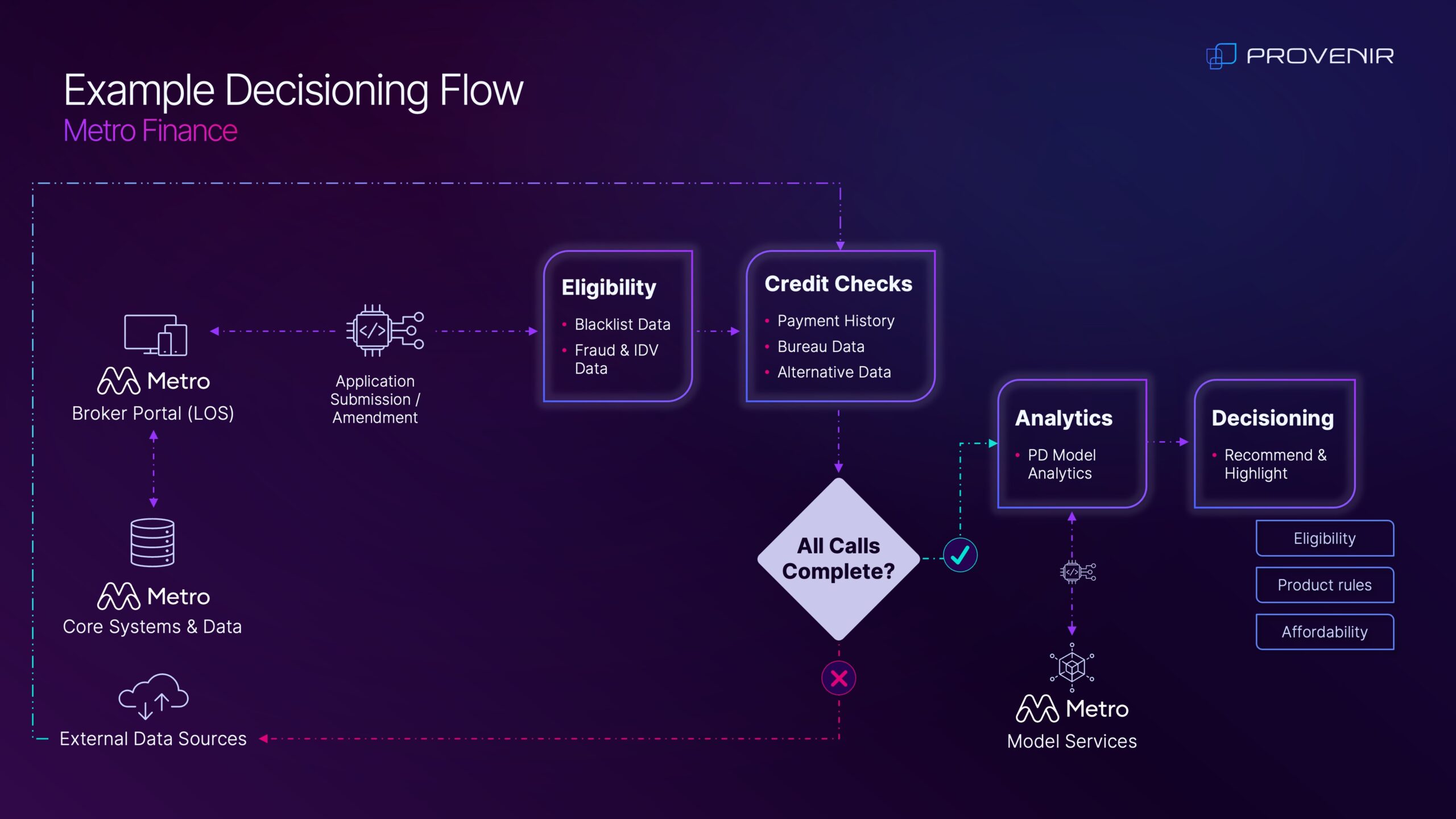
Example Decisioning Flows
  • New Application

    Decisioning

  • Eligibility

    Decisioning

    • Blacklist Data
    • Fraud & IDV Data
  • Credit Checks

    Decisioning

    • Payment history
    • Bureau data
    • Alternative data
  • Analytics

    Decisioning

    PD Score Verification
  • Decisioning

    Decisioning

    Recommend & Highlight
OTHER CUSTOMER STORIES

Continue reading

Loan Options

Customer Story: LoanOptions.ai

Loan Options

LoanOptions.ai is an intelligent loan comparison marketplace, with AI-assisted loan matching to find customers the best offers for car loans, personal loans, business loans and asset financing.

Using a combination of AI and dynamic logic, they are able to provide customers with predictive pre-approval and accurate lender rates for hundreds of financial products from over 70 different banks and lenders.

  • Industry
  • Region
  • Country

    Australia

  • Line of Business
  • Solution
  • Module
  • Infrastructure
  • ROI
  • Competition

Customer Timeline
Land MRR: $57K
Land PS: $35K
Expand MRR/PS: N/A
  • Opportunity Created
    27 Feb 2024
  • Opportunity Won
    4 April 2024
  • Go-Live
    May 2024
  • Customer Expansion
    • Provenir is guiding client to set up the first 10 lenders policy on the platform.
    • Client plans to launch more lenders policy independently on the Provenir platform.
Initial Opportunity Details

  • Customer Challenge

    They were looking to expand their business globally and saw limitations in their current processes; changes to credit policies require technical IT, so were looking for a more flexible and scalable solution.

    The CEO had been aware of Provenir’s solutions and had spoken with us in 2018, but now believes it is the right time to implement our tool.

    Their in-house developer left the business, and they were evaluating whether to build or buy.

  • Provenir Approach

    We were highly engaged in the opportunity’s early stages, actioning quickly in response to the customer’s urgency.

    We configured a comphrehensive demo to address their pain points around multiple lenders and multiple products offering, re-engineered the versatile lenders’ requirements with configuration on the fly, and offered a sandbox trial with frequent guidance follow-ups.

  • Provenir Impact

    Potential metrics after client’s go-live:

    • Time savings
    • Cost reductions
    • Improved customer satisfaction
    • Higher approval rates
    • Business expansion to multiple countries
  • Competitors

    In-house development
  • Why We Won

    • Flexible and scalable solution.
    • Compelling configured demo to targeted pain points.
    • Close relationship with CEO and working team.
    • Expedited and high engagement in early stages, after qualifying customer’s needs and urgency.
  • Pain Points

    • High code maintenance
    • Inflexibility with multiple product offerings
    • Slow to implement new lender policy and existing lenders’ policy changes
Customer Growth

Growth Opportunities

Upcoming opportunities:

  • Volume: 70+ lenders
  • Geographies: Philippines, New Zealand, Canada, etc.

Expansion

The client has not only agreed to a press release but also committed to being a reference client and facilitating introductions to their extensive network of 70 lenders.
Example Decisioning Flows
  • New Application Lead

    Decisioning

  • Bureau Data Enrichment

    Decisioning

    • Equifax
    • CreditorWatch
    • Illion
  • Eligible Lenders and Products Filtering

    Decisioning

    Product offering and Policy from different lenders
  • High Risk Patterns & Scoring

    Decisioning

    Application Score Model

    High Risk
    Low Risk

  • Loan Offer

    Decisioning

    Send qualified leads to eligible lenders for loan approval

    Present multiple loan offers to customer

OTHER CUSTOMER STORIES

Continue reading

Customer Story: Koinworks

koinworks

Established in 2016 as a Peer-to-Peer Lending company, Koinworks is headquartered in Jakarta and has a branch office in Yogyakarta. As of 2023, Koinworks’ Super Financial App has over 2.5 million active users.

Koinworks’s business focuses mainly on SMEs and BNPL.

  • Industry
  • Region
  • Country

    Indonesia

  • Line of Business
  • Solution
  • Module
  • Infrastructure
  • ROI
  • Competition

Customer Timeline
Land MRR: $8,381
Land PS: $49,000
Expand MRR / PS: N/A
  • Opportunity Created
    07/11/2020
  • Opportunity Won
    05/11/2022
  • Go-Live
    May 2023
  • Customer Expansion
    N/A
Initial Opportunity Details

  • Customer Challenge

    Koinworks was looking for a solution to help them build two workflows for their new instant approval products – mainly for SME lending and BNPL. Our decisioning will act as an additional filter to their existing risk system. They were also looking for a DE solution that help them integrate both internal and external data sources to run new workflows.
  • Provenir Approach

    Provenir Decisioning will help Koinworks launch their new business line in less than 12 weeks. Koinworks is expected to make decisions in real-time, with accurate credit decisions for their borrowers. Wants to increase approval rates as well. They are also looking to increase approval rates, and are looking ahead at training on how to use the maximize agility to create their own rules and inputs in the future.
  • Provenir Impact

    Koinworks was able to launch their new SME product within their expected timeline and increase revenue from new product. The SLA to process applications was decreased from 3 days to 1 day.
  • Competitors

    No competitor landscape as the opportunity came from close relationship with internal champion.
  • Why We Won

    Our data integration as part of our decisioning platfrom interested them initially. They intend to have us build one external integration to their external data partner. Because they will expand with new business lines, scalability on a SaaS solution became a key closing factor. Additional winning factors included the champion challenger features as well as the ease of use.
  • Pain Points

    • Data Integration
    • Flexible Decisioning
Customer Growth

Growth Opportunities

N/A

Expansion

N/A
Example Decisioning Flows
  • New Application

    Decisioning

  • Pre-Checking

    Decisioning

    In-house
  • KYC Check NTM Checking

    Decisioning

    Provenir
  • Fraud Score, Bureau Score

    Decisioning

    FINFIN (In-house)
    Fraud Score
    Bureau Score
  • Limit Calculation

    Decisioning

    Provenir

    Auto Accept
    Auto Decline
    Referrals

OTHER CUSTOMER STORIES

Continue reading