Industry: Banking

Remaining Relevant: Move Now to Tap Into These Top 10 Mega Banking Trends

NEWS

Remaining Relevant:
Move Now to Tap Into These Top 10 Mega Banking Trends

From evolving lending practices to new competition and changing fraud risks and compliance needs, banks are constantly adapting to a shifting landscape. In this FinTecBuzz article, Kathy Stares, Executive Vice President-North America at Provenir, dives into the 10 mega trends reshaping the banking landscape.

Read the Article

The Ultimate Guide to Decision Engines

What is a decision engine and how does it help your business processes?

Learn More


LATEST NEWS

Continue reading

Banking and Payments Experts Share Sector Forecasts for 2024

NEWS

Banking and payments experts
share sector forecasts for 2024

The Retail Banker International tapped industry experts including Frode Berg, Managing Director of EMEA for Provenir, to garner insights and predictions for 2024.

In this article, Frode shares his thoughts on net-zero banking trends and what organizations need to do to become more customer centric in the coming year.

Read Now

The Ultimate Guide to Decision Engines

What is a decision engine and how does it help your business processes?

Learn More


LATEST NEWS

Continue reading

Top 10 Banking Trends and Challenges in 2024

BLOG

Top 10 Banking Trends and Challenges in 2024

What to watch for in the year ahead

As we make the leap into a new year, the banking sector continues its transformation. From evolving lending practices to new competition, and changing fraud risks and compliance needs, banks are constantly adapting to a shifting landscape. We’re looking ahead to 10 trends and challenges to watch for in the coming year. 

  1. Increased Regulatory Scrutiny: With global financial regulations becoming more stringent, banks will also face increased compliance demands. Effectively adhering to these evolving regulations, especially in areas like Anti-Money Laundering (AML) and Know Your Customer (KYC), remains a top priority.
  2. AI and Machine Learning in Fraud Detection: Artificial Intelligence (AI) and Machine Learning (ML) are becoming indispensable in fraud screening. Banks who are able to successfully leverage these technologies can better anticipate and mitigate fraud risks.
  3. Changing Landscape of Lending: The lending market is constantly shifting, with new types of financial services regularly emerging, including things like Banking as a Service (BaaS) and peer-to-peer lending platforms gaining traction. According to Acumen, the global P2P lending market size is set to grow to over $800 Billion USD by 2030, with a CAGR of 29.1%. 
  4. Digital Banking Adoption: Digital banking is no longer a luxury but a necessity. Over 90% of consumers view digital banking as an important factor in their choice of bank. Convenience, lower fees, ease-of-access and use, streamlining all of your financial services – the advantages are practically endless.
  5. Onboarding Innovations: Streamlining customer and merchant onboarding processes is crucial. Integrating advanced technologies (for example, biometric verification) can significantly reduce onboarding time and reduce friction in the customer experience.
  6. Data-Driven Decisions and Hyper-Personalization: Personalized banking services are becoming a key differentiator. “According to a study by McKinsey & Company, banks that successfully use customer analytics to improve customer experience can increase their customer satisfaction scores by 20% and their revenues by 15%.” Using advanced data analytics and a wider variety of data sources integrated into credit decisioning also enables more accurate risk assessment and the ability to (safely) say yes to more customers. 
  7. Sustainable and Ethical Banking Practices: Sustainability and ethical practices are increasingly influencing consumer choices. Banks adopting green policies and transparent operations are likely to gain customer trust and loyalty.
  8. Effective Collections Strategies: With economic uncertainties, effective collections strategies are vital. Employing empathetic and customer-centric approaches in collections can improve recovery rates and customer relationships, and using a holistic risk decisioning solution can help you identify the best treatment strategies and most effective communication channels. But it can also help your pre-collections strategy, with embedded intelligence enabling you to be proactive in predicting potential defaults and minimizing loss.
  9. Emergence of New Competitors: The banking sector is witnessing the continued growth of non-traditional players like fintechs and tech giants. Banks need to innovate continuously (and explore more inventive partnerships) to stay competitive in this evolving market.
  10.  The Continued Rise of Buy Now, Pay Later: Last but certainly not least, our favorite industry-disruptor, BNPL, comes to play. While widely popular because of its simplicity and convenience, BNPL is also a way to tap into some of the more underserved market segments. Banks that can integrate BNPL into existing banking services can help ensure a more comprehensive (and competitive) financial solution to customers – and enable penetration into a wider customer base.  

2024 could be a pivotal junction for the banking industry – and the financial services industry as a whole –  where embracing change and innovating risk management strategies will be key to staying relevant and successful. Understanding these trends and adapting to the challenges at hand will be crucial for banks to thrive in this dynamic landscape.

Check out our 2024 Global Risk Decisioning Survey.

Read the Report

LATEST BLOGS

ken lee blog post

Driving Intelligent ...

Driving Intelligent Lending Beyond the LOS: A Leadership Perspective
blog selfie

Beyond the Selfie: W...

A solution needs to bridge the gap left by
The State of AI, Risk, and Fraud in Financial Services

The State of AI, Ris...

The State of AI, Risk, and Fraud in Financial
europe mortgages

Top Mortgage Lending...

Top Mortgage Lending Trends in the UK and Europe:
blog lending thumbnail

BLOG: Unlocking Succ...

Thriving Through Change: Unlocking Success in Poland’s Lending Revolution
BLOG AI Round up

BLOG: Shaping the Fu...

Shaping the Future of Decisioning: How These Leading Financial
The Importance of Customer Experience in Driving Loyalty Across the Subscriber Lifecycle

Blog: The Importance...

Discover how telcos can enhance customer experience across the
telco fraud

Three Steps to Fight...

BLOG Minimize Risk, Maximize Activations:Three Steps to Fighting Telco

Continue reading

Divorce, Data, Disruption: Oh My!

PODCAST

Divorce, Data, Disruption:
Oh My!

Divorcing your bank, debunking long-standing myths, advancing emerging tech, and approaching data ethically…

What do these topics all have in common? They’re innovative ideas our thought leaders have shared with us in our very first season of The Disruptor Sessions.

We’ve loved having fascinating conversations with our brilliant guests, so for our final episode of 2023, we’re looking back at some of the hot topics we couldn’t stop talking about. Tune in for global insights on financial inclusion, artificial intelligence, alternative data and open banking, and – our bread and butter – innovation across financial services. 

We hope you’ve enjoyed season 1 and we can’t wait to see you again next year for season 2!

Listen Now

Tune into our Podcast on Apple or Spotify by clicking the icons below.

Apple Podcast

Spotify Podcast

The Panelists:

  • Aaron Webster

    SoFi’s Aaron Webster Wants to Make It Easier to Divorce Your Bank

    What’s SoFi’s secret to differentiation in a crowded fintech ecosystem? Where should we look to find the next big disruption for American financial services? North America host Kathy Stares sits down with SoFi’s Chief Risk Officer, Aaron Webster, to answer these questions and more in our very first episode of The Disruptor Sessions.

  • Nidhi Verma

    TransUnion’s Nidhi Verma Introduces the New Kids on the (Credit) Block

    Though they used to be invisible, today they might be the future of the credit market. On this episode of The Disruptor Sessions, we’re exploring the new-to-credit (NTC) population. Though they used to be invisible, today they might be the future of the credit market.

    North America host Kathy Stares (Provenir’s EVP, Americas) and TransUnion’s VP of International Research and Consulting, Nidhi Verma, discuss the immense opportunities in engaging this powerful group. Drawing from TU’s recent report on NTCs, they debunk the myths around risk, define the business case for financial inclusion, and develop a vision of what the future of financial inclusion could look like globally.

  • Kike Fashola & Ceci López

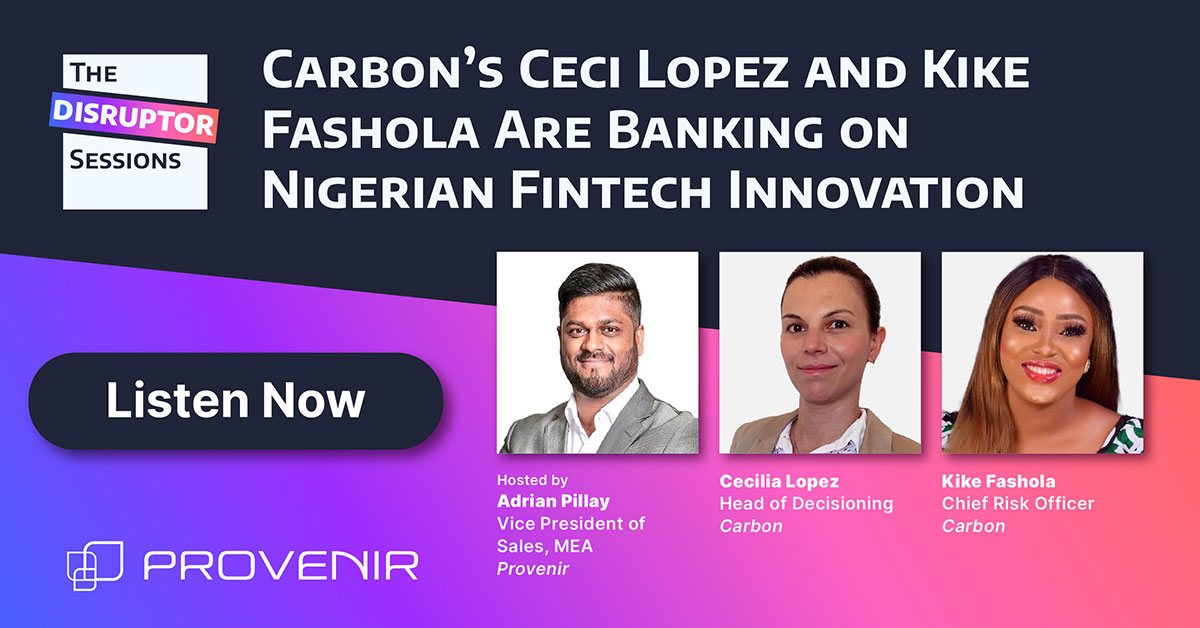
    Carbon’s Ceci López and Kike Fashola Are Banking on Nigerian Fintech Innovation

    These risk leaders are disrupting the status quo across Africa’s fintech landscape. In our first MEA-focused episode, host Adrian Pillay sits down with digital bank Carbon’s Ceci López (Head of Decisioning) and Kike Fashola (Chief Risk Officer) to take a look at the relationship between risk and reward and the future of fintech in Nigeria.

    They dig into topics like using data science to support innovation, how to drive adoption of emerging tech in an emerging market, and some of the implications we may not always think of when we talk about AI in risk management.

  • Costin Mincovici

    tbi Bank’s Costin Mincovici Wants to See More ‘Aha’ Moments in Digital Banking

    Costin Mincovici, tbi Bank’s Chief Credit Officer, is a risk leader that likes to say yes. Yes to mobile-first financial services, yes to digital banking disruption, and yes to multi-country risk strategies that offer the accessible experiences that can make or break a provider.

    He shares his insights with our EMEA host and Provenir’s regional leader, Frode Berg. They explore everything from the ethical implications of data usage, to market approaches that protect the interests of both the customer and bank, to the “aha” moments Costin hopes to see more of across fintech.

  • Aaron Webster

    SoFi’s Aaron Webster Wants to Make It Easier to Divorce Your Bank

    What’s SoFi’s secret to differentiation in a crowded fintech ecosystem? Where should we look to find the next big disruption for American financial services? North America host Kathy Stares sits down with SoFi’s Chief Risk Officer, Aaron Webster, to answer these questions and more in our very first episode of The Disruptor Sessions.

  • Nidhi Verma

    TransUnion’s Nidhi Verma Introduces the New Kids on the (Credit) Block

    Though they used to be invisible, today they might be the future of the credit market. On this episode of The Disruptor Sessions, we’re exploring the new-to-credit (NTC) population. Though they used to be invisible, today they might be the future of the credit market.

    North America host Kathy Stares (Provenir’s EVP, Americas) and TransUnion’s VP of International Research and Consulting, Nidhi Verma, discuss the immense opportunities in engaging this powerful group. Drawing from TU’s recent report on NTCs, they debunk the myths around risk, define the business case for financial inclusion, and develop a vision of what the future of financial inclusion could look like globally.

    Kike is a graduate of Covenant University, where she majored in Industrial Mathematics.

    Kike is a positive and proactive individual who is always looking for ways to improve. She is not afraid to challenge the status quo and is always looking for the silver lining.

  • Kike Fashola & Ceci López

    Carbon’s Ceci López and Kike Fashola Are Banking on Nigerian Fintech Innovation

    These risk leaders are disrupting the status quo across Africa’s fintech landscape. In our first MEA-focused episode, host Adrian Pillay sits down with digital bank Carbon’s Ceci López (Head of Decisioning) and Kike Fashola (Chief Risk Officer) to take a look at the relationship between risk and reward and the future of fintech in Nigeria.

    They dig into topics like using data science to support innovation, how to drive adoption of emerging tech in an emerging market, and some of the implications we may not always think of when we talk about AI in risk management.

    He has held various leadership roles at leading Credit Risk companies such as TransUnion, Dun & Bradstreet, Experian and FICO. He is Vice President of Sales at Provenir, and is responsible for its business in Middle East and Africa.

  • Costin Mincovici

    tbi Bank’s Costin Mincovici Wants to See More ‘Aha’ Moments in Digital Banking

    Costin Mincovici, tbi Bank’s Chief Credit Officer, is a risk leader that likes to say yes. Yes to mobile-first financial services, yes to digital banking disruption, and yes to multi-country risk strategies that offer the accessible experiences that can make or break a provider.

    He shares his insights with our EMEA host and Provenir’s regional leader, Frode Berg. They explore everything from the ethical implications of data usage, to market approaches that protect the interests of both the customer and bank, to the “aha” moments Costin hopes to see more of across fintech.


LATEST PODCASTS

Continue reading

tbi Bank’s Costin Mincovici Wants to See More ‘Aha’ Moments in Digital Banking

tbi Bank’s Costin Mincovici Wants to See More ‘Aha’ Moments in Digital Banking

Costin Mincovici, tbi Bank’s Chief Credit Officer, is a risk leader that likes to say yes.

Yes to mobile-first financial services, yes to digital banking disruption, and yes to multi-country risk strategies that offer the accessible experiences that can make or break a provider.

He shares his insights with our EMEA host and Provenir’s regional leader, Frode Berg. They explore everything from the ethical implications of data usage, to market approaches that protect the interests of both the customer and bank, to the “aha” moments Costin hopes to see more of across fintech.

LATEST PODCASTS

TDS Mini: Can Financial Services Really Be Intelligent?

TDS Mini: Can Financ...

PODCAST TDS Mini:Can Financial Services Really Be Intelligent? Today’s TDS Mini tackles a question that
TDS Mini: Reducing Biases with Alternative Data and AI

TDS Mini: Reducing B...

PODCAST TDS Mini:Reducing Biases with Alternative Data and AI Fair and accurate: these are the
TDS Mini: Fintech Cheat Sheet (Part 2)

TDS Mini: Fintech Ch...

PODCAST TDS Mini:Fintech Cheat Sheet (Part 2) We’re back for part two of our TDS
TDS Mini: Fintech Cheat Sheet (Part 1)

TDS Mini: Fintech Ch...

PODCAST TDS Mini:Fintech Cheat Sheet (Part 1) The first half of 2023 has blown by

Continue reading

Provenir Named Finalist for 2023 Banking Tech Awards

NEWS

Provenir Named Finalist
for 2023 Banking Tech Awards

Provenir’s AI-Powered Risk Decisioning Platform provides a cohesive risk ecosystem to enable smarter decisions across the full customer lifecycle

Parsippany, NJ October 25, 2023 – Provenir, a global leader in AI-powered risk decisioning software, today announced that it has been named a 2023 Banking Tech Awards finalist in the “Tech of the Future – AI and Data – Decision Engine” category.

The Banking Tech Awards recognize excellence and innovation in the use of IT in financial services worldwide, and the people who make it happen. The awards are owned and produced by FinTech Futures, the definitive source of news and analysis of the global fintech sector. Winners will be unveiled Nov. 30 during an awards ceremony at the Royal Lancaster in London.

“We are honored to be named winner of the ‘Tech of the Future – AI and Data – Decision Engine’ category for this very prestigious and global awards competition,” said Frode Berg, Provenir’s Managing Director for EMEA. “Provenir continues to power real-time risk decisioning by delivering a low-code, drag-and-drop studio platform, enabling the financial services community to design, deploy, and deliver decisioning processes with ease.”

The Ultimate Guide to Decision Engines

What is a decision engine and how does it help your business processes?

Learn More


LATEST NEWS

Continue reading

What is Banking as a Service (BaaS): Exploring BaaS Trends in 2023

BLOG

What is Banking as a Service (BaaS):
Exploring BaaS Trends in 2023

In the rapidly evolving landscape of finance and technology, new paradigms are constantly reshaping traditional banking models. One such innovation that has gained significant traction recently is Banking as a Service (BaaS). But what exactly is banking as a service? This blog takes a look at the concept of BaaS, trends to keep an eye on, and the impact it’s having on the financial industry.

What is Banking as a Service (BaaS)?

Banking as a Service, or BaaS, is revolutionizing the financial sector. It’s a method that integrates tech companies with a bank’s system via APIs. The result? These organizations can create advanced financial services. The integration happens on the provider bank’s regulated infrastructure and promotes open banking services. It’s a win-win for everyone involved. Tech firms can offer financial services without dealing with complex regulatory issues and banks get to offer services through new channels. Much like Software as a Service (SaaS) revolutionized software delivery, BaaS brings a similar shift to banking.

In simple terms, BaaS is a game-changer. It’s making finance more accessible and innovative than ever before. Essentially, BaaS allows for the offering of banking products and services through third-party distributors – which are often NOT typical banking businesses.

Understanding How Banking as a Service Works

To grasp the mechanics of BaaS, it’s essential to explore how it functions. This section delves into the intricacies of BaaS, highlighting the roles of key stakeholders, the technological infrastructure, and the underlying processes that enable the seamless integration of financial services.

When it comes to Banking as a Service (BaaS), several key elements play vital roles in making it function effectively:

  • API Integration: BaaS relies on Application Programming Interfaces (APIs) that act as bridges between banks or financial institutions and third-party organizations. These APIs facilitate seamless communication and data exchange.
  • Third-Party Utilization: BaaS opens the door for third-party entities like fintech companies, programmers, app developers, and tech organizations, regardless of their financial sector expertise. They can leverage these APIs to access banking services.
  • Enhanced Customization: What sets BaaS apart is the flexibility it offers. Third-party organizations can integrate their own features, branding, and value-added services on top of the core banking services provided by the financial institution.
  • Collaborative Innovation: With BaaS, fintech and tech companies pay for access to these APIs. In turn, the banks and financial institutions grant them access, fostering collaborative innovation. This allows these third-party entities to create innovative solutions that combine their unique features with the fundamental services provided by the bank.

In essence, Banking as a Service empowers a collaborative ecosystem where traditional financial institutions and tech-savvy organizations can join forces to offer innovative and customized financial solutions.

Benefits of Banking as a Service (BaaS)

But what exactly are the benefits of BaaS? According to Deloitte, “through integrating non-banking businesses with regulated financial infrastructure, BaaS offerings are enabling new, specialized propositions and bringing them to market faster.” 

Let’s look more closely at some of the specific benefits that BaaS offers.

1. Accelerated Time-to-Market for Financial Products

BaaS enables financial institutions and fintech companies to rapidly introduce new financial products and services to the market. By leveraging existing infrastructure and partnering with BaaS providers, these entities can bypass the lengthy and complex process of building financial products from scratch. This accelerated time-to-market allows them to capitalize on emerging trends and meet customer demands promptly.

2. Enhanced Customer Experience

BaaS empowers businesses to offer a comprehensive suite of financial services seamlessly integrated within their existing platforms. This integration provides customers with a seamless and convenient experience, eliminating the need to navigate between multiple apps or websites. From fund transfers to payments and lending, customers can access a range of financial services through a single interface.

3. Access to Expertise and Compliance

Navigating the regulatory landscape and ensuring compliance with financial regulations can be daunting. BaaS providers, often established financial institutions, bring their expertise in compliance and regulatory matters to the table. Fintech companies partnering with BaaS providers can tap into this expertise, ensuring that their offerings adhere to the latest industry standards.

4. Cost-Efficiency

Developing and maintaining a full suite of financial services requires substantial investments in technology, infrastructure, and talent. BaaS allows businesses to minimize upfront costs by leveraging the infrastructure and resources of the BaaS provider. This cost-efficiency enables startups and established businesses alike to allocate resources more strategically.

5. Flexibility and Customization

BaaS providers offer flexible APIs and modular solutions that allow businesses to customize their financial offerings to meet specific customer needs. This flexibility enables businesses to tailor their services, adapt to market trends, and respond to customer preferences quickly.

6. New Revenue Opportunities

BaaS opens up new revenue streams for traditional banks and financial institutions. By providing their services as APIs to third-party platforms, these institutions can expand their reach beyond their traditional customer base. This creates additional revenue sources while also increasing customer engagement.

7. Global Expansion

For businesses aiming to expand their services internationally, BaaS offers a streamlined approach. Partnering with BaaS providers that have a global presence can facilitate the expansion process by providing access to localized financial services and compliance expertise in various regions.

8. Innovation and Collaboration

BaaS encourages innovation through collaboration. Fintech companies and startups can focus on creating innovative user experiences and niche solutions while relying on BaaS providers for core banking services. This symbiotic relationship fosters creativity and drives industry-wide advancements.

9. Scalability

As businesses grow, their demands for financial services also increase. BaaS providers offer scalable solutions that can seamlessly accommodate higher transaction volumes and user demands without disruptions.

10. Risk Mitigation

For emerging fintech companies, partnering with established BaaS providers reduces operational and financial risks. These providers bring a wealth of experience, robust security measures, and risk management protocols to the partnership, enhancing the overall stability of the fintech ecosystem.

Discover how Provenir’s AI-powered credit risk decisioning platform can help.

Learn More

QUESTIONS

Frequenly Asked Questions

Get in Touch

  • How to Implement Banking as a Service for Businesses?

    Implementing Banking as a Service (BaaS) requires careful planning and collaboration. Here’s a general roadmap for businesses considering BaaS integration:

    • Assessment: Evaluate your business needs and objectives. Determine which financial services you want to offer through BaaS.
    • Select a BaaS Provider: Research and choose a BaaS provider that aligns with your goals. Consider factors such as their technology stack, compliance capabilities, and track record.
    • Integration: Collaborate with your chosen BaaS provider to integrate their APIs and solutions into your platform. Ensure seamless user experience and data security.
    • Customization: Tailor the integrated financial services to match your branding and user interface. Consider offering additional value-added features to stand out.
    • Testing: Thoroughly test the integrated services to ensure they function as intended. Address any issues or glitches before launching.
    • Launch and Monitoring: Launch the BaaS-powered services to your customers. Monitor usage, feedback, and performance to make refinements if needed.
  • Is Banking as a Service the Same as Open Banking?

    While both Banking as a Service (BaaS) and open banking share similarities, they are distinct concepts:

    • BaaS (Banking as a Service): BaaS refers to a comprehensive model where financial services are seamlessly integrated into third-party platforms. BaaS providers offer a wide range of banking functionalities, enabling businesses to offer financial services without the need to build their own infrastructure.
    • Open Banking: Open banking involves the sharing of customer financial data among banks and other financial institutions through standardized APIs. It aims to foster competition and innovation by allowing authorized third parties to access this data to develop new financial products and services.
    • In essence, BaaS encompasses a broader scope, providing a platform for offering a suite of financial services, while open banking focuses on data sharing to encourage innovation in financial products and services.

What Are the Future Trends for Banking as a Service?

The future of Banking as a Service (BaaS) holds exciting possibilities as technology continues to evolve. Here are some trends to watch for:

  • Personalization: BaaS providers will offer more personalized financial solutions tailored to individual customer needs and preferences.
  • AI and Automation: Artificial intelligence and automation will play a significant role in enhancing BaaS capabilities, from customer support to risk assessment.
  • Ecosystem Expansion: BaaS providers will form ecosystems of partners, including fintechs, to offer a comprehensive range of financial services.
  • Global Reach: BaaS will facilitate cross-border financial services, enabling businesses to serve customers globally.
  • Regulatory Evolution: As BaaS gains prominence, regulations specific to BaaS models may emerge to ensure consumer protection and data privacy.
  • Emergence of Niche Offerings: BaaS will support the emergence of niche financial services catering to specific industries or demographics.
  • Sustainability Integration: BaaS may incorporate sustainable finance options, aligning with the growing focus on environmental and social responsibility.

The future of BaaS is dynamic and will likely be shaped by ongoing technological advancements, regulatory changes, and evolving customer expectations. How can you take advantage of the benefits that BaaS has to offer? One of the keys to success is choosing the right technology partner. 


LATEST BLOGS

Continue reading

Provenir Recognized as Best Credit Risk Solution in the Global BankTech Awards 2023

NEWS

Provenir Recognized as Best Credit Risk Solution
in the Global BankTech Awards 2023

The awards program celebrates the world’s most cutting-edge vendor and solution providers transforming the financial services sector

Parsippany, NJ September 13, 2023 – Provenir, a global leader in AI-powered risk decisioning software, today announced that it has been recognized in the Global BankTech Awards 2023 as the “Best Credit Risk Solution by a Vendor.”

“Provenir is honored to be recognized for its forward-thinking technology that is enabling the financial services market to make credit decisions faster to better serve its customers,” said Frode Berg, Provenir’s Managing Director for EMEA. “With embedded machine learning and simplified data orchestration, Provenir’s AI-Powered Risk Decisioning Platform provides a cohesive risk ecosystem to enable smarter decisions across the entire customer lifecycle.”

The Global BankTech Awards are organized by The Digital Banker, a globally trusted news, business intelligence and research partner to the worldwide financial services sector. The awards honor and celebrate the world’s preeminent and ground-breaking technology companies and their contributions to technology-based enhancements, initiatives and innovations within the financial services industry that are streamlining operational processes, automating workflow and re-engineering business models, while materially driving productivity gains.

The Ultimate Guide to Decision Engines

What is a decision engine and how does it help your business processes?

Learn More


LATEST NEWS

Continue reading

Making Good on the Promise of Open Banking Requires Technology and Solid Execution

NEWS

Making Good on the Promise of Open Banking
Requires Technology and Solid Execution

Open banking is here and is showing no signs of slowing down.

According to a recent Finastra survey, 56 percent of US financial institutions (FIs) surveyed regard open finance as a “must have”, up from 45% in 2021. Globally, the open banking market is expected to grow to $43 billion by 2026 from its value of $7 billion in 2018.

With the advent of open banking, consumers can now manage their financial information, accessing it across different platforms, benefiting from a smoother, more personalized experience in the process.

In this Finextra blog, Kathy Stares, executive vice president, North America with Provenir, explains how FIs must change – analytically, operationally, and even culturally (no longer owning customer data) – to benefit from the open banking revolution.

Read Now

The Ultimate Guide to Decision Engines

What is a decision engine and how does it help your business processes?

Learn More


LATEST NEWS

Continue reading

The Reinvention of Banking

BLOG

The Reinvention of Banking

Why banks need to ensure resiliency and innovation to achieve long-term profitability

As economic stability increasingly looks like a thing of the past, what does this mean for traditional banks? With disruption after disruption in the financial services sector, it’s clear that resiliency is a must. According to McKinsey, “banks will need to become more resilient and reinvent their business models to ride out the current volatile period and achieve long-term growth and profitability.” But what does reinvention really mean? And is it possible to reinvent your business models quickly? We’re looking at some of the key challenges the banking industry is facing, and the ways that upgrading credit risk decisioning capabilities can help solve for some of these challenges.

Banking Disruptors:

Banks and the financial industry as a whole face many challenges, not the least of which includes fintechs and challenger banks. But the need to keep up with the competition is not the only obstacle banks are facing.

Evolving Regulations: Complying with various regulatory requirements is always a challenge, but it’s even more difficult when those regulations are constantly evolving. Look at the world of Buy Now, Pay Later as an example – as this non-traditional financial services offering continues to grow and shift worldwide, more and more traditional banks are sitting up and taking notice. But getting into the market can be fraught with compliance issues, which can be costly and time-consuming, and as a result, impedes your ability to innovate and respond quickly to changing customer needs.

Increasing Digitization: If the last few years have taught us anything, it’s that more things than ever thought possible can be done digitally. Customers increasingly want digital channels to meet ALL of their needs, including financial services of all kinds – whether that’s applying for credit or embedded finance enabling banking super-apps. But this requires clear investment in technology from banks to remain competitive.

Growing Competition: Speaking of remaining competitive – more than ever, new players are continually entering the market, vying for a share of the wallets of increasingly discerning consumers. Whether it’s established players with new offerings or innovative fintech startups, the landscape is changing, putting pressure on banks to reduce costs and improve offerings, while still providing frictionless experiences for consumers.

Also, read: What is Banking as a Service?

Turning Disruption into Opportunity:

But it’s not all dire. Banks can be uniquely positioned to effectively deal with these disruptors. As Siobhan Byron writes, “established banks, though still only recently starting to harness the power of digital, have a key advantage over new entrants. Their decades of institutional knowledge is difficult to build up quickly.” Banks are also in a better position to deal with market shifts than they were a decade ago – if they can leverage data analytics and automated workflows to make “better and more informed credit decisions.”

So, if you’re a bank, what can you do? Look for ways to leverage advanced technology like artificial intelligence and machine learning, automated credit risk decisioning, and data integration to improve efficiency, reduce costs, and renew your focus on customer-centric products and services.

Increase Efficiency: Machine learning algorithms can enhance your credit risk models, processing vast amounts of data quickly and reducing the time and person-power needed for risk assessments and credit decisioning.

Reduce Costs: Automating your credit risk decisioning process reduces the manual labor required, allowing you to allocate resources to other strategic initiatives that can help grow your revenue and improve the customer experience.

Enhance the Customer Experience: Focus on frictionless onboarding and customer management, with faster credit decisions, digitized processes, and more personalized product offerings (including everything from interest rates to loan terms, upsell/cross-sell offers, and even optimized collections strategies).

Improve Risk Management: Advanced analytics can enable you to identify key patterns and trends in customer behavior, ensuring more accurate risk assessments and reduced losses due to defaults and improved fraud detection.

Enable Agility: With more flexible, user-friendly decisioning technology, you can make changes to decisioning workflows quickly, respond to market shifts, meet changing consumer demands, and launch new products faster to stay ahead of your competition.

Foster Innovation: Enabling all the above points (with more automated decisioning, advanced analytics, superior data integration, improved efficiency, etc.) means you can foster a true culture of innovation. Allow your teams to focus on strategic initiatives, competitive insights, and innovative product development for customer-centric offerings that can help put you ahead of the competition.

Roadmap for Success:

The larger the bank and the more complex the systems, the more daunting it can feel to implement any changes to your decisioning software or data sources. But fear not, follow some simple steps to incorporate tech upgrades into your credit risk decisioning – and remember, it’s not all or nothing: look at decisioning solutions that can easily work alongside your existing systems and/or partners that have experience replacing legacy systems to ensure a smooth transition.

  1. Assess Current Capabilities: Evaluate your existing credit risk decisioning capabilities and identify areas where you can improve your processes.
  2. Define Your Objectives: What are your goals for upgrading your tech? Prioritize the areas that are most important for you (i.e., reducing costs with improved efficiencies, versus enhancing the customer experience with increased digitization capabilities).
  3. Select Technology Capabilities: Choose what is most critical to upgrade – is it automated risk decisioning, machine learning, data integration?
  4. Choose Your Solution: Outline a plan for integrating the chosen technology into your existing systems and workflows, with a partner that can help with timelines, resource allocations, and important milestones.
  5. Test and Iterate: Be sure your chosen risk decisioning solution offers you the ability to test workflows, refine your credit models, easily integrate new data sources, and iterate your processes – on your timeline, not theirs!

With the right technology in place, not only can you accomplish all the goals set out above, but you can more easily maximize the value of your customers across the entire lifecycle. Because with upgraded credit risk decisioning, you can more efficiently move beyond credit origination and onboarding and bring that customer-centric experience to all the financial services products you offer. As McKinsey points out, “banks that have already embedded high-performance credit-decisioning models into their digital lending have reaped three key benefits,” including increased revenue, reduction in credit losses and gains in efficiency. So, what are you waiting for?

Want more info on how to turn challenges into opportunities?

Contact Us


LATEST BLOGS

Continue reading