Industry: Decisioning

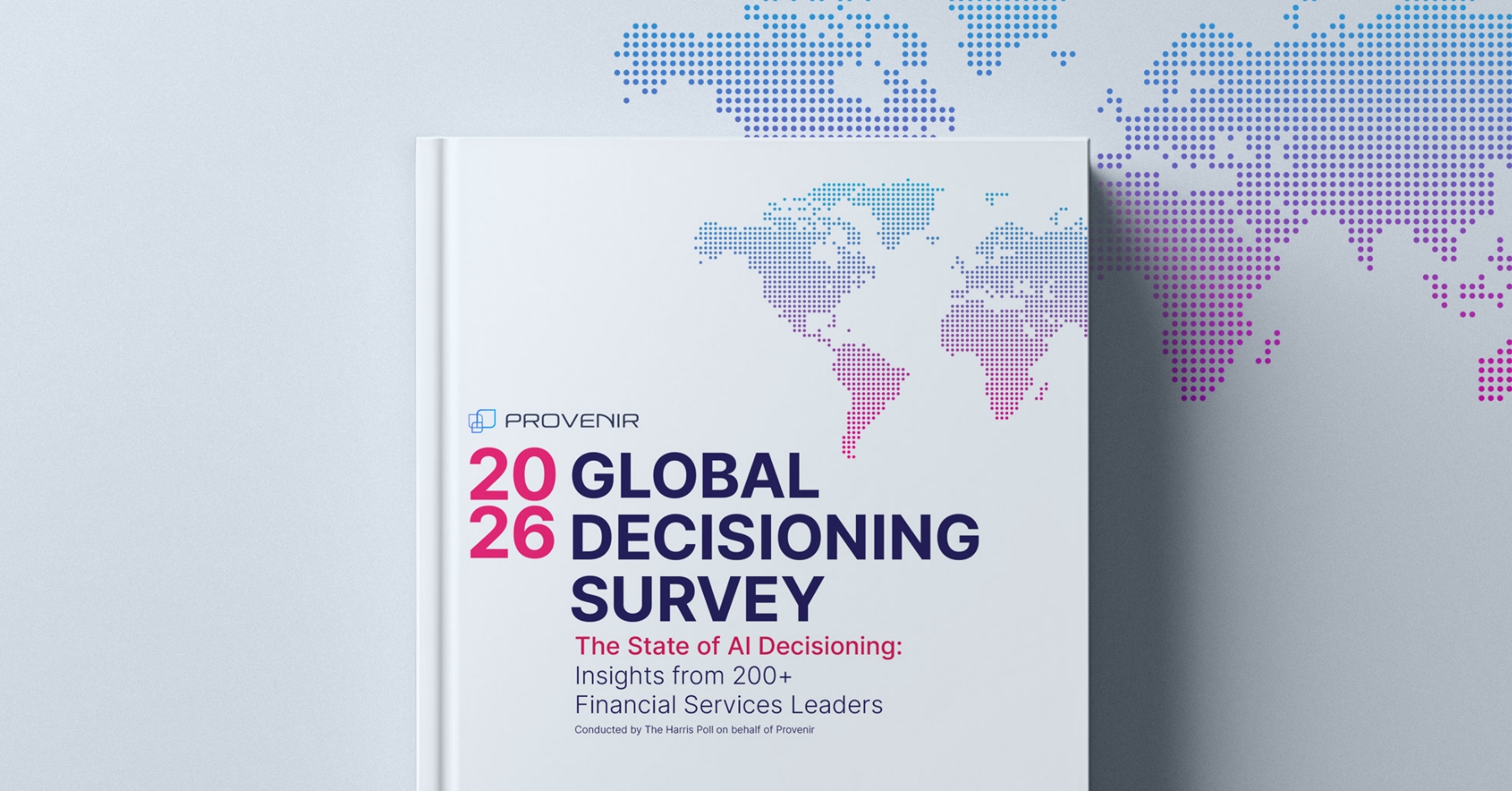
Survey: 2026 Global Decisioning Survey
What are the key challenges and priorities for financial services leaders in 2026 and beyond?

The financial services industry stands at an inflection point in its adoption of artificial intelligence for decisioning. Our 2026 Global Decisioning Survey reveals a sector that recognizes AI’s transformative potential yet struggles with universal implementation challenges.

We surveyed 203 senior decision-makers—including Chief Risk Officers, CEOs, CFOs, and Heads of Risk—across 22 countries spanning banking, fintech, insurance, telecommunications, and other financial services sectors. The findings paint a nuanced picture of an industry in transition.

KEY FINDINGS AT A GLANCE
  • The AI Paradox:

    87% trust AI-driven decisioning outcomes, yet 97% face implementation barriers
  • The Fraud Challenge:

    77% are concerned about AI-enabled fraud threats while needing AI to combat fraud
  • Real-Time Momentum:

    91% have moved beyond static-only models; 52% use hybrid approaches
  • Decision Intelligence:

    77% see it as very valuable for their strategy over the next 2-3 years
  • Investment Priority:

    60% plan to invest in AI or embedded intelligence for decisioning in 2026
  • Governance Gap:

    Only 33% have fully implemented responsible AI frameworks

These findings reveal an industry that knows where it needs to go but faces significant challenges getting there. The organizations that successfully navigate implementation barriers—around compliance, explainability, and integration—will build sustainable competitive advantages through faster, more accurate, and more adaptive decisioning.

ADDITIONAL RESOURCES

BLOG Christian Ball
Blog ::

Smarter Acquisition and Customer Mana...

Smarter Acquisition and Customer Management:How Provenir Drives Growth and Reduces ...
Open Banking Expo Toronto
Event ::

Open Banking Expo Toronto

Open Banking Expo Join Provenir at The Open Banking Expo ...
Zero Trust in Digital Banking

Zero Trust in Digital Banking

Zero Trust in Digital Banking: Why Risk Leaders Need a ...
EBOOK Survey2026
eBook, Survey ::

Survey: 2026 Global Decisioning Surve...

What are the key challenges and priorities for financial services ...
LewisGRP
News ::

Leading South African Furniture Retai...

Leading South African Furniture Retailer Lewis Group Partners with Provenir ...
carol blog
Blog ::

The Generational Shift: Why Banks Are...

The Generational Shift:Why Banks Are Replacing Their Decisioning Infrastructure Financial ...
Frederic blog
Blog ::

Why AI Requires Enterprise Platforms ...

Why AI Requires Enterprise Platforms to Deliver Business Value The ...
INFOGRAPHIC Hyper-personalization
Infographic ::

Hyper-Personalization in Action

Hyper-Personalization in Action: How AI-Driven Decisioning Transforms Every Customer Interaction ...

Continue reading

Leading South African Furniture Retailer Lewis Group Partners with Provenir to Drive AI Credit Decisioning Transformation in the Cloud

Leading South African Furniture Retailer Lewis Group Partners with Provenir to Drive AI Credit Decisioning Transformation in the Cloud

The retailer will deploy Provenir’s AI Decisioning Platform in the cloud to improve agility and operational efficiencies, with the ability to capitalize on greater customer insights

Parsippany, NJ | January 21, 2026 – South African furniture retailer Lewis Group is migrating its credit decisioning to the cloud with Provenir, a global leader in AI risk decisioning, to streamline its onboarding processes and expand customer touchpoints.

Lewis Group is a leading retailer of furniture, home appliances, electronic goods and homeware in South Africa through its brands Lewis, Best Home & Electric, Beares, UFO, Bedzone, Real Beds and Monarch Insurance. The retailer has 813 stores across South Africa and 145 in southern Africa, including Namibia, Botswana, Lesotho and Eswatini.

A Provenir customer for 15 years, Lewis Group is embarking on a cloud-migration strategy on the AWS stack, designed to elevate the customer experience and further drive innovation in credit decisioning. The goal is to enable more personalized customer engagements, further improve the onboarding process, and unlock meaningful productivity gains.

By modernizing and enhancing decisioning capabilities via the cloud, the Provenir AI Decisioning Platform supports Lewis Group’s commitment to responsible and effective customer engagement.

“Our long-standing collaboration with Provenir underscores a shared focus on using technology to deliver better outcomes for our customers… By migrating to the cloud, we are able to realize enhanced speed and agility, scalability, improved security, and faster time-to-market for solutions and services to our valued customers.”

Lambert Fick, Lewis Group’s GM Credit Risk

“After more than 15 years of partnership, we’re proud to support Lewis Group’s move to a modern cloud platform with our AI Decisioning Platform to drive improved business outcomes,” said Ryan Morrison, executive vice president, Provenir. “This migration will give Lewis Group faster, more effective decisioning, a unified customer view across channels, and the ability to leverage advanced analytics to enhance onboarding, fraud prevention, and overall customer management.”

Provenir’s AI Decisioning Platform combines data, decisioning, and decision intelligence to enable smarter, faster decisions across the entire customer lifecycle – from onboarding and application fraud to credit risk, customer management, and collections.

Explore Our AI-Decisioning Platform

Read More

LATEST NEWS

Continue reading

The Generational Shift: Why Banks Are Replacing Their Decisioning Infrastructure 

The Generational Shift:
Why Banks Are Replacing Their Decisioning Infrastructure

Financial institutions are ripping out decisioning infrastructure they spent two decades building. This isn’t a routine technology refresh. Banks are replacing entire systems because the architecture that powered the last generation can’t support what the market now demands.

Here’s what I see from working with major banks on this transformation: the technology decision is actually the easy part. The harder question is whether the organization is ready to use what becomes possible. At a recent AI conference in London, the dominant theme wasn’t about technology capabilities but organizational readiness.

The story of how we got here explains why this organizational challenge is so acute. Twenty years ago, banks moved from monolithic mainframes to commercial decisioning applications. The promise was flexibility and lower maintenance costs. What emerged instead was fragmentation. Today’s typical bank runs separate systems for credit, fraud, compliance, onboarding, and collections. Each line of business and geography has its own stack. This siloed architecture creates two critical problems: it delivers poor customer experiences, and it makes real AI impossible.

At Provenir, we work with tier one banks around the world, and we see firsthand which institutions move quickly and which get paralyzed by complexity. This article examines why re-platforming is happening now, what truly differentiates AI-capable infrastructure, and the timeline institutions can expect for transformation.

  • Why Digital Disruptors Force the Issue

    Ten years ago, Revolut raised a $2.3 million seed round. Today, they serve 65 million customers across 48 countries and hold a $75 billion valuation. Companies like Monzo, Klarna, and Stripe followed similar trajectories, resetting customer expectations for financial services entirely.

    Customers now expect instant approvals, personalized offers, and seamless experiences across every touchpoint. Traditional banks lose market share because their infrastructure can’t deliver this. The technology that worked for batch processing and overnight decisions can’t support the always-on, contextually aware experiences that digital natives established as baseline.

  • The AI Imperative:

    Why Siloed Systems Fail

    AI requires two things that fragmented architectures fundamentally can’t provide: a unified view of the customer and the ability to act on insights instantly across any touchpoint.

    Let me be specific about what a unified customer view actually means. Take a customer applying for a loan. You need to orchestrate their credit card transaction history, bank account behavior, biometric verification, external data signals about email validity and device fingerprinting, behavioral patterns across channels. One system might know their credit history. Another tracks fraud signals. A third manages compliance data. If these never converge into a single profile, AI has nothing comprehensive to analyze.

    This is why profiling needs Machine Learning at its core. You can’t just pull data from various sources and stack it together. You need to apply analytics to networked, contextual information. A suspicious transaction pattern means something entirely different when connected to a recently created email address and a high-risk merchant code. Disconnected systems miss these connections entirely.

    There’s a massive gap between running AI pilot projects and operationalizing AI at enterprise scale. Banks experiment with AI in isolated use cases all the time. Embedding these capabilities across the entire organization is fundamentally different. It requires infrastructure designed for AI from the ground up.

  • Native AI Architecture vs. Bolted-On Capabilities

    Moving from fragmented applications to AI-capable infrastructure requires understanding what platform architecture actually means. I’ll use a concrete analogy. Adding AI to legacy systems is like retrofitting solar panels onto a house that wasn’t designed for them. You can make it work. But you’ll have cables running down the outside of the building, connections that require extensive modifications, and an outcome that’s never as efficient as if you’d designed the house holistically from the start.

    We’ve seen competitors try to build separate AI engines because it’s too difficult to evolve their existing technology. Then they attempt to connect these disparate pieces. The integration is awkward. The outcomes are less accurate. The results are harder to explain and audit. When AI capabilities are embedded natively, the entire system is engineered to make those capabilities effective. Data orchestration, model deployment, execution, and monitoring all work together seamlessly.

    Speed matters enormously here. Traditional data science teams might spend months manually building and deploying a credit risk model. With a Decision Intelligence platform, you can spin up challenger models in minutes. The system can automatically generate alternatives, simulate their performance against historical data, compare results, and deploy the best option immediately.

  • Agents:

    The Next Evolution in Decisioning

    The future of AI decisioning involves autonomous agents, and platform architecture determines whether you can deploy them effectively. There are two distinct ways agents transform how institutions operate.

    First, platforms can embed agents directly into workflows. During customer onboarding, an agent might recognize that additional information is needed and interact with the customer to collect it, then feed that data back into the process. The agent handles the dynamic, conversational piece while the decisioning platform orchestrates the broader workflow.

    Second, and this is where it gets interesting, you can wrap decisioning workflows themselves into agents. Instead of predefined sequences where we tell the system exactly what data to call and which models to execute in what order, agents can make intelligent choices. Maybe the agent determines it doesn’t need to call all the data sources we thought were necessary. Maybe it doesn’t need to fire every model to reach a confident decision. This creates efficiency gains through reduced computing costs and intelligence gains through dynamic learning.

    Think about the implications. An agent adapts its approach based on what it observes rather than following a static rulebook. Organizations that can deploy agents across credit, fraud, compliance, and customer management will operate with speed and intelligence that static workflows simply can’t match.

What Actually Changes

The transformation delivers measurable outcomes. Processing time moves from hours to milliseconds. This enables instant experiences that weren’t previously possible. Quality improves dramatically because institutions gain access to comprehensive customer profiles rather than making choices based on incomplete data.

The business impact shows up as profitable growth combined with reduced losses. Better decisions mean approving more good customers while declining more risky ones. Institutions can expand their customer base without proportionally increasing credit or fraud losses. This is the outcome that gets C-suite attention.

The Re-Platforming Challenge No One Talks About

Here’s what can be frustrating about most re-platforming initiatives. Banks want to take all the rules they’ve had, all the models they’ve built, and simply replicate them on a new, more modern system. They’ve upgraded the quality but have missed the opportunity to reimagine what’s possible.

We see this nine times out of ten. Banks want to start with what they know, even if what they know was designed for a different era with different constraints. Eventually, once they’re comfortable with the new system, they’ll try new approaches. But why not use the transition as the moment to rethink how you want to manage customers in a modern way?

The resistance we encounter falls into three categories. First, it’s genuinely difficult. Re-platforming is another project to organize and orchestrate. Banks have existing roadmaps and limited bandwidth. Second, there are upfront costs. You need technical teams to disconnect legacy systems and implement new infrastructure. Some institutions don’t have the capital or resources available right now, even if the long-term economics are compelling. Third, organizational AI maturity varies enormously. If an institution doesn’t deeply understand AI yet, they may be nervous about re-platforming until they’re convinced the new platform is transparent, auditable, and meets their requirements.

The Timeline Reality

When institutions commit to transformation, we see sales cycles ranging from four months to two years. The variance depends on whether they need to build internal consensus, run proof of value exercises, or work through procurement complexity. The implementation itself takes months, not years, but organizational readiness takes longer.

Here’s the irony about investment: moving to cloud-native platforms typically saves money. Institutions spending millions annually on on-premise licenses and infrastructure can often reduce total cost of ownership significantly. The platform provider handles infrastructure, scaling, and maintenance. The upfront investment is about organizational change and implementation services, not ongoing license costs that exceed what modern platforms charge.

Moving Forward

The third generational shift in financial services technology is underway. Organizations that treat this as a technology upgrade will miss the point. Success requires treating this as a strategic imperative that determines whether you can compete in the next decade. It requires organizational readiness alongside technical capability. It requires willingness to reimagine processes rather than simply replicating them on better infrastructure.

The institutions that move decisively to unified, AI-capable platforms will define what competitive advantage looks like in financial services. Those that hesitate will find themselves competing against organizations operating with fundamentally superior capabilities. The choice is whether your institution will lead or follow.

LATEST BLOGS

BLOG Christian Ball

Smarter Acquisition ...

Smarter Acquisition and Customer Management:How Provenir Drives Growth and
carol blog

The Generational Shi...

The Generational Shift:Why Banks Are Replacing Their Decisioning Infrastructure
Frederic blog

Why AI Requires Ente...

Why AI Requires Enterprise Platforms to Deliver Business Value
HyperPersonalization

From Risk Manager to...

From Risk Manager to Revenue Generator:How CROs Are Becoming
Hyper-personalization Myth2

The Hyper-personaliz...

The Hyper-personalization Myth Series #2:The Scorecard Trap: How Traditional
Hyper-personalization Myth1

The Hyper-personaliz...

The Hyper-personalization Myth Series #1:Why Banks Think They're Doing
Beyond Static Rules

Beyond Static Rules

Beyond Static Rules:How Learning Systems Enhance Decisioning in Financial
AI Campaign

Beyond Traditional C...

Beyond Traditional Credit Scores:How Alternative Data is Revolutionizing Financial

Continue reading

Beyond Static Rules

Beyond Static Rules:
How Learning Systems Enhance Decisioning in Financial Services

In financial services, we’ve built our decision-making infrastructure on a foundation of static rules. If credit score is above 650 and income exceeds $50,000, approve the loan. If transaction amount is over $10,000 and location differs from historical patterns, flag for fraud review. If payment is more than 30 days late, initiate collections contact.

These rules have served us well, providing consistency, transparency, and regulatory compliance. They enabled rapid scaling of decision processes and created clear audit trails that remain essential today. But in an increasingly dynamic financial environment, rules alone are no longer sufficient. The question isn’t whether to abandon rules, but how to augment them with adaptive intelligence that responds to evolving patterns in real-time.

The future of financial services decision-making lies in hybrid systems that combine the reliability and transparency of rule-based logic with the adaptability and pattern recognition of learning systems.

The Limitations of Rules-Only Systems

Static rules excel at encoding known patterns and maintaining consistent standards. They provide the transparency and auditability that regulators require and the predictability that operations teams depend on. However, rules alone struggle to keep pace with rapidly evolving environments.

Consider fraud detection. Traditional rule-based systems might flag transactions over $5,000 from new merchants as suspicious. This rule made sense when established based on historical fraud patterns, and it continues to catch certain types of fraud effectively. But fraudsters adapt. They start making $4,999 transactions. They use familiar merchants. They exploit the predictable gaps in purely rule-based logic.

Meanwhile, legitimate customer behavior evolves. The rise of digital payments, changing shopping patterns, and new financial products creates scenarios that existing rules never contemplated. A rule designed to catch credit card fraud might inadvertently block legitimate cryptocurrency purchases or gig economy payments.

Rule-only systems face a maintenance challenge: they require constant manual updates to remain effective, while each new rule potentially creates friction for legitimate customers. This is where learning systems provide crucial augmentation.

Learning Systems as Intelligent Augmentation

Learning systems complement rule-based approaches by continuously adapting based on outcomes and feedback. Rather than replacing rules, they enhance decision-making by identifying nuanced patterns that would be impossible to codify manually.

In fraud detection, a hybrid system might use foundational rules to catch known fraud patterns while employing learning algorithms to detect emerging threats. When transactions consistently prove legitimate for customers with certain behavioral patterns, the learning component adjusts its risk assessment. It discovers that transaction amount matters less than the combination of merchant type, time of day, and customer history—insights that inform but don’t override critical safety rules.

When new fraud patterns emerge, learning systems detect them without manual rule updates. They identify subtle correlations, like specific device fingerprints combined with particular geographic transitions, that would be impractical to encode in traditional rules. Meanwhile, core fraud prevention rules continue to provide consistent baseline protection.

The Adaptive Advantage in Credit Decisions

Credit decisioning showcases the power of learning systems even more dramatically. Traditional credit scoring relies heavily on bureau data and static models updated quarterly or annually. These approaches miss real-time behavioral signals that predict creditworthiness more accurately than historical snapshots.

Learning systems can incorporate dynamic factors: recent spending patterns, employment stability indicators from payroll data, seasonal income variations for gig workers, even macro-economic trends that affect different customer segments differently. They adapt to changing economic conditions automatically rather than waiting for model revalidation cycles.

The Implementation Reality

Transitioning from rules to learning systems requires a fundamental shift in operational philosophy. It requires organizations to move from controlling decisions to guiding learning, from perfect predictability to optimized outcomes.

This transition creates both opportunities and challenges:

  • Enhanced Accuracy:

    Learning systems typically improve decision accuracy by 15-30% compared to static rules because they adapt to changing patterns continuously.
  • Reduced Maintenance:

    Instead of manually updating rules as conditions change, learning systems evolve automatically based on outcome feedback.
  • Improved Customer Experience:

    Dynamic decisions create less friction for legitimate customers while maintaining or improving risk controls.
  • Regulatory Complexity:

    Learning systems require more sophisticated explanation capabilities to satisfy regulatory requirements for decision transparency.

The Hybrid Approach

The most successful implementations combine human judgment with machine learning. This hybrid approach uses learning systems to identify patterns and optimize outcomes while maintaining human oversight for exception handling and strategic direction.

Key components of effective hybrid systems include:

  • Guardrails:

    Automated systems operate within predefined boundaries that prevent extreme decisions or outcomes that violate business or regulatory constraints.
  • Explanation Capabilities:

    Learning systems provide clear justification for decisions, enabling human review and regulatory compliance.
  • Feedback Loops:

    Human experts can correct system decisions and provide guidance that improves future learning.
  • Escalation Triggers:

    Complex or high-impact decisions automatically route to human review while routine decisions proceed automatically.

Building Learning Organizations

Successful deployment of learning systems requires more than technology—it demands organizational capabilities that support both rigorous rule governance and adaptive learning.

This means investing in data infrastructure that serves both systems, developing teams skilled in both rule logic and model management, and fostering a culture that values consistency and continuous improvement equally.

The Strategic Transformation

The transition from static rules to learning systems represents strategic transformation. Organizations that master this shift create institutional learning capabilities that compound over time rather than making better individual decisions.

Every customer interaction becomes a learning opportunity. Every decision outcome improves future decisions. Every market change becomes a source of adaptive advantage rather than operational disruption.

In financial services, where success depends on making millions of good decisions rather than a few perfect ones, learning systems provide sustainable competitive advantages that static rules simply cannot match. The institutions that recognize this reality and act on it will define the future of financial services decision-making.

Where Are You on Your AI Journey?
Take the AI Readiness Quiz

Take the Quiz

LATEST BLOGS

BLOG Christian Ball

Smarter Acquisition ...

Smarter Acquisition and Customer Management:How Provenir Drives Growth and
carol blog

The Generational Shi...

The Generational Shift:Why Banks Are Replacing Their Decisioning Infrastructure
Frederic blog

Why AI Requires Ente...

Why AI Requires Enterprise Platforms to Deliver Business Value
HyperPersonalization

From Risk Manager to...

From Risk Manager to Revenue Generator:How CROs Are Becoming
Hyper-personalization Myth2

The Hyper-personaliz...

The Hyper-personalization Myth Series #2:The Scorecard Trap: How Traditional
Hyper-personalization Myth1

The Hyper-personaliz...

The Hyper-personalization Myth Series #1:Why Banks Think They're Doing
Beyond Static Rules

Beyond Static Rules

Beyond Static Rules:How Learning Systems Enhance Decisioning in Financial
AI Campaign

Beyond Traditional C...

Beyond Traditional Credit Scores:How Alternative Data is Revolutionizing Financial

Continue reading

Financial Institution Türk Ekonomi Bankası to Deploy Provenir’s AI Decisioning Platform

Financial Institution Türk Ekonomi Bankası to Deploy Provenir’s AI Decisioning Platform

Parsippany, NJ – Sept. 23, 2025 – Provenir, a global leader in AI risk decisioning software, today announced Türk Ekonomi Bankası (TEB), has selected the Provenir AI Decisioning Platform to speed its batch risk decisioning processes for its retail and small business lending products.

Established in 1927, TEB is a leading institution in the Turkish banking sector. Since its founding, TEB has operated in various fields of the financial sector, including investment, leasing, factoring, and portfolio management, all while expanding its branch network and diversifying its products and services.

With Provenir’s AI Decisioning Platform, TEB aims to achieve greater speed and agility in its batch risk decisioning, which will enable it to meet the demands of its growing customer base and for improved competitive advantage. “Provenir’s AI-based, low-code risk decision platform delivers the flexibility we need, delivering deeper insights to expedite the decisioning process and empower us to operate with greater speed and ease for an improved customer experience,” said Osman Durmuş, Assistant General Manager, Retail and Micro SME Credits, TEB.

“Provenir supports a growing number of distinguished financial service leaders in Türkiye. We are proud to partner with TEB to provide best-in-class AI decisioning to make informed decisions quickly and at scale as the company grows… With its low-code technology, the Provenir AI Decisioning Platform eliminates the hard work of building and maintaining a decision-making model, enabling TEB to focus on developing products for its most important asset – its customers.”

Louis Garner, Vice President Europe, Middle East & Africa, Provenir.

Provenir’s AI Decisioning Platform brings together the power of decisioning, data, and decision intelligence to drive smarter decisions. This unique offering gives organizations the ability to power decisioning innovation across the full customer lifecycle, driving improvements in customer experience, best-in-class fraud prevention, access to financial services, business agility, and more.

Explore All of Provenir’s Decisioning Features

Explore

LATEST NEWS

Continue reading

 Smart Customer Management

ProvenirNEXT

Smart Customer Management:
Using Hyper-Personalisation to Power Growth and Pre-Delinquency Insights to Mitigate Risk

Transform Your Customer Management Strategy with AI-Driven Decisioning

  • October 8, 2025
  • 8:15 AM – 12:00 PM
  • Wyndham Grand İstanbul Levent Hotel & Conference Center

What You’ll Learn

  • Hyper-Personalisation Strategies
    Discover how AI-driven approaches can transform your customer engagement, reduce churn, and maximize ARPU through dynamic, contextually relevant experiences.
  • Pre-Delinquency Prevention
    Learn proven strategies to identify at-risk customers early and implement proactive interventions that preserve relationships while protecting revenue.
  • Global Market Insights
    Understand how international trends are shaping Turkey’s customer management landscape and what this means for your organization.
  • Real-World Results
    Hear firsthand from Garanti BBVA about their successful customer management transformation and the measurable business impact achieved.

Agenda

  • 8:15 AM – 8:30 AM

    Arrival and registration
  • 8:30 AM – 9:30 AM

    Breakfast and networking
  • 9:30 AM – 10:00 AM

    Opening & Provenir Introduction – Gülçin Uysal, Senior Sales Executive, Provenir & Louis Garner, Vice President Account Management, Provenir
  • 10:00 AM – 10:20 AM

    The future of customer experience:
    Hyper-personalisation — AI driven approach

    How to deliver hyper-personalised strategies that improve customer management and reduce risk.

    Rakesh Tadathilveedu, Senior Presales Consultant, Provenir

  • 10:20 AM – 10:40 AM

    Preventing Delinquency Before It Starts
    The best pre-delinquency strategies focus on engaging customers early, identifying risks, and taking actions before payment issues escalate.

    Rakesh Tadathilveedu, Senior Presales Consultant, Provenir

  • 10:40 AM – 10:50 AM

    Refreshment break
  • 10:50 AM – 11:10 AM

    Global Shifts, Local Impact:
    AI- Driven Customer Growth in Turkey’s Banking Future

    Gökhan Mataracı: KPMG Türkiye, Innovation and Technology Consulting Leader, Partner

  • 11:10 AM – 11:30 AM

    Real-World Impact:
    Wholesale Digital Transformation Case Study from Garanti BBVA

    Alp Gürakan, Risk Solutions Manager / GarantiBBVA Türkiye

  • 11:30 AM – 12:00 PM

    Closing & Wrap Up
Join us for an exclusive breakfast event in Istanbul

Featured Speakers

  • Alp

    Alp Gürakan

    For over 10 years, Alp Gürakan has been leading the transformation of origination, monitoring/early warning and collection processes within Garanti BBVA commercial and corporate credit life cycle. He focuses on leveraging digitalization and automation to build a smart and effective risk management framework. His expertise lies in developing solutions that not only address today’s needs but also shape the future of business models.
  • Gökhan Mataracı

    Gökhan Mataracı

    Gökhan Mataracı is a Partner at KPMG Türkiye, where he leads Innovation & Technology Consulting as well as the Technology, Media, and Telecommunications (TMT) sector. With 19+ years of experience spanning software development, strategic consulting, and enterprise data management, he drives technology and data-driven transformation projects, focusing on AI, digital strategy, customer experience, and embedding innovation into corporate culture.
  • Frédéric Dubout

    Gülçin Uysal

    Gülçin Uysal is Business Development Director at Provenir, covering Turkey, the Balkans, and the Southern Caucasus. An Industrial Engineer with an MSc in Engineering Management, she brings 25+ years of sales and business development experience, supporting banks and financial institutions with a consultative approach.
  • louis-garner

    Louis Garner

    Louis Garner, Vice President at Provenir, brings over 20 years of experience in driving growth and innovation across the technology, financial services and SaaS sectors. He leads the strategy and execution of market expansion across Europe, the Middle East and Africa, partnering with organisations to harness the strategic power of AI-driven decisioning and SaaS innovation. Louis enables businesses to scale with confidence, adapt with agility, and create exceptional experiences that shape the future of customer engagement. By aligning advanced decisioning technology with business ambition, he ensures clients unlock new opportunities for transformation and sustainable growth.
  • Rakesh Tadathilveedu

    Rakesh Tadathilveedu

    Rakesh Tadathilveedu is a senior presales consultant at Provenir with 20+ years in banking and fintech across Middle East and APAC. He architects solutions for Tier-1 banks, digital lenders, and e-commerce/fintech players on AI-powered credit decisioning, application-fraud prevention, and customer management/collections. Rakesh blends techno-functional depth with business impact and holds advanced degrees in management and cybersecurity, plus certifications in fraud, risk, and project delivery.

LATEST WEBINARS

fraud alert

Stop Fraudsters in T...

Stop Fraudsters in Their Tracks – Before They
fraud

Rethinking Fraud Pre...

On-Demand Webinar Rethinking Fraud Prevention in the Middle
webinar collections

Webinar: Optimizing ...

On-Demand Webinar Optimizing Collections with Advanced Decisioning Solutions
AFN webinar

Webinar: Mitigating ...

Mitigating Application Fraud in Africa: A Holistic Approach
the fullerton hotel singapore

Striking the Balance...

Provenir Financial Services Club: Strategies for Excellence in
Embedded Lending is Inevitable: How Banks Can Compete and Win in a New Environment

Embedded Lending is ...

ON-DEMAND WEBINAR Embedded Lending is Inevitable: How Banks
Roundtable: Navigating Regulatory Challenges and Affordability with Foresight in Financial Services

Roundtable: Navigati...

Provenir Financial Executive Club: Strategies for Excellence in

Leveraging Technolog...

In today's fast-paced and competitive financial landscape, both

Continue reading

Ryt Bank, The World’s First AI-Powered Bank, Selects Provenir for AI Risk Decisioning

Ryt Bank, The World’s First AI-Powered Bank,
Selects Provenir for AI Risk Decisioning

Provenir’s AI Decisioning Platform will support real-time credit risk assessment,
personalized consumer loan approvals and automated compliance checks

Parsippany, NJ – July 23, 2025 – Provenir, a global leader in AI risk decisioning software, today announced it has partnered with Ryt Bank – The World’s First AI-Powered Bank to embolden the company’s innovation and mission to deliver banking done right with speed, simplicity, and innovation.

Ryt Bank has selected the Provenir AI Decisioning Platform to power faster credit decisions and more personalized customer offers for its consumer lending products.

As a newly licensed digital bank, Ryt Bank aimed to rapidly launch a consumer lending product that aligns with its AI-first approach. The challenge was to implement a decisioning infrastructure capable of delivering instant, personalized loan approvals while ensuring compliance with regulatory standards and risk management best practices.

Ryt Bank selected Provenir’s AI Decisioning Platform to support real-time credit risk assessment for instant loan approvals, and for its ability to surface data insights for personalized loan offers based on AI-driven customer profiling. Provenir will also play a crucial role in automating compliance checks to meet regulatory requirements while providing continuous learning models to adapt to changing market dynamics. Finally, Provenir will support fast, accurate decisions to elevate the customer experience, supporting Ryt Bank’s mission to deliver smarter, faster finance and create meaningful impact for all Malaysians.

“Ryt Bank is taking digital banking to a new level with its AI-first approach and we are excited to be a part of its journey… Our AI Decisioning Platform will provide the foundation for Ryt Bank to help reach its business goals via AI-driven decisioning that meets customer expectations for near instant approvals and highly personalized digital interactions.”

Kavinesswaran Karthigasan, Head of APAC, Provenir.

Let’s Start the Conversation

Have questions about risk decisioning, compliance, or AI in banking? Our regional team is here to help.

Contact Us Today

LATEST NEWS

Continue reading

Provenir Named a Strong Performer in Debut Inclusion in 2025 AI Decisioning Platforms Report 

REPORT

Provenir Named a Strong Performer in Debut Inclusion in 2025 AI Decisioning Platforms Report

Unlock Growth Potential – Without Compromising on Risk

In its debut inclusion, Provenir has been recognized as a Strong Performer in The Forrester Wave™: AI Decisioning Platforms, Q2 2025. The report notes, “Provenir best fits customers who want an all-in-one decisioning solution that includes credit risk, fraud and identity management, collections, and customer management.”

Why We Believe Provenir Stands Out:

  • All-in-One Decisioning:

    Combines data, decisioning, and AI-powered analytics for smarter, faster decisions.
  • Best-in-Class Usability:

    Top ratings for cohesive and intuitive user experience – ensuring high productivity and adoption in weeks not months.
  • Flexible & Scalable:

    Low-code tools empower business users to build and adapt decision strategies without IT.
  • Intelligent Decisions:

    Maximize customer lifetime value and minimize risk with AI Decisioning across the customer lifecycle.

Forrester does not endorse any company, product, brand, or service included in its research publications and does not advise any person to select the products or services of any company or brand based on the ratings included in such publications. Information is based on the best available resources. Opinions reflect judgment at the time and are subject to change. For more information, read about Forrester’s objectivity here.

Get The Full Forrester Report

LATEST NEWS

Continue reading

Forrester Wave 2025 PR

Provenir Named a Strong Performer in 2025 AI Decisioning Platforms Report by Independent Research Firm

Per the report, “Provenir best fits customers who want an all-in-one decisioning solution that includes credit risk, fraud and identity management, collections, and customer management.”

Parsippany, NJ – July 14, 2025 – Provenir, a global leader in AI risk decisioning software, today announced it has been recognized as a “Strong Performer” in “The Forrester Wave™: AI Decisioning Platforms, Q2 2025” report.

Forrester evaluated 15 top AI decisioning platform providers against 18 criteria, assessing Current Offering, Strategy, and Customer Feedback.

Per the report, “Provenir’s strategy is to focus on the full credit decisioning lifecycle with prebuilt solutions built on top of the platform to optimize go-to-market resources. However, the platform is quite capable of handling any decisioning use case, giving the company the opportunity to diversify. The company provides solid implementation resources, aiding customer onboarding for enterprise clients. It also facilitates additional services, contributing to effective deployment of decisioning solutions.”

The Provenir AI Decisioning Platform received the highest possible marks in both the cohesive experience and intuitive experience criteria. When looking at the platform capabilities, the Forrester report noted, “Provenir excels in a cohesive user experience, delivering a unified interface with consistent design, as well as an intuitive user experience, boosting productivity for business and technical users.”

The report also states, “Provenir best fits customers who want an all-in-one decisioning solution that includes credit risk, fraud and identity management, collections, and customer management.”

“We are honored to be designated a Strong Performer in our inaugural placement in a Forrester Wave evaluation. Too often organizations have primarily focused on risk mitigation in customer decisioning, while missing moments to build trust, loyalty, and lifetime value. But every interaction is a chance to both manage risk and unlock value in a hyper-personalized way. That balance is where modern AI decisioning excels, and this is exactly what we do at Provenir.”

Carol Hamilton, Chief Product Officer for Provenir

Provenir’s AI Decisioning Platform combines data, decisioning, and decision intelligence to enable smarter, faster decisions across the entire customer lifecycle – from onboarding and application fraud to credit risk, customer management, and collections.

Forrester does not endorse any company, product, brand, or service included in its research publications and does not advise any person to select the products or services of any company or brand based on the ratings included in such publications. Information is based on the best available resources. Opinions reflect judgment at the time and are subject to change. For more information, read about Forrester’s objectivity here.

The “Forrester Wave”: AI Decisioning Platforms 2025, Q2 2025

Read More

LATEST NEWS

Continue reading

Atom Bank Selects Provenir for Risk Decisioning and Data Orchestration

Atom Bank Selects Provenir for Risk Decisioning and Data Orchestration

The UK’s first app-based bank to deploy Provenir’s award-winning AI Decisioning Platform to support multiple consumer and business banking products

Parsippany, NJ – April 28, 2025 – Provenir, a global leader in AI risk decisioning software, today announced Atom Bank has selected the Provenir AI Decisioning Platform to streamline and modernize credit risk decisioning and data orchestration.

Atom Bank launched operations in April 2016 as the UK’s first app-based bank, offering mortgages and savings through its app, as well as secured business lending for small and medium-sized enterprises. It is currently the highest rated UK bank, savings bank and mortgage lender on Trustpilot.

With Provenir’s AI Decisioning Platform, Atom Bank is streamlining its data orchestration and decisioning in the areas of credit, fraud, and identity, across its residential mortgage, business banking secured lending, consumer savings, and Buy-to-let mortgages offerings.

“Atom Bank provides simple, well-designed mortgages and savings products that deliver ease, speed and value right to your device. As our customer base and operations continue to grow, our adoption of Provenir’s AI Decisioning Platform will reduce the complexities of managing multiple risk decisioning platforms while supporting our commitment to exceptional customer experience…Provenir demonstrated a deep understanding of what we were looking for in a modern, all-in-one decisioning and data solution that could scale to meet our growth plans.”

Chris Storey, Chief Commercial Officer

“We’re proud to partner with Atom Bank, which has quickly become one of the most innovative and successful challenger banks in the U.K.,” said Mark Collingwood, Vice President Sales Europe at Provenir. “Our AI-Decisioning Platform will help Atom Bank achieve its business objectives and customer experience aspirations to support its goal of being ‘the most customer-centric bank on the planet.’”

Provenir’s AI Decisioning Platform brings together the power of decisioning, data, and decision intelligence to drive smarter decisions. This unique offering gives organizations the ability to power decisioning innovation across the full customer lifecycle, driving improvements in customer experience, best-in-class fraud prevention, access to financial services, business agility, and more.


atom

About Atom Bank

Atom Bank is the UK’s first app-based bank, on a mission to make the experience of borrowing and saving faster, simpler and better value than anyone else.

The bank launched operations in April 2016, and offers award-winning mortgages and savings through its app, alongside secured business lending for small and medium-sized enterprises.

Based in the North East of England with a team of over 500 people, Atom is here to change banking for the good, for the better, and for everyone. This means focusing on customers’ needs, delivering better value than the incumbents, providing an exceptional app-based experience and offering award-winning customer support via phone, chat, email and social channels. The bank has some of the best customer service credentials in the UK, having achieved 5-star ratings on both the iOS and Android App Stores, and on Trustpilot, whilst consistently delivering Net Promoter Scores (NPS) in the high 80s.

Based in Durham, Atom is an engaged and active member of the North East Community. In 2022 Atom signed a five-year Memorandum of Understanding with Durham University to progress key research and diversity initiatives. The region has one of the highest levels of youth unemployment in the UK and Atom is passionate about addressing the critical digital skills gap and helping develop young people and other groups that are under-represented within the industry.

As of November 2021, all employees enjoy a four-day working week, after Atom became the largest company – and only bank – in Britain to introduce the policy for all employees, with no reduction in salary.

The Atom executive team are highly experienced, having built and run some of the most well-respected banks in the UK. CEO Mark Mullen has 30 years’ experience in the sector and was previously CEO at the multi- award-winning telephone and internet bank first direct. The team is supported by a strong non-exec board, chaired by Lee Rochford.

LATEST NEWS

Continue reading