CS-Region: AMER

Claire Hartley - APAC Compliance Challenge

APAC’s New Compliance Challenge

APAC’s New Compliance Challenge:
Managing Innovation Across a Fragmented Regulatory Region

Asia-Pacific is entering a more demanding phase of compliance, regulatory and data protection oversight.

The challenge is no longer simply keeping pace with new legislation. Organisations must now manage an increasingly complex combination of national privacy laws, data localisation requirements, international transfer restrictions, artificial intelligence governance and sector-specific regulation.

Unlike the European Union, APAC does not operate under one harmonised regulatory framework. Each jurisdiction has its own legal requirements, regulatory priorities and enforcement approach. A control that is appropriate in Singapore may not be sufficient in Australia, China, India, Indonesia or New Zealand.

This fragmentation creates a significant challenge for organisations operating across multiple APAC markets.

AI and Automated Decision-Making

Artificial intelligence is becoming inseparable from data protection and regulatory compliance.

In July 2026, Singapore’s Personal Data Protection Commission published guidance addressing how personal data should be collected and used throughout the generative AI lifecycle. This includes web scraping, reusing existing customer data, allocating responsibilities between AI providers and users, managing retention and responding to individual rights requests.

Australia is also introducing new transparency requirements for automated decision-making. From 10 December 2026, regulated organisations will need to disclose certain uses of personal information in computer-generated decisions that could significantly affect an individual’s rights or interests.

For financial services organisations, these developments create particular challenges. AI and automated models may influence credit, fraud, identity, affordability and customer-management decisions. Organisations must therefore be able to explain not only what a model does, but also how data is selected, how risk is assessed and where human oversight is applied.

Biometrics and Identity Data

Biometric information is also receiving greater regulatory attention.

New Zealand’s Biometric Processing Privacy Code introduces specific rules governing the collection and use of facial, fingerprint, voice, behavioural and other biometric information. Organisations already using biometric processing must transition to the new requirements by 3 August 2026.

This reflects a wider regional trend. Identity verification and fraud-prevention technology can deliver substantial benefits, but regulators increasingly expect organisations to demonstrate necessity, proportionality, transparency, security and appropriate retention.

Data Transfers and Local Requirements

Cross-border data transfers remain another major area of complexity.

APAC organisations frequently rely on global cloud infrastructure, regional service providers and international data sources. However, the legal mechanisms for transferring personal data differ significantly between jurisdictions.

Some countries require contractual safeguards. Others may require regulatory assessments, certifications, local storage or additional controls for particular categories of information. Organisations therefore cannot rely on one global transfer mechanism without first assessing the law, data and processing activity in each relevant market.

The practical challenge is knowing where information is located, how it moves, which providers can access it and which organisation is accountable at every stage.

How Provenir Meets These Demands

Provenir addresses these challenges through a global Compliance, Regulatory and Data Protection, or CRDP, framework that combines central governance with jurisdiction-specific regulatory analysis.

CRDP provides independent oversight and challenge across Provenir’s platform and works alongside Information Security, Product, Engineering, Technology and Legal. This enables regulatory requirements to be considered throughout product development, contracting, implementation and ongoing customer support rather than only at the final compliance review stage.

Provenir’s approach includes:

  • – privacy and data protection assessments for new technologies, products and processing activities;
  • – governance of international transfers, subprocessors and regional data flows;
  • – due diligence and risk assessment for vendors and data providers;
  • – defined incident identification, escalation, investigation and notification processes;
  • – data-minimisation, retention and access-control requirements;
  • – regulatory monitoring across the countries in which Provenir and its customers operate;
  • – documented accountability for AI, model governance and automated decision-making.

Provenir also uses a structured lines-of-defence model. Operational teams own and manage their controls, CRDP provides policy, advice, monitoring and challenge, and independent certification and assurance activity provides further scrutiny.

Privacy governance is embedded within how Provenir designs, deploys and operates its platform. This includes clear controller and processor role allocation, data-processing agreements, privacy impact assessments, international transfer safeguards, subprocessor oversight and breach-management procedures.

AI governance is similarly integrated across CRDP, Product, Engineering and Information Security. Provenir’s framework addresses purpose, accountability, data governance, fairness, transparency, human oversight, security and continuing monitoring, with reference to ISO/IEC 42001 and emerging regulatory requirements.

The platform itself supports this governance approach by bringing data, models and decisioning into a controlled environment. This gives customers greater visibility over decision strategies, testing, deployment and performance, while allowing them to apply their own regulatory policies and risk controls.

From Compliance Obligation to Market Confidence

The most successful organisations in APAC will not be those that attempt to apply one policy everywhere.

They will be those that establish consistent global governance while retaining the flexibility to respond to local laws, regulatory expectations and customer requirements.

For Provenir, strong CRDP governance is not separate from innovation or commercial growth. It provides the structure required to deploy data and AI responsibly, support customers across different regulatory environments and enter new markets with greater confidence.

In a region defined by rapid technological development and regulatory diversity, this ability to combine innovation with demonstrable control is becoming a significant competitive advantage.

Claire Hartley, Chief Compliance Officer Group DPO, Provenir

Claire Hartley

Written By

Chief Compliance Officer Group DPO, Provenir

Latest Resources

260817 - BLOG Closing Fraud Gap - FeatureIMG - EN 61409

Beyond Detection: Cl...

Beyond Detection:Closing the Fraud Prevention Gap Financial services providers
260726 - BLOG eyeDP - FeatureIMG - 61058

Beyond Data: Why Dec...

Beyond Data:Why Decisioning Needs Document Intelligence Financial services providers
Fraud in Telco: Provenir Experts Answer Frequently Asked Questions

Fraud in Telco: Prov...

Fraud in Telco:Provenir Experts Answer Frequently Asked Questions 1.
260722 - ARTICLE Mike - FeatureIMG - 60958

AI governance in fin...

AI governance in financial services:What "governed" means in practice
Latam Compliance Challenge for Decisioning

LATAM Next Complianc...

From Data Protection to Decisioning Accountability:What LATAM Regulation Means
Banks Architecture Gap - Provenir

The Architecture Gap...

Decisioning ArchitectureThe Architecture Gap: Banking's Next Competitive Battleground Banks
BLOG Andy

The Real Cost of Ven...

The Real Cost of Vendor Dependency in Credit Decisioning
260617 - BLOG Matthew Nutt - FeatureIMG - 60431

What Does a Good Dat...

What Does a Good Data Provider Review Actually Look

Continue reading

BLOG Survey01

Why 77% of Financial Institutions See Decision Intelligence as Their 2026 Priority

Why 77% of Financial Institutions See Decision Intelligence as Their 2026 Priority

The financial services industry is experiencing a fundamental shift. Organizations have spent years automating decisions. Now they need those decisions to get smarter.

Our 2026 Global Decisioning Survey reveals the scope of this transition: 77% of senior decision-makers see Decision Intelligence as very valuable for their strategy over the next 2-3 years.

What Decision Intelligence Actually Means

Decision Intelligence represents the evolution from automated decisioning to continuously optimized, AI-driven decision-making that learns and improves.

THE DIFFERENCE:

  • The Traditional Approach:

    Deploy AI models, measure results periodically, update quarterly, manage explainability and governance separately
  • Decision Intelligence Approach:

    Execute decisions at scale, measure outcomes continuously, learn from performance, optimize in real-time within unified platforms that provide transparency, governance, and integration
Organizations are moving quickly:
  • 75%

    are already collaborating on AI-driven decision intelligence
  • 18%

    are exploring partnerships
  • 66%

    are very interested in using AI for strategy implementation and optimization
  • 60%

    plan to invest in AI or embedded intelligence for decisioning in 2026 (making it the top investment priority)

What Organizations Value Most

When we asked which AI features provide the most value, organizations prioritized capabilities that go beyond basic automation:

51%

Ability to leverage generative AI for natural language queries
The democratization of AI insights through conversational interfaces transforms who can access and act on decisioning data. Business users, executives, operations teams, and compliance staff can all interact directly with AI systems using natural language.

92%

of organizations find it important to interact with data quickly using natural language queries.
(62% find it very important, 30% moderately important).
  • 49%

    Real-time decisioning across customer touchpoints:
    Speed and consistency across channels create better customer experiences and reduce operational complexity.
  • 50%

    Transparency and explainability of AI models:
    Organizations need AI they can understand and defend to regulators and stakeholders.
  • 47%

    Integration with existing systems and data sources:
    AI must work with existing infrastructure rather than requiring complete replacement.

The Business Impact

Organizations cite four primary benefits from improved Decision Intelligence:
  • 62%

    cite operational efficiency:

    Automated decision-making reduces manual review, accelerates processes, and lowers costs while improving consistency.
  • 52%

    cite better customer experience:

    Faster decisions, reduced friction, and personalized interactions create superior customer journeys.
  • 58%

    cite improved accuracy of models and strategies:

    Continuous learning and optimization improve predictive performance and business outcomes over time.
  • 56%

    cite faster deployment of new decision strategies:

    Rapid testing and iteration enable organizations to adapt quickly to market changes and competitive pressure.
These benefits compound over time. Organizations that deploy Decision Intelligence don’t just get better decisions today. They build systems that continuously improve.

The Intelligence Loop in Practice

Decision Intelligence creates a continuous cycle:
  • chess

    Shape Strategy

    Design and evolve decision strategy by learning from how decisions actually perform. Strategy is measured through outcomes and continuously refined to balance risk exposure and revenue opportunity.
  • rocket

    Execute Decisions

    Make real-time, data-driven decisions at every customer touchpoint using deep customer understanding, data, context, and decision history.
  • dashboard

    Measure Outcomes

    Connect decisions to business outcomes to see what actually drives risk, revenue, and profitability.
  • learning

    Learn and Optimize

    Get specific recommendations to improve performance based on actual results. Learn from the results over time and continuously refine strategies.
This loop transforms decisioning from a periodic batch process into a continuous optimization system.

The Natural Language Revolution

92% of organizations find it important to interact with data quickly using natural language queries. This represents a fundamental shift.

When business users can interact directly with AI systems using conversation, they build intuition about how these systems work. That understanding improves their ability to provide governance oversight and makes the entire organization more comfortable with AI-driven decisioning.

Natural language querying enables:

  • Business users to explore decisioning data without SQL knowledge
  • Executives to get instant answers to strategic questions
  • Operations teams to investigate anomalies in real-time
  • Compliance teams to audit decisions conversationally
This democratization helps address one of the top implementation barriers: explainability. When more people in the organization can interact with and understand AI systems, those systems become more transparent by design.

Addressing Implementation Barriers

Decision Intelligence approaches help address the barriers preventing AI adoption:
  • Explainability

    Platforms provide visibility into what decisions were made, how they perform, and why. This makes it easier to explain outcomes to regulators and stakeholders.
  • Governance

    Connecting decisions to business outcomes (risk, revenue, customer experience) makes governance more manageable. You measure results and learn from performance rather than monitoring models in isolation.
  • Integration

    Decision Intelligence platforms orchestrate data and decisions across existing infrastructure without requiring wholesale system replacement.
  • Speed

    Organizations can learn from every decision and optimize continuously, addressing the speed challenge that 50% cite as their biggest fraud detection obstacle.

Looking Ahead

The survey reveals clear momentum:
  • 77%

    see Decision Intelligence as very valuable
  • 75%

    are already implementing it
  • 66%

    want AI for strategy optimization
  • 60%

    are investing in 2026 (top priority)
Traditional decisioning optimizes for speed. Decision Intelligence optimizes for outcomes. Organizations that build systems capable of continuous learning will create advantages that compound over time.

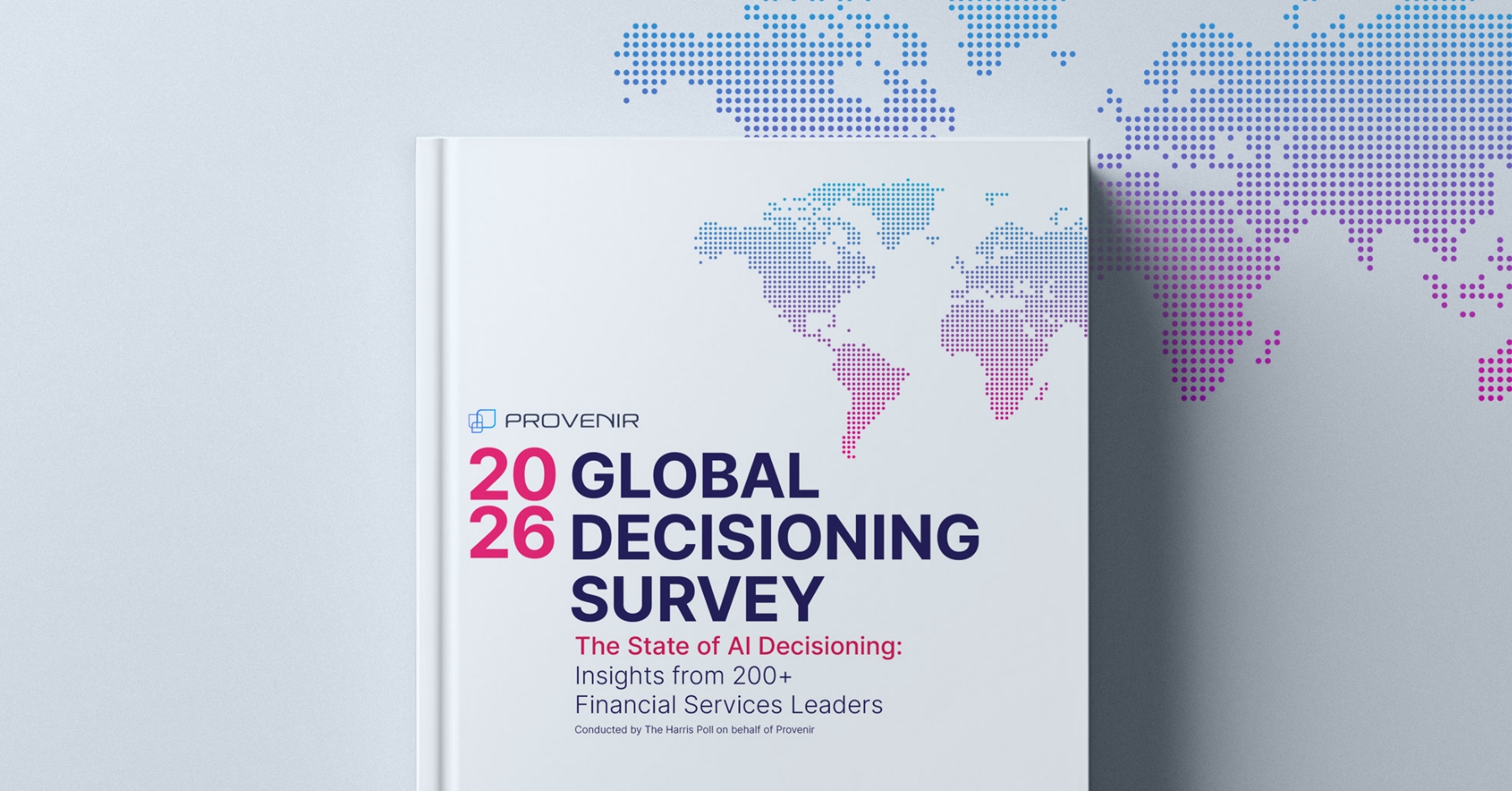
EBOOK Survey2026

Download the full 2026 Global Decisioning Survey:

Download Survey

LATEST RESOURCES

BLOG Survey02

The Fraud-AI Double ...

Financial institutions face a critical tension. They need AI to combat increasingly sophisticated fraud. Yet
BLOG Survey01

Why 77% of Financial...

The financial services industry is experiencing a fundamental shift. Organizations have spent years automating decisions.
EBOOK Survey2026

Survey: 2026 Global ...

The financial services industry stands at an inflection point in its adoption of artificial intelligence
The State of AI, Risk, and Fraud in Financial Services

The State of AI, Ris...

The State of AI, Risk, and Fraud in Financial Services 2025: A Year of Transformation

Continue reading

Columbia Credit Union

Customer Story: Columbia Credit Union

Columbia Credit Union is a member owned financial co-op serving over 100K members and managing over $2 billion in assets. Founded in 1952, CCU provides a full suite of personal & business financial services, including checking/savings, consumer + auto loans, credit cards, Home services, and SMB lending. CCU is known for their strong community focus & are recognized for their deep commitment to member services. Credit Unions like CCU are focus on strong member experiences and financial inclusion for the geography and members they serve.
  • Industry
  • Region
  • Countries

    United States

  • Line of Business
  • Solution
  • Module
  • Infrastructure
  • ROI
  • Competition

Customer Timeline
Land MRR: $13,200
Land PS: $170K
Land DS: $0
Expand MRR: ~$17.5K
Expand PS: $84K
Expand DS: $71K
  • Opportunity Created
    August 6, 2020
  • Opportunity Won
    June 24, 2021
  • Go-Live
    Late 2020, Technical Go-Live

    Unknown Full Go-Live

  • Customer Expansion
    • In Progress:
      • Deposits New Account Opening – Fraud Checks
      • Account Management
      • Deposits New Account Opening Cross-Sell Model (Data Science)
      • Indirect Auto loan portfolio analysis and optimization (Data Science)
    • Future:
      Collections, SMB Lending, HELOC, Case Management
Initial Opportunity Details

  • Customer Challenge

    • Digital transformation, move to automated underwriting to reduce cumbersome onboarding and loan process and create a more frictionless experience for Members
    • Auto, Personal Loans, and Credit Cards will be focus 1st.
    • 4,500 apps / month, where only 20% / 900 are auto approved. 40% approved, with around 425 approvals per month. Biggest channel is auto dealer indirect channel.
    • Improved and enhanced member communication
      • Ability to automatically send “notifications” and/or “text messages”
      • Ability for two way communication with applicant via text messages
  • Provenir Impact

    • Automated Underwriting Process By implementing Provenir solutions in conjunction with incumbent Meridian Link, CCU could greatly increase their automated approval rates. This improved customer satisfcation, removed unnecessary friction for good users, and streamlined the UW process.
    • Reporting The ability to Easily generate “out of policy” reports to include the reason the loan was approved/declined was a significant piece for CCU.Ingesting the decision information based on where loan failed in the auto decision process provided insights for future improvement within the workflow
    • Member Communication Utilizing decisioning and data insights from Provenir to communicate value to their member community. Ability to automatically send “notifications” and/or “text messages” Ability for two way communication with applicant via text messages​
  • Competitors

    Meridian Link, NCINO
  • Why We Won

    • Speed to change / time to market.
    • The ability to auto decision based on numerous “if-then” scenarios – Ease of updating auto decision criteria
    • Object-oriented solution design enabled more complex, multi-threaded decisioning strategies
    • Reporting:
      • Easily generate “out of policy” report to include reason the loan was approved/declined
      • Decision information based on where loan failed in the auto decision process
  • Pain Points

    • Current automated approval at 20%; wants to get to 70%.
    • Limited member communication
    • Incumbent vendor’s slow and friction-filled delivery experience
Customer Growth

Growth Opportunities

TBD

Expansion

TBD

OTHER CUSTOMER STORIES

Continue reading

FNBO

Customer Story: FNBO

First National Bank of Omaha (FNBO) is a privately owned financial institution headquartered in Omaha, Nebraska. Founded in 1857 by brothers Herman and Augustus Kountze, it is the oldest national bank in the United States west of the Missouri River. FNBO operates as a subsidiary of First National of Nebraska, Inc., a bank holding company primarily owned by the Lauritzen family.

FNBO has over $32 billion in assets and employs approximately 4,500 people across eight states: Nebraska, Colorado, Illinois, Iowa, Kansas, South Dakota, Texas, and Wyoming.

  • Industry
  • Region
  • Countries

    United States

  • Line of Business
  • Solution
  • Module
  • Infrastructure
  • ROI
  • Competition

Customer Timeline
Land MRR: $61,341.90
Land PS: $400K
Expand MRR: $24,204
Expand PS: $360K
  • Opportunity Created
    October 2023
  • Opportunity Won
    May 2024
  • Go-Live
    Unsecured Consumer Loans, April 2025

    Consumer Credit Card, November 2025

  • Customer Expansion
    • NEXT: Small Business Credit Card,
      Customer Management
    • FUTURE:
      • Auto Loans
      • Home Equity Loans & Lines of Credit
      • Collections
      • Multi-bureau Waterfall
      • Application Re-decisioning
      • Fraud Risk Decisioning Waterfall
      • Document Verification
      • Zest Migration/ AI Model Support
      • Payment Verification
Initial Opportunity Details

  • Customer Challenge

    • Migrating from legacy platforms that required frequently updates, upgrades, patches and maintenance costs
    • Testing capabilities were very limited
    • Onboarding and testing new data sources difficult, time consuming and costly
    • Complex decisioning strategies were impractical given solution design, requiring inefficient workarounds that weighed on SLAs
  • Provenir Impact

    • Return to Growth: After the challenges brought on by COVD-19 and the inflationary and high-interest rate environments that resulted, FNBO can now invest for growth by more rapidly testing and deploying multi-faceted risk strategies for their high-growth unsecured credit card product lines that are sold through strong retail partnerships through the USA, optimizing price and controlling for credit and fraud risk
    • Improve Lending Efficiency: Limitations of legacy systems prevented FNBO from intelligently waterfalling through alternative bureau, fraud & other data sources, decisioning on multiple applicants, & re-processing applications upon receipt of new information. Now lending operations are streamlined, false positives reduced, & automation increased, leading to higher volumes that exceed pricing & lending standards.
    • Full 360º View of Lending Operations: The Provenir unified platform now allows administrative governance of risk strategies across lines of business, allowing shared components to be deployed for multiple products and enhanced in a more agile fashion, allowing FNBO to move faster than previously and re-deploy human resources to higher return activities vs. on maintenance of credit risk decisioning systems.
  • Competitors

    Experian
  • Why We Won

    • Cloud-native solution reduced / eliminated costly maintenance
    • Strong testing and deployment capabilities
    • Object-oriented solution design enabled more complex, multi-threaded decisioning strategies
    • Unified platform for all decisioning made customer management, collections and other lines of business easy to migrate onto the platform
  • Pain Points

    • Migrating from legacy platforms that required frequently updates, upgrades, patches and maintenance costs
    • Testing capabilities were very limited
    • Onboarding and testing new data sources difficult, time consuming and costly
    • Complex decisioning strategies were impractical given solution design, requiring inefficient workarounds that weighed on SLAs
Customer Growth

Growth Opportunities

FNBO plans to expand the platform into Account Management and Collections as its two near-term strategic initiatives, and will expand its use into new lines of business including small business credit card, auto lending, home equity and other lines of business.

Additionally, several areas of opportunity for optimization have arisen in re-evaluating certain business workflows and decisioning strategies, including but not limited to multi-bureau waterfalls that features a new primary bureau, fraud risk decisioning waterfalls to support stronger onboarding with less friction and more fraud assurances, migration from Zest for ML scoring to internal use of advanced analytics, document verification in new account opening processes for consumer and small business banking, and others.

Expansion

The collaborative, on-demand relationship developed between FNBO and Provenir to implement products and consult on a wide-range of topics necessitate a more flexible support model. As a result, Provenir is proposing a bespoke support subscription that includes implementation resources, training, data science and business consulting to both expand the product and maximize its impact on the bank’s top- and bottom lines.

The bespoke support subscription adds $24,000+ in MRR and allows FNBO to tap into up to 4,000 hours over 42 months to tackle a broad range initiatives that directors at the bank have indicated are its top priorities.

Example Decisioning Flows
  • Initialize Data

    Step 1

    • Initialize Data
    • Initial Trasnformation
    • Initial Calculations
  • Critical Field Check

    Step 2

    • Require field checks
    • Checking Missing or Null
  • Eligibility Check

    Step 3

    • Product Eligibiltiy Check
    • Knockout Rules
  • Fetch Acct Data

    Step 4

    • Call FNBO to get Acct Data
  • Duplicate Application Check

    Step 5

    • Check if duplicate app
  • Duplicate Account Check

    Step 6

    • Check for duplicate accounts
  • Delinquency Check

    Step 7

    • Check for delinquency
  • Aggregate Exposure Check

    Step 8

    • Calculate Aggregate Exposure
  • Internal Fraud Check

    Step 9

    • Run a check against internal fraud database
  • External Fraud Check

    Step 10

    • Call Iovation, Socure Fraud
    • Check for Fraud
  • KYC Check

    Step 11

    • Call Socure KYC
    • Verify Applicant
  • Final Decision

    Step 12

    • Final Decision
    • Final Trasnformation
  • Save Data Model to DB

    Step 13

    • Save Data Model to DB
  • Initialize Data

    Step 1

    • Initialize Data
    • Initial Trasnformation
    • Initial Calculations
OTHER CUSTOMER STORIES

Continue reading

traton

Customer Story: Traton

Traton Financial Services operates as a finance provider for the wider Traton Group, one of the world’s largest commercial vehicle manufactures. Traton comprises of 4 major brands – Scania, MAN, International Financial and VW Bus & Trucking.

Traton Financial Services’ primary role is to provide financial options that help drive the growth and strategic goals of each business unit.

Today, Traton Group has circa 105 thousand employees, spread over 100 countries globally.

  • Industry
  • Region
  • Countries

    Sweden, Finland, Denmark, Norway

  • Line of Business
  • Solution
  • Module
  • Infrastructure
  • ROI
  • Competition

Customer Timeline
Land MRR: €10K
Land PS: €194K
Expansion MRR: €29K
Expansion PS: €500K
Future MRR: ~€ 20K (TFS)
Future PS: €250K
  • Opportunity Created
    April 2020
  • Opportunity Won
    February 2021
  • Go-Live
    Scania Italy January 2024
    Scania Australia May 2024
    MAN Italy May 2024
    MAN Spain Jan 2025
    MAN Portugal June 2025
  • Customer Expansion

    In Progress

    • Discussions around Cloud 2 and adoption in other geographies
    • Subscription Services – driving self sufficiency.

    Future

    • Broaden discussions into Fraud
    • Leverage success to drive across the wider VW Group
Initial Opportunity Details

  • Customer Challenge

    Our journey began with Scania who were looking to replace a fractured legacy of disparate systems across their global business units with a modernized singular decisioning platform to support their TOM. They were focusing on removing customer friction from the sales process and supporting a move towards a single Global Customer View.

    Following the merger into Traton FS, Provenir was selected as the group standard as they looked to address a larger problem: how to create a unified, consistent customer experience across the group. We are now in the process of supporting the central team drive this standard to the global business units.

  • Provenir Impact

    • Improve operational efficiency through Digitalization & Automation of the customer onboarding and credit processes
    • Improve CX and conversion rates through customization and real time decisioning
    • Provide better overview, control and risk governance through a structured global platform
    • Support growth through improved flexibility, speed and scalability
  • Competitors

    Experian, FICO
  • Why We Won

    Data-Orchestration / Integration:

    • We demonstrated the ease in which we can automate 3rd party calls to provide a single view of the customers data, integrating into various systems globally.

    Re-Use for accelerated value:

    • Traton’s ambition for a global harmonisation of their credit systems meant re-use was essential for their business to scale. This was a clear differentiator for us in the process.
  • Pain Points

    • Slow transactions with too much customer friction
    • No Consistency – bad global standard
    • Lack of Global and Local Customisation
Customer Growth

Short-Term Growth Opportunities

Self-Sufficiency:

  • Driving the adoption of a subscription service that will provide their centralised team with access to enablement materials and collaboration with wider PS / DS teams.

New Business Units

  • Expansion into Thailand & Malaysia. These units are run by the team in Australia, where we are already live, and provide us the opportunity to consolidate the APJ triton business units onto a single instance, separate from the existing global infrastructure.

Expansion

We are engaging with Traton on expansion into other regions, where Data Residency laws are making it challenging for the local business units to leverage the existing global solution. Each deployment across into new regions ensures that the Provenir solution becomes a more integral component of their global architecture.

OTHER CUSTOMER STORIES

Continue reading

Jason Abbott, Fraud Solution Director at Provenir, explains how to fight First-Party Fraud.

First-Party Fraud: The Hidden Cost

BLOG

First-Party Fraud:
The Hidden Cost of “Good” Customers

Unmasking Risk with a Unified Approach

  • jason abbott headshot

    Jason Abbott 

In the relentless battle against fraud, our industry has traditionally focused heavily on third-party attacks – the obvious criminals attempting to steal identities or hijack accounts. While crucial, this focus can obscure a far more insidious and often underestimated threat: first-party fraud (FPF).

First-party fraud occurs when a seemingly legitimate customer manipulates products or services for financial gain. Unlike external fraudsters, these individuals often use their own genuine identity, making them incredibly difficult to detect with traditional fraud detection methods. The insidious nature of FPF means it frequently slips through the cracks, masquerading as legitimate credit risk or bad debt, and quietly eroding profitability across a number of businesses globally.

The Nuances of First-Party: Beyond Just Bad Debt

FPF manifests in various forms:
  • No Intent to Repay: This is perhaps the most damaging type. Here, the applicant takes out a loan, opens a credit line, or acquires a device with a deliberate intention not to repay from the outset. They may appear creditworthy on paper, but their true aim is to default.
  • Fabricated Income/Employment: Inflating income, creating fake employment, or misrepresenting financial obligations to secure better terms or larger credit limits.
  • Bust-Out Schemes: Initially establishing a good payment history, then maxing out credit lines with no intention of repayment, often followed by disappearing or declaring bankruptcy.
  • Friendly Fraud/Chargeback Abuse: Disputing legitimate charges or feigning non-receipt of goods/services to avoid payment.
  • Early Account Closure/Churn: Using an account for a specific benefit (e.g., promotional offer, cashback) and then closing it immediately, leaving the provider out of pocket.

The core challenge with FPF, particularly “no intent to repay,” is that it blurs the lines between credit risk and outright fraud. A customer might appear to simply be a “bad credit risk” when, in fact, they are a fraudster. Traditional fraud prevention systems, often siloed from credit risk assessments, are not designed to detect this deliberate deception.

Why FPF Goes Undetected: The Blurry Line of Intent

The struggle to detect FPF stems from several factors:

  • Authentic Identity: The applicant uses their real name, address, and genuine identity documents. This makes it difficult for standard ID&V checks to flag them as fraudulent.
  • Intent is Hard to Prove: Proving intent to defraud is complex. Unlike stolen identities, where the illicit nature is clear, FPF relies on understanding behavioral anomalies and subtle red flags that indicate malicious pre-meditation.
  • Siloed Operations: Credit risk, fraud, and collections teams often operate independently, using separate data sets and disparate systems. This prevents a holistic view of the customer journey and makes it challenging to connect early application behaviors with later default patterns.
  • Data Gaps: Traditional credit models primarily focus on past payment behavior. They often lack the dynamic, real-time insights into application inconsistencies, behavioral biometrics, or device intelligence that could expose FPF.

Unifying Risk to Unmask First-Party Fraud Through Behavioral Intelligence

Effectively combating first-party fraud – especially the “no intent to repay” variant – requires a unified, data-driven approach that breaks down the traditional silos between fraud, credit risk, and even collections. This necessitates adding a crucial layer of behavioral intelligence to risk assessments.

  • Orchestrating a 360-Degree View of the Applicant: The key to unmasking intent lies in connecting seemingly disparate data points. This involves integrating vast and diverse data sources – not just credit bureau data, but alternative data, device intelligence, telecom data, and internal application history. By orchestrating this rich tapestry of information, a comprehensive profile can be built that reveals subtle inconsistencies and red flags indicative of FPF.
  • Early Detection of Fraudulent Intent through Behavioral Signals: This goes beyond traditional checks. Actively capturing and analyzing behavioral signals during the application process and beyond can provide critical insights. These include:

    • Application Behavior: How an applicant interacts with the application form (e.g., speed of completion, excessive copy/pasting, rapid changes to information, unusual navigation patterns).
    • Device Fingerprinting: Identifying suspicious device usage patterns (e.g., multiple applications from the same device but different identities, use of emulators or VPNs).
    • User Interface Anomalies: Detecting unusual interactions that deviate from typical, legitimate user behavior. These early behavioral indicators, often invisible to conventional systems, provide invaluable insights into a potential “no intent to repay” scenario, allowing for intervention before a loss occurs.
  • Advanced Machine Learning Models for Deeper Intent Detection: Leveraging this enriched dataset, including behavioral signals, powerful machine learning models can be employed. These models should be continuously learning and adapting to:

    • Identify Anomalies in Application Data: Pinpointing unusual patterns that might bypass basic checks.
    • Correlate Behavioral Flags with Risk: Understanding how specific behavioral patterns, when combined with other data, indicate a higher propensity for FPF.
    • Predict “No Intent to Repay”: By analyzing a combination of application data, behavioral signals, past repayment behaviors (across an ecosystem of lenders, if applicable), and external fraud indicators, models can generate a predictive score for intent-based fraud. This allows for proactive intervention at the application stage.

  • Real-Time, Adaptive Decisioning: FPF requires rapid response. Real-time decision engines allow organizations to instantly assess the nuanced risk of each applicant. This means legitimate customers experience seamless onboarding, while suspicious applications are flagged for further review or denied, preventing losses before they occur. The flexibility of such systems enables rapid adaptation of strategies as new FPF patterns emerge.

Connecting the Dots Across the Customer Lifecycle: A core strength lies in unifying platforms for credit risk, fraud prevention, and collections. This holistic view is paramount for FPF:

  • Integrated Data for Credit Risk: Data insights gathered during fraud detection, including behavioral signals, can directly feed into and enhance credit risk models, providing a more accurate assessment of true repayment likelihood.
  • Early Warning for Collections: By identifying FPF at the application stage or early in the account lifecycle, businesses can proactively adjust collections strategies, prioritize accounts, or even prevent the onboarding of high-risk individuals from the outset.
  • Feedback Loops for Continuous Improvement: Performance data from credit risk and collections efforts can be fed back into the fraud models, creating a powerful feedback loop that continuously refines detection capabilities.

Beyond the Bad Debt Write-Off: Preventing Fraud at the Source

First-party fraud is not simply bad debt; it’s a deliberate act of deception that demands a dedicated, intelligent solution. By moving beyond siloed operations and embracing a unified risk approach that intelligently combines traditional and behavioral data, leverages advanced machine learning, and enables real-time decisioning, businesses can effectively unmask “no intent to repay” schemes and other forms of FPF. This not only mitigates significant financial losses but also ensures that resources are focused on truly legitimate customers, fostering a more secure and profitable ecosystem for all.


Jason Abbott is a highly experienced fraud prevention leader with 18 years of expertise, currently serving as the Director of Fraud Solutions at Provenir. He specializes in application fraud, identity, and authentication, with a strong background in product management and go-to-market strategies for fraud software. Having held significant roles at major UK banks like JPMorgan Chase & Co., Barclays, and HSBC, Jason has a proven ability to deliver results across retail, corporate, and wealth sectors, actively contributing to the industry by sharing insights on evolving fraud threats. Get in touch on LinkedIn.

Learn More on our fraud solution

Contact Us

LATEST BLOGS

260817 - BLOG Closing Fraud Gap - FeatureIMG - EN 61409

Beyond Detection: Cl...

Beyond Detection:Closing the Fraud Prevention Gap Financial services providers
260726 - BLOG eyeDP - FeatureIMG - 61058

Beyond Data: Why Dec...

Beyond Data:Why Decisioning Needs Document Intelligence Financial services providers
Fraud in Telco: Provenir Experts Answer Frequently Asked Questions

Fraud in Telco: Prov...

Fraud in Telco:Provenir Experts Answer Frequently Asked Questions 1.
260722 - ARTICLE Mike - FeatureIMG - 60958

AI governance in fin...

AI governance in financial services:What "governed" means in practice
Latam Compliance Challenge for Decisioning

LATAM Next Complianc...

From Data Protection to Decisioning Accountability:What LATAM Regulation Means
Banks Architecture Gap - Provenir

The Architecture Gap...

Decisioning ArchitectureThe Architecture Gap: Banking's Next Competitive Battleground Banks
BLOG Andy

The Real Cost of Ven...

The Real Cost of Vendor Dependency in Credit Decisioning
260617 - BLOG Matthew Nutt - FeatureIMG - 60431

What Does a Good Dat...

What Does a Good Data Provider Review Actually Look

Continue reading

charter logo

Customer Story: Charter

charter logo

Charter Communications is a leading broadband connectivity company and cable operator, headquartered in Stamford, Connecticut. With an annual revenue of $55 billion, Charter provides high-speed internet, video, mobile, and voice services to millions of customers across 41 U.S. states.

As a trusted provider, Charter serves 57 million homes and connects 500 million IP devices to its robust network. The company also powers businesses with 300,000 fiber-lit commercial office buildings, ensuring seamless connectivity and innovation. Recognized for excellence, Charter has been ranked #1 in customer satisfaction by JD Power within its peer group, reflecting its commitment to delivering high-quality service and superior customer experience.

  • Industry
  • Region
  • Countries

    United States

  • Line of Business
  • Solution
  • Module
  • Infrastructure
  • ROI
  • Competition

Customer Timeline
Land MRR: $62K
Land PS: $462K
Expand MRR: $100K
Expand PS: $250K
  • Opportunity Created
    June 28, 2024
  • Opportunity Won
    January 21, 2025
  • Go-Live
    Estimated July 2025
  • Customer Expansion
    • Collections/Delinquency Mitigation
    • Portfolio Management (upsell/cross sell)
    • TRMA Sponsorship
    • Case Study
Initial Opportunity Details

  • Customer Challenge

    • Charter has seen application fraud rates spike significantly over the past three years.
    • Antiquated systems prevented Charter from effectively mitigating application fraud
    • Experian FraudNet Solution cost over $1M a year to support and was ineffective.
    • New senior executive team hired to rebuild Charter fraud onboarding infrastructure
    • Charter Data Science team was handcuffed by poor analytics, testing capabilities, and decentralized workflow tools.
  • Provenir Approach

    Profiling Engine

    Aggregation of specific values over a time period.

    • “Grouping of Activity” / “Buckets of Behavior”
    Examples:
    • IP Address 168.192.1.1 has been on 10 transactions over the past 6 hours
    • Location 123 has had a median order amount of $5,222 over the past 180 days
    Python Model Deployment

    Provenir provides the Charter Data Science team a platform to deploy, execute, test, monitor models they build to detect Fraud and Risk.

  • Provenir Impact

    • Reduced customer friction and losses, while optimizing operations through a stable, reliable, and scalable platform to support analytics and reporting needs.
    • Fraud and credit abuse controls prior to order submission will enable more accurate real-time decisioning.
    • $1M immediate annual cost reduction with the elimination of the Experian FraudNet tool.
    • The platform will enable risk assessment functionalities like testing rule performance and fraud decisioning through advanced ML models
    • Centralized Rule and Model Governance
  • Competitors

    Experian (incumbent), FICO, DataVisor, Socure, Visa (risk product) and Pega
  • Why We Won

    • Provenir Solution: Provenir Profiling Engine provided the most compelling/complete solution for Charter
    • Our Team: Fraud Expertise + Implementation Certainty
    • Decision Intelligence and Advanced AI/ML
      Centralized Rules and Model Governance
  • Pain Points

    • Decentralized fraud controls
    • Poor Analytics and Reporting
    • Infrastructure Downtime
    • Inability to leverage AI and Advanced Learning models
Customer Growth

Growth Opportunities

Organic Volume Growth – Charter’s expecting significant geographic expansion over next 3-5 years.

Expansion

  • Portfolio Management/Account Management
  • Collections – Charter has seen a rise in delinquencies and customer churn
Example Decisioning Flows
  • New Application

    Decisioning

    Orders received for two channels:

    1.Ship to Home
    or
    2.In Store

  • Internal/external Data Calls

    Decisioning

    Data Vendors

    • Ekata
    • SentiLink
    • Datafiniti
    • Nuance
    • RevSprings
    • UPS/FedEx
    • Citrix
    • Authentic ID
  • Real-Time Fraud Checks

    Decisioning

    Rules and Lookups

    • Negative List
    • Velocity Checks
    • Email, Billing, Device, Attempts, etc.
    • Feature Aggregation
    • Blacklist
    • Valid/Deceased SSN
    • Fraud Prevention Scenarios
    • SMB Orders
    • Positive Lists
  • Scoring and Risk Models

    Decisioning

    Analytical Models

    • Models built by Charter Data Scientists in KC
    • Champion / Challenge
    • Ongoing Feature Engineering
  • Manual Review Exceptions

    Decisioning

    Alert Review

    • Red / Yellow / Green Risk Assignment
    • Fraud, Credit, Sanctions, Affordability Analyst and Underwriter Reviews
OTHER CUSTOMER STORIES

Continue reading

navan

Customer Story: Navan

navan

Formerly ‘TripActions’, Navan were founded in 2015 and are an online travel, corporate card and expense management company. They look to automate manual processes and drive a better spending visibility for their clients via their next generation of software design. They were looking for a solution that can enable them to automate their credit risk assessments for corporate travel card applications, which brought them to Provenir.
  • Industry
  • Region
  • Country

    United States

  • Line of Business
  • Solution
  • Module
  • Infrastructure
  • ROI
  • Competition

Customer Timeline
Land MRR: $15,960
Land PS: $92,656
Expand MRR/PS: TBD
  • Opportunity Created
    March 1, 2024
  • Opportunity Won
    April 18, 2022
    Selection from the Business received

    May 6, 2024
    Selection from the Technical team received

  • Go-Live
    TBD
  • Customer Expansion
    TBD. But there is significant opportunity for expanded use in Portfolio Management and Fraud strategies.
Initial Opportunity Details

  • Customer Challenge

    Navan’s assessment of new applications was done completely via complex formatted scorecards maintained in a google sheet. They had onboarded another decision solutions provider called Benoble, but had never reached a true point of utilization with them before Benoble announced they were folding as an organization. This left Navan performing an extremely manual credit assessment via their google sheet scorecard, which caused issues for Navan, such as:

    • Difficulty tracking application data and outcomes, which is bad for auditing.
    • Longer application processing times (2-3 days for onboarding).
    • Credit strategy not easily maintained.
  • Provenir Approach

    Initial scope of the ‘day 1’ solution is to essentially automate what they do today, taking the manual scorecard maintained in the google sheet, automate them via scorecard objects while maintaining some of the key principles they wish to keep going forward related to scoring and weighting. Case Management will give them an improved grip over making the final decision (‘rubber stamp’) on all applications, while being able to easily capture and edit application data before submitting into the process.
  • Provenir Impact

    Navan had no existing automated origination system. The main business impacts:

    • Significantly reduced ‘time to lend’ and ‘cost to lend’
    • Enhanced compliance
    • Improved manual intervention capabilities
  • Competitors

    Alloy and another unnamed.
  • Why We Won

    Following a POC, Navan were impressed by our solution’s features and capabilities which enabled them to easily automate their existing policy while maintaining some of the key principles they wished to keep with their ‘day 1’ solution. Against Alloy, we filled a feature gap around our ability to flexibly batch test new configurations while also supporting batch processing. Furthermore, Alloy resell data with certain attributes not available or withheld from the response, and Navan appreciated we have full response structures in our marketplace adaptors for them to select from.

    Navan also appreciated our commitment to them, their success criteria and any questions they had, valuing the level of involvement we maintained during the entire sales process. Something, according to them, other vendors they were speaking to were not as good at.

  • Pain Points

    • Poor auditing capabilities.
    • Long time to lending.
    • Difficult to maintain credit strategy.
Customer Growth

Growth Opportunities

  • Portfolio (customer) Management
  • Fraud

Expansion

TBD
Example Decisioning Flows
  • New Application

    Decisioning

    Pre-Bureau Knockout Rules
  • Bureau Integration

    Decisioning

    circulo
  • Rules and Models

    Decisioning

    A series of scorecards covering:

    • Business Information
    • Financials
    • 3rd Party Data
  • Credit Line Assignment

    Decisioning

    • Credit Risk Rating
    • Credit Limit Line Assignment
  • Case Management

    Decisioning

    Case Management used in all cases to:

    • Sense Check assessed data
    • Make final credit limit decision
    • Multi-level approvals
OTHER CUSTOMER STORIES

Continue reading

Customer Story: Varo

varo

Fintech startup Varo Bank is one of several fintechs and “challenger banks” in the United States aiming to take on the big traditional financial institutions by catering to the customers those institutions neglect: people with lower incomes and little wealth. The bank is completely digital with no brick-and-mortar branches.
  • Industry
  • Region
  • Country

    United States

  • Line of Business
  • Solution
  • Module
  • Infrastructure
  • ROI
  • Competition

Customer Timeline
Land MRR: $13,513
Land PS: $196K est
Expand MRR: TBD
Expand PS: $52,740
  • Opportunity Created
    June 20, 2020
  • Opportunity Won

    January 18, 2022

    The decision timeline was significantly delayed due to the ongoing COVID-19 pandemic.

  • Go-Live

    April 17, 2024

    Reorganizations and multiple project holds from Varo affected the timeline. Actual implementation took 5 months.

  • Customer Expansion
    • The original plan (2022) was to expand usage to all consumer products.
    • The first go-live (April 2024) was to support an employee line of credit.
    • Current plans are to expand to customers in May 2024.
    • Provenir is finalizing a PS Consulting SOW for $52,740, expected to close in May 2024.
Initial Opportunity Details

  • Customer Challenge

    Varo’s initial tech stack included an in-house-built mobile application and Temenos as the core banking system. By 2020, Varo was on the cusp of receiving its banking license and went to market to find an origination solution in anticipation of rolling out a variety of consumer loan products and credit cards.

    In looking at other vendors + the possibility of leveraging older in-house-build applications to create an in-house solution, the ability to configure rapidly, test efficiently including use of A/B testing, and expand easily in the future to new use cases were identified as key drivers of the decision.

  • Provenir Approach

    • The initial POC was more complicated from a functionality perspective than the finalized scope of the LOC decisioning process put into production in April 2024.
    • Nonetheless, Provenir’s initial reasons for selection – ability to rapidly configure business objects and deploy models – were both used to support the eventual as-deployed project, with numerous rule sets and Python models part of the configuration.
  • Provenir Impact

    Varo had no previous origination system and as a de novo solution, no before-and-after comparisons are possible.

  • Competitors

    GDS Link, In-House Build (finalists) + Zoot, Alchemy
  • Why We Won

    Competitive Pricing, Product Functionality – especially object configuration and model execution, Relationship with executives built over several years.

    GDS took 3+ weeks to configure/deliver custom demo requirements; Provenir did a better custom demo only a week after receiving requirements.

  • Pain Points

    Temenos (Varo’s existing core system of record) didn’t have origination capability. Thus, they were in the market for an origination solution.
Customer Growth

Growth Opportunities

  • The initial license was only ringfenced based on DE utilization and “consumer lending.” At this time, additional expansion will only likely affect DE utilization as Varo is not currently planning expansion beyond consumer products.
  • Case Management has been something in which Varo has shown interest in the past; this should be revisited at a later date and is considered “closed nurture” today.
  • Lexis Nexis is interested in partnering with Provenir to sell data into Varo.

Expansion

  • So far, with so many starts and stops of the implementation project (all initiated by the Varo team), getting the initial project live has been the focus.
  • At the time we were named the selected vendor, the plan was to leverage Provenir across all decisioning as Varo introduced new products. Even though Varo’s timeline to roll out new products has greatly increased, Provenir is still positioned to support these initiatives when they happen.
Example Decisioning Flows
  • New Application

    Decisioning

  • Bureau Integration

    Decisioning

    circulo
  • Rules and Models

    Decisioning

    • Post-Bureau Knockout Rules
    • Python Models
    • Post-Model Knockout Rules
  • Credit Line Assignment

    Decisioning

    • Credit Line Grid
    • Line-Capping Rules
  • Compliance

    Decisioning

    Compliance Rules
OTHER CUSTOMER STORIES

Continue reading

Customer Story: Humm

humm logo

Hummgroup specialises in financing bigger ticket purchases with a range of credit card and fixed term instalment products that are designed for consumers and SMEs.

Hummgroup, founded in Australia, currently operates in Australia, New Zealand, Ireland, Canada and the UK.

Industry: Financial Services.

Company Size: 501 – 1000 employees.

Consumer & Commercial Leasing – Offers leasing solutions to consumers, businesses and corporations through brands including Lisa, FlexiRent, FlexiWay, FlexiCommercial, and SmartWay.

  • Industry
  • Region
  • Country

    Canada

  • Line of Business
  • Solution
  • Module
  • Infrastructure
  • ROI
  • Competition

Customer Timeline
Land MRR: $9,162
Land PS: $40,500
Expand MRR: N/A
Expand PS: $24,950
  • Opportunity Created
    02/06/2021
  • Opportunity Won
    27/08/2021
  • Go-Live
    End 2021
  • Customer Expansion

    CR:

    • Jun 2023 Credit rule revision
    • Sep 2023 Merchant-Led Provenir Rules
    • Oct 2023 Credit Band and Seller-led changes
Initial Opportunity Details

  • Customer Challenge

    In February 2021, hummgroup announced the launch of its BNPL product humm into Canada in 2H21 following its recent expansion into the UK market. They needed to launch operations in a new market with a challenging time frame.
  • Provenir Approach

    Provenir provided the decisioning engine for humm’s BNPL offering in Canada, including access to data partners via the Marketplace (initially two TransUnion Canada feeds).
  • Provenir Impact

    • Successful business expansion into Canada
    • Quick launch within the challenging timeline, including immediate access to multiple credit bureau data feeds
    • Flexible, easy, and quick configuration changes post launch
  • Competitors

    Illion Australia, Equifax Canada
  • Why We Won

    • Provenir’s rapid configuration capability, and the confidence our services team instilled to deliver in a 2-month timeframe.
    • Our proven experience in the Canadian market together with our Marketplace partnership with TransUnion Canadian data services.
    • Our global experience coupled with an APAC delivery team in the same time-zone as the humm technology team in Australia was viewed as an advantage.
    • The humm lead consultant had previously reviewed Provenir in a selection exercise for another opportunity and introduced Provenir to the wider humm team for evaluation. This reduced some of the product feature review time in the evaluation phase.
  • Pain Points

    • Quick launch
    • Ability to make changes easily
    • Data Integration with external data sources
Customer Growth

Growth Opportunities

Solution upgrade from Platform to Cloud 2.0 to unlock more cloud features, such as Decision Intelligence, more Provenir Marketplace data access.

Could consider expanding the solution usage to other countries where Humm operates, such as Australia, UK.

Could consider expanding the solution to automate products offered by Humm, such as SME lending.

Could consider expanding the use cases, such as Customer Management and Collection Strategy.

Expansion

N/A
Example Decisioning Flows
  • Fraud Checks

    Decisioning

    GBG Instinct

    TransUnion

    • Fraud Score IDX
  • IDV & AML

    Decisioning

    TransUnion

    • IDV
    • AML, PEP, Sanctions
    • EBVS-ID
  • Credit Bureau

    Decisioning

    TransUnion

    • Consumer Credit File
  • Financial Analysis

    Decisioning

    Flinks
  • High Risk Patters & Scoring

    Decisioning

    • Credit Checks
    • Policy Rules
    • Fraud Rules
    • Affordability
    • Bank Verification
    • Servicing Rules
    • Limit Assignment
    • Scorecard
    • Auto Accept
    • Auto Decline
    • Referrals
OTHER CUSTOMER STORIES

Continue reading