Resource: Survey

The Fraud-AI Double Bind

The Fraud-AI Double Bind: New Survey Reveals the Fraud-AI Paradox Facing Financial Institutions

Financial institutions face a critical tension. They need AI to combat increasingly sophisticated fraud. Yet 77% are concerned about AI-enabled fraud threats.

Our 2026 Global Decisioning Survey, conducted by The Harris Poll across 203 senior decision-makers in 22 countries, reveals the scope of this challenge and the strategies organizations are using to address it.

The Numbers

  • The adoption of AI for fraud prevention is strong:

    • 75% use AI-driven adaptive fraud prevention
    • 74% deploy real-time anomaly detection
    • 87% trust AI decisioning outcomes
  • Yet the concern is equally widespread:

    • 77% worry about AI-enabled fraud threats
    • 50% struggle to detect and react quickly to new fraud trends
One Chief Risk Officer we surveyed described the compliance challenge as “trying to get certified for a standard that hasn’t been written yet.”

The Speed Problem

When we asked about their biggest application fraud challenge, 50% identified detecting and reacting quickly to new fraud trends.

Bad actors use AI to evolve their tactics in real-time, testing thousands of attack vectors simultaneously. Traditional monthly or quarterly model updates can’t keep pace. Organizations need real-time, adaptive AI systems to combat fraud, but deploying those systems runs directly into implementation barriers around governance and explainability.

What Comprehensive Fraud Strategy Requires

When we asked what’s most important for delivering comprehensive fraud prevention, organizations prioritized four capabilities:

33%

rank as most important

Comprehensive fraud risk review of customer data:
Organizations need complete visibility across customer interactions and behavior patterns. Siloed views by channel or product line leave blind spots.

23%

Reducing friction in customer experience

Security cannot come at the cost of customer experience. Organizations that create too much friction lose legitimate customers to competitors.

22%

Aligning data at customer level vs. by channel

Breaking down silos to create unified customer views enables better fraud detection without false positives that frustrate good customers.

19%

Breaking down data silos between fraud and credit teams

Traditional organizational separation between fraud and credit creates blind spots. Integrated views improve both fraud prevention and credit decisioning.

How Organizations Measure Success

The variety in primary metrics reflects different organizational priorities:
  • 54%

    track enhancing operational efficiency and automation (16% say this is their primary metric)
  • 54%

    track improving accuracy of AI and ML models (25% say this is their primary metric)
  • 52%

    track reducing fraud loss (15% say this is their primary metric)
Operational efficiency and model accuracy rank equally with fraud loss reduction. Organizations recognize that sustainable fraud prevention requires systematic operational excellence beyond just loss minimization.
  • Breaking Free from the Double Bind:

    Organizations successfully navigating this tension balance aggressive AI adoption with comprehensive risk management.
  • Deploy explainable AI architectures from the start:

    They don’t sacrifice interpretability for performance. Modern approaches enable both.
  • Maintain human-in-the-loop oversight for high-risk decisions:

    AI handles volume and speed, but humans make final calls on edge cases and high-stakes scenarios.
  • Implement continuous monitoring for model drift and bias:

    They don’t deploy and forget. Models require ongoing governance.
  • Build governance as an ongoing product, not a one-time project:

    Governance evolves alongside AI capabilities and regulatory requirements.

The Implementation Reality

You can’t sacrifice governance for speed. But you also can’t sacrifice speed for governance. The most successful organizations find ways to achieve both.

They leverage platforms designed to orchestrate decisions across existing systems rather than requiring wholesale system replacement. This approach accelerates time-to-value and reduces technical risk.

Rather than ripping out decades of infrastructure, they deploy decisioning layers that orchestrate data from multiple sources and deliver decisions back to existing platforms in milliseconds.

Looking Ahead

The fraud landscape will continue to evolve faster than most organizations can currently respond. Organizations that successfully deploy explainable, governed AI at speed will protect revenue, preserve customer experience, and build sustainable advantages.

EBOOK Survey2026

Download the full 2026 Global Decisioning Survey:

Download Survey

LATEST BLOGS

BLOG Christian Ball

Smarter Acquisition ...

Smarter Acquisition and Customer Management:How Provenir Drives Growth and
carol blog

The Generational Shi...

The Generational Shift:Why Banks Are Replacing Their Decisioning Infrastructure
Frederic blog

Why AI Requires Ente...

Why AI Requires Enterprise Platforms to Deliver Business Value
HyperPersonalization

From Risk Manager to...

From Risk Manager to Revenue Generator:How CROs Are Becoming
Hyper-personalization Myth2

The Hyper-personaliz...

The Hyper-personalization Myth Series #2:The Scorecard Trap: How Traditional
Hyper-personalization Myth1

The Hyper-personaliz...

The Hyper-personalization Myth Series #1:Why Banks Think They're Doing
Beyond Static Rules

Beyond Static Rules

Beyond Static Rules:How Learning Systems Enhance Decisioning in Financial
AI Campaign

Beyond Traditional C...

Beyond Traditional Credit Scores:How Alternative Data is Revolutionizing Financial

Continue reading

Why 77% of Financial Institutions See Decision Intelligence as Their 2026 Priority

Why 77% of Financial Institutions See Decision Intelligence as Their 2026 Priority

The financial services industry is experiencing a fundamental shift. Organizations have spent years automating decisions. Now they need those decisions to get smarter.

Our 2026 Global Decisioning Survey reveals the scope of this transition: 77% of senior decision-makers see Decision Intelligence as very valuable for their strategy over the next 2-3 years.

What Decision Intelligence Actually Means

Decision Intelligence represents the evolution from automated decisioning to continuously optimized, AI-driven decision-making that learns and improves.

THE DIFFERENCE:

  • The Traditional Approach:

    Deploy AI models, measure results periodically, update quarterly, manage explainability and governance separately
  • Decision Intelligence Approach:

    Execute decisions at scale, measure outcomes continuously, learn from performance, optimize in real-time within unified platforms that provide transparency, governance, and integration
Organizations are moving quickly:
  • 75%

    are already collaborating on AI-driven decision intelligence
  • 18%

    are exploring partnerships
  • 66%

    are very interested in using AI for strategy implementation and optimization
  • 60%

    plan to invest in AI or embedded intelligence for decisioning in 2026 (making it the top investment priority)

What Organizations Value Most

When we asked which AI features provide the most value, organizations prioritized capabilities that go beyond basic automation:

51%

Ability to leverage generative AI for natural language queries
The democratization of AI insights through conversational interfaces transforms who can access and act on decisioning data. Business users, executives, operations teams, and compliance staff can all interact directly with AI systems using natural language.

92%

of organizations find it important to interact with data quickly using natural language queries.
(62% find it very important, 30% moderately important).
  • 49%

    Real-time decisioning across customer touchpoints:
    Speed and consistency across channels create better customer experiences and reduce operational complexity.
  • 50%

    Transparency and explainability of AI models:
    Organizations need AI they can understand and defend to regulators and stakeholders.
  • 47%

    Integration with existing systems and data sources:
    AI must work with existing infrastructure rather than requiring complete replacement.

The Business Impact

Organizations cite four primary benefits from improved Decision Intelligence:
  • 62%

    cite operational efficiency:

    Automated decision-making reduces manual review, accelerates processes, and lowers costs while improving consistency.
  • 52%

    cite better customer experience:

    Faster decisions, reduced friction, and personalized interactions create superior customer journeys.
  • 58%

    cite improved accuracy of models and strategies:

    Continuous learning and optimization improve predictive performance and business outcomes over time.
  • 56%

    cite faster deployment of new decision strategies:

    Rapid testing and iteration enable organizations to adapt quickly to market changes and competitive pressure.
These benefits compound over time. Organizations that deploy Decision Intelligence don’t just get better decisions today. They build systems that continuously improve.

The Intelligence Loop in Practice

Decision Intelligence creates a continuous cycle:
  • chess

    Shape Strategy

    Design and evolve decision strategy by learning from how decisions actually perform. Strategy is measured through outcomes and continuously refined to balance risk exposure and revenue opportunity.
  • rocket

    Execute Decisions

    Make real-time, data-driven decisions at every customer touchpoint using deep customer understanding, data, context, and decision history.
  • dashboard

    Measure Outcomes

    Connect decisions to business outcomes to see what actually drives risk, revenue, and profitability.
  • learning

    Learn and Optimize

    Get specific recommendations to improve performance based on actual results. Learn from the results over time and continuously refine strategies.
This loop transforms decisioning from a periodic batch process into a continuous optimization system.

The Natural Language Revolution

92% of organizations find it important to interact with data quickly using natural language queries. This represents a fundamental shift.

When business users can interact directly with AI systems using conversation, they build intuition about how these systems work. That understanding improves their ability to provide governance oversight and makes the entire organization more comfortable with AI-driven decisioning.

Natural language querying enables:

  • Business users to explore decisioning data without SQL knowledge
  • Executives to get instant answers to strategic questions
  • Operations teams to investigate anomalies in real-time
  • Compliance teams to audit decisions conversationally
This democratization helps address one of the top implementation barriers: explainability. When more people in the organization can interact with and understand AI systems, those systems become more transparent by design.

Addressing Implementation Barriers

Decision Intelligence approaches help address the barriers preventing AI adoption:
  • Explainability

    Platforms provide visibility into what decisions were made, how they perform, and why. This makes it easier to explain outcomes to regulators and stakeholders.
  • Governance

    Connecting decisions to business outcomes (risk, revenue, customer experience) makes governance more manageable. You measure results and learn from performance rather than monitoring models in isolation.
  • Integration

    Decision Intelligence platforms orchestrate data and decisions across existing infrastructure without requiring wholesale system replacement.
  • Speed

    Organizations can learn from every decision and optimize continuously, addressing the speed challenge that 50% cite as their biggest fraud detection obstacle.

Looking Ahead

The survey reveals clear momentum:
  • 77%

    see Decision Intelligence as very valuable
  • 75%

    are already implementing it
  • 66%

    want AI for strategy optimization
  • 60%

    are investing in 2026 (top priority)
Traditional decisioning optimizes for speed. Decision Intelligence optimizes for outcomes. Organizations that build systems capable of continuous learning will create advantages that compound over time.

EBOOK Survey2026

Download the full 2026 Global Decisioning Survey:

Download Survey

LATEST BLOGS

BLOG Christian Ball

Smarter Acquisition ...

Smarter Acquisition and Customer Management:How Provenir Drives Growth and
carol blog

The Generational Shi...

The Generational Shift:Why Banks Are Replacing Their Decisioning Infrastructure
Frederic blog

Why AI Requires Ente...

Why AI Requires Enterprise Platforms to Deliver Business Value
HyperPersonalization

From Risk Manager to...

From Risk Manager to Revenue Generator:How CROs Are Becoming
Hyper-personalization Myth2

The Hyper-personaliz...

The Hyper-personalization Myth Series #2:The Scorecard Trap: How Traditional
Hyper-personalization Myth1

The Hyper-personaliz...

The Hyper-personalization Myth Series #1:Why Banks Think They're Doing
Beyond Static Rules

Beyond Static Rules

Beyond Static Rules:How Learning Systems Enhance Decisioning in Financial
AI Campaign

Beyond Traditional C...

Beyond Traditional Credit Scores:How Alternative Data is Revolutionizing Financial

Continue reading

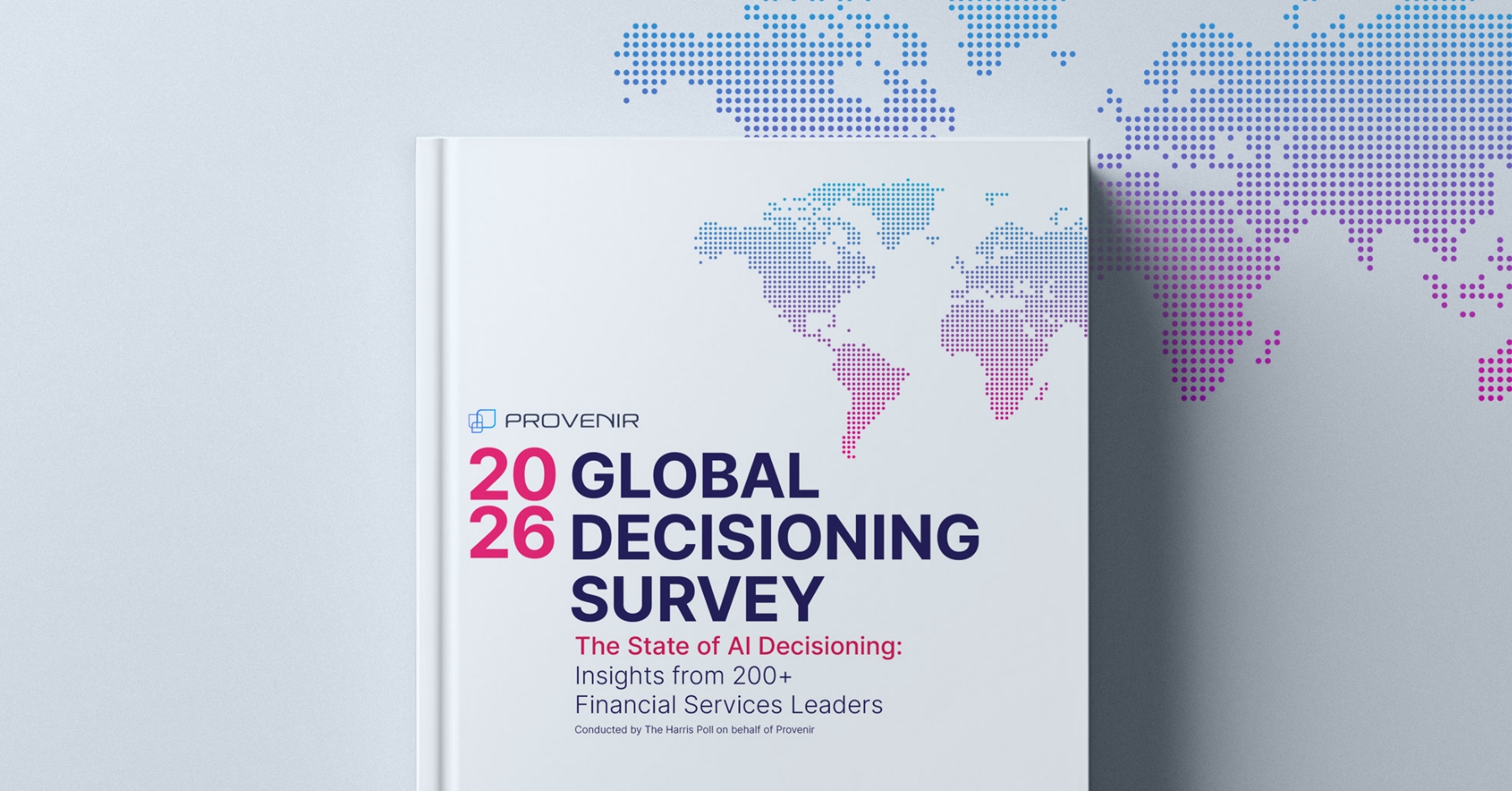
Survey: 2026 Global Decisioning Survey

What are the key challenges and priorities for financial services leaders in 2026 and beyond?

The financial services industry stands at an inflection point in its adoption of artificial intelligence for decisioning. Our 2026 Global Decisioning Survey reveals a sector that recognizes AI’s transformative potential yet struggles with universal implementation challenges.

We surveyed 203 senior decision-makers—including Chief Risk Officers, CEOs, CFOs, and Heads of Risk—across 22 countries spanning banking, fintech, insurance, telecommunications, and other financial services sectors. The findings paint a nuanced picture of an industry in transition.

KEY FINDINGS AT A GLANCE
  • The AI Paradox:

    87% trust AI-driven decisioning outcomes, yet 97% face implementation barriers
  • The Fraud Challenge:

    77% are concerned about AI-enabled fraud threats while needing AI to combat fraud
  • Real-Time Momentum:

    91% have moved beyond static-only models; 52% use hybrid approaches
  • Decision Intelligence:

    77% see it as very valuable for their strategy over the next 2-3 years
  • Investment Priority:

    60% plan to invest in AI or embedded intelligence for decisioning in 2026
  • Governance Gap:

    Only 33% have fully implemented responsible AI frameworks

These findings reveal an industry that knows where it needs to go but faces significant challenges getting there. The organizations that successfully navigate implementation barriers—around compliance, explainability, and integration—will build sustainable competitive advantages through faster, more accurate, and more adaptive decisioning.

ADDITIONAL RESOURCES

BLOG Christian Ball
Blog ::

Smarter Acquisition and Customer Mana...

Smarter Acquisition and Customer Management:How Provenir Drives Growth and Reduces ...
Open Banking Expo Toronto
Event ::

Open Banking Expo Toronto

Open Banking Expo Join Provenir at The Open Banking Expo ...
Zero Trust in Digital Banking

Zero Trust in Digital Banking

Zero Trust in Digital Banking: Why Risk Leaders Need a ...
EBOOK Survey2026
eBook, Survey ::

Survey: 2026 Global Decisioning Surve...

What are the key challenges and priorities for financial services ...
LewisGRP
News ::

Leading South African Furniture Retai...

Leading South African Furniture Retailer Lewis Group Partners with Provenir ...
carol blog
Blog ::

The Generational Shift: Why Banks Are...

The Generational Shift:Why Banks Are Replacing Their Decisioning Infrastructure Financial ...
Frederic blog
Blog ::

Why AI Requires Enterprise Platforms ...

Why AI Requires Enterprise Platforms to Deliver Business Value The ...
INFOGRAPHIC Hyper-personalization
Infographic ::

Hyper-Personalization in Action

Hyper-Personalization in Action: How AI-Driven Decisioning Transforms Every Customer Interaction ...

Continue reading

The State of AI, Risk, and Fraud in Financial Services

The State of AI, Risk, and Fraud in Financial Services

2025: A Year of Transformation in Risk Decisioning

The financial services industry is facing an inflection point. In 2025 (and beyond), staying ahead isn’t just about managing credit risk and preventing fraud – it’s about leveraging AI, unifying data, and modernizing decisioning systems to unlock new growth opportunities.

To better understand the challenges and priorities shaping the industry worldwide, we surveyed nearly 200 key decision-makers among financial services providers globally. The results highlight a pressing need for AI-driven insights, better data orchestration, and an end to fragmented decisioning strategies. This blog breaks down the key takeaways from the survey results and what they mean for the future of decisioning and your business.

Credit Risk and Fraud Prevention:
The Industry’s Top Concerns

The ability to manage credit risk and prevent fraud effectively remains a top priority, especially in an increasingly complex, digital economy. Forty-nine percent of our respondents identified managing credit risk as their biggest issue, and 48% cited detecting and preventing fraud as a primary concern, a noticeable increase from last year’s survey (43%).

While these issues aren’t new, their growing intensity underscores the fact that traditional approaches to risk decisioning just aren’t sufficient any more. Financial services providers are facing more sophisticated fraud threats, rising economic uncertainty, and increasing regulatory scrutiny – making real-time, AI-driven decisioning more critical than ever.

The escalation of fraud in particular is not shocking. While the industry leverages AI and automation for smarter decisioning, fraudsters are also utilizing advanced tech for more complex schemes, creating a never-ending loop. Identity fraud, deepfake technology, synthetic identities, and account takeovers are evolving – quickly. But at the same time, demanding consumers are pushing for seamless digital experiences, with instant approvals and frictionless onboarding becoming the bare minimum. This sort of demand creates a delicate balancing act – how do you ensure the proper security without adding unnecessary friction to the customer journey?

Providers relying on rule-based fraud detection alone will struggle to keep up. Fraud patterns shift in real-time, and static rules can’t adapt quickly enough. This showcases the urgent need for AI-powered fraud prevention solutions that can analyze behavioral data, detect anomalies, and predict fraud with greater accuracy. And AI-powered fraud detection doesn’t just stop fraud – it can also help reduce false positives, ensuring that legitimate customers aren’t caught in security roadblocks.

On the other side of the coin, managing credit risk has always been central to financial services providers. But economic volatility, including rising interest rates, inflation concerns, and shifting regulatory policies, means lenders must be more accurate than ever when assessing creditworthiness. Traditional credit scoring models often fail to provide a complete picture of a borrower’s risk profile, and without real-time insights, you may be missing out on prime opportunities for upsell/cross-sell and other revenue gains across the customer lifecycle. Not to mention the very real, very present risk of delinquencies and credit losses.

Over 30% of respondents in our survey cited limited data access as a challenge in risk
decisioning. Without access to real-time financial data, alternative credit signals, and behavioral analytics, making inaccurate credit decisions could either expose you to bad debt or cause you to reject creditworthy customers. Or both.

The Need for a Holistic Approach:
Moving Beyond Reactive Risk Management

To effectively combat fraud and manage credit risk, a reactive approach is no longer enough. Instead, you need to embrace a proactive, AI-driven strategy that integrates risk decisioning across the entire customer lifecycle. A successful approach includes:
  • Real-time AI-powered decisioning:

    Instead of relying on static models, consider AI-driven models that continuously learn and adapt to new fraud patterns and credit risks.
  • Integrated fraud and credit risk teams:

    Fraud and credit risk are often managed in separate silos, leading to inefficiencies and missed insights. A unified decisioning approach enables better risk assessment, faster response times, and enhanced customer experiences.
  • Expanding data access and alternative data integration:

    The ability to incorporate real-time transactional data, open banking insights, and behavioral analytics is critical for both fraud prevention and credit risk assessment.
  • Real-time AI-powered decisioning:

    Instead of relying on static models, consider AI-driven models that continuously learn and adapt to new fraud patterns and credit risks.
  • Integrated fraud and credit risk teams:

    Fraud and credit risk are often managed in separate silos, leading to inefficiencies and missed insights. A unified decisioning approach enables better risk assessment, faster response times, and enhanced customer experiences.
  • Expanding data access and alternative data integration:

    The ability to incorporate real-time transactional data, open banking insights, and behavioral analytics is critical for both fraud prevention and credit risk assessment.

The Urgent Need for AI:
Investment Priorities in 2025 and Beyond

Our survey found that 63% of financial services providers plan to invest in AI/embedded intelligence for risk decisioning, making it the top investment priority for 2025. Other key areas include:
  • 52%
    Risk decisioning solutions
  • 42%
    New data sources and orchestration
  • 33%
    Integrated fraud and decisioning solutions

The growing emphasis on AI decisioning reflects a shift from reactive risk management to proactive, real-time decisioning. Financial services providers recognize that AI can enhance credit risk assessments, strengthen fraud detection, and improve operational efficiency—but only if it’s powered by high-quality, integrated data.

While AI adoption is accelerating, poor data integration remains a significant barrier. Without seamless data orchestration, AI models risk being ineffective, leading to missed opportunities and inaccurate decisioning. If you’re investing in AI, you must prioritize data quality and accessibility to ensure these solutions deliver measurable impact.

In 2025, success in AI-driven risk decisioning (and maximizing ROI in AI investments) will depend on not just adopting AI, but implementing it with the right data strategy — one that fuels better insights, faster decisions, and a more seamless customer experience.

The AI Hurdles:
Why Adoption Isn’t as Simple as It Sounds

AI investment may be surging, but nearly 60% of financial services providers still struggle with deploying and maintaining AI risk models. The biggest roadblocks include:
  • 52%
    Data quality and availability
  • 48%
    Initial costs and unclear ROI
  • 47%
    Integration challenges
  • 42%
    Infrastructure requirements
  • 40%
    Regulatory compliance concerns

Implementing AI requires a solid foundation of clean, integrated data, robust infrastructure, and clear governance. The significant data challenge highlights the need for the seamless orchestration of new and alternative data sources (which can be easily integrated into decisioning) to truly unlock AI’s full potential.

One way to ensure success is to start small and scale smartly. To mitigate risk and ensure measurable impact, consider starting with AI projects that offer quick ROI (credit scoring, automated customer decisioning) or may be slightly less regulated (fraud detection). Try a phased approach, focused on early wins, continuous optimization, and scalable infrastructure, in order to build confidence in AI-driven strategies while demonstrating tangible business value.

Breaking Down Silos:
The Shift Towards Unified Decisioning

Disjointed decisioning systems are a major roadblock to efficiency. More than half (59%) of our respondents cited a lack of seamless data flow and unified insights as their biggest challenge. Other key issues include:
  • 52%
    Operational inefficiencies
  • 40%
    Added costs
  • 35%
    Disparate, siloed technology

Slower risk assessments, challenging fraud detection and inconsistent customer experiences are other outcomes from operational inefficiencies – when risk, fraud, and credit teams operate in silos, financial institutions miss out on better collaboration, faster approvals, more accurate risk mitigation, and growth opportunities.

But by consolidating risk decisioning into a single, end-to-end platform, you can:

  • Improve cross-team collaboration between fraud, credit risk, and compliance teams
  • Enable real-time, AI decisioning for faster and more accurate risk assessments
  • Enhance the customer experience by reducing friction and improving approval times
  • Maximize value across the customer lifecycle
  • Optimize growth for long-term success

Real-Time Decisioning and Personalization:
The New Frontier

Instant, frictionless experiences – this is what today’s consumers expect, whether applying for credit, disputing a charge, or managing their accounts. And providers are taking note, with 65% prioritizing real-time, event-driven decisioning as a key focus area. Other top priorities include:
  • 44%
    Eliminating friction across the customer lifecycle
  • 44%
    Increasing customer lifetime value
  • 36%
    Hyper-personalization

Traditional, batch-based decisioning models aren’t enough in an era where customer expectations are shaped by instant approvals and personalized digital interactions. AI-driven decisioning can improve risk assessments, but also enables proactive engagement and tailored offers that drive loyalty and maximize customer value.

To meet evolving consumer demands, adopt real-time, AI-powered decisioning models that ensure a more customer-centric approach, and which can:

  • Adapt dynamically to customer behavior in real time
  • Eliminate unnecessary friction while maintaining strong risk controls
  • Leverage hyper-personalization to increase engagement and lifetime value
Being able to deliver smarter, faster, and more customer-centric experiences with AI and real-time data and insights allows you to strike the right balance between effective risk mitigation and growth and customer retention.

A Call to Action for Financial Institutions

A more modern approach to risk management and fraud prevention is key. With fraud becoming more sophisticated, credit risk remaining a top concern, and AI adoption accelerating, financial services providers must rethink how they assess risk, optimize decisioning, and enhance customer experiences. To stay competitive and resilient in 2025 and beyond, focus on three key areas:
  • Invest in unified decisioning platforms

    to eliminate silos, reduce inefficiencies, and improve risk assessment accuracy
  • Leverage AI strategically

    by focusing on solutions that offer clear ROI and operational impact
  • Prioritize data integration and quality,

    ensuring seamless orchestration of diverse data sources to power more intelligent decisioning

The future of risk decisioning isn’t about isolated fixes—it’s about a holistic, AI-powered approach that aligns data, automation, and decisioning processes to maximize impact. Those that embrace this transformation will be better positioned to mitigate risks, drive growth, and deliver superior customer experiences.

Check out the full survey report for detailed responses.

Ready to shape the future of your decisioning with AI?

Contact Us

LATEST BLOGS
BLOG Christian Ball

Smarter Acquisition ...

Smarter Acquisition and Customer Management:How Provenir Drives Growth and
carol blog

The Generational Shi...

The Generational Shift:Why Banks Are Replacing Their Decisioning Infrastructure
Frederic blog

Why AI Requires Ente...

Why AI Requires Enterprise Platforms to Deliver Business Value

HyperPersonalization

From Risk Manager to...

From Risk Manager to Revenue Generator:How CROs Are Becoming

Hyper-personalization Myth2

The Hyper-personaliz...

The Hyper-personalization Myth Series #2:The Scorecard Trap: How Traditional

Hyper-personalization Myth1

The Hyper-personaliz...

The Hyper-personalization Myth Series #1:Why Banks Think They're Doing

Beyond Static Rules

Beyond Static Rules

Beyond Static Rules:How Learning Systems Enhance Decisioning in Financial
AI Campaign

Beyond Traditional C...

Beyond Traditional Credit Scores:How Alternative Data is Revolutionizing Financial

Continue reading

Survey: 2025 Global Risk Decisioning Survey

Survey: 2025 Global Risk Decisioning Survey

What are the key challenges and priorities for financial services providers in 2025 and beyond?
Provenir surveyed nearly 200 key decision makers at financial services providers globally, including Chief Risk Officers, CEOs, VPs, Senior Directors, Managing Directors, Decision Scientists, Heads of Risk, IT, Fraud and more.

The results highlight:

  • Their risk decisioning and fraud challenges across the customer lifecycle
  • Decisioning investment priorities
  • AI opportunities
Get the insights now.
Ready to shape the future of your decisioning with AI?

Contact Us

Latest Ebooks

EBOOK Survey2026

Survey: 2026 Global Decisioning Survey

What are the key challenges and priorities for financial ...
Survey: 2025 Global Risk Decisioning Survey

Survey: 2025 Global Risk Decisioning Survey

Survey: 2025 Global Risk Decisioning Survey What are the ...
EBOOK: How Telcos Can Boost Revenue Without the Risk

EBOOK: How Telcos Can Boost Revenue Without the Risk

Dial Into Profit: How Telcos Can Boost Revenue Without ...
Vendor Report: Chartis Research Names Provenir a Global Leader

Vendor Report: Chartis Research Names Provenir a Global Leader

Chartis Research Names Provenir a Global Leader Credit and ...
Mind the Gap: The Need for Speedy, Accessible SME Lending in EMEA

Mind the Gap: The Need for Speedy, Accessible SME Lending in EMEA

EBOOK Mind the Gap: The Need for Speedy, Accessible ...
Mind the Gap: The Need for Speedy, Accessible SME Lending in Asia Pacific

Mind the Gap: The Need for Speedy, Accessible SME Lending in Asia Pacific

EBOOK Mind the Gap: The Need for Speedy, Accessible ...

Continue reading

2024 Global Risk Decisioning Survey: North America Special Edition

SURVEY

2024 Global Risk Decisioning Survey:
North America Special Edition

What’s top of mind for financial services providers heading into 2024?

Provenir surveyed more than 300 decision makers from a variety of financial services providers and fintechs around the globe in order to understand their:

  • Risk decisioning challenges
  • Customer management priorities
  • Confidence in the accuracy and flexibility of their risk models and anti-fraud measures

This special North America edition includes 2024 opportunities for providers in the region from Provenir’s Executive Vice President of North America, Kathy Stares. She covers:

  • Widespread adoption of AI
  • Democratizing data
  • Digital payment evolution

LATEST BLOGS

Continue reading

2024 Global Risk Decisioning Survey

Survey

2024 Global Risk Decisioning Survey

What’s top of mind for financial services providers heading into 2024?

Provenir surveyed more than 300 decision makers from a variety of financial services providers and fintechs around the globe in order to understand their: 

  • Risk decisioning challenges
  • Customer management priorities
  • Confidence in the accuracy and flexibility of their risk models and anti-fraud measures

See how your organization aligns.

Latest Ebooks
EBOOK Survey2026

Survey: 2026 Global Decisioning Survey

What are the key challenges and priorities for financial ...
Survey: 2025 Global Risk Decisioning Survey

Survey: 2025 Global Risk Decisioning Survey

Survey: 2025 Global Risk Decisioning Survey What are the ...
EBOOK: How Telcos Can Boost Revenue Without the Risk

EBOOK: How Telcos Can Boost Revenue Without the Risk

Dial Into Profit: How Telcos Can Boost Revenue Without ...
Vendor Report: Chartis Research Names Provenir a Global Leader

Vendor Report: Chartis Research Names Provenir a Global Leader

Chartis Research Names Provenir a Global Leader Credit and ...
Mind the Gap: The Need for Speedy, Accessible SME Lending in EMEA

Mind the Gap: The Need for Speedy, Accessible SME Lending in EMEA

EBOOK Mind the Gap: The Need for Speedy, Accessible ...
Mind the Gap: The Need for Speedy, Accessible SME Lending in Asia Pacific

Mind the Gap: The Need for Speedy, Accessible SME Lending in Asia Pacific

EBOOK Mind the Gap: The Need for Speedy, Accessible ...

Continue reading