Author: Amy Sariego

Infographic: Discover the Secret to Consumer Lending Success

INFOGRAPHIC

Discover the Secret
to Consumer Lending Success

The consumer credit market reached a staggering $11 billion market size in 2022. As a consumer lender up against variable economic conditions, market shifts, and evolving technology, prioritizing growth often moves customer happiness and risk management to the back burner. 

How can you improve the customer experience for consumers while managing risk and growing your business? Read the infographic to discover how smarter risk decisioning is the secret to consumer lending success.

Uncover More Secrets to Consumer Lending Success:

Get the Guide

RESOURCE LIBRARY

Fintech helping to drive access to finance for Philippines’ MSMEs
News ::

Fintech helping to drive access to fi...

NEWS Fintech helping to drive accessto finance for Philippines’ MSMEs ...
Provenir appoints industry veteran Mark Collingwood as Vice President, and Regional Leader of UK, Ireland and the Nordics
News ::

Provenir appoints industry veteran Ma...

NEWS Provenir appoints industry veteran Mark Collingwoodas Vice President, and ...
As Default Rates Rise, 70 Percent of Financial Services Executives Lack Confidence in Their Ability to Modify Risk Decisioning at Speed
News ::

As Default Rates Rise, 70 Percent of ...

NEWS As Default Rates Rise,70 Percent of Financial Services Executives ...
Provenir and tbi bank Recognized for “Best in Digital Lending Implementation” in the IBSi NeoChallenger Bank Awards 2023
News ::

Provenir and tbi bank Recognized for ...

NEWS Provenir and tbi bank Recognizedfor “Best in Digital Lending ...
The Future of Buy Now, Pay Later
Webinar ::

The Future of Buy Now, Pay Later

ON-DEMAND WEBINAR The Future of Buy Now, Pay Later Book ...
Provenir Named Best Credit Risk Solution for Third Consecutive Year in the Credit & Collections Technology Awards
News ::

Provenir Named Best Credit Risk Solut...

NEWS Provenir Named Best Credit Risk Solutionfor Third Consecutive Year ...
provenir logo
Blog ::

Buy vs Build in the UK

BLOG Buy vs. Build in the UKWhy "Buy" is the ...
Evolving Buy Now, Pay Later and Pivoting to Profitability
News ::

Evolving Buy Now, Pay Later and Pivot...

NEWS Evolving Buy Now, Pay Laterand Pivoting to Profitability Why ...

Continue reading

KYC Compliance and Merchant Onboarding

GUIDE

The Ultimate Guide to
KYC Compliance and Faster Merchant Onboarding

Why KYC Compliance is Crucial for Faster Merchant Onboarding

The merchant onboarding process sits at the crux of the payments segment, its efficacy the basis for or deterrent of growth for organizations in this soon-to-be $2-trillion industry. Rapidly evolving, the global payments industry faces challenges and opportunities brought on by regulatory changes, macroeconomic trends, and fintech’s foray into the payments business.

As payments organizations navigate the circumstances of the industry none are immune from the digital transformation that is sweeping financial services as a whole. Customers and merchants grow accustomed to speedier, more convenient service, turning payments providers to digital infrastructure improvements to gain advantages in speed and flexibility. Meanwhile, up and coming startups are bursting onto the scene with unprecedented agility.

“The transformation and disruption of the merchant services business is playing out right in front of our eyes – and in real time. I would characterize it as co-opetition on steroids right now as hardware, software, payments, processing services and new platforms all converge, consolidate and collide to reshape the merchant services supply chain in entirely new ways.”

– Karen Webster, President of PYMNTS.com

Merchant Onboarding: Key Topics

This guide to faster merchant onboarding explores foundational themes within merchant onboarding while offering the resources to dive deeper into topics of interest such as:

Winning at Merchant Acquisition

Merchant acquisition is plagued by the same age-old challenges around regulations, trends, and competition that reflect the payments industry at large. However, where the industry dynamic once danced between the competitive margins negotiated by large retailers and the compliance headaches brought on by smaller merchants, the spectrum has spread to include the burgeoning marketplace economy. This is a world where everyone is a merchant, rendering merchant onboarding volume and transactional volume simultaneously opportunistic and challenging. A segment of innovative payments firms is navigating the risk and compliance gap that the marketplace economy has introduced.

As the payments industry evolves to serve ever growing commercial channels, organizations strive to improve around two major advantages: speed and compliance.

Some of the biggest disruptors in the payments segment have excelled with five-minute onboarding times in the face of an industry that traditionally accepted a 3-5 day, even up to weeks-long, merchant onboarding process. Shrinking onboarding cycles that automate compliance coupled with advanced analytical capabilities are contributing to simpler-than-ever merchant experience as processors and facilitators are able to handle the astounding volume.

KYC Compliance

The nature of each transaction and associated risk will determine its responsibility with regard to various global KYC statutes. For example, payments facilitators face regulatory requirements on either side of the decoupled transaction. They are subject to regulations as they charge customers, and again when they disburse funds to merchants. In some scenarios, payments providers are assuming additional risk on behalf of merchants and so KYC processes are integrated into complex credit risk workflows. Intricacy only increases when companies are engaging in cross-border activity or operating in particularly regulated industries.

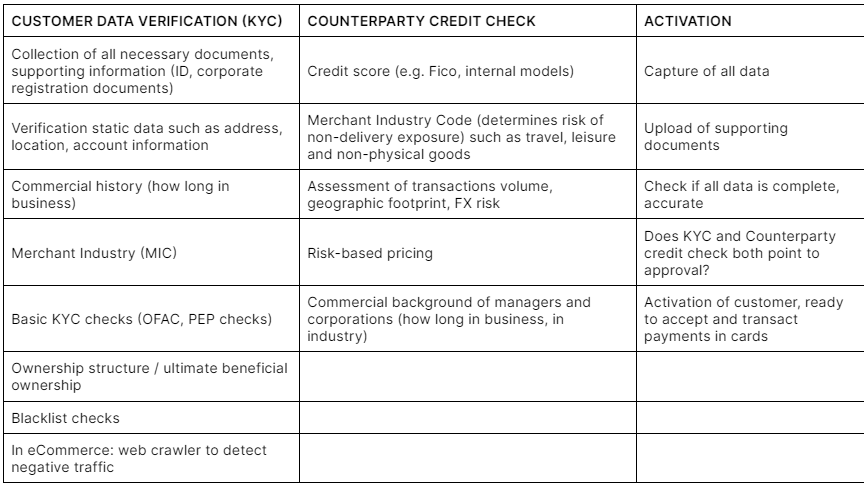
While the KYC/AML component of the merchant onboarding process used to be highly manual, today’s foremost payments firms are adopting advanced automation technologies to support:

  • The integration and standardization of structured and unstructured data in support of OFAC and PEP checks, blacklist checks, and other due diligence resources.
  • Business rules and process workflows that automate cross-border or regional specialization, intelligently applying appropriate rules to ensure compliance in every case.
  • Implementation of traditional and machine learning techniques in the creation and native operationalization of analytical models.

Transaction Monitoring AML

Like every corner of the payments universe, transaction monitoring and AML/CFT compliance are being propelled forward by technological progression. In fact, three movements have most significantly impacted AML/CFT monitoring:

  • Proliferation and accessibility of data.
  • Enhanced processing power that supports unprecedented speed and volume.
  • Widespread acceptance of advanced data analysis techniques.

Proliferation and Accessibility of Data

Historically, AML exposure data has been centralized to a select group of firms – packaged and commercialized for global use. However, around the time we gained the ‘Big Data’ buzzword, payments firms gained accessibility to a whole slew of untapped data. Pair the variety and volume of data that has become available with enhanced analytical capabilities, and compliance professionals now hold the reigns when it comes to powerful, data-centric AML/CFT insight.

In this era of automation, transaction monitoring strategies have to acknowledge the need for efficient data aggregation — the ability to analyze data is no longer enough. Web crawling technologies and copious APIs have opened up the world of data, and forward-thinking companies are capitalizing on its availability.

“Data! Data! Data! … I can’t make bricks with clay!

Sir Arthur Conan Doyle, Adventures of Sherlock Holmes

Enhanced Processing Power

In the meta-story, processing power has seen exponential uplift since the day we put an abacus in a museum. Let’s be precise: We have seen a 1-trillionfold increase in processing power over the course of 60 years.

In parallel to improved computing performance, we have also experienced a shift from primarily bare metal environments to cloud or hybrid infrastructures which introduce new opportunities.

Widespread Acceptance of Advanced Data Analysis Techniques

Machine learning is the future. Machine learning is here. It’s everywhere and for good reason. But, it’s not new. Machine learning in theory and application has a long history in academia and computer science. Now, it’s making its way into the mainstream of, well, everything – financial services notwithstanding.

Payments firms are familiar with machine learning techniques in transaction monitoring and data sciences are only becoming more predictive with time. Many firms are exploring ensemble models like Random Forest and Gradient Boosting to increase stability and accuracy in predictive analytics.

Merchant Onboarding Solutions

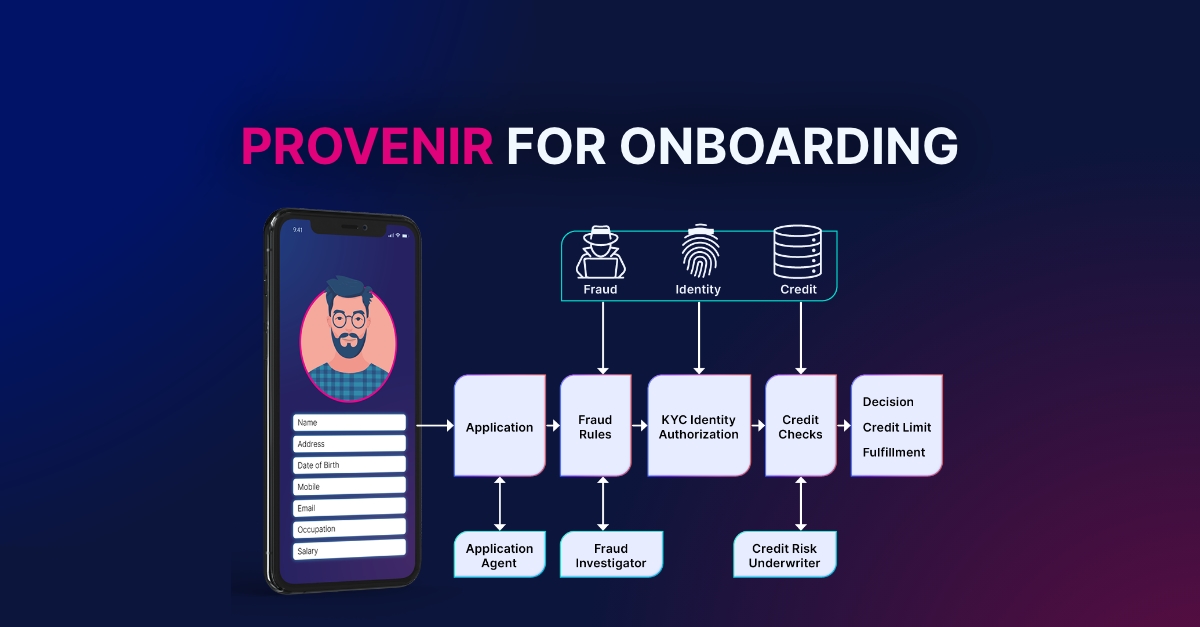
Provenir’s unified risk analytics and decisioning Platform can automatically gather data from multiple systems and bureaus, standardize and analyze it to drive a decision. With Provenir, you can complete KYC, AML and other compliance processes in minutes, offering clients quick onboarding while improving compliance at lower cost.

  • Easily configured adapters facilitate fast integration with internal and external systems and bureaus to automatically aggregate all of the data required.
  • Dynamic business rules ensure only the right data is aggregated, eliminating expensive, unnecessary calls to bureaus and third-party systems.
  • Automated standardization creates data uniformity across multiple data formats, countries and currencies.
  • Automated workflow identifies, verifies and validates the customer, performs checks and flags areas of potential risk.
  • Adapters extend the value of current compliance systems as you can easily use Provenir to aggregate, standardize and pass data to existing systems.
  • Business-friendly configuration tools let users quickly create, test, modify and deploy rules, processes, user interfaces and integrations to increase business-level control and agility.

Explore our resources (blogs, videos, case studies) to accelerate your innovation journey.

Resources

RESOURCE LIBRARY

Fintech helping to drive access to finance for Philippines’ MSMEs
News ::

Fintech helping to drive access to fi...

NEWS Fintech helping to drive accessto finance for Philippines’ MSMEs ...
Provenir appoints industry veteran Mark Collingwood as Vice President, and Regional Leader of UK, Ireland and the Nordics
News ::

Provenir appoints industry veteran Ma...

NEWS Provenir appoints industry veteran Mark Collingwoodas Vice President, and ...
As Default Rates Rise, 70 Percent of Financial Services Executives Lack Confidence in Their Ability to Modify Risk Decisioning at Speed
News ::

As Default Rates Rise, 70 Percent of ...

NEWS As Default Rates Rise,70 Percent of Financial Services Executives ...
Provenir and tbi bank Recognized for “Best in Digital Lending Implementation” in the IBSi NeoChallenger Bank Awards 2023
News ::

Provenir and tbi bank Recognized for ...

NEWS Provenir and tbi bank Recognizedfor “Best in Digital Lending ...
The Future of Buy Now, Pay Later
Webinar ::

The Future of Buy Now, Pay Later

ON-DEMAND WEBINAR The Future of Buy Now, Pay Later Book ...
Provenir Named Best Credit Risk Solution for Third Consecutive Year in the Credit & Collections Technology Awards
News ::

Provenir Named Best Credit Risk Solut...

NEWS Provenir Named Best Credit Risk Solutionfor Third Consecutive Year ...
provenir logo
Blog ::

Buy vs Build in the UK

BLOG Buy vs. Build in the UKWhy "Buy" is the ...
Evolving Buy Now, Pay Later and Pivoting to Profitability
News ::

Evolving Buy Now, Pay Later and Pivot...

NEWS Evolving Buy Now, Pay Laterand Pivoting to Profitability Why ...

Continue reading

10 Fintechs Accelerating SME Lending

BLOG

10 Fintechs Accelerating SME Lending

Championing SME Survival and Growth

A new wave of fintechs and neobanks has been sweeping the world of SME Lending off its feet by embracing digital technology, data, and advanced analytics like machine learning and AI. And there’s never been a better time for it. The landscape has changed dramatically for SMEs, not necessarily for the better. The potential of a global recession has consistently lowered margins and hurt SME scaling and expansion efforts. According to a recent report by the World Economic Forum, nearly two-thirds of small to mid-sized businesses (SMBs) said survival and expansion are their primary challenge.

Unlike consumer payments, the B2B variety remain mired in legacy systems and manual practices. And unlike larger, established companies who have long and secure relations with their financial institutions, SMEs have a larger need of help in accessing working capital, which remains their critical pain point.

The result? As access to working capital from traditional lenders dries up, SMEs are increasingly looking to digital-first and alternative channels. A surprising 75% of SMEs report being more likely to use a digital-only bank as their primary provider of working capital. We revisit our list of SME lending innovators, as they go from trend setters to “the new digital normal” in SME financing.

  1. OakNorth – UK-based fintech OakNorth delivers instant credit analysis and real-time portfolio insights focused on transforming commercial lending. The co-founders of OakNorth were rejected for the credit needed to grow their business numerous times, prompting them to create their Credit Intelligence platform. Their goal was to build a robust, sustainable bank but also to create software that would enable other banks to lend to SMEs that were previously underserved.
  2. NeoGrowth – Founded in 2011, India-based NeoGrowth Credit is a tech-enabled business that offers unsecured loans to small retailers in India. Combining traditional and alternate data for more accurate credit scoring, NeoGrowth also offers dynamic repayment terms and automated collections processes to help identify the most creditworthy customers. Calling themselves pioneers in SME lending based on the underwriting of digital payments data, their mission is to help small business owners drive growth that matches their ambitions. Also read: What is credit underwriting?
  3. Kabbage – Selected for the 2019 Forbes FinTech 50 startups list, Kabbage (now owned by American Express) provides SMBs with credit by evaluating business-focused alternative data like accounting info, online sales and shipping. With this more nuanced view of data to better understand performance, Kabbage is able to offer flexible credit options in real time.
  4. Banco Pichincha – In 2016, Banco Pichincha received a credit line of $55 million from the International Finance Corporation (IFC) to finance loans to women-owned SMEs in an effort to fuel the growth of female Ecuadorian entrepreneurs. Ecuador’s largest bank, they doubled down on their mission in 2019 when they signed an alliance with the Overseas Private Investment Corporation (OPIC) and Wells Fargo for a combined loan of $108 million to support loans to MSMEs in the region that are owned, led by or support women.
  5. Allica Bank – Claiming that SMEs have often been left behind by the ‘big banks,’ Allica Bank combines modern technology with local relationships to ensure SMEs have the tools and the funding they need to operate. Based in the UK, Allica Bank offers SMEs asset financing, with up to £1 million worth of flexible financing options.
  6. Judo Bank – Australia’s only challenger bank built specifically for lending to SMEs, this innovative organization seeks to bring back the lost art of relationships in business banking. Created by experienced business banking professionals, they brand themselves as a ‘genuine alternative’ for SMEs who want quick access to not only funds, but the superior customer experience they deserve.
  7. First Circle – Based in the Philippines, First Circle’s mission is to enable SMEs to achieve their full potential through fast and flexible financial partnership. Their customers often have no credit data or fixed collateral and as a result are excluded from the traditional banking sector (and therefore often forced to work with predatory lenders). First Circle allows these SMEs to secure funding in as little as a day through an automated, digitized application process.
  8. Lulalend – Sixty percent of South African businesses find it difficult to access the capital necessary to grow their business, due to long wait times, painful paperwork requirements and the necessity of high collateral. Lulalend uses AI to score creditworthiness instantly, ensuring small business owners are able to receive funding within 24 hours of applying. To date, they’ve processed over 70,000 applications and secured funding for thousands of small businesses across South Africa.
  9. Siembro – Argentinian organization Siembro uses AI to power their in-house loan algorithm, providing them the ability to offer instant loan approvals for small businesses in the area of agricultural and machinery. With over 1.5 million small and medium farm businesses in the country who have limited access to credit (and limited cash flows), Siembro focuses on ensuring corn, wheat and soy farmers obtain the funding they need to survive.
  10. Iwoca – A start-up that began when its founders noticed that small businesses were getting shut out of access to much-needed credit, iwoca is now one of the fastest-growing business lenders in Europe. Working towards a goal of funding one million small businesses, iwoca wants to ensure that SMEs have more time to run and grow their business instead of being forced to fill out endless paperwork and wait for approvals. Recently, their B2B financing solution iwocaPay integrated with Quickbooks to help small businesses with their cash flow, increasing businesses’ customer base and revenue.

Faster Loan Approvals

By embracing the use of digital technology, data, and advanced analytics like machine learning and AI, these companies have been able to simplify, and in many cases completely transform application processes. They are able to automate credit decisioning to provide accurate, real-time approvals, allowing SMEs to gain access to funds quicker than ever before. By automating data collection, risk decisioning and pricing, lenders can automate approvals and ensure funding is in hand within a matter of only days – or even hours!

The capabilities these lenders are offering are not just a critical lifeline. Their products tend to be more flexible and more personalized to each SMEs unique needs, allowing them to go from mere survival, to full-blown adaptation to a changing, uncertain environment. That is the unique power of AI-fueled, data-led tech innovation.

Also, read: What is Banking as a Service (BaaS)?

Meet the lending demand of SMEs without slow and costly manual processing.

Learn More


LATEST BLOGS

Continue reading

Unlocking Africa’s Credit Potential

NEWS

Unlocking Africa’s Credit Potential

According to KPMG data, there was a record $1.6 billion in fintech investment in 2021. At the same time, consumer spending in Africa is $1.4 trillion yet a significant percentage of the population has poor or no access to financial services.

In this Africa Business article, Adrian Pillay, VP of Middle East & Africa at Provenir, shares his insights on Africa’s financial landscape and how lenders can use fintechs’ innovative solutions to serve individuals with little or no credit history while improving risk assessment and increasing access to credit.

He also outlines the importance of using of alternative data, automation and real-time risk analytics to quickly evaluate SMEs creditworthiness to eliminate lengthy delays in funding approval, which can be the difference between a business flourishing or floundering.

Read Now

The Ultimate Guide to Decision Engines

What is a decision engine and how does it help your business processes?

Learn More


LATEST NEWS

Continue reading

Infrastructure Talents are Some of the Challenges Finance Industry Faces in Adopting AI: Provenir

NEWS

Infrastructure Talents are Some of the Challenges Finance Industry Faces in Adopting AI: Provenir

Bharath Vellore, Provenir’s General Manager of APAC, recently spoke to e27 about the increasing number of case studies for AI in the financial industry such as fraud identification, credit scoring and risk management. He also outlined key considerations organizations should consider to implement AI successfully.

Read Now

The Ultimate Guide to Decision Engines

What is a decision engine and how does it help your business processes?

Learn More


LATEST NEWS

Continue reading

provenir logo

APACs Top Fintech Trends to Watch

BLOG

APAC’s Top Fintech Trends to Watch

Asia Pacific (APAC) is home to diverse markets with different levels of maturation. But whether the market is emerging or mature, fintech innovation is booming across the region. Fintechs had their strongest year yet in 2022, with a record-breaking $50.5 billion invested into the industry – this level of investment is propelling APAC’s continued growth even when other regions are seeing slowdowns.

So what are the ideas driving this growth? Where is disruption happening now and where can we expect to see it develop as technology progresses? Provenir’s Bharath Vellore shares his insights on APAC’s hottest trends to watch for Indonesia, Malaysia, Singapore, the Philippines, and Australia.

Indonesia: Buy Now, Pay Later (BNPL)

Despite the recent negative press around BNPL, there’s good news for the industry in Indonesia, where it grew by 70% to reach almost $4.5 billion in 2022. The outlook for medium to long-term growth remains very strong, with projected growth of 32.5% to reach an expected market size of $25 billion by 2028.

Why has BNPL had such success in Indonesia? It has helped the country to fill a significant lending gap. Nearly 65% of the population is unbanked and credit card penetration is in the low single digits – the need for financially inclusive credit is broad. And the ways BNPL is being used are broad as well. Similar to usage around the world, the payment option is now breaking up the lowest value grocery runs and other everyday transactions to expensive luxury retail purchases.

Some fintechs pushing forward Indonesian BNPL include:

Malaysia: Digital Banking

In 2022, Malaysia’s Central Bank awarded 5 digital banking licenses for the first time, with the intent to drive financial inclusion in the country. With digital banks now in play, consumers can access convenient and flexible financial products. A dynamic space to watch will be how these digital banking entrants will grow, given the position of the traditional lenders and banks that have been entrenched in the space for a significant period of time with large customer bases.

Provenir partner Credolab agrees, also pointing out the importance of fraud mitigation:

“A digital banking transformation is accelerating in Malaysia, amid stiff competition from other countries in the region. To manage the associated fraud risks, banks offering digital services will have to take appropriate measures and collaborate with best-of-breed Fintechs to help fight fraud.”

Steve Thurley, Managing Director – APAC, Credolab

We believe that the digital banks that find success will create a path to profitable growth by finding low cost customer acquisition models and delivering new products to market rapidly. The best way to do this is find customers through partnerships and networks, and develop financial products on a low-code/no-code platform that allows business users to be agile and responsive to market needs. The fintech difference? These products should be highly personalized and feature-rich to offer consumers elevated digital banking experiences they can’t get from traditional banks.

The financial groups launching banks are:

Singapore: Embedded Finance
Unlike Indonesia, Singapore has a very mature financial ecosystem. Banks are quite well entrenched in the economy and have even proactively adopted digital services, making room for digital banks, embedded finance, and hyper-personalized financial products. Adopting embedded finance helps organizations that aren’t traditionally financial service providers to provide financial products, reaching new market segments and simplifying the customer experience.

The biggest opportunities for innovation in embedded finance include instant payments, cross-border transactions, and micro lending. Embedded finance products for SMEs are also gaining traction, helping small businesses with accounting and managing ledgers, while providing working capital loans. Micro credit loans, such as retail financing for e-commerce, merchant loan offers based on sales volumes, and embedded payment options in apps are streamlining financial products into everyday processes and changing the way consumers are engaging with money.

These fintechs are embedding themselves as top embedded finance providers in Singapore:

The Philippines: SME Lending

Micro, small, and medium-sized businesses are the lifeblood of the Philippine economy. Almost 36% of the GDP is generated by the SME sector and 63% of workers in the country work at one. Despite the enormous presence in the country, SMEs remain largely underfinanced, which limits their – and the economy’s – ability to grow. Enter: fintechs.

As digital loans are becoming a more viable and attractive option, fintechs are extending credit to SMEs through online platforms that small business owners can access from anywhere in the country. As big data becomes more available, SME lenders are able to tap into that ecosystem to build alternative credit scoring models. There is not great coverage from the bureau point of view, as the majority of SMEs have thin files or no credit report at all, so the lack of financial data is a huge gap for traditional lenders who don’t have enough information to make accurate decisions. Big data is providing access to alternative data such as customer reviews, income flows, and more to make lending decisions – this area is primed for significant growth.

Companies driving SME lending innovation include:

Australia: Open Banking
Consumer Data Right (CDR) legislation was introduced in Australia in 2020. Phase one mandated the country’s four biggest banks to share access to consumer data; phase two did the same for small banks; last year’s phase extended to energy and utility companies; and next year’s final phase brings non-bank lenders under CDR. What happens when you’re combining datasets across banking, energy, and nonbanking? Consumers access lending products across the ecosystem and are able to take advantage of the best deals on financial products.

Provenir partner SEON highlights the importance of payment speed as well:

“Open banking allows innovation in multiple areas, including payments, credit checks, loan applications, and more. The most exciting is open banking payment initiation, which provides instant access to cash flow on a faster payment rail (funds sent and received in 2-10s) at a fraction of the cost of credit cards.”

Daniel Sebes, Strategic Director, SEON

Currently, Australia has 115 data holders of consumer data and 24 active data recipients who can receive consumer data. The number of data recipients will grow tremendously, catalyzing fintechs to build innovative financial products that push one another ahead through competition while empowering consumers to find the best products available. For this reason, CDR and open banking will be a very interesting space to keep an eye on.

Active data recipients in Australia include:

It’s clear that fintechs have disrupted almost every aspect of financial services across the APAC region. Many of these trends will continue to inspire new ways to disrupt the way we manage and access credit, whether it’s through new ways to pay for goods, the data that paints financial health, or how the small businesses driving economic growth stay afloat. Whether the trends have staying power or will evolve as technology and regulation develops, only time will tell. What we do know is we’ll be watching.

Looking for a technology partner to help you jump on one of these trends?

Learn how a unified credit risk decisioning and data platform can help you go to market faster.

Explore

Back to the Future: 8 Features of Fast and Future-Proof BNPL Technology

Get the eBook

LATEST BLOGS

No posts found.

Continue reading

“Don’t wait to be approached”: IWD Spotlight with Mei Ye

NEWS

“Don’t wait to be approached”:
IWD Spotlight with Mei Ye

Being told she wouldn’t be promoted because “senior positions are for men” incentivized Mei Ye, Head of Pre-Sales (APAC) at Provenir, to change careers. Mei shares her journey and perspective on the importance of mentors and mistakes.

Read Now

The Ultimate Guide to Decision Engines

What is a decision engine and how does it help your business processes?

Learn More


LATEST NEWS

Continue reading

provenir logo

Ten Fintechs Shaking Up Consumer Lending

BLOG

Ten Fintechs Shaking Up Consumer Lending

With the ever-evolving landscape of financial technology, consumer lending has never been more accessible and efficient – in large part, due to fintech innovation. With a global consumer credit market size of $11 billion, rapidly growing middle classes in emerging markets, and economic uncertainty affecting us all, the opportunity for lenders to tap into the consumer need for credit is immense.

Across the broad spectrum of consumer lending, fintechs are answering the call and disrupting the traditional. No credit score? No problem. Worried about missing payments? You’re covered. From a company supporting gig workers around the world to a credit card for foodies, these ten fintechs are shaking up auto lending, BNPL, credit cards, mortgages, and retail/POS.

Auto Lending
Lendbuzz – USAIf you’re new to credit, it can be difficult to get approved for auto financing. Lendbuzz is here to change that. The fintech proves a simple and fast application process that assesses creditworthiness with data beyond just your credit score. Working directly with auto dealerships, Lendbuzz offers personalized loans and instant decisions, taking you through the process from start to finish.
Moove – EMEA and IndiaFounded in Nigeria in 2020, Moove is a global startup that aims to democratize access to vehicle ownership for “mobility entrepreneurs” across Africa, the Middle East, Europe, and India. Tackling the high barrier to vehicle financing that millions face, especially in emerging markets, Moove uses a revenue-based financing model to offer car loans that drivers then pay off through their ridesharing app.
Buy Now, Pay Later
ShopBack (formerly Hoolah) – Southeast Asia and Australia

Singapore-born ShopBack is a fintech that provides improved shopping experiences to consumers and broader reach and shopper engagement to brands and retailers. Operating across APAC, their integrated BNPL service allows you to pay off purchases in installments of three, which can be combined with features such as cashback and prepaid retail vouchers. ShopBack hopes to make shopping “more rewarding, delightful, and accessible.”

Nelo – MexicoIf you want to buy now, pay later at Mexico’s top merchants, you want to download Nelo’s top-rated app – it’s the first of its kind in the region, enabling shoppers to pay in installments with a virtual card generated at checkout. And through the company’s partnership with Mastercard, you can use it at any online merchant. You can also use it to finance everyday expenses like utilities and other bills, a mark of BNPL innovation and a sign of how the segment is likely to evolve.
Credit Cards
Cred.ai – USACred.ai is an AI-powered credit card designed to help users build credit while mitigating missed payments. The fintech sets up automated spending limits, helping you spend within your means, and their proprietary underwriting model means you don’t need a FICO score to apply. The card itself is metal, unicorn-themed, and free for approved applicants. It works best with their digital banking product and comes with features like an early paycheck (called flux capacitor) and digital “self-destruct” cards called stealthcards.
Yonder – LondonA rewards credit card “great for expats and immigrants,” Yonder is a rewards credit card that boasts no foreign exchange fees, worldwide travel insurance, and you can apply without a UK credit score. Leveraging open banking technology, the credit card is able to focus on financial inclusion while rewarding users for the experiences that enrich their lives, whether it’s travel or dining at Yonder’s curated restaurant partners around London.
Mortgage
Hypofriend – GermanyHypofriend was founded to simplify and personalize the process of getting a mortgage for Germans. They use advanced technology to analyze your optimal finance strategy while predicting bank decisions in order to connect you to a personalized mortgage offer from a lender that fits your needs. The Hypofriend team is also there to advise from start to finish, demystifying the complex process and providing transparency to support more financial literacy and understanding.
HomeCrowd – MalaysiaFocused on helping Millennials in Malaysia achieve the dream of owning a home, HomeCrowd uses holistic, data-driven credit scoring to match mortgage applicants with peer-to-peer (P2P) lenders on a blockchain-powered, Web3 platform. The company is the first in the country to be licensed and regulated for P2P lending specifically for mortgages and consumer financing by the government.
Retail/Point-of-Sale (POS)
Blink – EgyptDid you know that less than 4% of Egyptians have access to credit cards? The majority of Egyptians must rely on savings or finance purchases with high-interest loans. Blnk is here to change that – they enable any consumer to receive instant credit at the point-of-sale. Their current network of merchants includes over 300 businesses and the fintech has already disbursed over $20 million in loans.
Acima – USAUS-based Acima offers consumers lease-to-own solutions as an alternative to traditional retail financing. You don’t need credit to apply and your credit score isn’t affected. Simply lease the furniture, electronics, or any other item you want to purchase and “rent” it until the cost of the item is covered, or pay early at a discounted rate. If you no longer want the item, just return it! Acima enables online and in-store shopping and offers flexible payment terms.

Unlocking Consumer Lending Innovation

As access to consumer credit increases around the world, both fintechs and traditional financial service providers will need to leverage the right technology to provide it. The ten fintechs you just read about have found their innovative idea to disrupt consumer lending – what will yours be?

No matter the idea or use case, you need a technology partner that thinks like you. Future-proof your consumer lending strategy and launch new products with a data and decisioning ecosystem that manages risk, so you can focus on what matters most: serving your customers in new, disruptive ways.

Read the eBook, The Secret to Consumer Lending Sucess to discover how you can overcome any lending challenge with a robust credit risk decisioning platform that grants access to both alternative and traditional data sources through a single API.

Conquer Consumer Lending

Explore the eBook

LATEST BLOGS

No posts found.

Continue reading

The Secret to Consumer Lending Success

EBOOK

The Secret to
Consumer Lending Success

Book a Meeting

Between stark competition, evolving regulation, and an unpredictable global economy, consumer lending can be a difficult space to thrive within. But the secret to consumer lending success isn’t hard to find: it can be unlocked by understanding the key differentiators within the industry.

Explore how you can turn challenges into opportunities across five major use cases: auto, mortgage, retail, BNPL, and credit cards. Read the eBook to discover the secret to consumer lending!

RESOURCE LIBRARY

Fintech helping to drive access to finance for Philippines’ MSMEs
News ::

Fintech helping to drive access to fi...

NEWS Fintech helping to drive accessto finance for Philippines’ MSMEs ...
Provenir appoints industry veteran Mark Collingwood as Vice President, and Regional Leader of UK, Ireland and the Nordics
News ::

Provenir appoints industry veteran Ma...

NEWS Provenir appoints industry veteran Mark Collingwoodas Vice President, and ...
As Default Rates Rise, 70 Percent of Financial Services Executives Lack Confidence in Their Ability to Modify Risk Decisioning at Speed
News ::

As Default Rates Rise, 70 Percent of ...

NEWS As Default Rates Rise,70 Percent of Financial Services Executives ...
Provenir and tbi bank Recognized for “Best in Digital Lending Implementation” in the IBSi NeoChallenger Bank Awards 2023
News ::

Provenir and tbi bank Recognized for ...

NEWS Provenir and tbi bank Recognizedfor “Best in Digital Lending ...
The Future of Buy Now, Pay Later
Webinar ::

The Future of Buy Now, Pay Later

ON-DEMAND WEBINAR The Future of Buy Now, Pay Later Book ...
Provenir Named Best Credit Risk Solution for Third Consecutive Year in the Credit & Collections Technology Awards
News ::

Provenir Named Best Credit Risk Solut...

NEWS Provenir Named Best Credit Risk Solutionfor Third Consecutive Year ...
provenir logo
Blog ::

Buy vs Build in the UK

BLOG Buy vs. Build in the UKWhy "Buy" is the ...
Evolving Buy Now, Pay Later and Pivoting to Profitability
News ::

Evolving Buy Now, Pay Later and Pivot...

NEWS Evolving Buy Now, Pay Laterand Pivoting to Profitability Why ...

Continue reading

Brankas

Partners

Brankas

Brankas – Leading Open Finance Technology Leader

Key Benefits

  • Instant Multi-Bank Integrations with Brankas Data APIs. Let users connect their bank account to your platform, giving them faster access to their data and a better experience.
  • Capture Data Intelligently and Interpret it Faster. With quicker access to reliable data, you can personalize your customer’s experience depending on their wants and needs.

“Our partnership with Brankas allows us to help clinics in Indonesia finally move into a digital future that can make healthcare easier and more available for everyone. We are excited for the future of healthcare.”

OGY WINENRIANDHIKA, CO-FOUNDER & CEO AT KLINIKGO

Brankas – Leading Open Finance Technology Leader

Brankas helps businesses unlock modern financial services with market-leading technology. We have the largest network of bank APIs in Southeast Asia. We are also the only company invested in both API aggregation, which helps online businesses connect digitally to banks, as well as financial and payment infrastructure, which help banks and financial institutions monetize their banking platforms.

Resources

  • Visa Card Data Product

About Brankas

  • Services

    Account Opening

    Open Core

    Open Finance Suite

    Merchant Link

    Brankas Direct

    Brankas Disburse

    Brankas Bank Data

  • Profiles and Scores

    Life-centric profile

    Financial health profile

    Life-centric credit score

    Other risk scores

  • Custom Solutions

    Score card development

    Model development

    Design AI strategies and roadmaps for and with boards and management

    Education and training on AI for co-workers

  • Countries/Regions Supported

    Indonesia

    Philippines

    Vietnam

    Thailand

    Malaysia

    Bangladesh

    EMEA

Continue reading