Author: Amy Sariego

The Ultimate Guide to Decision Engines

BLOG

The Ultimate Guide
to Decision Engines

What is a decision engine and how does it help your business processes?

Decision engines, sometimes referred to as decision trees, are software platforms that automate business rules or business decisions – helping you streamline business processes that require decision-making without having to think about it. A decision engine automates these business decisions based on your business needs and the particular criteria the platform’s owner sets out, saving you from manual work and centralizing the decision-making process. 

What does a decision engine need to run? Besides the set of rules (logic), otherwise known as the decisioning workflow, decision engines need data. Lots and lots of data. By accessing and integrating data from multiple sources and applying these ‘rules’ according to your criteria, voila – you can automate decision-making. In the finance world in particular, decision engines are often used to help you make decisions on who to lend to and helps determine which sort of products you can offer your customers.

Automated decision engines can also enable personalized pricing and offers (i.e. finance terms and interest rates), all of which are customizable to your unique needs. Some popular examples in the world of fintech/financial services include: consumer lending, loan origination, credit card approvals, auto financing, point of sale lending like buy now, pay later (BNPL), lending to SMEs, insurance policy approvals, upsell/cross-sell offers, champion/challenger strategies, audits, collections and more.  

How does a decision engine help inform business decisions?

Decision engines can help inform various types of business decisions – on everything from basic day-to-day operations to more high-level, strategic business decisions. 

  • Strategic Decisions: Strategic decisions are top-level, and tend to be more complex, affecting a much larger portion of the organization and often applicable for a longer term (i.e. changing cost structures or planning for longer-term organizational growth). Decision engines and automated decisioning processes can expedite and streamline various processes, improve efficiency, and allow you to make smarter decisions overall. In the case of financial services, this could mean a shift in deciding who you can lend to in order to expand your overall customer base and plan for growth. Keep in mind that more complex decision execution typically requires a large amount of data, provided from a variety of data sources. Utilizing decision engines and automated decisioning processes can help an organization access, analyze, and action a large variety of data, enabling smarter decision-making.
  • Tactical Decisions: Tactical decisions are much more focused on business processes and tend to be shorter-term and less complex. Examples include launching new products, changing product pricing, managing inventory control, and supply chain and logistics. With decision engines, you can more easily analyze performance data and help determine new pricing strategies for your financial services products or look strategically at which demographic or region to target next. 
  • Operational Decisions: Focused on day-to-day operations of a business, operational decisions are much smaller in scale. They tend to be related to overall daily production and are usually executed in alignment with the overall strategic vision of an organization. In financial services, decision engines can improve efficiency and help automate or streamline varying day-to-day decisions, including loan approvals, interest rate offers, guidance on collections, merchant onboarding, pricing optimization, compliance processes, identity verification, fraud prevention and more.

Decision Engine Framework

So how does a decision engine actually work? And how do decision engines function in a business? While it’s up to each individual organization (and all of the individual business rules within) how they want their business decisions to be executed, there are some basic steps that remain true across the board.

  1. Set Desired Outcomes: Look at what your goals are. What are the specific business rules that you need your decision engine or workflows to execute on?
  2. Determine Decision Criteria: What are the standards or requirements to which you are making your evaluations or decisions? For example, in the case of many credit applications, particular criteria often include income, job status, age, marital status, debt ratio, etc.
  3. Organize Data Sources: To process these business decisions based on your desired outcomes and your determined criteria, what sort of data sources do you need? Do you need traditional credit bureau data, third-party sources, alternative data like rental info, social media presence and web data, etc.?
  4. Create Decisioning Workflows: What are the necessary steps in your decisioning process? Use the configuration tools within your decision engine to lay out your workflows and business rules and enable automated decisions.
  5. Test and Iterate: Create, test and deploy your modelling scorecards and decisioning process, and look at what happens when a typical customer is put into your system. For example, if a customer applies for a credit card, their information is put into the decision engine, which then pulls in necessary data (identity verification, KYC, income verification, fraud), and rejects or approves based on the initial criteria determined. Is something missing? Can your business process be smoother? Iterate!
  6. Determine Next Steps: Where is your threshold for complex applications? Which applications need manual intervention? Straight-through processing enables instant decisions for more simple credit and lending requests, while a rules-driven decisioning process helps to identify and re-route exceptions that require more manual intervention. 
  7. Monitor and Optimize: Is your decision engine offering real business value? Keep tabs on your decisioning performance by using the information your decision engine gives you. Identify opportunities for further enhancement of your decisioning process and tools and enable more efficient decisioning – and business growth.

How does a decision engine function in a business?

As we’ve shown, there are a large variety of ways that decision engines can help inform business processes. But how exactly does it do that? In the case of financial services, think of all the manual decisions that require human intervention. If an individual needs a car loan, for example, how does a lender determine if that individual is creditworthy or not? And if they are, what interest rate or repayment terms should they be offered? Having an automated decision engine can streamline the application, approval, and funding process to ensure an efficient, superior customer experience. 

In the auto financing example, applications can move from manual, paper-heavy forms, and hours of sitting in a dealership to simplified, online applications. An individual can easily fill out an application and provide ID, which then allows a decision engine to move that person quickly and easily through the decisioning workflow along a series of pre-determined steps, according to the initial criteria.

In this case, that criteria could start with analyzing data for identity verification (is this person really who they say they are? How old are they? Do they have a valid driver’s license?), then move through to various factors that determine creditworthiness. Does this person have an income that is above our threshold? What is their credit score? How much debt does this person already have, and what is their debt-to-income ratio? Do they have previous loan defaults on their record?

As the decision engine automatically accesses and analyzes all the data required according to the business rules, it moves that application through the workflow based on the answers. Driver’s license? Check, on to the next step! Old enough to own a car? You betcha. Have a job? Yep, move along! But then comes a doozy of a credit score and a record of numerous loans having gone to collections. The buck stops here and the decision engine (as per the initial ‘instructions’ when setting out the original workflow) stops the application and determines that this individual is NOT a risk this lender wants to take.

Of course, not all situations are as black and white as that example, but the beauty of automating business processes with a decision engine is that you can streamline and improve efficiency for many situations and types of applicants, while focusing that most precious resource, humans, on the more complex cases that require manual intervention.

Data, Data, and More Data

Despite all the wonderful ways that business processes can be improved using decision strategies, there can be no automating decision execution without extensive data and data aggregation. Data, preferably varied and from a wide range of data sources (including historical data), is critical to the decision-making process.

All financial services organizations use data to make informed decisions across the customer lifecycle – but having to manually access and integrate data sources is nothing short of a nightmare. Data consumption has evolved, right alongside the decision engines that data feeds into. It’s impossible to make accurate decisions based on business needs without the right data that aligns with the particular criteria set out. Think back to the examples previously discussed – where do you get information on loan payments, credit policies, credit scores, income to debt ratio, age verification, etc.? It’s all about your customer data sources.

These days, more and more lenders are increasingly looking to a wider range of data sources, including alternative data like rental payments, social media interactions, website info, travel data and more, to ensure: 

  • A more accurate view of identity verification
  • A more holistic view of risk and creditworthiness
  • Better fraud prevention

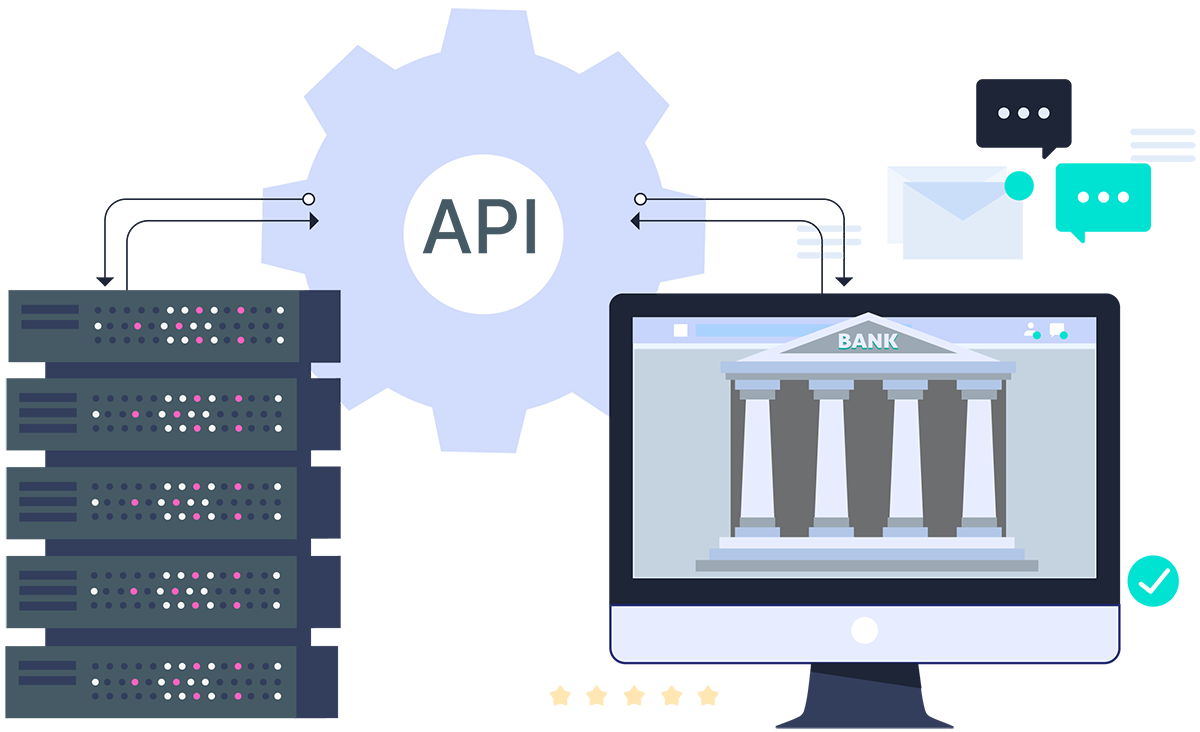
All this data must be accessed, analyzed, and actioned appropriately to help ensure more accurate, automated decisions that provide value to a business. As The Financial Brand said, “Data, by itself, is not a valuable asset. It’s what you do with it that counts.” Having a variety of data available on-demand is essential for enhancing your automated decisioning. Third-party data providers, connected through a centralized platform or marketplace with a single API, can make this data consumption effortless, giving you the ability to access and integrate numerous data sources in minutes. Use that data to test your decisioning workflows, and then iterate and adapt with ease.

AI-Powered Decisioning

The use of artificial intelligence and machine learning is growing. AI in financial services is seen as a $450 billion opportunity. But how can you use AI most effectively in your decision engines? Using AI/ML to power your decisioning process enables:

  • Improved decisioning accuracy
  • Superior fraud detection
  • Enriched customer relationships
  • Improved customer satisfaction
  • Expanded customer base
  • Optimized pricing
  • Revenue growth

McKinsey pointed out that “The continuing advances in big data, digital, and analytics are creating fresh opportunities for banks to improve the credit-decisioning models that underpin their lending processes… the banks (and fintech companies) that have put new models in place have already increased revenue, reduced credit-loss rates, and made significant efficiency gains thanks to more precise and automated decisioning.”

It may seem daunting to try to implement AI into your decisioning processes, but you don’t necessarily need data scientists on your team to make AI impactful. With a technology platform that incorporates both data sources and advanced machine learning into your decision engine, you can make use of advanced decisioning – and get all those benefits listed above.

AI allows you to do things that may be challenging for traditional decision engines, including enabling more approvals for unbanked consumers, adapting to rapidly changing market trends and consumer demands without sacrificing the customer experience, and finding relationships in your data (see? Data is king!) that may be otherwise unseeable. If you do happen to be lucky enough to have data scientists in-house and need to figure out a way to utilize all their expertise in your decision engine or business applications, look for a technology partner that can easily migrate existing models into a user-friendly platform.

What’s the benefit?

While we’re talking about data integrations, automated workflows, data scientists, machine learning… why go to all this trouble? There is immense value in using decision engines in financial services instead of manually trying to make complex decisions around your business processes. Some of the benefits include:

  • Boosted Performance: make decisions faster and more effectively, enabling optimized business performance
  • Increased Profits: lend to more customers, without increasing your risk, allowing for better profit margins
  • Improved Efficiency: save time and resources, with fewer human interventions needed and the ability to make decisions faster
  • Flexibility: change your decision criteria without having to re-do your entire workflow
  • Scalability: easily add more data integrations and new criteria or decision parameters to your workflows as your business grows or the needs of your consumers/the market changes
  • Focused Resources: save your underwriters’ attention and manual intervention for more complex cases
  • Consistency: ensure consistency and stability in your decision-making processes, enabling enhanced customer relationships and reliability in business performance
  • Transparency: get full visibility into what your decision engine is doing and measure performance so you can easily optimize
  • Capture information: manual underwriting requires manual information capture – with an automated decision engine you can easily maintain information on your customers, your decisions, and your overall performance, which you can then feed back into your decision engine for further optimization

Also read: The Essential Guide to Credit Underwriting

Customer experience is more critical than ever. In an age of having everything available on demand (tv shows, rides, food delivery, workouts), your consumers expect speed. On top of that, they value customization. We want Netflix to know exactly what kind of show we’re up for next or appreciate when our Facebook feed is filled with ads that resonate. According to PwC, 80% of consumers rank speed as a key buying factor, and Salesforce says that 76% of consumers expect customized offers. Who has time for that if you’re busy making all your business decisions manually?

The Future of Decision Engines

What does the future hold for decision engines? From our perspective, the prospects are bright. Did you know that Forrester recently added Digital Decisioning Platforms to their Wave report? According to Forrester, Digital Decisioning Platforms (DDP) are “an evolution of expert systems, knowledge-based systems, business rules management systems, and decision management systems.” It’s a mouthful, but it’s clear the trajectory is positive when you automate your business decisions. And with the increased acceptance of artificial intelligence and machine learning, the ways in which we can automate decisions will only get more exciting (and profitable).

For Further Reading:

Are you ready to discover how an AI-Powered Decisioning Platform can help your decision-making process?

Learn more


LATEST BLOGS

Continue reading

Interview: Real-Time Credit Decisioning Solutions that will Enable Organizations to Innovate Faster

NEWS

Interview:
Real-Time Credit Decisioning Solutions that will Enable Organizations to Innovate Faster

The Fintech space in India has seen tremendous growth in the last few years. According to a recent report by Bain, the fintech sector in India is expected to grow to $350 billion in enterprise value and will account for nearly 15 percent of Financial Services market cap by 2026. With this, the demand for innovative fintech solutions is also on the rise.

In an exclusive interview with CXOToday, Varun Bhalla, Country Manager – Provenir India, shares his insights on the need for purpose-built technology designed to power decisioning innovation across the full customer lifecycle.

Read Now

The Ultimate Guide to Decision Engines

What is a decision engine and how does it help your business processes?

Learn More


LATEST NEWS

Continue reading

A Geek’s Guide to Machine Learning (AI), Risk Analytics and Decisioning

GUIDE

A Geek’s Guide to Machine Learning (AI), Risk Analytics and Decisioning

Introduction

Artificial Intelligence (AI), Machine Learning (ML) – whatever you want to call it, these buzzwords are appearing more and more throughout the business and social world. So what are they and what do they mean?

Despite the growing interest, AI/ML isn’t new at all. In fact, the models themselves have been around since the 1970s and ‘80s. In the financial sector, banks have been using ML to mitigate fraud and detect irregular buyer behaviors and patterns for the last decade or more.

Fraud is a growing concern and is costing the financial sector millions of dollars in losses each year. A 2015 research note from Barclays stated that the United States is responsible for 47 percent of the world’s card fraud despite accounting for only 24 percent of total worldwide card volume. A 2014 Federal Trade Commission report shows that credit cards and other consumer payment methods produced the greatest losses over other types of fraud.

One of the ways in which UK financial firms have tried to reduce fraud is with the implementation of the Chip and Pin system. It was seen as an effective means to prevent and reduce card fraud. But a research paper by Murdoch et al (2010) showed how fundamentally flawed Chip and Pin is.

As technology evolves, so do the cunning methods for perpetrating a fraudulent crime. Financial firms are now relying on sophisticated artificial intelligence software to evolve, adapt and learn in line with the behavior patterns of fraudsters in order to track, detect and prevent fraud far more quickly than traditional methods. The use of AI has also been implemented in industries outside financial services including insurance, retail and telecommunications.

Obviously, it is in the interest of the card issuer or bank to implement strategies to reduce the risk of fraud. Unfortunately, this often requires a compromise between expense and inconvenience to the merchant and the customer. Merchants are at far more risk than the end credit card user as they are ultimately responsible for incurring the cost of a fraudulent purchase and the potential loss of the customer resulting from the bad experience. Other costs to the merchant include direct fraud costs, cost of manual order review, cost of reviewing tools and cost of rejecting orders.

This Provenir report describes the use of AI tools in credit card fraud to mitigate risk. We will be looking at various AI detection methods including Artificial Neural Networks (ANN), Fuzzy Neural Networks (FNN), Bayesian Neural Networks (BNN) and Expert Systems.

An Overview of Fraud Prevention and Detection Techniques

The modern information age is flooded with a rapidly growing and astonishingly huge amount of data. In the U.S alone, the total number of credit card transactions totaled 26.2 billion in 2012. The processing of these data sets by banks and credit card issuers requires complex statistical algorithms to extract the raw quantitative data.

These systems work by comparing the observed and collected data with expected values. Expected values can be calculated in a number of ways. For example, a behavior model would look at the way a customer’s bank account has been used in the past, and any deviance from usual purchasing habits would return a suspicion score. This method works by flagging a transaction with a typical score, usually between 1 and 999. The higher the score, the more suspicious the transaction is likely to be, or, the more similarities it shares between other fraudulent values.

Typically, the measures taken to combat fraud can be distinguished into two categories – Prevention and Detection.

  • Fraud Prevention constitutes the necessary steps to prevent fraud from occurring in the first place, with various preventative methods used to deter fraudsters, such as MasterCard SecureCode and Verified by Visa.
  • Fraud Detection, the focus of this report, comes into play once fraud prevention fails. Detection consists of identifying and detecting the fraudulent activity as quickly as possible and implementing the necessary methods to block and prevent the card from being used by the perpetrator again. Issues arise when criminals adapt and change their tactics once they are aware that a prevention method is in place, therefore the need for more intelligent and sophisticated technology which ‘learns’ is essential for the detection of fraud.

The techniques used to detect fraud also fall into two primary classes – Statistical techniques (clustering, algorithms) and Artificial Intelligence (ANN, FNN, Data Mining). Both of these methods still involve mining through the available data and highlighting any anomalies (which can be defined by a set of rules) from the purchasing and transaction data of the customer. The difference is that where we used human analysts to manually search useable knowledge in the past, today we make use by machine learning.

Artificial Intelligence Models

Artificial Neural Networks
Also known as connectionism, parallel distributed processing, neuro-computing and machine learning algorithms, Artificial Neural Networks (ANNs) were first developed during the late 1980s and have since become a fundamental tool in combating fraud. ANNs work by imitating the way the human brain learns, using complex input, hidden, and output layers.

Diagram representing a feed-forward multilayer perceptron (the most common type of ANN). (Source: www. oscarkilo.net)

The input nodes retrieve information from an outside source (for credit card fraud detection, this would be the transactional data of a customer’s account) and the output nodes send the results from the neural networks back to the external source. The hidden nodes in-between the input and output nodes have no interaction with the external source and become more complex in their configuration and nature depending on the complexity of the problem at hand.

The various nodes in each layer of the neural network are connected by edges where each edge represents a particular weight between two connected nodes. (In the human brain, these are called synapses.) The information that the neural network learns through supervised or unsupervised learning is stored in these weights.

An example of the way neural networks learn is similar to the way children learn to recognize animals. After seeing a dog, the child can then generalize on various other breeds of dogs, categorizing and defining them as ‘dogs’ without having seen them before.
An important feature of neural networks is that when they learn, they have the option to be supervised or unsupervised.

  • For unsupervised neural network learning, the system makes use of clustering, which groups patterns based on similarity. The two main unsupervised learning methods are Hebbian and Kohonen. Hebbian learning takes place by association, meaning that if two neurons which are on either side of a synapse are activated simultaneously, the strength of that synapse will be increased. Kohonen (also called Self-Organizing Maps) learning takes place by learning the categorization of the input space.
  • For supervised neural network learning (back-propagation), the correct output values for certain input data are determined before starting the algorithm, and the system then learns the function between the paired input and output nodes.

A user can train a neural network by running through examples of past data. The learning process occurs when the output data is compared to that of the ANN’s predicted output. The weights for each connection are then adjusted based on the exampled data, allowing the system to learn new patterns and behavior and improve accuracy without having to be taught or shown it.

Fuzzy Neural Networks

Fuzzy Neural Networks (FNNs) are a branch of hybrid intelligence systems which make use of fuzzy logic together with ANNs to detect fraudulent activity. The idea was first developed and proposed by Zadeh and has since been used and implemented successfully in a variety of industries. The core framework for fuzzy logic is to provide an accurate method for describing human perceptions. Some experts believe that the use of fuzzy rules can provide a more natural estimate as to the amount of deviation from the normal.

FNNs, like Expert Systems, make use of IF-THEN-ELSE statements and heuristic rules to handle uncertainty in applications, resulting in better approximate reasoning without the need for analytical precision. The use of traditional IF-THEN-ELSE statements and heuristic rules (see Expert Systems below) has been controversial, and therefore has not been as widely implemented as some of the other AI fraud detection systems.

Expert Systems

Expert Systems saw increased usability and growth during the 1980s with the expansion of computer processing power, programming and AI. It was used in credit card fraud detection by using a rule-based system which proved to be fairly popular when no other intelligent systems were around. These systems were used to imitate and replicate the knowledge of an ‘expert’ person and can be defined into two classes – facts and heuristic.

  • Facts are classified as a quantity of information, such as the credit card transaction history or an individual’s credit rating.
  • Heuristic is where a person of ‘expert’ knowledge defines a set of rules that they would usually follow by protocol as a result of their ‘expert’ experience, education, observation and training.

Expert systems work by taking this human knowledge and transferring it into a logical language that a computer can understand and follow in order to solve a problem. A fundamental part of expert systems is their extensive database of stored rules which are defined by a typical IF-THEN-ELSE format. For example, a rule based system using IF-THEN-ELSE may look like the following:

IF the amount of purchase is greater (>) than $1000 and the card acceptance authorization is through ‘eBay’, THEN raise a suspicion score and require further verification, ELSE approve transaction.

Limitations of Expert Systems however are that they require considerable storage space and rely heavily on extensive programming of expert human knowledge in order to make decisions. Some experts b

Bayesian Neural Networks

These types of networks take a slightly different approach to the general guidelines and rules of learning that are commonly seen in ANNs and FNNs. Typically, Bayesian Neural Networks use Naive Bayesian Classifiers, a simple method of classification, to classify transaction activity.

Bayesian learning can be trained very efficiently in a supervised learning setting and uses probability to represent uncertainty about relationships that have been learnt as opposed to variations on maximum likelihood estimation. Where neural networks try to find a set of weights for each node (process of learning) to best fit the data inputted, Bayesian learning makes prior predictions by means of probability distribution over the network weights as to what the true relationship might be. One study looked at the comparison of using both ANNs and Bayesian Belief Network algorithms in fraud detection, and found that the use of Bayesian Neural Networks, although slower, were in fact more accurate than the use of ANNs alone.

In fact, many believe the use of Bayesian methods to be highly effective in real world data sets as they offer better predictive accuracy. This is supported by research which concluded that the use of Bayesian Neural Networks were far superior and accurate in detecting credit card transactional fraud than Naive Bayesian Classifier.

The Data

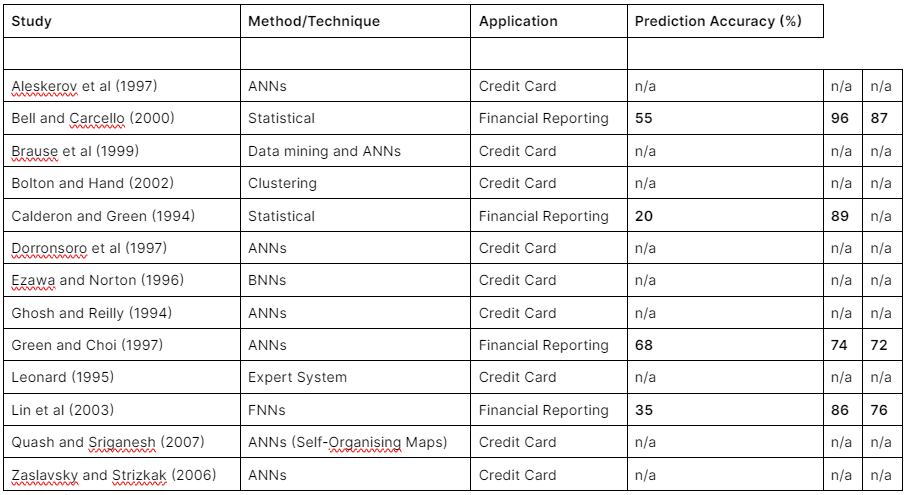
The following table compares the research findings to highlight which combination of models provides the highest prediction accuracy.

Summary of the most notable investigations into the use of Artificial Intelligence at mitigating fraud.

The greatest challenge when talking about artificial intelligence/machine learning is actually in understanding what data sets we are looking at, and what model/combination of models to apply. Amazon’s Machine Learning offering is one example of an automated process which analyses the data and automatically selects the best model to use in the scenario. Other big players who have similar offerings are IBM Watson, Google and Microsoft.

Conclusion

Provenir’s clients are continually looking at new and innovative ways to improve their risk decisioning. Traditional banks offering consumer, SME and commercial loans and credit, auto lenders, payment providers and fintech companies are using Provenir technology to help them make faster and better decisions about potential fraud. Integrating artificial intelligence/machine learning capabilities into the risk decisioning process can increase the organization’s ability to accurately assess the level of risk in order to detect and prevent fraud.

Provenir provides model integration adaptors for machine learning models, including Amazon Machine Learning (AML) that can automatically listen for and label business-defined events, calculate attributes and update machine learning models. By combining Provenir technology with machine learning, organizations can increase both the efficiency and predictive accuracy of their risk decisioning.

From advanced machine learning to generative intelligence and model governance, Provenir helps you maximize value, minimize risk, and accelerate ROI — all on a single platform.

Provenir AI

Download the PDF Version

RESOURCE LIBRARY

provenir logo
Blog ::

Maximizing Customer Value in Financia...

BLOG Navigating the Economic Landscape:Maximizing Customer Value in Financial Services ...
What is Banking as a Service (BaaS): Exploring BaaS Trends in 2023
Blog ::

What is Banking as a Service (BaaS): ...

BLOG What is Banking as a Service (BaaS):Exploring BaaS Trends ...
Today’s Data Will Not be Enough Tomorrow
News ::

Today’s Data Will Not be Enough Tomor...

NEWS Today's Data Will Not be Enough Tomorrow Listen in ...
AI ‘Fit for the Fraud Fight’
News ::

AI ‘Fit for the Fraud Fight’

NEWS AI ‘Fit for the Fraud Fight’ Artificial intelligence is ...
Lending process for SMEs seen faster with AI
News ::

Lending process for SMEs seen faster ...

NEWS Lending processfor SMEs seen faster with AI According to ...
Provenir Recognized as Best Credit Risk Solution in the Global BankTech Awards 2023
News ::

Provenir Recognized as Best Credit Ri...

NEWS Provenir Recognized as Best Credit Risk Solutionin the Global ...
Auto Loan Origination: Is the Dealer Still King in 2023?
Blog ::

Auto Loan Origination: Is the Dealer ...

BLOG Auto Loan Origination:Is the Dealer Still King in 2023? ...
Webinar ::

SME Lending in MENA: Leveraging Data ...

ON-DEMAND WEBINAR SME Lending in MENA:Leveraging Data + AI for ...

Continue reading

The History of Lending

INFOGRAPHIC

The History of Lending

Technology and the Democratization of Lending

Did you know that the earliest form of Buy Now, Pay Later dates back to the 19th century, when consumers were able to purchase expensive goods (like furniture and farm equipment) on installment plans? While modern lending is often thought of as, well, modern, some of the technologies that impact our current financial services landscape have much older roots. Check out the infographic for some interesting factoids on the history of lending, the rise of modern technology, and just how far we’ve come in the world of lending.

The Ultimate Guide to Decision Engines

What is a decision engine and how does it help your business processes?

Read the Blog

RESOURCE LIBRARY

provenir logo
Blog ::

Maximizing Customer Value in Financia...

BLOG Navigating the Economic Landscape:Maximizing Customer Value in Financial Services ...
What is Banking as a Service (BaaS): Exploring BaaS Trends in 2023
Blog ::

What is Banking as a Service (BaaS): ...

BLOG What is Banking as a Service (BaaS):Exploring BaaS Trends ...
Today’s Data Will Not be Enough Tomorrow
News ::

Today’s Data Will Not be Enough Tomor...

NEWS Today's Data Will Not be Enough Tomorrow Listen in ...
AI ‘Fit for the Fraud Fight’
News ::

AI ‘Fit for the Fraud Fight’

NEWS AI ‘Fit for the Fraud Fight’ Artificial intelligence is ...
Lending process for SMEs seen faster with AI
News ::

Lending process for SMEs seen faster ...

NEWS Lending processfor SMEs seen faster with AI According to ...
Provenir Recognized as Best Credit Risk Solution in the Global BankTech Awards 2023
News ::

Provenir Recognized as Best Credit Ri...

NEWS Provenir Recognized as Best Credit Risk Solutionin the Global ...
Auto Loan Origination: Is the Dealer Still King in 2023?
Blog ::

Auto Loan Origination: Is the Dealer ...

BLOG Auto Loan Origination:Is the Dealer Still King in 2023? ...
Webinar ::

SME Lending in MENA: Leveraging Data ...

ON-DEMAND WEBINAR SME Lending in MENA:Leveraging Data + AI for ...

Continue reading

Ten Fintechs Using Alternative Data for Financial Inclusion

BLOG

Ten Fintechs Using Alternative Data
for Financial Inclusion

Ensuring the Underbanked and Underserved Have Access to Credit

At one point, it was impossible for people to buy things without having cash in hand, right then and there. And then dawned the age of credit. While credit has taken many forms (layaway plans and credit cards, instalment plans and payday loans, mortgages and Buy Now, Pay Later products), one thing has remained constant: to get credit, you need to qualify for it.

As fintechs and credit providers evolve, so has the way lenders handle their credit risk decisioning. A traditional credit score (based on things like credit history, payment history and debt ratio) is no longer the only way to evaluate creditworthiness – and, it naturally precludes a large number of people who may not have much of a credit history to evaluate (i.e. minorities, recent immigrants, younger consumers, the financially underserved and others who are new to credit).

This is where alternative data comes in. A broad term that essentially refers to all credit data not currently reported via traditional credit scores, this type of data strengthens a person’s ‘profile’ and provides a more robust, comprehensive view of the risk associated with lending to them. The types of alternative data keep growing, but the term includes things like rental payments, utility records, social media presence, telco data and open banking info.

Also, read: What is Banking as a Service (BaaS)?

Financial Inclusion and Supporting SMEs

Using alternative data and deeming more people creditworthy is clearly good for business—it means organizations can more accurately predict risk and say yes to more people and enables lenders to grow and scale their business in a way that traditional data might not allow. But there’s more to it than that. Not only is alternative data good for business, it’s good for their consumers also. Companies all over the world are finding unique and inspiring ways to use alternative data to promote greater financial inclusion for thin-file/no-file clients (also known as the underbanked/unbanked), and to support greater access to credit for SMEs/MSMEs.

While this list is in no way comprehensive (there’s just too many amazing organizations doing awesome things) – here are ten unique companies using alternative data for the greater good.

  1. Bankly – In Nigeria, Bankly helps their users digitize and grow their cash in a safe, sustainable manner. Using technology and human touchpoints to digitize cash, they are able to generate data to create a digital/financial identity, which ensures their thin-file customers gain access to broader financial services including credit and insurance. Seventy-five percent of their users identify as underbanked, including such underserved populations as farmers, market traders, artisans and transport workers who are often paid in cash and can’t easily access traditional banking services.
  2. Davinta – Indian-based Davinta is an AI-based digital platform focused on offering credit and other financial products to people living in rural areas. The company leverages data from both traditional and alternative channels to recommend tailored financial products to their customers. To date, Davinta has acquired nearly 15,000 registered users, the vast majority (12,000) of which are women. As they say, they are not just another financial inclusion enterprise, but endeavor to “create wholesome social inclusion of the larger Indian society towards equal life opportunities.”
  3. Esusu – This American company uses rental payment data to help underserved populations build credit history. Serving low to moderate income households in the U.S., their proprietary platform reports rent payments to the three major credit bureaus in the region, allowing customers to build credit and unlocking future opportunities that may have otherwise been out of reach.
  4. Fairbanc – Headquartered in the United States but operating in Indonesia, Fairbanc offers a highly-scalable closed-loop credit platform for micro-merchants, enabling them to access the supply chain and more easily purchase fast-moving consumer goods. With a focus on financial inclusion for women, Fairbanc has access to a customer base of 650,000 unbanked micro-merchants in Indonesia, with nearly 260,000 of them being women. Their AI/ML platform analyzes transaction data and history to grant instant digital credit lines; and with their ‘Pay Later’ API integrated directly into Unilever’s order-taking tables, merchants need only a basic phone to participate.
  5. Fundfina – Operating in India, Fundfina is a financial marketplace powered by open banking architecture and machine learning analytics. Focused on MSMEs, the organization partners with local financial institutions to serve more than 150,000 customers across India, who would otherwise find it difficult to access traditional credit thanks to a lack of credit history. Combating the slow, complex lending process that is typical in India, Fundfina enables thin-file credit assessments through its proprietary digital engine (they’ve developed their own credit scoring method, TrueScore, looking at transactional data and payment history), curating the most appropriate financial products and even offering cashflow management tools to promote financial literacy.
  6. First Circle – One of the first fintech companies to be licensed by the Securities and Exchange Commission (SEC) in the Philippines, First Circle was founded to empower SMEs by helping to bridge the credit gap found for small businesses in the region. With various growth programs available, revolving credit lines, and mobile-first applications processes, First Circle aims to help customers who often have no credit data or fixed collateral available, many who have been forced to work with predatory lenders in the past.
  7. Oriente – Based in Hong Kong, Oriente has built a digital-first infrastructure designed to ignite economic opportunity for unbanked consumers and underserved merchants. Using real-time alternative data and insights, Oriente enables thousands of merchants to increase conversion rates while lowering risks. Their proprietary identity infrastructure uses AI and machine learning to make it hassle-free for unbanked consumers to get digital credit, and even enables them to build their credit profile if they pay on time.
  8. Paycode – Designed for those in remote, rural areas, South Africa’s Paycode provides financial services technology solutions to unbanked citizens, using biometric data collection for identity verification and to securely authenticate banking transactions. By partnering with local financial institutions, their complete alternative banking and payment platform has been able to create low-cost bank accounts for first-time users, with over 4 million end-users across 8 countries so far.
  9. TiendaPago – An innovative fintech operating in Mexico and Peru, TiendaPago targets ‘Mom and Pop’ businesses for financial inclusion, providing closed-loop working capital financing. Their mobile-based platform uses data related to inventory purchases to assess creditworthiness of merchants, ensuring that merchants can pay distributors for the correct amount of inventory they need to adequately provide for their customers and grow their business. Merchants typically have limited cash funds available to pay distributors, resulting in higher price points for inventory and limiting sales.
  10. ZigWay – Based in Myanmar, Zigway aims to help low-income families gain more access to household essentials in an affordable way. Offering a monthly subscription service that enables households to purchase quality staples like rice and cooking oil in bulk, they provide savings of up to 20 percent for participants. Using a proprietary, machine learning-based credit scoring model, ZigWay is able to offer participants flexible payment plants. They even promote accessibility and inclusion by empowering ‘Super Users’ to help register their neighbors, request services and make payments on their behalf. To date, they’ve piloted their services with over 500 customers, delivering enough food for over a million meals.

The story of alternative data – what it means, how it’s utilized, who uses it – will keep changing and evolving as more and more fintechs and data providers find unique ways to incorporate it in their risk decisioning processes. That is, if they can efficiently access it. When we surveyed 400 fintech decision-makers globally, the stats on using alternative data were pretty staggering:

  • 60% said access to alternative data sources is limited and 74% said data of any kind is not easily accessible, while 60% found it a challenge that they don’t have a centralized view of data across the customer lifecycle
  • 70% said data not being easily integrated into their decisioning solution was an impediment to using alternative data, and 51% said it simply wasn’t accessible in their organization

But the value of using alternative data for credit decisioning is clear – not only does it enable a more complete view of your customers, it also allows for greater financial inclusion, better access to credit for SMEs/MSMEs, and it can help you grow your business in ways you may never have imagined. If you find it challenging and costly to select, access, and use the right data at the right time to make accurate, inclusive decisions, check out how Provenir Data can help. Take control of your data, all from one centralized, easy-to-access global data platform, and never worry about how to integrate alternative data sources again.

Discover how Provenir Data can help you incorporate alternative data into your credit risk decisioning and encourage greater financial inclusion.

Learn More


LATEST BLOGS

Continue reading

Finally, The Secret to Credit Risk Modeling with Python

BLOG

Finally, The Secret to Credit Risk Modeling with Python

I’m going to defer to a quote from the Banker Scene in Monty Python’s Flying Circus to start this blog:

“I’m glad to say we’ve got the go-ahead to lend you the money you required…

We will, of course, want as security the deeds of your house, of your aunt’s house, of your second cousin’s house, of your wife’s parents’ house, and of your granny’s bungalow. And we will, in addition, need a controlling interest in your new company, unrestricted access to your private bank account, the deposit in our vaults of your three children as hostages…”

It may seem a little odd to quote Monty Python at the start of a blog about credit risk modeling using Python but, I have two very good reasons:

  1. While the level of security the borrower in this scene needed to provide is absurd, it highlights the need for lenders to fully understand the risk of a loan in order to not require their customers to put their children up as collateral…
  2. You’ll find out in a second

When Monty Python was filmed back in 1969 credit risk modeling was in its infancy, in fact it was barely crawling let alone walking into adolescence. Understanding default risk was a complicated, long, and labor-intensive process. We can thank risk modeling pioneers and languages like Python for helping banks and other lenders make more informed decisions about loan applications.

A Brief Recap on the History of Python

It was the week of Christmas in 1989 in Amsterdam, 48* F and cloudy, when Guido van Rossum started tinkering on a small project to busy himself while his employer’s office closed for the holiday. van Rossum set out to create a language, based on a previous project called ABC, that was reliant on the Unix infrastructure and conventions, without being Unix-bound. He placed a high emphasis on readability and uniformity in an era that praised languages like C and Perl (PHP’s high-maintenance personality would crash the party later). The result was a gorgeously elegant open source language named after (here’s reason 2) Monty Python’s Flying Circus.

Since its official release in 1993, Python has displayed its prowess across multiple industries and in widely varying use cases. It is now the most widely taught introductory language in the top computer science programs worldwide, was named the most in-demand programming language in the U.S. by Forbes’ fintech columnist, and hit #2 on the list of most GitHub pulls by language in 2017.

Python Risk Modeling in Finance

One increasingly popular application of Python is in credit risk modeling. Many brilliant data scientists and analysts wrangle the usability of Python to implement machine learning and deep learning algorithms. From simple algorithms like logistic regression, decision trees, random forests, support vector machines via classification and regression, to more advanced methods like clustering and neural networks, the many advantages of Python are opening the doors to apply artificial intelligence to credit risk challenges.

Yet, despite the promise that Python and other popular languages bring to financial services, we talk to companies nearly every day who vent frustration with the process of testing and deploying models to production, then maintaining or changing models as business objectives evolve. It has been stated that “The next breakthrough in data analysis may not be in individual algorithms, but in the ability to rapidly combine, deploy, and maintain existing algorithms.” I would venture to guess that most of us in financial services (or any data-driven industry, for that matter) would say, “Of course.” Delays in model deployment are nothing new, and we’re ready for a change.

Challenges Deploying Credit Risk Models using Python

Ben Lorica, the Chief Data Scientist at O’Reilly once called out the delays that exist from modeling to production, identifying two root causes for the long analytical lifecycle:

  1. Silos -Data Scientists and Production Engineering teams are historically divided, resulting in a wall between the two organizations that results in inherent delays.
  2. Recoding – Models often have to be recorded before they can be deployed into production. So, while your data scientist may prefer Python risk modeling, your production system probably requires Java.

You’re probably squirming in your seat right now because you get the same familiar anxiety that I do when thinking about this dynamic. But, stay with me.

It Doesn’t Have to Be This Way

If everybody is so frustrated with this problem, why doesn’t anyone fix it?

I’m so glad you asked.

Provenir tackled this challenge head on in two very distinct ways:

  1. Empowerment – Silos or no silos, your production system should be so easy to use that your data scientist can deploy a model autonomously. Deploying a model into a Provenir decisioning environment is as simple as attaching a document to an email. Just upload the document, visually map your values, and go.
  2. Native Operationalization – Recoding?! That sounds like re-work to me. Why not operationalize models in their native languages? So, Provenir supports the native operationalization of risk models in R, SaS, and Excel along with PMML and MathML. We also include support for Python, not just because we value any opportunity to share a Monty Python joke, but because we know how beneficial it is to let your team create models in the language they’re most comfortable with!

R and Python are two of the most popular programming languages in the analytical domain, learn more.

Blog: Python vs R


LATEST BLOGS

Continue reading

7 Reasons to Use Salesforce for Credit/Loan Origination and Risk Decisioning

BLOG

7 Reasons to Use Salesforce
for Credit/Loan Origination and Risk Decisioning

I had breakfast in an original Paramount Diner over the weekend. This authentic throwback to the 60s included fully restored jukeboxes on each table, letting diners choose their own private dining soundtrack.

So, what do my eating habits have to do with using Salesforce for loan origination and risk decisioning?

Well, this jukebox had a long list of song options that the diner needed to scroll through until they found something they liked. But the list was long, why? Because the diner wanted to include a range of tracks so that there was something for everyone.

It struck me as I watched the 10-year old at the table scroll through a range of classic tracks that he declared were ‘rubbish’ until he reached the pages of recent pop tracks that I declared were rubbish, that this experience was very much like shopping for financial services.

You’re often forced to scroll through the irrelevant offers until you find the one you’re ready to press play on. But, it doesn’t end there. You then you have to fill in the application and then if you’re lucky only wait a few seconds for your application to be approved.

But, financial services providers have the power to improve that experience when they combine the data within their CRM systems with their loan decisioning technology.

Using Salesforce to improve efficiency, make smarter decisions, and personalize user experience

Financial institutions want to serve customers well, so they strive for efficiency improvements. Process automation plays a big part in this. Manual, disconnected credit and lending processes are being weeded out and replaced with digital, automated solutions.

This is progress. But for complete efficiency, risk analytics and decision-making should be tied into other business systems. Salesforce is an excellent case in point. Its customer relationship management (CRM) solution is widely used by financial institutions to manage customer interactions.

Many banks, card issuers, and fintech companies manually extract and duplicate data from Salesforce to complete credit checks, risk scoring and due diligence processes using legacy systems.

This is slow and inefficient. And it can change. When credit and lending decisioning processes and Salesforce are connected, there can be seamless data exchange. Through connected ecosystems, a single data set can drive real-time risk analytics and decisioning.

The right technology, pre-integrated with Salesforce can help automate loan and credit origination. It can help your business:

  1. Increase use of Salesforce CRM data throughout the organization – listening for, reading and writing data into and out of Salesforce eliminates the manual moving of data from Salesforce to legacy systems. Technology can also enrich native Salesforce data with information maintained in other systems, which can be created and stored as custom fields within Salesforce.
  2. Automate originations and underwriting processes – by leveraging decisioning technology that can easily integrate to external and internal data sources and bureaus, organizations can make real time decisions based on the aggregated data, operationalize any risk models in minutes and use Salesforce to automate originations and underwriting. Also read: What is credit underwriting?
  3. Create a more transparent lending process – with a 360-degree view of your customers at a glance. You can unify your entire lending business through a single platform, giving borrowers, lenders, brokers, underwriters, and every member of your team a transparent view of the lending process.
  4. Provide end-to-end compliance and better reporting – automatically aggregated data from internal systems, KYCnet, and other external systems can be made available to a compliance interface built within Salesforce. Capabilities such as business rules that ensure only the right data is aggregated for each client simplify compliance end-to-end.
  5. Tailor product offers to the right customers – customers expect companies to know what they need when they need it. Combining a CRM such as Salesforce with a credit decisioning system allows businesses to collate the data they need by connected siloed data. So, you can take a consumer—not product—centric approach.
  6. Preapprove offers for existing customers – in addition to providing a customer focused offer, integrating Salesforce with a loan decisioning solution allows a business to preapprove customers for specific offers. This ensures that you only promote offers that are suitable for the customer and improves the application process.
  7. Target customers based on life events, financial triggers, or specific behaviors  data analytics can help your business predict the need for financial services based on event or behavior triggers such as marriage, saving habits, or even reduced the use of their existing products. With an integrated CRM and decisioning solution you’ll be able to not just predict the need for services but also choose the right product and preapprove the customer before reaching out through a tailored marketing campaign.

The benefits of using Salesforce for Credit/Loan origination and risk decisioning

The number of benefits that combining a CRM such as Salesforce are many and they don’t just offer small opportunities to advance your lending business. In fact, this perfect combination of technologies will empower your business to create a smarter, faster, and more customer centric user experience.

It will also bring many business gains such as the automation of manual lending processes, better KYC monitoring, and smarter decisioning to reduce risk. One huge opportunity these technologies, when used together, offer is the chance to grow and evolve your business. With analytics and customer knowledge deeply ingrained into your origination technology you’ll have a much clearer understanding of consumer needs, empowering your business to better target customers and develop products that best meet the needs of an evolving market.

Using Provenir within your Salesforce environment

With the Provenir pre-built integration adapter for Salesforce, financial institutions can automate complex analytics and decisioning processes for credit and loan applications from within their Salesforce environment.

Watch the Demo


LATEST BLOGS

Continue reading

Merge Ahead – What Happens When Buy Now, Pay Later and the Credit Card Industry Intersect?

BLOG

Merge Ahead –
What Happens When Buy Now, Pay Later and the Credit Card Industry Intersect?

Accelerating growth by working together

The BNPL industry, while similar in theory to credit cards, has provided a unique twist on credit – it’s immediate, it’s typically for a single purchase (traditional BNPL products don’t offer an open-ended credit limit) and there is usually a set installment plan for repayments (most often three or four).

But even that is changing – as more BNPL providers enter the growing market space, they are changing the rules (and the products offered) at a rapid pace. As providers and products continue to evolve, the wants and needs of customers are coming sharply into focus – for example, some consumers have expressed frustration at the one-and-done aspect of installment plans at checkout, and would rather have a revolving, renewable credit limit, which certain providers now offer.

BNPL in its current state began as a 21st century, usually internet-based alternative to credit cards, allowing consumers to purchase items at point of sale (either online or in a physical store location) via installment plans. Australia is often credited with being the pioneer of BNPL, with giants like AfterPay and OpenPay, but Sweden-based Klarna brought the movement to Europe and other companies began offering BNPL services across the globe in quick succession. As more regulatory oversight comes into play and more widely varied BNPL products emerge on the scene, industry analysts and other providers may increasingly look to how Australian products react to shifts in trends as an indicator for how the evolution of the market will play out globally.

It’s clear the fintech buzz-term of the decade has to be Buy Now, Pay Later – it’s impossible to get away from. But as BNPL continues to grow and evolve so rapidly, where does that leave the credit card industry?

BNPL Crashes Credit Cards’ Party

The impact of the meteoric rise of BNPL has not gone unnoticed by the credit card industry. Consumers, especially the younger generation, have been actively looking for alternatives to high-interest credit cards, forcing traditional lenders to be more competitive if they want to stay relevant. Sixty-two percent of current BNPL customers think that the payment concept could completely replace their credit cards1, with just over a third of users in the U.S. (36%) being repeat customers – utilizing BNPL services once a month or more2. As of April 2021, about 5.8 million Australians have a BNPL account, while 38 percent of people in Singapore utilize BNPL for frequent purchases.3

And why is BNPL so popular? 47% of users take advantage of BNPL plans because they want to avoid paying credit card interest. Other reasons included their friends using BNPL, credit cards being maxed out, and feeling more responsible when they break large purchases into smaller payments2. In Europe, “BNPL options are projected to see the largest gains in usage [in e-commerce] in the next three years and almost double their share until 2024, accounting for almost 14% of the spending on e-commerce in Europe.

With BNPL on its rapid ascent, where does that leave credit cards? Since the start of the Covid-19 pandemic, the value of credit card transactions in the United States has dropped by approximately 11%4. You could argue that consumers were spending less thanks to job loss and closed stores amid economic uncertainty, and there may not be definitive data yet to suggest they are shifting spending from credit to BNPL, but data does suggest “a universal decline in credit card ownership,” particularly among Gen Z consumers, half of whom don’t even own a credit card4. As the revenue streams of big banks in certain regions dry up thanks to loss of interchange and other card-related fees, the credit card industry is looking for ways to offset those declining transactions. Rather than looking at BNPL as direct competition, banks and other traditional lenders can look at BNPL as an opportunity.

“As the digital word spins faster, people expect financial services to be aligned with their busy and demanding lifestyles. The wide adoption of [BNPL products] being universally integrated into purchases reduces friction, grows sales, and gives consumers more options to improve the customer experience. Banks that ignore this market dynamic risk missing out on the opportunity to engage with future generations of borrowers.”4

Lending United

How can BNPL and credit cards work together then? Is there an ideal future state where each space merges together to offer consumers the best of both worlds? There are pros and cons to traditional credit card lending as well as Buy Now, Pay Later plans – depending on a particular consumer’s perspective, risk comfort level, cash flow needs, credit history, etc. If banks were able to include checkout purchase options in their digitization strategy4, they could help ensure longer-term growth potential – perhaps giving users options to pay in installments via credit card or offering lower interest rates. Some consumers may not be aware that the traditional BNPL model shifts the interest fees away from the consumer and onto the merchant, offering a mutually attractive option for both (less perceived interest on the part of consumers, and larger carts with less abandonment for merchants). But, in part as a result of the apparent lack of interest, some 30% of BNPL users trust BNPL providers more than credit cards when it comes to fair business practices.5  

BNPL providers could protect consumers with a blended approach – keeping the simplified lending consumers love (particularly at checkout) but offering additional rewards or perks and ensuring that consumers are able to actually build credit with their use of installment payments. And the rewards of convergence would be worth it as the runway of opportunities is not getting any smaller – a study by Mastercard showed that “43% of consumers in Asia Pacific are willing to increase their spending by at least 15% if allowed to pay in installments.” Meanwhile a research study conducted by Coherent Market Insights showed that the global BNPL market will grow to upwards of $33.6 billion by 2027 (a massive increase from $7.6 billion in 2019)6. To capitalize on this growing market (and those consumers who want to increase their spending) MasterCard invested in Pine Labs, an Asia-based BNPL provider. The partnership aims to bring new installment plans to Asia, with a solution rolled out earlier this year in Thailand and the Philippines, followed by Vietnam, Singapore and Indonesia. Credit, debit and bank cardholders in the region will subsequently have access to installment plans for both online and bricks and mortar merchants upon checkout.

With more than half of the world’s consumer borrowing happening in the Asia Pacific region, there are massive opportunities for fintechs to offer shoppers what they want – namely flexibility and convenience. In a press release from earlier this year, Sandeep Malhotra, Mastercard’s Executive Vice President, Products & Innovation, Asia Pacific outlined the benefits to both consumers and merchants. Flexibility and cash flow management for the former; an increase in sales and reduction in cart abandonment for the latter. And of course, the development of an omni-channel solution benefits MasterCard too: “Installment options complement Mastercard’s wide range of payment programs and align completely with Mastercard’s mission of fostering an integrated, inclusive digital economy and delivering great checkout experiences with payments that are secure, simple and smart.”7

MasterCard isn’t the first credit card company to think outside the box (and they won’t be the last). American Express launched a BNPL-style service in 2017, with its cardholders utilizing installment payment plans for nearly $4 billion in purchases. The “Pay It, Plan It” program directs AMEX to pay a card transaction right after it’s made through a linkage with the consumer’s bank account, and then permits consumers to turn that card transaction into a short-term installment plan for a small fee8. As mentioned, traditionally the merchants pay these types of fees, meaning AMEX is shifting this cost to the consumers – another example of the many ways the term BNPL is no longer a one-size-fits-all product.

By utilizing some of the most-loved aspects of BNPL, credit cards can help ensure their ongoing relevance. And at the same time, evolving their lending methodology and risk decisioning processes could help them widen their net. For example, “alternative data can be used to better underwrite loans for consumers who fall outside of traditional credit metrics,” like the unbanked or underbanked (who usually love BNPL), particularly in regions where it’s very difficult for the average consumer to build credit because spending profiles have changed9. Using technology to better access and aggregate real-time data to make better credit decisions can also potentially provide an easier intersection of BNPL and credit cards – better data and instant decisioning means less risk, allowing providers to offer more personalized payment plans. As Jim Marous put it, “financial institutions must deliver innovative credit options, on-demand, in an almost instantaneous manner” to capture the hearts (and wallets) of their target audience10.   

A Match Made in Fintech Heaven

The future of BNPL is here – in fact, it changes almost daily. And the credit card industry can clearly capitalize on that on a wider scale, if the success of the regional, niche partnerships that MasterCard and AMEX offer are any indication. Not only does a thoughtful marriage help both industries continue to benefit from the incredibly large runway of available market share, it helps merchants and consumers too. As we strive for more inclusion in this increasingly global, diverse world, BNPL and credit cards have the opportunity to give more viable lending/payment/purchasing options and more protection to all types of consumers, especially the unbanked and underbanked. And what better way to help stimulate the global economy than being sure that everyone has a chance to participate in it?

For more information on what industry influencers say about the future landscape of BNPL, read our latest blog.


LATEST BLOGS

Continue reading

Why Customer Experience is so important in financial services, and how a unified decisioning platform can help

BLOG

Why Customer Experience is so important in financial services,
and how a unified decisioning platform can help

Enhancing Customer Experience Across the Entire Lifecycle

Personalized experiences are everything these days, and the world of financial services is no exception. We expect our Netflix recommendations to be spot on, we download apps to preview what a new hairstyle would look like, and we trust our Instagram feeds to offer up relevant ad content… but some traditional financial services institutions are missing the boat on personalized, meaningful customer experiences. And their growth is suffering as a result. Why? In part, because legacy systems (including data infrastructure and decisioning platforms) just can’t handle making more personalized offerings. To truly enhance the customer experience from end-to-end, financial services institutions, both big and small, need to look to an all-in-one, Financial Brand shares, “No matter what the future brings, financial institutions need to develop a strategy that can recession-proof and future-proof their current business models. The banking industry has a once-in-a-generation opportunity to transform legacy business models to become more competitive and more resilient during economic upheaval. By integrating data, analytics, advanced technologies, automation and an up-skilled workforce, banks and credit unions can become more future-ready and agile in a crisis.” 

CX: The Rise of Instant Everything

So, what exactly does the oft-overused term Customer Experience really mean? And why is it so critical to an organization’s success? Broadly, customer experience is the impression your customers have of your brand and your solutions as they interact with you – at all stages of the buyer’s journey, from first view of an ad or consuming your content all the way through to purchasing, onboarding and renewals. Customer experience matters in everything we as individuals consume – think about how you feel about your favorite grocery store, smartphone, hair products or exercise program (is Peloton actually a cult?). Now think about how you feel about your banking apps, your credit cards, your mortgage company, your last auto financing application. Are those everyday financial transactions memorable (in a good way)? Do you feel seen? Do you feel like your needs are being met in a personalized way?

Consumers want instant answers and tailored offers with their lending/banking experiences, with far less waiting and paperwork. With the rapid increase in digital-only banking and fintech innovations like buy now, pay later (BNPL) and embedded financing apps, providing anything less than a stellar customer experience means fewer repeat customers and a decrease in brand value.

Accenture reports that 5% of traditional banks’ revenue is at risk as millions of consumers are enticed by the transparent, tailored offerings of fintechs and neobanks. A 2020 survey of credit union/bank marketing leaders found that personalized approaches are the most effective for engaging people and expanding share-of-wallet. But 44% of those same organizations only send a couple of targeted marketing emails per year. Why? “Limited data insights make it difficult to truly understand a consumer and what they need in the moment.”

Data + AI-Powered Decisioning Technology = More Satisfied Customers

What does your risk decisioning platform have to do with the customer experience? In one word… everything. While some financial institutions are still using siloed environments and separate vendors or partners for data, decisioning workflows, analytics models and business insights, the more agile, adaptable organizations are looking at unified, all-in-one decisioning platforms. One solution that integrates real-time data, advanced analytics, artificial intelligence and machine learning (AI/ML), and decisioning automation can help accelerate digital transformation for a more customer-centric experience. With a unified solution, you can:

  • Make smarter, more accurate decisions
  • Shorten the product development lifecycle and get new products/offerings to market faster
  • See real-time views of decisioning and performance data to uncover actionable business insights
  • Create streamlined user experiences across the customer lifecycle
  • Scale and grow your business to respond to market trends and consumer demands (with fewer growing pains for your loyal customers along for the ride)
  • Democratize data access for more holistic views of your customers
  • Optimize pricing and product offerings
  • Expand your customer relationships with personalized upsell/cross-sell offers

McKinsey doesn’t hold back: “Predictive customer insight is the future.” Their article on ‘Future of CX’ predictions states that “those with an eye toward the future are boosting their data and analytics capabilities and harnessing predictive insights to connect more closely with their customers, anticipate behaviors, and identify CX issues and opportunities in real time.” While customer success teams and feedback surveys will always have a place in understanding the consumer experience, it’s clear that real, actionable data that can be analyzed in real-time is a game-changer.

But accessing, integrating, and analyzing data is not the only challenge facing financial institutions who desire a better experience for their customers. In today’s ultra-competitive landscape, doing so at speed is critical. As the Financial Brand shares, “Speed is a competitive weapon. The ability to see market trends, adjust strategies, innovate, create new solutions, make tactical decisions, and deploy resources quickly provides a business advantage… Banks and credit unions can no longer respond to opportunities and challenges with a legacy banking timetable.” But being able to adapt your offerings and pivot to new products or strategies quickly is next-to-impossible without an integrated, unified solution.

What to Look for in a Unified Solution

If you’re overwhelmed by the idea of choosing yet another technology partner, don’t fret. We’ve looked at some key factors to consider when evaluating decisioning platforms.

  • No-code Management: Can you easily integrate systems, change processes, and launch new products, without relying heavily on your IT team and/or your technology vendors? Is your team empowered with a low/no-code UI (see, the customer experience matters in absolutely everything!) that can offer you things like pre-built data integrations and drag-and-drop functionality?
  • Connected Data: Do you have easy access to both real-time and historical data, including alternative data sources? Can you centralize your data sources (goodbye silos) so users can more efficiently manage various data sets across the credit lifecycle and make smarter decisions?
  • Centralized Control Across the Lifecycle: Can you bring together data and decisioning to better manage identity, fraud, and credit decisions across the entire lifecycle of the customer? Are you able to efficiently connect all systems to fully understand customer needs and personalize user experiences? When consumers are expecting seamless experiences, with tailored financial services and protection from fraud, can your technology deliver?
  • Auto-Optimization: Does your decisioning platform get more accurate each time decisions are made? Are you able to see how your current risk models are performing, and can you respond to these performance shifts once you’ve spotted them? Instead of relying on humans or individual systems to uncover opportunities for improvements, can you connect all systems and power a continuous feedback loop that keeps optimizing your decisions?
  • Ability to Scale: Your systems may be working well enough for now, but as the industry continues to grow more and more competitive… can they adapt and scale with you in the future? Does your decisioning solution simplify your growth or inhibit it?

A unified decisioning platform not only powers more accurate decisions across the entire customer journey, but it enables rapid growth and innovation opportunities. Instead of waiting for vendors to make workflow changes or sifting through siloed sets of data, you can spend more time focusing on what matters – your customers. Adapt as the market shifts, diversify to meet your customers’ needs, personalize offers to encourage engagement and brand loyalty. The opportunities for enhancing the customer experience are endless – and with a holistic, unified view of your data and decisioning, you don’t have to compromise your risk strategy to do so.

Discover more benefits of unified access to AI-powered decisioning and the data that fuels it.

Ready to get smarter?

Get the eBook


LATEST BLOGS

Continue reading

Tartan

Partners

Tartan

Real-Time Income, Employment Verification of End Users

Key Benefits

  • Making Income and Employment Verification Seamless. Using income and employment data, lenders know more about their users and club with other data sources to develop a holistic credit profile. Get 60+ data points in a standardized format from the HRMS system.
  • Ten times reduction rate in end user journey TAT. Make use of multiple data points to pre-fill the end-user journey, which means less time spent by end users to input details without uploading numerous documents—leading to fewer user drop-offs and a seamless onboarding journey.

“Working with TartanHQ has helped us fetch and verify end users’ income and employment data in real time, making our underwriting model quicker and enabling better decisions.”

ASHWIN, PRODUCT LEAD, M2P

One-Click Access to Work Data From the Source-of-Truth

With Tartan’s payroll and workforce connectivity and digital identity APIs, we are making the process of employment and income verification seamless and credible using technology.

We enable businesses like digital banks, lenders, insurance, upskilling, tax platforms, and marketers to create and distribute products efficiently by partnering with HRMS, HRIS, work platforms, and payroll service providers.

We truly believe in financial inclusion for all and solve for multiple categories across salaried, freelance and gig workers. With the help our payroll APIs, our customers are able to target new segments, reach broader geographies and enter new markets.

About Tartan

  • Services

    • Payroll pull
    • Payslip OCR
    • Work history verification
    • Identity verification
    • Utility verification
    • Vehicle verification
    • Financial Verification
  • Countries Supported

    • India

Continue reading