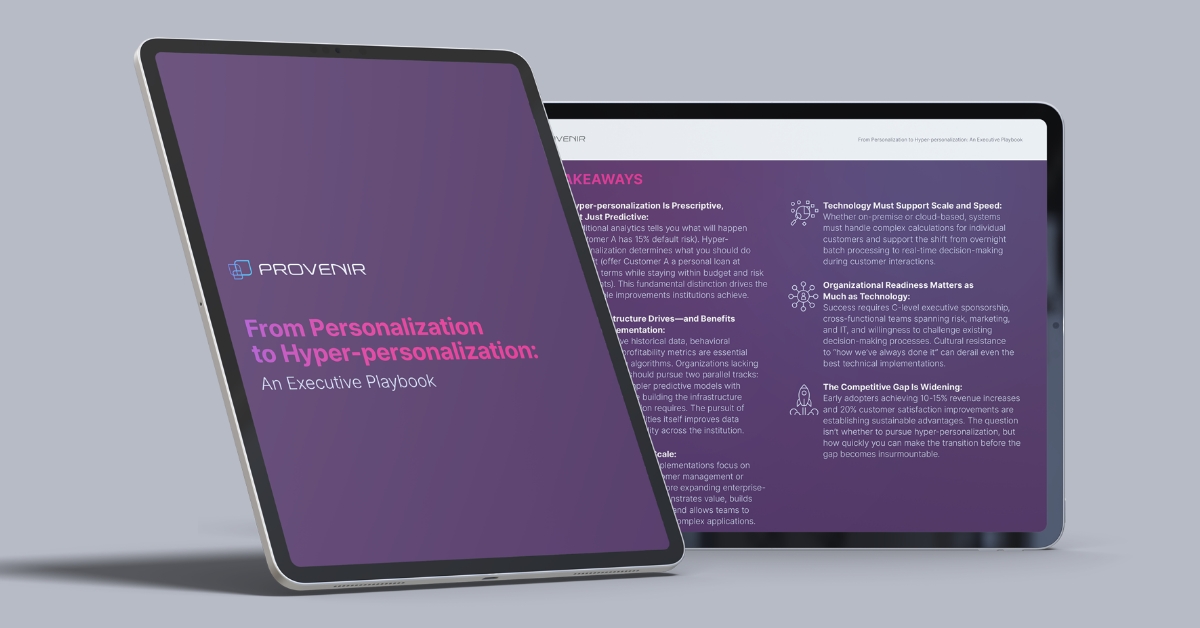
AI-Powered Customer Management:
How Leading Institutions Turn Intelligence Into Revenue
What this guide covers:
The four fundamental transformations AI enables
How leading institutions apply AI across
credit line management, campaigns, pre-delinquency, and authorization decisioning
The technology infrastructure required
How to build a quantifiable business case
A phased implementation roadmap with realistic timelines
Organizational implications and change management requirements
Next steps for getting started
Who should read this:
CEOs evaluating strategic investments in customer intelligence, CROs and CFOs building business cases for AI transformation, Chief Lending Officers seeking competitive advantage through better decisioning, CMOs looking to personalize at scale, and CIOs and CTOs responsible for enabling AI infrastructure.
Table of Contents
What this guide covers:
The strategic rationale for AI-powered Customer Management, the four fundamental transformations AI enables, how leading institutions apply AI across credit line management, campaigns, pre-delinquency, and authorization decisioning, the technology infrastructure required, how to build a quantifiable business case, a phased implementation roadmap with realistic timelines, organizational implications and change management requirements, and next steps for getting started.
Introduction
Most financial institutions are sitting on untapped revenue. Not in new markets or unbanked populations, but in the customer relationships they already have.
Here’s the reality: somewhere between 40–70% of your future growth will come from your existing customers. Credit line increases, product cross-sells, retention improvements. The question is whether you’ll capture that value before your competitors do.
The institutions pulling ahead have figured something out. While traditional banks discover problems after customers miss payments, they’re predicting trouble 90 days early. While most organizations send the same offers to broad segments, they’re personalizing every interaction at the individual level. While quarterly reviews create months of strategic lag, their systems optimize continuously based on what’s actually working.
The difference is AI. And the results are measurable: 5–10x ROI within 18 months, 20% reductions in defaults, and 130% increases in approvals.
Over 110 institutions across 60 countries are already using Provenir. This guide shows you how they’re doing it and what it takes to get there.
Chapter 1: The Problem with Traditional Customer Management
Most Customer Management strategies don’t fail because of a lack of data or expertise. It’s a fundamental timing problem.
You identify a customer showing signs of financial stress. Great. Now you need to pull their complete profile, analyze their situation, decide on an intervention strategy, get approvals, and execute. By the time you finish this process, they’ve already missed two payments and you’re in recovery mode instead of prevention mode.
Or consider the opposite scenario. You have a high-value customer who’s ready for a credit increase. But your system requires days or weeks to process the request. Meanwhile, a competitor with faster decisioning approves them instantly. You just lost share of their wallet.
This pattern repeats constantly across your portfolio. Opportunities expire. Risks materialize. Customers defect to faster, smarter competitors.
Why Manual Processes Can’t Keep Up
Your customers generate millions of behavioral signals. Transaction patterns, payment timing, channel preferences, product usage, external credit activity. Human analysts can process maybe 1% of this information. The other 99% contains patterns that indicate pre-delinquency risk, cross-sell propensity, churn signals, and fraud indicators.
Traditional segmentation helps, but only marginally. You group customers by shared characteristics and apply uniform strategies. Low-risk customers receive conservative offers. Marginal accounts get aggressive collection tactics. Everyone in between gets treated the same as thousands of others.
The market has moved past this. Fintechs approve loans in seconds because AI evaluates applications in real-time. Neobanks personalize offers because machine learning predicts individual propensity. Digital lenders reduce defaults by 20% because early warning systems spot trouble months before it appears in traditional metrics. If you’re still relying on quarterly reviews and segment-based strategies, you’re not competing on equal footing.
Chapter 2: How AI Changes Everything
AI transforms Customer Management in four fundamental ways. Each addresses a critical limitation of traditional approaches.
Prediction Instead of Discovery
Traditional risk management discovers problems after they occur. A customer misses a payment, triggering your collections process. Recovery is expensive and success rates are low.
AI changes the timeline entirely. Machine learning models analyze behavioral patterns to identify deterioration 90+ days before first missed payment. Changes in transaction frequency, payment timing, balance utilization, external credit activity—these combine to signal approaching financial stress. The intervention window this creates is enormous. You can offer payment restructuring, credit counseling, or product modifications before default, preserving both the customer relationship and portfolio value.
Personalization Instead of Segmentation
Traditional segmentation groups customers by shared characteristics and applies uniform strategies. AI enables true individual-level personalization.
For each customer at each moment, AI evaluates thousands of possible actions. Credit line adjustments, product offers, engagement timing, channel selection, message content. The platform identifies the specific action most likely to generate desired outcomes for that individual right now.
This isn’t about better segments. It’s about treating millions of customers as individuals. Organizations achieve significant increases in product offers because AI identifies and engages customers at optimal moments with propositions matched to their specific needs and propensity.
Continuous Operation Instead of Periodic Reviews
Traditional Customer Management operates in periodic cycles. Monthly risk reviews. Quarterly campaign planning. Annual strategy refreshes. Customer behavior changes daily but your response happens monthly at best.
AI monitors portfolio health continuously. Risk scores update in real-time as new information arrives. The platform identifies emerging threats immediately rather than waiting for scheduled reviews. Strategies evolve automatically based on what’s actually working rather than waiting for manual analysis. While competitors plan their next quarterly campaign, you’ve already learned from thousands of interactions and refined your approach accordingly. The advantages compound.
Testing Instead of Guessing
Traditional strategy development relies on intuition validated through slow deployment cycles. You make your best guess, launch broadly, and wait months to understand results.
AI enables scenario simulation before launch. Test different credit policies, model various campaign approaches, understand tradeoffs between risk and revenue. During implementation, deploy multiple variations simultaneously. AI automatically measures relative performance and declares winners based on statistical significance. You learn faster, deploy better strategies, and avoid expensive mistakes.
Chapter 3: What This Looks Like in Practice
Understanding AI capabilities conceptually is one thing. Seeing how it transforms specific Customer Management processes is another.
Credit Line Management
Managing credit limits requires balancing opportunity and risk. Increase limits too aggressively and defaults rise. Too conservative and you leave revenue untapped.
AI optimizes this tradeoff at the individual level. Models identify customers who can safely handle higher limits by analyzing payment history, utilization patterns, income stability, and external credit behavior. For customers showing deterioration, AI detects warning signals before risk becomes evident in traditional metrics and recommends proactive decreases. Rather than applying uniform policies, the system allocates credit capacity across customers to maximize risk-adjusted returns. High-quality customers receive larger increases. Marginal accounts receive modest adjustments or decrease recommendations. Revenue increases without proportional risk elevation.
Campaign Orchestration
Traditional campaigns target broad segments with generic offers. AI enables something entirely different.
For each customer, models predict response likelihood to specific cross-sell/up-sell offers. Credit card balance transfers, savings promotions, investment products—AI identifies which customers will engage with which propositions. But propensity is only part of the equation. Timing matters as much as offer selection. AI analyzes historical engagement patterns to determine optimal contact timing for each customer. Some respond to morning emails, others prefer evening app notifications. The platform determines whether to use email, SMS, in-app messaging, or phone outreach based on channel preference history, and message content adapts to communication style patterns.
Pre-Delinquency Management
Most collections efforts begin after customers miss payments. By then, recovery is expensive and often unsuccessful. AI enables intervention before delinquency occurs.
Early warning models identify at-risk accounts 90+ days before first missed payment. Behavioral pattern changes, transaction anomalies, external credit stress indicators combine to predict approaching financial difficulty. Not every customer showing stress requires intervention—AI predicts which accounts will self-cure without contact, focusing resources on customers who benefit from proactive engagement. For customers needing assistance, the system determines sustainable payment plans based on income patterns, expense obligations, and historical payment capability, balancing customer capacity with recovery objectives.
MTN Group increased pre-approvals by 130% while simultaneously reducing defaults by implementing AI that continuously monitors every customer, predicts risk before problems emerge, and personalizes credit decisions at the individual level. Jeitto reduced defaults by 20% through pre-delinquency detection. These aren’t outliers. They’re what becomes possible when you shift from periodic reviews to continuous intelligence.
Chapter 4: What You Actually Need to Make This Work
AI-powered Customer Management requires integrated technology infrastructure. Fragmented systems can’t deliver the intelligence and responsiveness modern financial services demand.
Data Infrastructure
AI quality depends entirely on data quality. The platform must integrate information from across your organization and external sources.
You can seamlessly connect to a universe of over 120 external data sources through a single API, giving you the flexibility to enrich decisions only when it adds value. These external data sources—including credit bureaus, fraud databases, and alternative data providers—work in harmony with data from your internal systems such as core banking, transaction processing, CRM, and product platforms to deliver smarter, more confident decisions. All of this consolidates into unified customer profiles that update continuously. Every transaction, interaction, and external event enriches understanding of each customer.
Embedded Machine Learning
Start with pre-trained models for common use cases: probability of default, loss given default, propensity-to-pay, churn prediction. These deliver value immediately while custom development proceeds.
The platform must support custom model development for organization-specific requirements and manage the complete model lifecycle: training, validation, deployment, monitoring, and retraining. Regulatory requirements and risk management standards demand transparency. Explainability features showing which factors drive each prediction enable risk teams to validate logic and regulators to audit decisioning.
Decision Intelligence
This is where predictions become actions. AI insights translate into automated decisions without manual intervention while maintaining appropriate controls.
Next-best-action engines evaluate thousands of possible actions for each customer at each moment—credit adjustments, product offers, communication timing, channel selection—and identify optimal decisions based on predicted outcomes. Decision Intelligence automatically balances competing objectives: maximize revenue while maintaining risk tolerances, improve customer experience within operational constraints. Performance feedback connects decisions to outcomes. Every action generates data that trains future models and refines strategy. This closed-loop learning enables continuous improvement without manual intervention.
Low-Code Configuration
Business agility requires business user empowerment. Risk and marketing teams must be able to refine strategies without waiting for IT resources. Intuitive interfaces allow non-technical users to modify decisioning logic, adjust parameters, and deploy new strategies. Drag-and-drop workflow design and visual decision tree builders replace coding requirements. Launch new strategies in days rather than months. Test variations through A/B experiments. Deploy winners across the portfolio. Speed of iteration becomes competitive advantage.
Why You Shouldn’t Build This Yourself
AI-powered Customer Management platforms represent years of development by specialized teams—data orchestration, model management, decisioning engines, low-code interfaces. Custom systems require continuous enhancement as regulations change, new data sources emerge, and internal systems evolve. Maintenance costs typically exceed initial development investment. Platform implementations deliver value in months with accumulated best practices from hundreds of deployments. Internal development projects take years and often fail to achieve full functionality.
Chapter 5: Building Your Business Case
CFOs and CROs require quantifiable returns before approving investment. AI-powered Customer Management delivers measurable value across multiple dimensions.
Revenue Protection
Calculate potential savings from reduced default rates. If AI achieves 20% default reduction on a portfolio with $500M outstanding and 3% annual default rate, annual benefit is $3M. Add avoided recovery costs and the numbers compound. Early intervention costs less and succeeds more frequently than post-default collections. Account modification programs and hardship assistance preserve relationships while minimizing losses.
Customer acquisition costs range from hundreds to thousands of dollars per customer. Preventing defection preserves both initial acquisition investment and future profit potential. Lifetime value preservation compounds over years. Growing revenue from existing relationships costs less than acquiring new customers—acquisition costs decline as a percentage of revenue while maintaining growth rates.
Operational Efficiency
AI handles routine decisioning without human intervention. Credit increases, campaign targeting, authorization decisioning, pre-delinquency monitoring operate continuously without manual effort. Exception-based management concentrates human expertise on cases requiring judgment. Staff productivity improves as resource allocation focuses on highest-value activities. Automated decisioning delivers approvals in seconds rather than days, improving customer experience and capturing opportunities before competitors respond.
The Numbers
Portfolio analysis establishes current performance baselines: default rates, churn percentages, cross-sell ratios, campaign response rates, decision processing times, manual review volumes. Use conservative improvement assumptions when building business cases. If industry benchmarks show 20% default reduction, model 10% for projections. Exceed expectations during implementation rather than overpromising upfront.
Chapter 6: How to Actually Implement This
Successful implementations follow phased approaches that demonstrate value quickly while building toward comprehensive transformation.
Phases 1–3: Foundation
Integrate core data sources—internal transaction history, customer profiles, product information, external connections to credit bureaus and fraud databases—and establish unified customer views.
Deploy initial models starting with pre-delinquency detection. This use case delivers clear value, requires straightforward data inputs, and demonstrates AI capability. Early warning models begin identifying at-risk accounts within weeks. Target 30–60 day deliverables that demonstrate platform value: automated reporting, improved decisioning speed, initial risk predictions. These early successes build momentum and executive confidence.
Establish governance structure. Define roles and responsibilities across risk, marketing, IT, and data science teams. Create communication channels and decision-making processes.
Phases 4–6: Intelligent Decisioning
Deploy recommendation engines for credit line management and product offers, starting with high-value customer segments where personalization generates measurable returns. Launch AI-powered campaigns targeting specific outcomes: credit limit increases, product cross-sells, retention offers. Measure performance against historical baselines.
Establish A/B testing infrastructure. Deploy strategy variations simultaneously, measure relative performance, automate winner selection and deployment. Track KPIs rigorously and document improvements in default rates, approval speeds, campaign response rates, and operational efficiency. Establish closed-loop learning so performance feedback links decisions to outcomes, continuously training models and refining strategy with minimal manual effort.
Phases 7–12: Scale
Apply proven strategies to broader populations. Extend credit line management from prime customers to near-prime segments. Deploy pre-delinquency monitoring across the entire portfolio. Connect Customer Management
decisioning with
onboarding and
collections to create consistent intelligence across the complete customer journey. Move beyond basic next-best-action to sophisticated optimization that considers multiple objectives simultaneously—balancing short-term revenue with long-term relationship value across products and channels.
Final Phase: Maturity
Decision Intelligence operates continuously from onboarding through collections. Risk assessment, fraud detection, customer engagement, and recovery optimization work as an integrated system. AI refines strategies automatically based on outcomes. Human teams set objectives and constraints. The platform determines optimal execution approaches and adjusts continuously. Continuous learning creates compounding advantages—every interaction makes the system smarter.
What Actually Matters for Success
C-suite commitment enables cross-functional collaboration and ensures resource availability. Strong executive sponsorship matters more than most people realize. Successful implementations require collaboration across risk, marketing, IT, and data science—establish governance structures that facilitate rather than impede coordination. Technology alone doesn’t deliver transformation. Organizations must adapt processes, train teams, and manage cultural shift from intuition-based to data-driven decisioning. Choose platform providers with deep financial services expertise, proven implementation track record, and ongoing innovation capability.
What to Avoid
Organizations that attempt comprehensive transformation immediately often struggle—start with focused use cases that demonstrate value quickly and expand based on proven success. AI quality depends on data quality, so allocate sufficient resources for data integration, cleansing, and governance. Regulatory requirements demand model transparency, so deploy AI with proper governance and explainability from the start. And remember: AI-powered Customer Management is business transformation enabled by technology. Business leaders must drive strategy and change management. IT enables but doesn’t lead.
Chapter 7: What This Means for Your Organization
AI transforms how organizations make decisions and how teams work. The shift is less about headcount and more about where human judgment gets applied.
How Roles Change
AI augments rather than replaces human judgment. Executives set AI strategy and risk appetite, oversee governance frameworks, and ensure ROI and resource allocation. Risk and credit officers shift from making individual decisions to reviewing AI recommendations and managing exception cases—focus moves to strategy development and model validation. Marketing professionals move from segment-based campaign management to AI-driven personalization strategy, defining objectives and constraints, interpreting results, and refining approaches based on performance data.
AI also creates demand for new roles: data scientists developing models, ML engineers operationalizing algorithms, model risk managers ensuring governance, and decision scientists translating business problems into AI solutions.
Building Capabilities
Teams need understanding of AI capabilities and limitations. Risk professionals require sufficient data science literacy to validate models. Marketing teams must understand propensity scoring and optimization. IT staff need expertise in AI platform architecture. Develop comprehensive enablement programs combining classroom training, hands-on workshops, and ongoing coaching. The cultural shift from intuition-based to data-driven decision-making requires environments where challenging assumptions with data is valued and experimentation is encouraged.
Governance and Ethics
Establish clear processes for model development, validation, deployment, and ongoing monitoring. Document model logic, training data, performance metrics, and limitations. Regulators demand transparency in automated decisioning—deploy AI with built-in explainability and audit trails demonstrating compliance with fair lending and consumer protection regulations. Monitor AI outcomes across demographic groups. Identify and address disparate impact. Regular auditing ensures AI remains fair and compliant over time as models evolve.
Chapter 8: Moving Forward
The institutions that thrive won’t be those with the most customers. They’ll be those that use AI to extract the most value from relationships they already have.
Your Next Steps
Evaluate existing Customer Management capabilities honestly. Identify gaps between current state and competitive requirements and quantify performance against industry benchmarks. Determine which use cases deliver maximum value quickly—pre-delinquency detection typically provides clear returns within months, with credit line optimization and campaign personalization following. Prove value through focused implementations rather than attempting comprehensive transformation immediately.
Select AI platform providers with deep financial services expertise, proven track record across similar institutions, comprehensive capabilities from data orchestration through Decision Intelligence, and commitment to ongoing innovation. When evaluating potential partners, ask specifically about models for Customer Management, how they ensure explainability and regulatory compliance, what data sources their platform integrates and how quickly, how much coding versus configuration is required for strategy changes, and what realistic implementation timelines look like. Most importantly, ask for customer success examples from organizations similar to yours.
The Bottom Line
AI-powered Customer Management isn’t a technology project. It’s strategic transformation touching every part of your organization—how you assess risk, how you engage customers, how you measure success.
The playbook exists. The technology exists. Organizations implementing AI-powered Customer Management consistently demonstrate measurable results: 5–10x ROI within 12–18 months, 20% default reductions, 130% approval increases, 550% growth in product offers. Competitors are making this shift. The gap widens while deliberation continues. Action separates market leaders from those struggling to keep pace.
About Provenir
Provenir is redefining how leading enterprises manage risk, personalize customer experiences, and drive growth with Decision Intelligence.
Provenir’s single Decision Intelligence platform brings together data, models, and agents to enable continuous optimization of customer decisions and faster deployment of business strategies. Solutions for credit risk, fraud, and customer management are unified in one platform, providing a holistic approach to customer intelligence.
Trusted by the world’s leading financial services providers, Provenir is at the heart of mission-critical operations in over 60 countries, processing more than 4 billion transactions annually.
LATEST BLOGS
Beyond Data:Why Decisioning Needs Document Intelligence Financial services providers
Fraud in Telco:Provenir Experts Answer Frequently Asked Questions 1.

AI governance in financial services:What "governed" means in practice
From Data Protection to Decisioning Accountability:What LATAM Regulation Means
Decisioning ArchitectureThe Architecture Gap: Banking's Next Competitive Battleground Banks
The Real Cost of Vendor Dependency in Credit Decisioning

What Does a Good Data Provider Review Actually Look
AI-Powered Customer Management:How Leading Institutions Turn Intelligence Into Revenue