Language: EN

HyperPersonalization

From Risk Manager to Revenue Generator

From Risk Manager to Revenue Generator:
How CROs Are Becoming the New Growth Heroes

As a Chief Risk Officer or senior executive, you’ve likely defended your risk budget in countless board presentations. You’ve explained loss ratios, regulatory compliance costs, and the value of preventing defaults. But here’s a question that might change how you position your department forever:

What if your risk team doesn’t just protect profit, but creates it.

The most profitable financial institutions have already discovered this truth. While their competitors view risk management as a necessary cost center, these organizations have transformed their risk functions into revenue engines that optimize every customer decision for maximum profitability.

Consider the numbers: McKinsey research shows that true personalization can boost revenue by 10-15% while increasing customer satisfaction by 20%. Yet when we analyze how most institutions actually make decisions, we find that most organizations believe they’re hyper-personalizing customer experiences when in reality they haven’t moved past applying predictive analytics with human judgment overlays.

The gap between perception and reality represents the difference between incremental improvements and transformational competitive advantage.

Your risk department sits on the most valuable asset in your organization: the ability to make profit-optimizing decisions for every customer interaction. While commercial teams bring customers through the door, risk teams determine whether those relationships generate sustainable returns or catastrophic losses.

The fintech graveyard is littered with companies that prioritized customer acquisition over sophisticated risk decision-making. They built beautiful user experiences, raised hundreds of millions in venture capital, and acquired millions of customers. They also gave away billions in capital because they never understood that sustainable revenue generation requires prescriptive risk management, not just predictive analytics.

Smart CROs are recognizing this inflection point. When we present this revenue-generation paradigm to risk leaders, the response is immediate recognition: “We’ve been saying this for years, but nobody listened.”

The conversation is changing. The question for your organization is whether you’ll lead this transformation or follow competitors who recognize risk management’s true revenue potential.

The Hyper-personalization Myth

Industry buzzwords create dangerous illusions. The same pattern that affects AI adoption – where everyone claims advanced capabilities while few achieve true implementation – applies directly to hyper-personalization.

Many organizations describe their approach as hyper-personalized because they use customer data to inform product recommendations. The critical distinction lies in execution methodology. Traditional approaches use predictive analytics to calculate probabilities, then apply human judgment to make final decisions about customer treatment.

This approach falls short of true hyper-personalization, which requires algorithmic decision-making without human interpretation layers.

  • Collections:

    The Decision-Making Divide

    Traditional collections processes illustrate this distinction perfectly. Standard approaches predict customer payment probabilities and delinquency risks, then rely on human judgment to determine contact timing, communication channels, and messaging approaches.

    Collections teams decide when to contact customers, whether to use phone calls, texts, or emails, and what tone to employ. These represent the when, how, and what of collections strategy – all determined by human analysis of predictive data.

    True hyper-personalization eliminates human decision-making. Advanced algorithms determine optimal contact timing for each customer, identify the most effective communication channel based on individual success probabilities, and prescribe specific messaging approaches. The system drives strategy execution based on optimization algorithms, not human interpretation of predictive analytics.

  • Credit Line Management:

    From Standard to Optimal

    Credit card portfolio management demonstrates another critical application. Effective credit limit optimization drives transaction volume and revenue generation through both interest income and interchange fees.

    Traditional approaches apply standardized credit limit policies, often resulting in customers preferentially using competitors’ cards with more suitable limits. This creates revenue leakage and reduces share-of-wallet performance.

    Hyper-personalized credit line management determines optimal limits for individual customers, ensuring specific cards become primary payment methods. The algorithm optimizes for usage frequency while maintaining payment capacity, maximizing profitability for each customer relationship.

  • Product Recommendations:

    Machine vs. Human Decision Authority

    Standard cross-sell processes predict customer preferences and acceptance probabilities for various products. Human analysts interpret these predictions to select specific products and terms for individual customers.

    True hyper-personalization requires algorithmic product selection with specific terms. The optimization engine makes complete decisions by balancing multiple factors: profitability, conversion likelihood, and long-term customer loyalty. The machine prescribes the right product with optimal terms for each customer based on what will generate the best total relationship value over time.

Your Internal Data Goldmine

The best decisions come from understanding your customers deeply. You already have the information you need.

Your existing customers are your biggest advantage. You’ve seen how they bank with you: their spending patterns, how they manage credit, when they make payments, and which products they use. This history tells you what each customer actually needs.

Even more valuable is understanding how customers react to your decisions. When you increase a credit limit, does the customer use it or ignore it? When you offer a new product, do they engage or opt out? This reaction data helps you predict how individual customers will respond next time.

For customers you don’t know as well, smart analytics can help. By studying customers you understand deeply, you can identify patterns that apply to similar customers with less history. You learn from your best relationships to improve your newest ones.

Looking ahead:

Beyond your walls. Right now, most personalization uses data you already own. There’s a largely untapped opportunity in bringing together different types of information beyond credit scores: broader signals that reveal customer needs and behaviors.

Making the Transformation Real

Historical financial services decision-making relies heavily on human judgment. Even when institutions can accurately predict customer behaviors, final decisions about loan amounts, pricing, and terms often depend on subjective analysis and competitive market reactions.

Competitive positioning doesn’t necessarily optimize profitability for specific customer relationships. True optimization requires maximizing profitability for every decision rather than simply maintaining market-competitive offerings.

  • The Technology Foundation

    Prescriptive analytics platforms provide the technological infrastructure needed to optimize individual decisions at institutional scale. These systems integrate predictive capabilities with optimization algorithms, enabling profit-maximizing decisions for every customer interaction.

    Advanced platforms process multiple constraints simultaneously: regulatory requirements, risk appetite parameters, profitability targets, and customer experience objectives. The technology enables real-time optimization across thousands of decision variables.

  • Success Measurement Evolution

    Revenue-generating risk functions require new measurement frameworks that capture both traditional risk metrics and financial performance indicators. Organizations must develop comprehensive measurement approaches that evaluate revenue generation, profit optimization, and sustainable growth alongside risk management effectiveness.

    Key performance indicators should include revenue per customer, profit margins by customer segment, lifetime value optimization, and cross-sell success rates. These metrics demonstrate risk management’s direct contribution to organizational financial performance.

  • Organizational Alignment

    Effective optimization frameworks unite commercial and risk stakeholders around shared objectives, eliminating traditional conflicts between revenue growth and risk management. Properly implemented optimization serves both revenue goals and risk management requirements simultaneously.

The Strategic Imperative

Implementation separates leaders from followers. Organizations ready to begin this transformation should start with three concrete steps:
  • Audit current decision-making processes.
    Map where human judgment currently overrides data in credit decisions, collections strategies, and product recommendations. These are your optimization opportunities.
  • Establish baseline metrics.
    Measure current performance on revenue per customer, lifetime value, and cross-sell conversion rates. You need to quantify the improvement as you shift to algorithmic optimization.
  • Start with one high-impact use case.
    Don’t attempt a full transformation immediately. Choose credit line management or collections optimization where you can demonstrate results within quarters, not years. Success in one area builds organizational support for broader implementation.

The technology exists.
The data exists in your systems.
What’s required now is leadership commitment to move from predictive analytics to prescriptive action.

LATEST BLOGS

Jason Abbott, Fraud Solution Director at Provenir, explains how to fight First-Party Fraud.

First-Party Fraud: T...

BLOG First-Party Fraud: The Hidden Cost of "Good" Customers
ken lee blog post

Driving Intelligent ...

Driving Intelligent Lending Beyond the LOS: A Leadership Perspective
blog selfie

Beyond the Selfie: W...

A solution needs to bridge the gap left by
The State of AI, Risk, and Fraud in Financial Services

The State of AI, Ris...

The State of AI, Risk, and Fraud in Financial
europe mortgages

Top Mortgage Lending...

Top Mortgage Lending Trends in the UK and Europe:
blog lending thumbnail

BLOG: Unlocking Succ...

Thriving Through Change: Unlocking Success in Poland’s Lending Revolution
BLOG AI Round up

BLOG: Shaping the Fu...

Shaping the Future of Decisioning: How These Leading Financial
The Importance of Customer Experience in Driving Loyalty Across the Subscriber Lifecycle

Blog: The Importance...

Discover how telcos can enhance customer experience across the

Continue reading

ATandT

Customer Story: AT&T

AT&T Mexico is a leading telecommunications provider offering advanced mobile services, high-speed internet, and intelligent solutions for individuals and businesses. In Q3 2025, the company reported EBITDA of $199 million USD, marking an 18.5% year-over-year increase, and revenue of $1,095 million USD, up 7% year-over-year—reflecting strong operational performance and continued growth.

AT&T Mexico connects over 24.1 million customers across the country. The company remains committed to transforming connectivity, driving digital inclusion, and delivering innovative services that empower people and businesses throughout Mexico.

  • Industry
  • Region
  • Country

    Mexico

  • Line of Business
  • Solution
  • Module
  • Infrastructure
  • ROI
  • Competition

Customer Timeline
Land MRR: $27,713 USD
Land PS: $62,430 USD
Expand MRR: $20K USD
Expand PS: $10K USD
  • Opportunity Created
    August 30, 2024
  • Opportunity Won
    October 30, 2025
  • Go-Live
    Technical Go-Live:
    Early February 2026


    Full Go-Live:
    February 2026

  • Customer Expansion
    • IN PROGRESS:
      Application fraud solution
    • FUTURE:
      Predictive models and onboarding credit
Initial Opportunity Details

  • Customer Challenge

    With the rise of identity theft, synthetic identities, and subscription fraud as well as higher cost of handsets and equipment fraud is a growing concern. AT&T Mexico faces increasing threats that impact revenue, customer experience, increased complexity to balance onboarding risk and customer friction. Traditional fraud prevention methods often lead to high false positives, increasing operational costs and friction in customer onboarding. ​
  • Provenir Impact

    • Decrease financial losses: Implementing a 10% improvement in fraud detection and a 5% reduction in false positives would save the business a minimum of $5 million annually based on its ~$4Bn USD revenue.
    • Fraud detection improvement:
      Current fraud losses:
      • $40 million/year (1% of $4bn revenue)
      • 10% improvement impact: Reduces losses by $4 million/year
    • False positive reduction and customer experience:
      False Positive Reduction:
      • Current false positive costs: $20 million/year (0.5% of revenue)
      • 5% reduction impact: Saves $1 million/year
  • Competitors

    In-house
    SAS
    Experian
  • Why We Won

    • Strategic Technology Fit
    • Tailored Flexibility
    • Trusted Collaboration
    • Operational Impact
    • Scalable Vision
  • Pain Points

    • Financial losses
    • Fraud detection improvement
    • False positive
    • Improve customer experience
Customer Growth

Growth Opportunities

We could work on onboarding and collection business process to improve all customer life cycle

PSD will continue working closely with AT&T to explore new opportunities.

Expansion

With PSD, the next step is to integrate AI and predictive models to strengthen fraud prevention efforts and leverage alternative data. The goal is to enhance customer profiling and streamline the investigation process, ultimately reducing false positives.
OTHER CUSTOMER STORIES

No posts found.

Continue reading

RytBank

Customer Story: Ryt Bank

Ryt Bank is a Malaysia-based digital bank backed by YTL Group and Sea Limited. It positions itself as the first AI-powered bank, using its Ryt AI assistant (built on Malaysia’s ILMU LLM) to let you chat to pay bills, transfer money, and manage your account, targeting young professionals and frequent travelers with a simple, app-driven experience and transparent fees.
  • Industry
  • Region
  • Country

    Malaysia

  • Line of Business
  • Solution
  • Module
  • Infrastructure
  • ROI
  • Competition

Customer Timeline
Land MRR: $6,500 USD
Land PS: $16K USD
Expand MRR: ~$10K USD
Expand PS: $80K USD
  • Opportunity Created
    26th May 2023
  • Opportunity Won
    12th May 2025
  • Go-Live
    20th July 2025
    Technical Go-Live


    30 th August 2025
    Full Go-Live

  • Customer Expansion
    • Future: Property & Infrastructure-Linked Products
Initial Opportunity Details

  • Customer Challenge

    As a newly launched AI-powered digital bank, Ryt Bank needs to onboard and serve customers in seconds while maintaining robust risk controls and regulatory compliance. Early processes rely on a mix of internal systems, manual reviews, and hard-coded rules, making it difficult to support rapid product launches, dynamic pricing, and personalised credit decisions. This fragmentation slows time-to-yes, drives up operational effort, and limits the bank’s ability to fully leverage data and AI across the customer lifecycle. Ultimately, this impacts Ryt Bank’s ambition to scale quickly and deliver a seamless digital experience.
  • Provenir Impact

    • Smarter, AI-Driven Risk Decisions
      By combining Provenir’s decisioning platform with Ryt’s own AI models, Ryt Bank can assess creditworthiness in real time using a broader set of data points. This delivers more accurate approvals, reduces risk exposure, and supports consistent, data-driven decisions across the retail portfolio.
    • Faster Turnaround and Fully Digital Journeys
      End-to-end automation – from KYC and fraud checks to bureau calls and decision execution – has significantly reduced manual intervention, enabling near-instant decisions for onboarding and credit requests. This improves straight-through-processing rates, shortens time-to-yes, and enhances customer conversion in Ryt’s mobile-first channels.
    • Policy Compliance and Scalable Decisioning
      The solution enforces Ryt Bank’s credit, risk, and regulatory policies through configurable rules and strategies, ensuring consistent compliance with internal standards and Malaysian regulations. At the same time, it provides a flexible, scalable foundation to rapidly introduce new products and tweak policies as the bank grows.
  • Competitors

    FICO
  • Why We Won

    • Digital-Bank Ready, Cloud-Native Platform
      Provenir provides a modern, cloud-native decisioning platform designed for high-growth digital banks, supporting real-time decisions for onboarding, cards, and PayLater in a single environment.
    • Speed to Market and Business User Autonomy
      Our low-code configuration and reusable components allow Ryt Bank’s teams to rapidly design, test, and deploy strategies without heavy IT dependency, accelerating product launches and change cycles.
  • Pain Points

    • Need for instant, consistent decisions across onboarding
    • Difficulty orchestrating multiple data sources and analytics in one place
    • Limited agility to test and roll out new strategies, products, and risk policies
    • High operational overhead from manual reviews and fragmented workflows
Customer Growth

Growth Opportunities

Data Science Initiative: Collaboration with ILMU

Initial discussions have commenced between Ryt Bank, ILMU (YTL’s AI lab) and Provenir’s Data Science team to explore how ILMU’s LLM can be embedded into Provenir decisioning. This early collaboration focuses on use cases such as conversational credit applications, smarter risk insights, and automated policy explanations, laying the foundation for future AI-powered decision intelligence across Ryt Bank’s products.

Expansion

Property & Infrastructure-Linked Products

As YTL expands its townships, transport, and utilities footprint, Ryt Bank can create embedded financial products that are tightly linked to YTL’s property and infrastructure ecosystem. This includes tailored financing for YTL developments, bundled offerings that combine housing, utilities, connectivity, and banking, as well as subscription-style payments for transport and community services—all managed through the Ryt app. Such offerings deepen ecosystem stickiness, unlock new recurring revenue streams, and position Ryt Bank as the primary financial layer across YTL’s integrated developments.

OTHER CUSTOMER STORIES

No posts found.

Continue reading

2025 winner

Provenir Wins Credit Risk Solution Award at 2025 Credit & Collections Technology Awards 

Provenir Wins Credit Risk Solution Award at 2025 Credit & Collections Technology Awards

AI decisioning platform recognized for innovation in
credit risk management across consumer lending and banking

LONDON, UK – December 1, 2025 – Provenir, a global leader in AI decisioning platforms for financial services, won the Credit Risk Solution award at the 2025 Credit & Collections Technology Awards. The ninth annual ceremony took place November 20, 2025, at the Midland Hotel in Manchester.

The Credit & Collections Technology Awards celebrate companies driving innovation in credit risk management across the financial services industry. The awards recognize organizations that consistently advance the profession through technology and strategic innovation.

Provenir’s award reflects the company’s work helping financial institutions make smarter credit risk decisions across the customer lifecycle—from onboarding through collections. The platform processes over 4 billion decisions annually for 110+ enterprise customers across 60+ countries, combining real-time risk assessment with embedded AI to help banks, fintechs, and consumer lenders balance growth with portfolio health.

The platform enables risk teams to automate underwriting decisions, adapt credit strategies in real-time, and optimize portfolio performance across consumer lending, banking, and BNPL use cases. Recent customer results include 10% increases in approval rates, 30% decreases in delinquent accounts, and 2X growth in customer base while maintaining risk discipline.

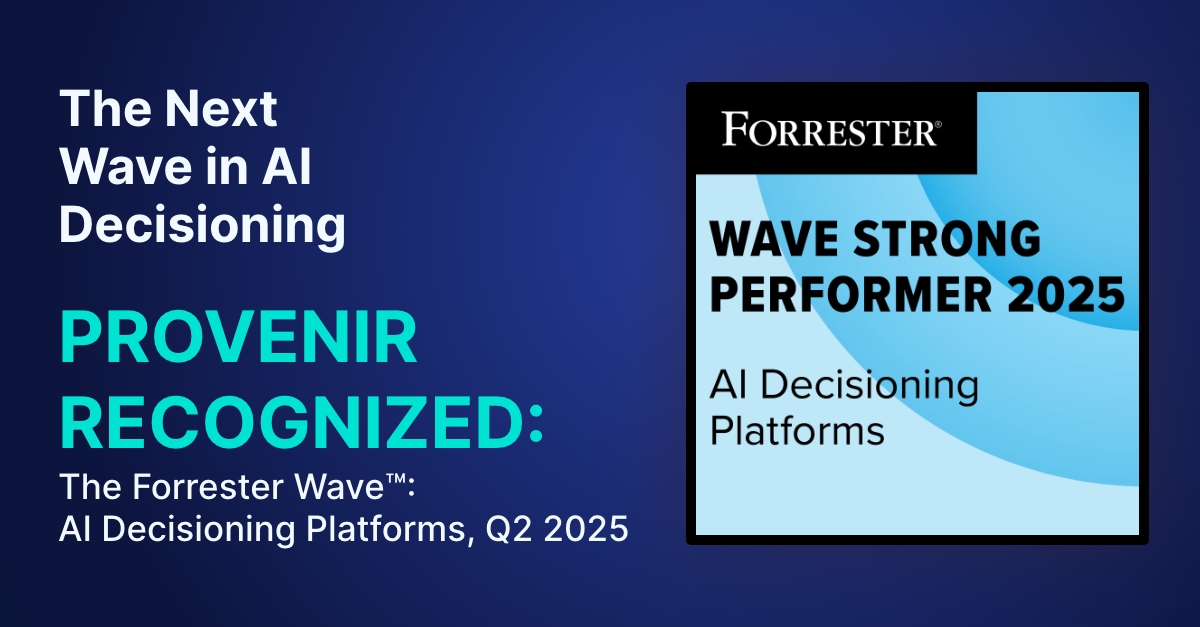
Provenir has been recognized as a Strong Performer in Forrester’s Wave for AI Decisioning Platforms and a Category Leader by Chartis Research in Credit Portfolio Management, Credit Lending Operations, and Risk Tech Quadrant for Retail Credit Solutions.

View All the Awards

View Awards

LATEST NEWS

Continue reading

Hyper-personalization Myth2

The Hyper-personalization Myth Series 2

The Hyper-personalization Myth Series #2:
The Scorecard Trap: How Traditional Models Are Leaving Money on the Table

Your institution has invested millions in analytics. You’ve built scorecards, deployed predictive models, and segmented your customer base into carefully defined groups. Your risk teams use these tools daily. Your data science team maintains them diligently.

And yet, you’re still losing to competitors who seem to make better decisions faster. Your customer satisfaction scores aren’t improving despite all this sophistication. Your profit per customer remains stubbornly flat.

Here’s why: scorecards and traditional segmentation models (the backbone of financial services decisioning for decades) were designed for a different era. They’re leaving enormous value on the table because they fundamentally cannot deliver what today’s market demands: truly individualized treatment at scale.

The Scorecard Legacy

Scorecards became ubiquitous in financial services for good reason. They’re transparent, explainable to regulators, and relatively simple to implement. A credit scorecard might use 10-15 variables to generate a risk score. Customers above a certain threshold get approved; those below get declined. Some institutions have dozens of scorecards for different products, channels, and customer segments.

The problem isn’t that scorecards don’t work—it’s that they’re fundamentally limited by their simplicity. Consider what a scorecard actually does: it takes a handful of variables, applies predetermined weights, and outputs a single number. That number then gets used to make a binary or simple categorical decision.

This approach made perfect sense when computational power was limited and data was scarce. But in today’s environment, where institutions have access to hundreds of data points per customer and virtually unlimited processing capability, scorecards are like using an abacus in the age of supercomputers.

The mathematical reality is stark: a scorecard might consider 15 variables. Modern machine learning models can process hundreds or thousands of variables, identifying complex patterns and interactions that scorecards miss entirely. More critically, optimization algorithms can then use those insights to determine individual optimal actions while balancing multiple business objectives simultaneously.

The Segmentation Illusion

Most institutions have evolved beyond single scorecards to sophisticated segmentation strategies. They might have different models or rules for:
  • High-income vs. low-income customers

  • Young professionals vs. retirees

  • Urban vs. rural customers

  • High credit scores vs. marginal credit

  • Long-tenure vs. new customers

This feels like personalization. An institution might have 20, 50, or even 100 different segments, each with tailored strategies. But this is still fundamentally a bucketing approach, and buckets, no matter how numerous, cannot capture individual-level optimization.

Consider two customers in the same segment: both are 35-year-old professionals with $80,000 income, 720 credit scores, and $50,000 in deposits. By any reasonable segmentation logic, they should receive identical treatment. But look closer:

  • Customer A:

    • Has been with the institution for 8 years
    • Holds checking, savings, and an auto loan
    • Uses digital channels 90% of the time
    • Has never called customer service
    • Lives in a competitive market with three other branches nearby
    • Recently searched for mortgage rates online
  • Customer B:

    • Opened an account 6 months ago
    • Has only a checking account with direct deposit
    • Visits branches frequently
    • Has called customer service three times about fees
    • Lives in a rural area with limited banking options
    • Just paid off student loans

The optimal product, pricing, and engagement strategy for these two customers is completely different, but segmentation treats them identically because they fit the same demographic and credit profile.

True Hyper-personalization recognizes that Customer A is at risk of moving their mortgage business to a competitor and should receive a proactive, digitally-delivered, competitively-priced mortgage offer. Customer B is a safe customer who values in-person service and should receive education about additional products delivered through branch interactions.

No segmentation strategy, no matter how sophisticated, can capture these nuances at scale across thousands of customers.

The Evolution:

Rules → Predictive → Prescriptive

The journey from scorecards to Hyper-personalization isn’t a single leap—it’s an evolution through three distinct stages:
  • STAGE 1:

    Rules and Scorecards

    This is where most institutions still operate for many decisions. Fixed rules and simple scorecards determine actions: “If credit score > 700 AND income > $50K, approve up to $10K.” These provide consistency and explainability but leave massive value on the table because they cannot adapt to individual circumstances or balance multiple objectives.
  • STAGE 2:

    Predictive Analytics

    Institutions deploy machine learning models that generate probabilities: “This customer has a 23% probability of default, 67% propensity to purchase, and 15% likelihood of churn in 90 days.” This is a significant improvement—the predictions are more accurate and can consider many more variables than scorecards.

    But here’s the trap: many institutions stop here and think they’ve achieved personalization. They have better predictions, but humans still make the decisions based on those predictions. A product manager reviews the propensity scores and decides which customers get which offers. This is still segmentation with extra steps.

  • STAGE 3:

    Prescriptive Optimization

    This is true hyperpersonalization: algorithms determine the optimal action for each individual customer while simultaneously considering:

    • Multiple predictive models (risk, propensity, lifetime value)
    • Business objectives (profitability, growth, risk-adjusted returns)
    • Operational constraints (budget, inventory, capacity)
    • Strategic priorities (market share, customer satisfaction, competitive positioning)
    • Regulatory requirements

    The output isn’t a prediction or a score—it’s a specific decision: “Offer Customer 1,547 a $12,000 personal loan at 8.2% APR with 36-month terms, delivered via email on Tuesday morning.”

Why Individual Treatment Isn’t Optional Anymore

The shift from segmentation to individual optimization isn’t just about squeezing out marginal improvements—it’s about remaining competitive in a market where customer expectations have been fundamentally reset.

Consider what your customers experience in their daily digital lives:

  • Netflix doesn’t show the same content recommendations to everyone aged 25-34 with similar viewing history—it creates individual recommendations for each user
  • Amazon doesn’t display the same products to everyone in the same demographic segment—it personalizes down to the individual
  • Spotify doesn’t create the same playlists for everyone who likes rock music—it generates unique mixes for each listener

Your customers experience this level of personalization dozens of times per day. Then they interact with their financial institution and receive the same generic offers as thousands of other customers in their segment.

The disconnect creates real business impact:

  • Offers that aren’t relevant get ignored, wasting marketing spend

  • Products that don’t match individual needs generate low engagement and high attrition

  • Generic credit decisions either take excessive risk or miss profitable opportunities

  • Customers increasingly expect better and defect to competitors who deliver it

The Structural Limitations of Segmentation

Even sophisticated segmentation approaches have fundamental mathematical limitations:
  • Constraint Blindness:
    Segments cannot optimize resource allocation. If you have 10,000 customers in a segment and budget for 3,000 offers, which 3,000 should receive them? Segmentation can’t answer this; it requires optimization.
  • Multi-Objective Failure:
    Should you prioritize profitability or customer lifetime value? Risk minimization or growth? Segments force you to choose. Optimization can balance multiple objectives simultaneously.
  • Inflexibility:
    Market conditions change, but segments are relatively static. Rebuilding segmentation strategies takes weeks or months. Re-running optimization takes minutes.
Lost Interactions: Variables don’t just add; they interact in complex ways. Income matters differently depending on debt levels, which matter differently depending on payment history, which matters differently depending on life stage. Segments capture some of this; machine learning captures much more; optimization leverages all of it.

The Path Forward

The transition from scorecards and segmentation to true Hyper-personalization requires honest assessment of where you are versus where the market is heading.

Ask yourself these diagnostic questions:

  • Are you still using scorecards for primary decisions?
    If yes, you’re operating with 1990s technology in a 2025 market. Scorecards provide consistency but cannot compete with approaches that consider hundreds of variables and complex interactions.
  • Do you rely on segmentation strategies with fixed rules per segment?
    If yes, you’re leaving money on the table even if you have sophisticated segments. No bucketing approach can optimize individual decisions while balancing multiple objectives and constraints.
  • After generating predictions, do humans decide actions?
    If yes, you’re stuck in Stage 2—you have better information but aren’t leveraging optimization to determine what to do with it.
  • Can you explain why Customer A received one offer while Customer B received a different offer, beyond “they’re in different segments”?
    If not, you’re not doing individual-level optimization.

The institutions winning in today’s market have moved beyond asking “What segment is this customer in?” to “What is the optimal action for this specific customer given all our objectives and constraints?”

That shift—from classification to optimization—is what separates leaders from laggards. Scorecards and segments were brilliant solutions for their time. But that time has passed.

The question is whether your institution will evolve before your competitors do, or whether you’ll spend the next decade wondering why your sophisticated analytics aren’t translating into business results.

LATEST BLOGS

Jason Abbott, Fraud Solution Director at Provenir, explains how to fight First-Party Fraud.

First-Party Fraud: T...

BLOG First-Party Fraud: The Hidden Cost of "Good" Customers
ken lee blog post

Driving Intelligent ...

Driving Intelligent Lending Beyond the LOS: A Leadership Perspective
blog selfie

Beyond the Selfie: W...

A solution needs to bridge the gap left by
The State of AI, Risk, and Fraud in Financial Services

The State of AI, Ris...

The State of AI, Risk, and Fraud in Financial
europe mortgages

Top Mortgage Lending...

Top Mortgage Lending Trends in the UK and Europe:
blog lending thumbnail

BLOG: Unlocking Succ...

Thriving Through Change: Unlocking Success in Poland’s Lending Revolution
BLOG AI Round up

BLOG: Shaping the Fu...

Shaping the Future of Decisioning: How These Leading Financial
The Importance of Customer Experience in Driving Loyalty Across the Subscriber Lifecycle

Blog: The Importance...

Discover how telcos can enhance customer experience across the

Continue reading

Hyper-personalization Myth1

The Hyper-personalization Myth Series 1

The Hyper-personalization Myth Series #1:
Why Banks Think They’re Doing Hyper-personalization (But Aren’t)

Walk into most financial institutions today and ask about their Hyper-personalization strategy, and you’ll hear impressive claims. Banks, credit unions, fintechs, and lenders have deployed machine learning models. They can predict which customers will default, respond to offers, or churn. Their data science teams run sophisticated analyses daily.

But here’s the uncomfortable truth: most of what financial services providers call “Hyper-personalization” is actually just prediction with manual decision-making. And that gap—between prediction and prescription—is costing them millions in lost revenue and customer satisfaction.

This article explores the distinction between predictive analytics (what most organizations have) and true prescriptive optimization (what actually drives results). You’ll learn how to identify whether your institution is doing real Hyper-personalization or just sophisticated guesswork—and why that difference determines whether you’re building competitive advantage or burning through analytics budgets with minimal return.

The Critical Distinction Most Banks Miss

The difference between real Hyper-personalization and what most banks are doing comes down to a simple question: Who makes the final decision—the human or the machine?

In most organizations today, the process looks like this:

  • Machine learning models generate predictions (probability of default, propensity to buy, likelihood of churn)
  • These predictions are packaged into reports or dashboards
  • A human—a collections manager, marketing director, or risk officer—reviews the predictions
  • That human decides what action to take based on the predictions plus their judgment

This is predictive analytics, not Hyper-personalization. It’s sophisticated, certainly. But it’s fundamentally limited by human cognitive capacity.

True Hyper-personalization flips this model: the machine determines the optimal action for each individual customer while considering all business objectives and constraints simultaneously. The human sets the goals and guardrails; the algorithm makes the decisions.

The Collections Reality Check

Consider a typical collections scenario that reveals why this distinction matters. A bank has 10,000 accounts that are 30 days past due. Their analytics team has built impressive models predicting propensity to pay, likelihood of self-cure, and probability of default for each customer.

  • The Traditional Approach:

    The collections manager reviews dashboard reports showing these probabilities, grouped into segments: high propensity to pay, medium, low. Based on this information and years of experience, they design treatment strategies. High-propensity customers get gentle email reminders. Medium-propensity customers receive phone calls. Low-propensity accounts go to external agencies.

    This seems logical. But here’s what’s actually happening:

    The manager can realistically evaluate perhaps 5-10 different strategy combinations. They cannot simultaneously optimize across 10,000 individual customers while considering budget constraints, staff availability, channel costs, regulatory requirements, time zone differences, and strategic customer retention objectives.

    Customer 1,547 and Customer 3,891 might have identical propensity-to-pay scores but dramatically different optimal approaches based on their complete behavioral history, communication preferences, product holdings, and lifetime value potential. The segmentation treats them identically.

    The manager knows the collection center has limited capacity, but they cannot precisely calculate which specific customers should receive which interventions to maximize recovery within that constraint.

  • The Hyper-personalization Reality:

    True optimization algorithms determine the exact approach for each customer: Email or phone? Morning or evening? Firm or empathetic tone? Settlement offer of how much? Payment plan of what structure?

    The system makes these determinations by simultaneously considering:

    • Individual customer characteristics and history
    • Propensity models for various outcomes
    • Cost of each intervention approach
    • Staff and budget constraints
    • Regulatory requirements
    • Strategic priorities (customer retention vs. immediate recovery)
    • Portfolio-level objectives

    No human can balance dozens of objectives across thousands of customers simultaneously while respecting multiple business constraints. The machine can—and it can do so in seconds rather than weeks.

The Credit Line Management Example

The distinction becomes even clearer in credit line management. One institution we worked with wanted to optimize credit line increases and decreases across their portfolio. They had sophisticated predictive models for probability of default at various limits, propensity to utilize additional credit, likelihood of balance transfers, and customer lifetime value projections.

  • Their Original Process:

    Product managers reviewed these predictions and created rules: “Customers with probability of default below 5% and utilization above 60% are eligible for line increases up to $10,000.” They had perhaps a dozen rules covering different customer segments.
  • What Hyper-personalization Delivered:

    Instead of segment-based rules, the optimization engine determined individual credit limits for each customer. Two customers with identical risk scores might receive different credit decisions based on their complete profiles, the competitive landscape, and the bank’s current portfolio composition.

The system simultaneously maximized profitability while ensuring portfolio-level risk stayed within targets, marketing budgets were respected, and regulatory capital requirements were met. When the bank’s risk appetite changed or market conditions shifted, the system re-calculated optimal decisions across the entire portfolio in minutes.

  • Results:

    15% higher portfolio profitability with no increase in default rates, 23% improvement in customer satisfaction as customers received credit access that better matched their actual needs.
  • The key insight:

    Customer A and Customer B might have the same probability of default, but Customer A’s optimal credit line might be $8,500 while Customer B’s is $12,000—because the optimization considers dozens of factors beyond risk, including profitability potential, competitive threats, portfolio composition, and strategic objectives.
No human analyst reviewing prediction reports could make these individualized determinations across thousands of customers while balancing portfolio-level constraints.

What Real Hyper-personalization Actually Requires

The gap between prediction and prescription isn’t just semantic—it requires fundamentally different technology:
  • Optimization Engines, Not Just Models
    You need algorithms that determine optimal actions while balancing multiple objectives and respecting numerous constraints. These are sophisticated mathematical solvers, not traditional machine learning models. They take predictions as inputs but produce decisions as outputs.
  • Integrated Decision-Making
    The human doesn’t sit between prediction and action, translating probabilities into decisions. Instead, humans set objectives (“maximize profitability while keeping portfolio default rate below 3%”) and constraints (“stay within marketing budget of $2M”), then the system optimizes within those parameters.
  • Constraint Management
    The system must handle real business limitations: budget caps, risk thresholds, inventory levels, regulatory requirements, staff capacity, operational constraints. These aren’t nice-to-haves—they’re fundamental to determining what the optimal decision actually is.
  • Goal Function Definition
    Organizations must explicitly define what they’re optimizing: Maximize profitability? Minimize defaults? Maximize customer lifetime value? Optimize customer satisfaction? Usually it’s some combination, and the weighting matters enormously.
  • Multi-Objective Balancing
    Here’s where traditional approaches completely break down. A collections manager might maximize recovery rates, but at what cost to customer retention? A marketing manager might maximize campaign response, but at what cost to profitability? Optimization engines can balance competing objectives mathematically rather than through human judgment.

Why the Distinction Matters Now

The gap between prediction and prescription might seem technical, but it has profound business implications. Consider what happens when you rely on human judgment to translate predictions into decisions:
  • Limited Optimization Scope:
    Humans can consider perhaps 5-10 variables simultaneously. Hyper-personalization algorithms can consider hundreds while respecting dozens of constraints.
  • Suboptimal Resource Allocation:
    Even excellent managers cannot allocate limited resources (budget, staff time, inventory) to maximize outcomes across thousands of customers simultaneously.
  • Slow Adaptation:
    When market conditions change, updating human-driven decision rules takes weeks. Re-running optimization takes minutes.
  • Local Optimization:
    Each department optimizes for their objectives—collections maximizes recovery, marketing maximizes response rates, risk minimizes defaults. True Hyper-personalization optimizes across the entire customer lifecycle.
The financial institutions implementing real Hyper-personalization are achieving 10-15% revenue increases and 20% customer satisfaction improvements, according to McKinsey research. More importantly, they’re building competitive advantages that compound over time through accumulated learning and organizational capability.

The Uncomfortable Question

Here’s how to tell if you’re really doing Hyper-personalization or just sophisticated prediction:

Ask yourself: “After our models generate predictions, does a human decide what action to take?”

If the answer is yes—if someone reviews reports and determines which customers get which offers, which collections approach to use, which credit limits to assign—you’re not doing Hyper-personalization.

You’re doing predictive analytics with human judgment. It’s better than rules alone, certainly. But it’s leaving enormous value on the table.

Moving Beyond the Myth

The organizations that figure out true Hyper-personalization first will define the competitive landscape for the next decade. The ones that remain stuck in prediction-plus-judgment will spend that decade wondering why their sophisticated analytics aren’t translating into business results.

True Hyper-personalization means the machine determines the optimal action for each customer, considering all your business objectives and constraints simultaneously. The human’s role shifts from making decisions to setting strategy: defining objectives, establishing constraints, and continuously refining what “optimal” means for your organization.

Anything less is just prediction with extra steps—no matter how sophisticated your models are.


Continue exploring hyper-personalization in the second article of our series “The Scorecard Trap: How Traditional Models Are Leaving Money on the Table”.

LATEST BLOGS

Jason Abbott, Fraud Solution Director at Provenir, explains how to fight First-Party Fraud.

First-Party Fraud: T...

BLOG First-Party Fraud: The Hidden Cost of "Good" Customers

ken lee blog post

Driving Intelligent ...

Driving Intelligent Lending Beyond the LOS: A Leadership Perspective
blog selfie

Beyond the Selfie: W...

A solution needs to bridge the gap left by
The State of AI, Risk, and Fraud in Financial Services

The State of AI, Ris...

The State of AI, Risk, and Fraud in Financial
europe mortgages

Top Mortgage Lending...

Top Mortgage Lending Trends in the UK and Europe:
blog lending thumbnail

BLOG: Unlocking Succ...

Thriving Through Change: Unlocking Success in Poland’s Lending Revolution
BLOG AI Round up

BLOG: Shaping the Fu...

Shaping the Future of Decisioning: How These Leading Financial
The Importance of Customer Experience in Driving Loyalty Across the Subscriber Lifecycle

Blog: The Importance...

Discover how telcos can enhance customer experience across the

Continue reading

Beyond Static Rules

Beyond Static Rules

Beyond Static Rules:
How Learning Systems Enhance Decisioning in Financial Services

In financial services, we’ve built our decision-making infrastructure on a foundation of static rules. If credit score is above 650 and income exceeds $50,000, approve the loan. If transaction amount is over $10,000 and location differs from historical patterns, flag for fraud review. If payment is more than 30 days late, initiate collections contact.

These rules have served us well, providing consistency, transparency, and regulatory compliance. They enabled rapid scaling of decision processes and created clear audit trails that remain essential today. But in an increasingly dynamic financial environment, rules alone are no longer sufficient. The question isn’t whether to abandon rules, but how to augment them with adaptive intelligence that responds to evolving patterns in real-time.

The future of financial services decision-making lies in hybrid systems that combine the reliability and transparency of rule-based logic with the adaptability and pattern recognition of learning systems.

The Limitations of Rules-Only Systems

Static rules excel at encoding known patterns and maintaining consistent standards. They provide the transparency and auditability that regulators require and the predictability that operations teams depend on. However, rules alone struggle to keep pace with rapidly evolving environments.

Consider fraud detection. Traditional rule-based systems might flag transactions over $5,000 from new merchants as suspicious. This rule made sense when established based on historical fraud patterns, and it continues to catch certain types of fraud effectively. But fraudsters adapt. They start making $4,999 transactions. They use familiar merchants. They exploit the predictable gaps in purely rule-based logic.

Meanwhile, legitimate customer behavior evolves. The rise of digital payments, changing shopping patterns, and new financial products creates scenarios that existing rules never contemplated. A rule designed to catch credit card fraud might inadvertently block legitimate cryptocurrency purchases or gig economy payments.

Rule-only systems face a maintenance challenge: they require constant manual updates to remain effective, while each new rule potentially creates friction for legitimate customers. This is where learning systems provide crucial augmentation.

Learning Systems as Intelligent Augmentation

Learning systems complement rule-based approaches by continuously adapting based on outcomes and feedback. Rather than replacing rules, they enhance decision-making by identifying nuanced patterns that would be impossible to codify manually.

In fraud detection, a hybrid system might use foundational rules to catch known fraud patterns while employing learning algorithms to detect emerging threats. When transactions consistently prove legitimate for customers with certain behavioral patterns, the learning component adjusts its risk assessment. It discovers that transaction amount matters less than the combination of merchant type, time of day, and customer history—insights that inform but don’t override critical safety rules.

When new fraud patterns emerge, learning systems detect them without manual rule updates. They identify subtle correlations, like specific device fingerprints combined with particular geographic transitions, that would be impractical to encode in traditional rules. Meanwhile, core fraud prevention rules continue to provide consistent baseline protection.

The Adaptive Advantage in Credit Decisions

Credit decisioning showcases the power of learning systems even more dramatically. Traditional credit scoring relies heavily on bureau data and static models updated quarterly or annually. These approaches miss real-time behavioral signals that predict creditworthiness more accurately than historical snapshots.

Learning systems can incorporate dynamic factors: recent spending patterns, employment stability indicators from payroll data, seasonal income variations for gig workers, even macro-economic trends that affect different customer segments differently. They adapt to changing economic conditions automatically rather than waiting for model revalidation cycles.

The Implementation Reality

Transitioning from rules to learning systems requires a fundamental shift in operational philosophy. It requires organizations to move from controlling decisions to guiding learning, from perfect predictability to optimized outcomes.

This transition creates both opportunities and challenges:

  • Enhanced Accuracy:

    Learning systems typically improve decision accuracy by 15-30% compared to static rules because they adapt to changing patterns continuously.
  • Reduced Maintenance:

    Instead of manually updating rules as conditions change, learning systems evolve automatically based on outcome feedback.
  • Improved Customer Experience:

    Dynamic decisions create less friction for legitimate customers while maintaining or improving risk controls.
  • Regulatory Complexity:

    Learning systems require more sophisticated explanation capabilities to satisfy regulatory requirements for decision transparency.

The Hybrid Approach

The most successful implementations combine human judgment with machine learning. This hybrid approach uses learning systems to identify patterns and optimize outcomes while maintaining human oversight for exception handling and strategic direction.

Key components of effective hybrid systems include:

  • Guardrails:

    Automated systems operate within predefined boundaries that prevent extreme decisions or outcomes that violate business or regulatory constraints.
  • Explanation Capabilities:

    Learning systems provide clear justification for decisions, enabling human review and regulatory compliance.
  • Feedback Loops:

    Human experts can correct system decisions and provide guidance that improves future learning.
  • Escalation Triggers:

    Complex or high-impact decisions automatically route to human review while routine decisions proceed automatically.

Building Learning Organizations

Successful deployment of learning systems requires more than technology—it demands organizational capabilities that support both rigorous rule governance and adaptive learning.

This means investing in data infrastructure that serves both systems, developing teams skilled in both rule logic and model management, and fostering a culture that values consistency and continuous improvement equally.

The Strategic Transformation

The transition from static rules to learning systems represents strategic transformation. Organizations that master this shift create institutional learning capabilities that compound over time rather than making better individual decisions.

Every customer interaction becomes a learning opportunity. Every decision outcome improves future decisions. Every market change becomes a source of adaptive advantage rather than operational disruption.

In financial services, where success depends on making millions of good decisions rather than a few perfect ones, learning systems provide sustainable competitive advantages that static rules simply cannot match. The institutions that recognize this reality and act on it will define the future of financial services decision-making.

Where Are You on Your AI Journey?
Take the AI Readiness Quiz

Take the Quiz

LATEST BLOGS

Jason Abbott, Fraud Solution Director at Provenir, explains how to fight First-Party Fraud.

First-Party Fraud: T...

BLOG First-Party Fraud: The Hidden Cost of "Good" Customers
ken lee blog post

Driving Intelligent ...

Driving Intelligent Lending Beyond the LOS: A Leadership Perspective
blog selfie

Beyond the Selfie: W...

A solution needs to bridge the gap left by
The State of AI, Risk, and Fraud in Financial Services

The State of AI, Ris...

The State of AI, Risk, and Fraud in Financial
europe mortgages

Top Mortgage Lending...

Top Mortgage Lending Trends in the UK and Europe:
blog lending thumbnail

BLOG: Unlocking Succ...

Thriving Through Change: Unlocking Success in Poland’s Lending Revolution
BLOG AI Round up

BLOG: Shaping the Fu...

Shaping the Future of Decisioning: How These Leading Financial
The Importance of Customer Experience in Driving Loyalty Across the Subscriber Lifecycle

Blog: The Importance...

Discover how telcos can enhance customer experience across the

Continue reading

Event WFIS

WFIS Indonesia 2025

Event

WFIS Indonesia 2025

The Premier Financial Services Innovation Event

  • November 25–26, 2025
  • Booth P13

Provenir is proud to be a Gold Sponsor at WFIS Indonesia 2025 – The Premier Financial Services Innovation Event 

The two-day event will unite C-suite leaders, VPs, Directors, and decision-makers from over 200 banks, insurers, and fintechs across Indonesia. Together, they’ll explore how data, AI, and intelligent decisioning are reshaping the region’s financial ecosystem. 

Discover Intelligent Decisioning @ Booth P13 

Join us at Booth P13 on November 25–26, 2025, to experience how Provenir enables intelligent, data-driven decisions for financial services providers. 

As a global leader in AI decisioning, Provenir empowers organizations to automate, predict, and personalize every customer interaction – driving growth and trust across the financial lifecycle. 

Why Meet Us at WFIS Indonesia 2025? 

  • Smarter Risk Decisions – Automated in Real Time – Manage losses and approve more good customers with adaptive, AI-driven decisioning that learns continuously from data.
  • Predict Customer Needs with Behavioural Insights – Leverage contextual and behavioural data to anticipate customer intent and deliver proactive, relevant offers.
  • Hyper-Personalize Customer Experiences – Use AI-powered decisioning to personalize onboarding, engagement, and servicing at every touchpoint – driving loyalty and lifetime value.
  • End-to-End Financial Decisioning Solutions – Credit Risk Onboarding: Fast, accurate approvals with intelligent automation
    Application Fraud & Compliance: Detect, prevent, and stay compliant in real time
    Customer Management & Hyper-Personalization: Understand, engage, and retain with data-driven intelligence
    Collections Optimization: Recover smarter, faster, and more empathetically
  • Scalable, Cloud-Native Platform – Accelerate innovation with a configurable, low-code environment that scales effortlessly with your business.

Join our Session at 9.25 am | Day 2 – 26th Nov

Balancing Innovation and Trust: How AI Decisioning is Redefining Risk, Inclusion, and Customer Experience

  • How Provenir helps financial institutions embrace AI innovation responsibly by balancing automation, transparency, and compliance
  • Exploring how real-time decision intelligence detects social engineering and safeguards digital trust across customer interactions
  • Using Provenir’s AI and data marketplace to promote financial inclusiveness and expand access to underserved customer segments
  • Delivering hyper-personalized financial experiences that remain compliant, secure, and customer-centric
  • Uncovering how GenAI and agentic AI are shaping the next generation of intelligent, ethical, and inclusive financial ecosystems
Register your interest here

Speaker:

Wana Sedayu

Wana Sedayu

Senior Presales Consultant, APAC – Provenir

Wana is a Senior Presales Consultant at Provenir, supporting clients across the APAC region in driving digital transformation within the financial services sector. With over 15 years of experience in the industry, Wana brings deep expertise in loan origination, core leasing, credit decisioning, and customer management solutions.

Beginning his career as a software developer, Wana later transitioned into business consulting before dedicating the past decade to presales and value engineering roles. He has worked with prominent institutions such as Citibank, SMBC Indonesia, Bank Danamon, Bank of America, the Indonesia Stock Exchange, and the Ministry of Finance, contributing to numerous high-impact technology initiatives. OnlinePajak as Senior Manager Presales, and Fujitsu Indonesia as Presales Manager.

Combining his technical foundation with a strong business perspective, Wana is passionate about helping financial institutions accelerate innovation, optimize their decisioning processes, and achieve measurable business outcomes through data-driven solutions.

Why Provenir:

At Provenir, we help financial institutions automate smarter risk decisions, use behavioral insights to drive growth, and personalize every interaction with contextual intelligence all from a single, unified platform. 

Let’s Connect:

Meet our team at Raffles Jakarta to discover how Provenir’s AI Decisioning Platform can help your organization accelerate approvals, prevent fraud, and deliver personalized customer experiences that build trust and profitability. 

LATEST WEBINARS

Watch Now: Trends in...

ON-DEMAND WEBINAR Watch Now:Trends in Digital Lending for

SME Lending in MENA:...

ON-DEMAND WEBINAR SME Lending in MENA:Leveraging Data +

SME Lending in Afric...

ON-DEMAND WEBINAR SME Lending in Africa -Leveraging Data
Pioneering the Future of Low-Risk Consumer Lending

Pioneering the Futur...

ON-DEMAND WEBINAR Pioneering the Futureof Low-Risk Consumer Lending
Fireside Chat: Maximizing Member Experiences with Better Technology, Data + Automation

Fireside Chat: Maxim...

ON-DEMAND WEBINAR Fireside Chat:Maximizing Member Experiences with Better

Maximizing the Value...

ON-DEMAND WEBINAR Maximizing the Value of Your Customers:Better

Achieving Frictionle...

ON-DEMAND WEBINAR Achieving Frictionless Fraud Prevention:Striking the Perfect

Embedding Exceptiona...

ON-DEMAND WEBINAR Embedding ExceptionalBorrower Experience in Embedded Finance

Continue reading

AI Campaign

Beyond Traditional Credit Scores

Beyond Traditional Credit Scores:
How Alternative Data is Revolutionizing Financial Inclusion

In financial services, the question isn’t whether you can lend responsibly, but whether you can identify creditworthy customers that traditional methods miss entirely. For millions of potential borrowers worldwide, thin credit files or complete absence from traditional credit bureaus creates an insurmountable barrier to financial services. AI-powered alternative data underwriting is changing that reality, one data point at a time.

The Hidden Market of the Credit Invisible

Nearly 26 million Americans are “credit invisible”, they have no credit history with nationwide credit reporting agencies. Globally, that number swells to over 1.7 billion adults who remain unbanked or underbanked. These aren’t necessarily high-risk borrowers; they’re simply invisible to traditional scoring methods that rely heavily on credit bureau data.

This represents both a massive untapped market and a profound opportunity for financial inclusion. The challenge lies in assessing creditworthiness without traditional markers and this is precisely where alternative data shines.

The AI Advantage in Alternative Underwriting

Alternative data underwriting leverages AI to analyze non-traditional data sources that reveal creditworthiness patterns invisible to conventional scoring. These data sources include:
  • Cash flow underwriting that analyzes real-time income and spending patterns, including:

    • Telco and utility payment histories demonstrating consistent payment behavior
    • Gig economy income flows that traditional employment verification might miss
    • Open banking transaction data providing comprehensive financial activity insights
  • Behavioral and psychometric data

    including mobile usage patterns and psychometric assessments that indicate financial responsibility
  • Social network analysis

    that can identify fraud rings while respecting privacy
Machine learning algorithms identify subtle patterns like consistent utility payments paired with stable mobile usage that strongly correlate with loan repayment likelihood. AI combines these diverse data streams into coherent risk profiles that traditional scoring cannot achieve.

The Real-World Impact

Financial institutions implementing AI-driven alternative data strategies report significant outcomes:
  • 15-54%

    Increased addressable market by 15-40% as previously “unscoreable” applicants become viable
  • 60%

    Reduced manual review processes by up to 60% through automated decision-making
  • Inclusion

    More responsible inclusion with default rates remaining stable or improving compared to traditional methods
For borrowers, alternative data underwriting means access to credit for education, business development, and financial emergencies that would otherwise remain out of reach.

The Data Integration Challenge

Successfully implementing alternative data underwriting requires intelligent synthesis across multiple data sources. The most effective approaches combine traditional bureau data (when available) with alternative sources to create comprehensive risk profiles.

AI excels at this integration challenge. Unlike rules-based systems that struggle with data inconsistencies, machine learning models can weight different data sources dynamically based on their predictive value for specific customer segments. A recent graduate with limited credit history featuring strong educational credentials and consistent digital payment patterns might receive favorable consideration that traditional scoring would miss.

Emerging Markets: The Ultimate Testing Ground

Alternative data underwriting finds its most dramatic applications in emerging markets, where traditional credit infrastructure remains underdeveloped. In these environments, AI models might analyze:
  • Mobile money transaction patterns indicating cash flow stability
  • Agricultural data for farmers seeking seasonal credit
  • Educational completion rates and professional certifications
  • Social community involvement and local reputation indicators
Financial institutions operating in these markets report that AI-powered alternative data models often outperform traditional credit scoring, even when both are available, because they capture more nuanced, real-time behavioral patterns.

Regulatory Considerations and Ethical AI

As alternative data adoption accelerates, regulatory frameworks are evolving to address fair lending concerns. Alternative data must enhance rather than undermine financial inclusion goals. This requires:
  • Transparent model governance

    that can explain decision factors
  • Bias monitoring

    to prevent discriminatory outcomes
  • Data privacy compliance

    that respects consumer information rights
  • Continuous model validation

    to ensure predictive accuracy across demographic groups

The Strategic Implementation Path

For financial institutions considering alternative data underwriting, the most successful approaches follow a structured progression:
  • Start with data partnerships that provide reliable, compliant alternative data sources
  • Pilot with specific segments where traditional scoring shows limitations
  • Implement robust model governance from day one to ensure regulatory compliance
  • Scale gradually while monitoring outcomes across customer cohorts
  • Continuously refine data sources and model performance based on results

Looking Forward: The Future of Inclusive Lending

Alternative data underwriting represents a fundamental shift toward more inclusive, accurate risk assessment. As AI capabilities continue advancing and data sources become richer, we can expect even more sophisticated approaches that combine traditional and alternative data streams seamlessly.

The institutions that master this integration will expand their addressable markets while creating competitive advantages in customer acquisition, risk management, and regulatory compliance. More importantly, they’ll contribute to a more inclusive financial system that serves previously underserved populations effectively.

The future of lending augments traditional methods with AI-powered insights that reveal creditworthiness in all its forms. For the millions of credit-invisible consumers worldwide, that future can’t arrive soon enough.

Where Are You on Your AI Journey?
Take the AI Readiness Quiz

Take the Quiz

LATEST BLOGS

Jason Abbott, Fraud Solution Director at Provenir, explains how to fight First-Party Fraud.

First-Party Fraud: T...

BLOG First-Party Fraud: The Hidden Cost of "Good" Customers
ken lee blog post

Driving Intelligent ...

Driving Intelligent Lending Beyond the LOS: A Leadership Perspective
blog selfie

Beyond the Selfie: W...

A solution needs to bridge the gap left by
The State of AI, Risk, and Fraud in Financial Services

The State of AI, Ris...

The State of AI, Risk, and Fraud in Financial
europe mortgages

Top Mortgage Lending...

Top Mortgage Lending Trends in the UK and Europe:
blog lending thumbnail

BLOG: Unlocking Succ...

Thriving Through Change: Unlocking Success in Poland’s Lending Revolution
BLOG AI Round up

BLOG: Shaping the Fu...

Shaping the Future of Decisioning: How These Leading Financial
The Importance of Customer Experience in Driving Loyalty Across the Subscriber Lifecycle

Blog: The Importance...

Discover how telcos can enhance customer experience across the

Continue reading

model ecosystem

From Single Model to Enterprise AI Ecosystem

From Single Model to Enterprise AI Ecosystem:
Why Most Financial Services AI Initiatives Fail to Scale

Most AI projects in financial services begin with impressive proof-of-concepts. A fraud detection model catches 15% more suspicious transactions. A credit scoring algorithm approves 20% more qualified applicants. An onboarding optimization reduces drop-off rates by 12%. These wins generate excitement, secure budget approvals, and create momentum for expansion.

Then reality hits. The fraud model works brilliantly in isolation while creating conflicts with credit decisions downstream. The credit algorithm improves approvals while generating data inconsistencies that confuse collections teams. The onboarding optimization succeeds for one product line while failing when applied to others.

Welcome to the scaling paradox: individual AI successes that don’t translate into enterprise transformation.

The Fundamental Scaling Challenge

Most organizations approach AI scaling as a multiplication problem, if one model works, ten models should work ten times better. Enterprise AI requires orchestration rather than arithmetic. The difference between isolated AI wins and transformative AI ecosystems lies in how those models work together as an integrated intelligence layer.

Consider a typical financial services customer journey. At onboarding, AI assesses fraud risk and creditworthiness. During the relationship, AI monitors spending patterns and adjusts credit limits. When payments become irregular, AI determines collection strategies. Each decision point involves different teams, different data sources, and different objectives, they all involve the same customer.

In siloed AI implementations, each team optimizes for their specific metrics without visibility into upstream or downstream impacts. This might create conflicting decisions, inconsistent customer experiences, and suboptimal outcomes across the entire lifecycle.

The Architecture of Scalable AI

Successful AI scaling requires what we call “decisioning architecture”, a foundational approach that treats AI as a shared intelligence layer rather than departmental tools. This architecture has four critical components:
  • Unified Data Foundation:
    Scalable AI depends on consistent, real-time access to comprehensive customer data across all decision points. This means moving beyond departmental data silos toward integrated data platforms that provide a single source of truth. When the fraud team’s risk signals are immediately available to credit decisions and collection strategies, the entire system becomes more intelligent.
  • Shared Simulation Capabilities:
    Before any AI model goes live, successful organizations simulate its impact across the entire customer lifecycle. What happens to collection rates when fraud detection becomes more sensitive? How do credit limit increases affect payment behavior? Simulation capabilities allow teams to understand these interdependencies before deployment.
  • Decision Insight Loops:
    Scalable AI learns from every decision across every touchpoint. When a customer approved despite borderline fraud signals becomes a valuable long-term relationship, that outcome should inform future fraud decisions. When a collections strategy succeeds for one segment, those insights should be available to other segments. This requires systematic feedback loops that connect outcomes back to decision logic.
  • Consistent Logic and Measurement:
    Different teams can have different objectives while operating from consistent underlying logic about customer value, risk assessment, and relationship management. This means compatible models that share foundational assumptions and measurement frameworks.

Optimizing Intelligence and Cost

One of the most powerful patterns in scalable AI is progressive decisioning: a multi-stage approach where models evaluate customers at successive decision points, incorporating additional data only when needed.

Consider credit underwriting. A first-stage model evaluates applications using only internal data—existing relationships, identity verification, and basic bureau information—identifying clear approvals and declines quickly. Uncertain applications trigger a second stage incorporating alternative data sources like cash flow analysis or open banking data. Only the most ambiguous cases proceed to manual review.

This delivers multiple benefits:

  • Cost Optimization:

    Alternative data sources carry per-query costs. Reserving these for cases where they’ll impact decisions expands approval rates while controlling expenses.
  • Speed and Experience:

    Early-stage approvals using minimal data can be nearly instantaneous for straightforward cases while reserving processing time for complex situations.
  • Continuous Learning:

    Each stage generates insights that improve the entire system. Strong performance from stage-one approvals strengthens confidence in similar future decisions, while predictive alternative data insights can eventually inform earlier-stage logic.
The key is defining clear thresholds between stages that balance efficiency with accuracy. Simulation capabilities become essential, allowing you to model how different thresholds affect approval rates, risk levels, and data costs across the entire funnel.

Scaling Readiness and Governance

Technical architecture alone doesn’t ensure successful scaling. Organizations also need governance structures that support coordinated AI development and deployment. This includes:
  • Cross-functional AI centers of excellence that bring together fraud, credit, customer experience, and analytics teams to identify scaling opportunities and resolve conflicts.
  • Shared KPIs that balance departmental objectives with enterprise outcomes. When fraud prevention is measured on loss reduction plus customer experience impact, different optimization decisions emerge.
  • Interpretability and security frameworks that allow enterprises to evaluate and validate AI decisions rather than accepting them blindly. This includes explainability tools, security protocols for model integrity, and continuous monitoring systems that detect drift, bias, or anomalous behavior.
  • Model risk management that extends beyond individual model performance to consider system-wide risks and interactions. A perfectly performing fraud model that creates excessive friction for valuable customers represents a system-level risk that traditional model validation might miss.
  • Proven AI success that includes at least one successful use case that delivers measurable business value. Scaling requires demonstrated competency in AI development, deployment, and management.
  • Governance models to establish processes for resolving conflicts between different AI initiatives. As AI scales, competing objectives and resource constraints inevitably create tensions that require structured resolution.
  • Simulation Capabilities that ensure that you can model the impact of AI decisions before deployment. Scaling without simulation is like expanding a building without architectural plans, possible while dangerous.

Common Scaling Pitfalls

Even organizations with strong technical capabilities can struggle with AI scaling. The most common pitfalls include:
  • The Copy-Paste Trap:

    Assuming successful models in one domain will work identically in others. Fraud detection logic optimized for credit cards won’t necessarily work for personal loans or mortgages.
  • Tool Proliferation Problem:

    Implementing different AI platforms for different use cases creates integration nightmares and prevents the cross-pollination of insights that makes AI systems truly intelligent.
  • The Metrics Mismatch:

    Optimizing individual models for departmental KPIs without considering enterprise impacts leads to local optimization at the expense of global performance.
  • The Change Management Gap:

    Underestimating the organizational changes required to support scaled AI deployment. Successful scaling changes how teams work together, beyond the tools they use.

The Path Forward

Scaling AI across the financial services enterprise requires creating more intelligent decision-making systems. This means viewing AI as shared infrastructure rather than departmental applications.

Organizations that master this transition move from asking “How many AI models do we have?” to “How much smarter are our decisions?” They shift from celebrating individual model performance to measuring enterprise outcomes. They evolve from siloed AI initiatives to orchestrated intelligence ecosystems.

The transformation isn’t easy while being essential. In an environment where margins are shrinking and customer expectations are rising, financial services organizations can’t afford to leave AI value trapped in departmental silos. The future belongs to institutions that can turn isolated AI wins into coordinated intelligence systems that make every decision better than the last.

Are You Ready to Scale Your AI Ecosystem?

Explore AI

LATEST BLOGS

Jason Abbott, Fraud Solution Director at Provenir, explains how to fight First-Party Fraud.

First-Party Fraud: T...

BLOG First-Party Fraud: The Hidden Cost of "Good" Customers
ken lee blog post

Driving Intelligent ...

Driving Intelligent Lending Beyond the LOS: A Leadership Perspective
blog selfie

Beyond the Selfie: W...

A solution needs to bridge the gap left by
The State of AI, Risk, and Fraud in Financial Services

The State of AI, Ris...

The State of AI, Risk, and Fraud in Financial
europe mortgages

Top Mortgage Lending...

Top Mortgage Lending Trends in the UK and Europe:
blog lending thumbnail

BLOG: Unlocking Succ...

Thriving Through Change: Unlocking Success in Poland’s Lending Revolution
BLOG AI Round up

BLOG: Shaping the Fu...

Shaping the Future of Decisioning: How These Leading Financial
The Importance of Customer Experience in Driving Loyalty Across the Subscriber Lifecycle

Blog: The Importance...

Discover how telcos can enhance customer experience across the

Continue reading