Language: EN

BLOG Survey02

The Fraud-AI Double Bind

The Fraud-AI Double Bind: New Survey Reveals the Fraud-AI Paradox Facing Financial Institutions

Financial institutions face a critical tension. They need AI to combat increasingly sophisticated fraud. Yet 77% are concerned about AI-enabled fraud threats.

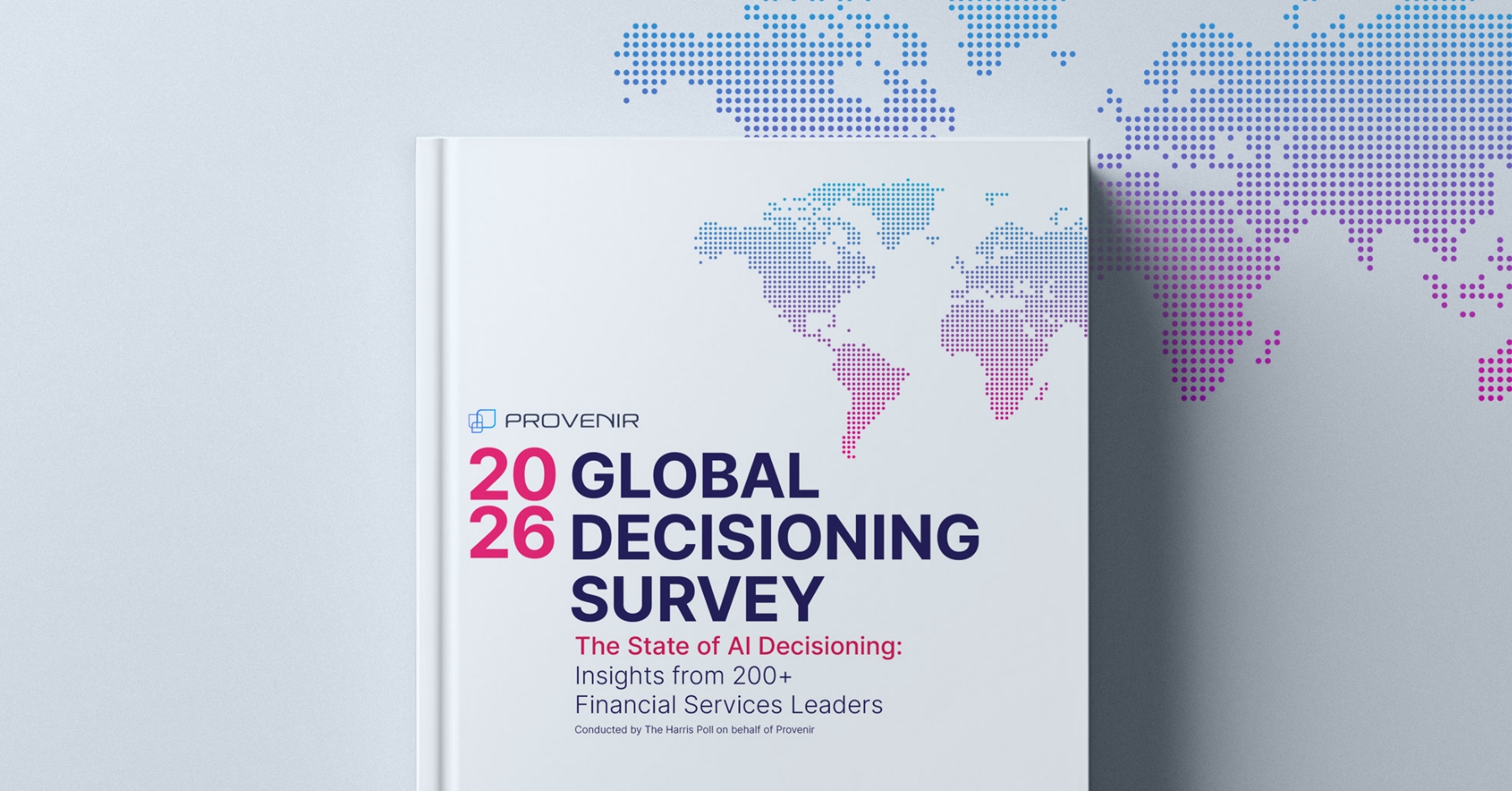
Our 2026 Global Decisioning Survey, conducted by The Harris Poll across 203 senior decision-makers in 22 countries, reveals the scope of this challenge and the strategies organizations are using to address it.

The Numbers

  • The adoption of AI for fraud prevention is strong:

  • Yet the concern is equally widespread:

    • 77% worry about AI-enabled fraud threats
    • 50% struggle to detect and react quickly to new fraud trends
One Chief Risk Officer we surveyed described the compliance challenge as “trying to get certified for a standard that hasn’t been written yet.”

The Speed Problem

When we asked about their biggest application fraud challenge, 50% identified detecting and reacting quickly to new fraud trends.

Bad actors use AI to evolve their tactics in real-time, testing thousands of attack vectors simultaneously. Traditional monthly or quarterly model updates can’t keep pace. Organizations need real-time, adaptive AI systems to combat fraud, but deploying those systems runs directly into implementation barriers around governance and explainability.

What Comprehensive Fraud Strategy Requires

When we asked what’s most important for delivering comprehensive fraud prevention, organizations prioritized four capabilities:

33%

rank as most important

Comprehensive fraud risk review of customer data:
Organizations need complete visibility across customer interactions and behavior patterns. Siloed views by channel or product line leave blind spots.

23%

Reducing friction in customer experience

Security cannot come at the cost of customer experience. Organizations that create too much friction lose legitimate customers to competitors.

22%

Aligning data at customer level vs. by channel

Breaking down silos to create unified customer views enables better fraud detection without false positives that frustrate good customers.

19%

Breaking down data silos between fraud and credit teams

Traditional organizational separation between fraud and credit creates blind spots. Integrated views improve both fraud prevention and credit decisioning.

How Organizations Measure Success

The variety in primary metrics reflects different organizational priorities:
  • 54%

    track enhancing operational efficiency and automation (16% say this is their primary metric)
  • 54%

    track improving accuracy of AI and ML models (25% say this is their primary metric)
  • 52%

    track reducing fraud loss (15% say this is their primary metric)
Operational efficiency and model accuracy rank equally with fraud loss reduction. Organizations recognize that sustainable fraud prevention requires systematic operational excellence beyond just loss minimization.
  • Breaking Free from the Double Bind:

    Organizations successfully navigating this tension balance aggressive AI adoption with comprehensive risk management.
  • Deploy explainable AI architectures from the start:

    They don’t sacrifice interpretability for performance. Modern approaches enable both.
  • Maintain human-in-the-loop oversight for high-risk decisions:

    AI handles volume and speed, but humans make final calls on edge cases and high-stakes scenarios.
  • Implement continuous monitoring for model drift and bias:

    They don’t deploy and forget. Models require ongoing governance.
  • Build governance as an ongoing product, not a one-time project:

    Governance evolves alongside AI capabilities and regulatory requirements.

The Implementation Reality

You can’t sacrifice governance for speed. But you also can’t sacrifice speed for governance. The most successful organizations find ways to achieve both.

They leverage platforms designed to orchestrate decisions across existing systems rather than requiring wholesale system replacement. This approach accelerates time-to-value and reduces technical risk.

Rather than ripping out decades of infrastructure, they deploy decisioning layers that orchestrate data from multiple sources and deliver decisions back to existing platforms in milliseconds.

Looking Ahead

The fraud landscape will continue to evolve faster than most organizations can currently respond. Organizations that successfully deploy explainable, governed AI at speed will protect revenue, preserve customer experience, and build sustainable advantages.

EBOOK Survey2026

Download the full 2026 Global Decisioning Survey:

Download Survey

LATEST BLOGS

britcard blog

BritCard: Identity, ...

BritCard: Identity, Inclusion, and the Fine Line Between Safety
ai perils

Navigating the Promi...

Navigating the Promise and Peril of Generative AI in
blog digital bank in APAC

How Digital Banks in...

How Digital Banks in APAC Can Turn AI Governance
Jason Abbott, Fraud Solution Director at Provenir, explains how to fight First-Party Fraud.

First-Party Fraud: T...

BLOG First-Party Fraud: The Hidden Cost of "Good" Customers
ken lee blog post

Driving Intelligent ...

Driving Intelligent Lending Beyond the LOS: A Leadership Perspective
blog selfie

Beyond the Selfie: W...

A solution needs to bridge the gap left by
The State of AI, Risk, and Fraud in Financial Services

The State of AI, Ris...

The State of AI, Risk, and Fraud in Financial
europe mortgages

Top Mortgage Lending...

Top Mortgage Lending Trends in the UK and Europe:

Continue reading

BLOG Survey01

Why 77% of Financial Institutions See Decision Intelligence as Their 2026 Priority

Why 77% of Financial Institutions See Decision Intelligence as Their 2026 Priority

The financial services industry is experiencing a fundamental shift. Organizations have spent years automating decisions. Now they need those decisions to get smarter.

Our 2026 Global Decisioning Survey reveals the scope of this transition: 77% of senior decision-makers see Decision Intelligence as very valuable for their strategy over the next 2-3 years.

What Decision Intelligence Actually Means

Decision Intelligence represents the evolution from automated decisioning to continuously optimized, AI-driven decision-making that learns and improves.

THE DIFFERENCE:

  • The Traditional Approach:

    Deploy AI models, measure results periodically, update quarterly, manage explainability and governance separately
  • Decision Intelligence Approach:

    Execute decisions at scale, measure outcomes continuously, learn from performance, optimize in real-time within unified platforms that provide transparency, governance, and integration
Organizations are moving quickly:
  • 75%

    are already collaborating on AI-driven decision intelligence
  • 18%

    are exploring partnerships
  • 66%

    are very interested in using AI for strategy implementation and optimization
  • 60%

    plan to invest in AI or embedded intelligence for decisioning in 2026 (making it the top investment priority)

What Organizations Value Most

When we asked which AI features provide the most value, organizations prioritized capabilities that go beyond basic automation:

51%

Ability to leverage generative AI for natural language queries
The democratization of AI insights through conversational interfaces transforms who can access and act on decisioning data. Business users, executives, operations teams, and compliance staff can all interact directly with AI systems using natural language.

92%

of organizations find it important to interact with data quickly using natural language queries.
(62% find it very important, 30% moderately important).
  • 49%

    Real-time decisioning across customer touchpoints:
    Speed and consistency across channels create better customer experiences and reduce operational complexity.
  • 50%

    Transparency and explainability of AI models:
    Organizations need AI they can understand and defend to regulators and stakeholders.
  • 47%

    Integration with existing systems and data sources:
    AI must work with existing infrastructure rather than requiring complete replacement.

The Business Impact

Organizations cite four primary benefits from improved Decision Intelligence:
  • 62%

    cite operational efficiency:

    Automated decision-making reduces manual review, accelerates processes, and lowers costs while improving consistency.
  • 52%

    cite better customer experience:

    Faster decisions, reduced friction, and personalized interactions create superior customer journeys.
  • 58%

    cite improved accuracy of models and strategies:

    Continuous learning and optimization improve predictive performance and business outcomes over time.
  • 56%

    cite faster deployment of new decision strategies:

    Rapid testing and iteration enable organizations to adapt quickly to market changes and competitive pressure.
These benefits compound over time. Organizations that deploy Decision Intelligence don’t just get better decisions today. They build systems that continuously improve.

The Intelligence Loop in Practice

Decision Intelligence creates a continuous cycle:
  • chess

    Shape Strategy

    Design and evolve decision strategy by learning from how decisions actually perform. Strategy is measured through outcomes and continuously refined to balance risk exposure and revenue opportunity.
  • rocket

    Execute Decisions

    Make real-time, data-driven decisions at every customer touchpoint using deep customer understanding, data, context, and decision history.
  • dashboard

    Measure Outcomes

    Connect decisions to business outcomes to see what actually drives risk, revenue, and profitability.
  • learning

    Learn and Optimize

    Get specific recommendations to improve performance based on actual results. Learn from the results over time and continuously refine strategies.
This loop transforms decisioning from a periodic batch process into a continuous optimization system.

The Natural Language Revolution

92% of organizations find it important to interact with data quickly using natural language queries. This represents a fundamental shift.

When business users can interact directly with AI systems using conversation, they build intuition about how these systems work. That understanding improves their ability to provide governance oversight and makes the entire organization more comfortable with AI-driven decisioning.

Natural language querying enables:

  • Business users to explore decisioning data without SQL knowledge
  • Executives to get instant answers to strategic questions
  • Operations teams to investigate anomalies in real-time
  • Compliance teams to audit decisions conversationally
This democratization helps address one of the top implementation barriers: explainability. When more people in the organization can interact with and understand AI systems, those systems become more transparent by design.

Addressing Implementation Barriers

Decision Intelligence approaches help address the barriers preventing AI adoption:
  • Explainability

    Platforms provide visibility into what decisions were made, how they perform, and why. This makes it easier to explain outcomes to regulators and stakeholders.
  • Governance

    Connecting decisions to business outcomes (risk, revenue, customer experience) makes governance more manageable. You measure results and learn from performance rather than monitoring models in isolation.
  • Integration

    Decision Intelligence platforms orchestrate data and decisions across existing infrastructure without requiring wholesale system replacement.
  • Speed

    Organizations can learn from every decision and optimize continuously, addressing the speed challenge that 50% cite as their biggest fraud detection obstacle.

Looking Ahead

The survey reveals clear momentum:
  • 77%

    see Decision Intelligence as very valuable
  • 75%

    are already implementing it
  • 66%

    want AI for strategy optimization
  • 60%

    are investing in 2026 (top priority)
Traditional decisioning optimizes for speed. Decision Intelligence optimizes for outcomes. Organizations that build systems capable of continuous learning will create advantages that compound over time.

EBOOK Survey2026

Download the full 2026 Global Decisioning Survey:

Download Survey

LATEST BLOGS

britcard blog

BritCard: Identity, ...

BritCard: Identity, Inclusion, and the Fine Line Between Safety
ai perils

Navigating the Promi...

Navigating the Promise and Peril of Generative AI in
blog digital bank in APAC

How Digital Banks in...

How Digital Banks in APAC Can Turn AI Governance
Jason Abbott, Fraud Solution Director at Provenir, explains how to fight First-Party Fraud.

First-Party Fraud: T...

BLOG First-Party Fraud: The Hidden Cost of "Good" Customers
ken lee blog post

Driving Intelligent ...

Driving Intelligent Lending Beyond the LOS: A Leadership Perspective
blog selfie

Beyond the Selfie: W...

A solution needs to bridge the gap left by
The State of AI, Risk, and Fraud in Financial Services

The State of AI, Ris...

The State of AI, Risk, and Fraud in Financial
europe mortgages

Top Mortgage Lending...

Top Mortgage Lending Trends in the UK and Europe:

Continue reading

BLOG Christian Ball

Smarter Acquisition and Customer Management

Smarter Acquisition and Customer Management:
How Provenir Drives Growth and Reduces Risk

  • christian-ball

    Christian Ball
    Enterprise Account Exec

Financial institutions face a straightforward challenge: acquire profitable customers and manage those relationships effectively over time. The organizations winning this game have figured out how to turn their data into intelligent, real-time decisions. According to a 2024 Deloitte survey of IT and line-of-business executives, 86% of financial services AI adopters said that AI would be very or critically important to their business’s success in the next two years. This brings us to today, where AI adoption continues to increase.

Provenir’s decision engine connects data, AI, and decisioning in a unified, no-code platform. Financial institutions use it to make faster, more accurate credit decisions while continuously optimizing customer relationships beyond the initial onboarding. The platform integrates multiple data sources and allows teams to refine models as new performance insights emerge.

The impact shows up across the customer lifecycle:

Faster decisions, higher conversion

Speed directly affects conversion rates, especially in point-of-sale financing where customers are waiting in-store. Rent-a-Center processes complex lease-to-own approvals—evaluating creditworthiness, rental history, and affordability—in under 10 seconds at the point of sale, while tbi Bank makes decisions in milliseconds. When MTN Group implemented Provenir’s decisioning platform, they saw pre-approvals increase by 130% and conversions jump by 135%.

Reduced risk, protected portfolios:

AI-powered analytics continuously monitor portfolio performance, enabling early detection of credit deterioration. Jeitto achieved a 20% reduction in defaults while simultaneously increasing approval rates by 10%. MTN Group stopped an additional 135% of high-risk transactions through Provenir’s fraud solutions.

Stronger customer relationships:

Data-driven insights enable tailored offers, credit limits, and retention strategies in real time. Jeitto increased their average ticket size by 8% while improving their approval speed by 67%. The result: they achieved ROI on their Provenir investment in less than 12 months.

Operational agility:

A configurable, no-code environment lets teams adapt quickly. NewDay improved their speed of change by 80% and achieved 2.5x faster quote responses while maintaining sub-1 second decision processing times and 99.95% SLA for availability. Provenir helps organizations build a continuous decisioning ecosystem where acquisition, engagement, and retention connect intelligently.

Provenir helps organizations build a continuous decisioning ecosystem where acquisition, engagement, and retention connect intelligently.

In essence, Provenir helps organizations build a continuous decisioning ecosystem—where acquisition, engagement, and retention are intelligently connected. It’s not just smarter decisioning; it’s smarter customer growth.

LATEST BLOGS

260726 - BLOG eyeDP - FeatureIMG - 61058

Beyond Data: Why Dec...
Beyond Data:Why Decisioning Needs Document Intelligence Financial services providers
Fraud in Telco: Provenir Experts Answer Frequently Asked Questions

Fraud in Telco: Prov...

Fraud in Telco:Provenir Experts Answer Frequently Asked Questions 1.
260722 - ARTICLE Mike - FeatureIMG - 60958

AI governance in fin...

AI governance in financial services:What "governed" means in practice
Latam Compliance Challenge for Decisioning

LATAM Next Complianc...

From Data Protection to Decisioning Accountability:What LATAM Regulation Means
Banks Architecture Gap - Provenir

The Architecture Gap...

Decisioning ArchitectureThe Architecture Gap: Banking's Next Competitive Battleground Banks
BLOG Andy

The Real Cost of Ven...

The Real Cost of Vendor Dependency in Credit Decisioning
260617 - BLOG Matthew Nutt - FeatureIMG - 60431

What Does a Good Dat...

What Does a Good Data Provider Review Actually Look
Ebook CM

AI-Powered Customer ...

AI-Powered Customer Management:How Leading Institutions Turn Intelligence Into Revenue

Continue reading

Open Banking Expo Toronto

Open Banking Expo

Join Provenir at The Open Banking Expo in Toronto
We’re excited to sponsor The Open Banking Expo in Toronto on March 5 at the Metro Toronto Convention Centre. Stop by Booth G1 to meet our team. We’ll be showcasing how Provenir’s Decision Intelligence platform helps financial institutions turn insights into action. We enable our customers to process billions of decisions annually while maintaining the agility to adapt to market changes in real time. Whether you’re focused on streamlining onboarding, managing risk more effectively, or creating personalized customer experiences, let’s talk about what’s possible when you combine intelligence with execution.
Attend our Main Stage Presentation

“AI meets Consumer-Driven Banking: From intelligent access to agentic finance” at 2:15pm with

Sam Rohde

Sam Rohde

VP Solutions Consulting

Provenir
Book a Meeting with Our Experts

Reserve dedicated 1:1 time with the Provenir team to take a test drive of our platform and explore how we can support your specific initiatives.

Cenker Ozhelvaci

Cenker Ozhelvaci

Country Manager – Canada, Provenir

Ryan Mason

Ryan Mason

Vice President of Sales for East and Canada, Provenir

Alicia Huff

Alicia Huff

Head of Business Development North America & Latin America, Provenir

brendan deakin

Brendan Deakin

Executive Vice President – North America, Provenir

Sam Rohde

Sam Rohde

VP Solutions Consulting, Provenir

Michaela Caizzi

Michaela Caizzi

Senior Field Marketing Manager, North America, Provenir

Meet with us onsite!

LATEST WEBINARS

Maximizing the Value...

ON-DEMAND WEBINAR Maximizing the Value of Your Customers:Better

Achieving Frictionle...

ON-DEMAND WEBINAR Achieving Frictionless Fraud Prevention:Striking the Perfect

Embedding Exceptiona...

ON-DEMAND WEBINAR Embedding ExceptionalBorrower Experience in Embedded Finance
How to Power Risk Decisions Faster than the Competition

How to Power Risk De...

ON-DEMAND WEBINAR How to Power Risk DecisionsFaster than

Enhancing Financial ...

ON-DEMAND WEBINAR Enhancing Financial Inclusion in the Digital

Customer-Centric Ris...

ON-DEMAND WEBINAR Customer-Centric Risk Decisioning in Digital Lending:

The Decisioning Impe...

ON-DEMAND WEBINAR The Decisioning Imperativefor Open Banking Book

Canadian Lenders Ass...

ON-DEMAND WEBINAR Canadian Lenders AssociationRisk Roundtable Book a

Continue reading

Zero Trust in Digital Banking

Zero Trust in Digital Banking

Zero Trust in Digital Banking: Why Risk Leaders Need a Bridge Between Legacy and Next-Gen Systems

Digital banking has firmly established itself across APAC From the sophisticated, interconnected financial hubs of Singapore and Australia to the rapidly expanding, mobile-first markets of Indonesia and Malaysia, financial institutions are reinventing how consumers engage with their money. Yet, beneath the sleek apps and instant transfers lies a complex and often contradictory challenge: how to operate at lightning speed without inviting catastrophic risk. 

The prevailing mindset, often rooted in traditional banking, is “trust but verify.” But as cyber threats escalate and financial fraud becomes more sophisticated, a new paradigm is emerging from the cybersecurity world that risk leaders must adopt: Zero Trust. 

What “Zero Trust” Means for Digital Banking Risk

In cybersecurity, Zero Trust dictates: never trust, always verify. Applied to financial risk, it means moving beyond static rules and blanket assumptions. It’s about:
  • Continuous Verification

    Every transaction, every application, every customer interaction is assessed in real-time, regardless of past approvals.
  • Contextual Decisioning

    Decisions aren’t just based on who the customer is, but what they are doing, where, and how.
  • Micro-segmentation of Risk

    Isolating and evaluating each risk factor independently, preventing a single point of failure or an assumed “safe” interaction from becoming a vulnerability.
This is a profound shift from traditional “gatekeeper” approaches. But here’s the challenge, most digital banks are built on a patchwork of legacy infrastructure and shiny new AI tools, creating a chasm between ambition and execution.

The Chasm: Legacy vs. Next-Gen

Many digital banks, even the “challengers,” find themselves in a precarious position:
  • Legacy Constraints

    Core banking systems, built for a different era, struggle to ingest diverse, real-time data streams essential for a Zero Trust approach. Updating them is costly, slow, and disruptive.
  • Data Silos

    Customer data, fraud intelligence, and credit history often reside in disparate systems, making a holistic, continuous view impossible. How can you “verify everything” if you can’t see everything?
  • Rigid Rules Engines

    Traditional decisioning systems are often hard-coded with static rules, incapable of adapting to emerging fraud patterns or rapidly changing market conditions (like new regulatory directives in Malaysia or evolving credit needs in Indonesia).
  • “Black Box” AI

    While next-gen AI/ML models offer unparalleled predictive power, their lack of transparency can be a non-starter in highly regulated environments like Singapore and Australia, where “Explainable AI” isn’t just a buzzword—it’s a compliance mandate.
This chasm doesn’t just slow down innovation; it creates vulnerabilities. A “Zero Trust” vision cannot be achieved if your decisioning systems inherently “trust” data that’s old, isolated, or incomprehensible.

Building the Bridge: Unified Decisioning Platforms

The solution lies in creating a strategic bridge: a unified, agile decisioning platform that sits between your legacy systems and your customer-facing innovations. This bridge allows risk leaders to implement a true Zero Trust framework without a rip-and-replace overhaul of their core infrastructure.

Such a platform must offer: 

  • Real-time Data Orchestration

    The ability to seamlessly ingest, cleanse, and unify data from all sources  traditional credit bureaus, alternative data (e.g., telco, utility), internal transaction histories, and third-party fraud signals  in real-time. This is the foundation for continuous verification.

  • Agile AI/ML and Rules Engines

    A low-code/no-code environment where risk teams can build, test, and deploy sophisticated AI models and dynamic business rules independently, adapting to new threats and opportunities within minutes, not months. This empowers contextual decisioning.

  • Explainable AI (XAI)

    Critically, the platform must provide clear, auditable insights into why an AI model made a particular decision. This satisfies regulatory scrutiny (MAS, APRA) and builds confidence in automated decisions, supporting the “always verify” principle.

  • Unified Risk View

    Consolidating credit risk, fraud prevention, and compliance on a single platform creates a 360-degree view of each customer interaction, enabling holistic risk assessment and micro-segmentation.

The APAC Imperative

For digital banks across Singapore, Malaysia, Indonesia, and Australia, adopting a Zero Trust approach to risk isn’t merely about preventing losses; it’s about unlocking growth. It enables: 

  • Faster, Smarter Onboarding

    Instantly verify new applicants, reducing abandonment rates.

  • Personalized Lending

    Offer tailored products to underserved segments (especially critical in Indonesia and Malaysia) with confidence.

  • Proactive Fraud Prevention

    Detect and mitigate emerging threats before they impact customers or capital.

  • Regulatory Confidence

    Demonstrate robust, auditable risk management to meet increasingly stringent local requirements.

The digital banking revolution in APAC demands more than just speed; it demands intelligent speed grounded in unwavering trust. By building a robust bridge with a unified decisioning platform, risk leaders can truly embrace the Zero Trust paradigm, transforming risk from a barrier into a powerful catalyst for sustainable growth. 

  • Analogy for the Whole Blog:

  • If a digital bank is a high-speed rail network, your legacy systems are the old tracks and the Zero Trust model is the advanced safety protocol. You don’t need to rebuild every mile of track to increase speed; you need a unified signaling and control center (the decisioning platform). This center monitors every train’s position and speed in real-time, allowing them to travel faster and closer together than ever before, because the system never assumes the track is clear – it verifies it every second.

Discover Provenir for Digital Banking

Contact Us

LATEST BLOGS

britcard blog

BritCard: Identity, ...

BritCard: Identity, Inclusion, and the Fine Line Between Safety
ai perils

Navigating the Promi...

Navigating the Promise and Peril of Generative AI in
blog digital bank in APAC

How Digital Banks in...

How Digital Banks in APAC Can Turn AI Governance
Jason Abbott, Fraud Solution Director at Provenir, explains how to fight First-Party Fraud.

First-Party Fraud: T...

BLOG First-Party Fraud: The Hidden Cost of "Good" Customers
ken lee blog post

Driving Intelligent ...

Driving Intelligent Lending Beyond the LOS: A Leadership Perspective
blog selfie

Beyond the Selfie: W...

A solution needs to bridge the gap left by
The State of AI, Risk, and Fraud in Financial Services

The State of AI, Ris...

The State of AI, Risk, and Fraud in Financial
europe mortgages

Top Mortgage Lending...

Top Mortgage Lending Trends in the UK and Europe:

Continue reading

EBOOK Survey2026

Survey: 2026 Global Decisioning Survey

What are the key challenges and priorities for financial services leaders in 2026 and beyond?

The financial services industry stands at an inflection point in its adoption of artificial intelligence for decisioning. Our 2026 Global Decisioning Survey reveals a sector that recognizes AI’s transformative potential yet struggles with universal implementation challenges.

We surveyed 203 senior decision-makers—including Chief Risk Officers, CEOs, CFOs, and Heads of Risk—across 22 countries spanning banking, fintech, insurance, telecommunications, and other financial services sectors. The findings paint a nuanced picture of an industry in transition.

KEY FINDINGS AT A GLANCE
  • The AI Paradox:

    87% trust AI-driven decisioning outcomes, yet 97% face implementation barriers
  • The Fraud Challenge:

    77% are concerned about AI-enabled fraud threats while needing AI to combat fraud
  • Real-Time Momentum:

    91% have moved beyond static-only models; 52% use hybrid approaches
  • Decision Intelligence:

    77% see it as very valuable for their strategy over the next 2-3 years
  • Investment Priority:

    60% plan to invest in AI or embedded intelligence for decisioning in 2026
  • Governance Gap:

    Only 33% have fully implemented responsible AI frameworks

These findings reveal an industry that knows where it needs to go but faces significant challenges getting there. The organizations that successfully navigate implementation barriers—around compliance, explainability, and integration—will build sustainable competitive advantages through faster, more accurate, and more adaptive decisioning.

ADDITIONAL RESOURCES

britcard blog
Blog, Fraud /

BritCard: Identity, Inclusion, and th...

BritCard: Identity, Inclusion, and the Fine Line Between Safety and Surveillance Let’s ... Read More →
ai perils
Blog, AI, Financial Services /

Navigating the Promise and Peril of G...

Navigating the Promise and Peril of Generative AI in Financial Services Financial ... Read More →
blog digital bank in APAC
Blog, Banking /

How Digital Banks in APAC Can Turn AI...

How Digital Banks in APAC Can Turn AI Governance Into Competitive Advantage ... Read More →
Jason Abbott, Fraud Solution Director at Provenir, explains how to fight First-Party Fraud.
Blog, Fraud /

First-Party Fraud: The Hidden Cost

BLOG First-Party Fraud: The Hidden Cost of "Good" Customers Unmasking Risk with ... Read More →
Jakarta-Ritz
Event, Digital Lending /

Bringing together visionary minds fro...

ProvenirNext Roundtable Enabling Responsible Growth and Customer Trust in Indonesia’s Digital Lending ... Read More →
ritz carlton dubai
Event, Fraud /

Customer Lifetime Value – Unlocking G...

Roundtable Customer Lifetime Value – Unlocking Growth Through Intelligent Customer Management 13th ... Read More →
london brdige
Event, Financial Services /

ProvenirNEXT London: Skyline Networki...

Logo-ProvenirNEXT-Brandmark-REV newday-WHT London: Skyline Networking Join us for an evening of connection, ... Read More →
ken lee blog post
Blog, Digital Banking /

Driving Intelligent Lending Beyond th...

Driving Intelligent Lending Beyond the LOS: A Leadership Perspective from Provenir As ... Read More →
sophia podcast
Podcast, Fraud /

Multi-Faceted Fraud Response Strategi...

Multi-Faceted Fraud ResponseStrategies for Financial Services Our VP of Product Management for ... Read More →
ryt bank PR
News, Banking, Decisioning /

Ryt Bank, The World’s First AI-Powere...

Ryt Bank, The World’s First AI-Powered Bank, Selects Provenir for AI Risk ... Read More →
Forrester
News, AI, Decisioning /

Provenir Named a Strong Performer in ...

REPORT Provenir Named a Strong Performer in Debut Inclusion in 2025 AI ... Read More →
Forrester
News, AI, Decisioning /

Forrester Wave 2025 PR

Provenir Named a Strong Performer in 2025 AI Decisioning Platforms Report by ... Read More →
Maslow
Event, Banking /

Navigating South Africa’s Debt Crisis...

Navigating South Africa’s Debt Crisis: Strategies for Recovery and Engagement in 2025 ... Read More →
fraud alert
Webinar, Fraud /

Stop Fraudsters in Their Tracks – Bef...

Stop Fraudsters in Their Tracks – Before They Strike Watch Our On-Demand ... Read More →
Enabling Responsible Growth and Customer Trust in Malaysia’s Digital Lending Landscape through Data-Driven Insights
Event, Financial Services, Fintech /

Enabling Responsible Growth and Custo...

ProvenirNext Roundtable Enabling Responsible Growth and Customer Trust in Malaysia’s Digital Lending ... Read More →

Continue reading

LewisGRP

Leading South African Furniture Retailer Lewis Group Partners with Provenir to Drive AI Credit Decisioning Transformation in the Cloud

Leading South African Furniture Retailer Lewis Group Partners with Provenir to Drive AI Credit Decisioning Transformation in the Cloud

The retailer will deploy Provenir’s AI Decisioning Platform in the cloud to improve agility and operational efficiencies, with the ability to capitalize on greater customer insights

Parsippany, NJ | January 21, 2026 – South African furniture retailer Lewis Group is migrating its credit decisioning to the cloud with Provenir, a global leader in AI risk decisioning, to streamline its onboarding processes and expand customer touchpoints.

Lewis Group is a leading retailer of furniture, home appliances, electronic goods and homeware in South Africa through its brands Lewis, Best Home & Electric, Beares, UFO, Bedzone, Real Beds and Monarch Insurance. The retailer has 813 stores across South Africa and 145 in southern Africa, including Namibia, Botswana, Lesotho and Eswatini.

A Provenir customer for 15 years, Lewis Group is embarking on a cloud-migration strategy on the AWS stack, designed to elevate the customer experience and further drive innovation in credit decisioning. The goal is to enable more personalized customer engagements, further improve the onboarding process, and unlock meaningful productivity gains.

By modernizing and enhancing decisioning capabilities via the cloud, the Provenir AI Decisioning Platform supports Lewis Group’s commitment to responsible and effective customer engagement.

“Our long-standing collaboration with Provenir underscores a shared focus on using technology to deliver better outcomes for our customers… By migrating to the cloud, we are able to realize enhanced speed and agility, scalability, improved security, and faster time-to-market for solutions and services to our valued customers.”

Lambert Fick, Lewis Group’s GM Credit Risk

“After more than 15 years of partnership, we’re proud to support Lewis Group’s move to a modern cloud platform with our AI Decisioning Platform to drive improved business outcomes,” said Ryan Morrison, executive vice president, Provenir. “This migration will give Lewis Group faster, more effective decisioning, a unified customer view across channels, and the ability to leverage advanced analytics to enhance onboarding, fraud prevention, and overall customer management.”

Provenir’s AI Decisioning Platform combines data, decisioning, and decision intelligence to enable smarter, faster decisions across the entire customer lifecycle – from onboarding and application fraud to credit risk, customer management, and collections.

Explore Our AI-Decisioning Platform

Read More

LATEST NEWS

Continue reading

carol blog

The Generational Shift: Why Banks Are Replacing Their Decisioning Infrastructure 

The Generational Shift:
Why Banks Are Replacing Their Decisioning Infrastructure

Financial institutions are ripping out decisioning infrastructure they spent two decades building. This isn’t a routine technology refresh. Banks are replacing entire systems because the architecture that powered the last generation can’t support what the market now demands.

Here’s what I see from working with major banks on this transformation: the technology decision is actually the easy part. The harder question is whether the organization is ready to use what becomes possible. At a recent AI conference in London, the dominant theme wasn’t about technology capabilities but organizational readiness.

The story of how we got here explains why this organizational challenge is so acute. Twenty years ago, banks moved from monolithic mainframes to commercial decisioning applications. The promise was flexibility and lower maintenance costs. What emerged instead was fragmentation. Today’s typical bank runs separate systems for credit, fraud, compliance, onboarding, and collections. Each line of business and geography has its own stack. This siloed architecture creates two critical problems: it delivers poor customer experiences, and it makes real AI impossible.

At Provenir, we work with tier one banks around the world, and we see firsthand which institutions move quickly and which get paralyzed by complexity. This article examines why re-platforming is happening now, what truly differentiates AI-capable infrastructure, and the timeline institutions can expect for transformation.

  • Why Digital Disruptors Force the Issue

    Ten years ago, Revolut raised a $2.3 million seed round. Today, they serve 65 million customers across 48 countries and hold a $75 billion valuation. Companies like Monzo, Klarna, and Stripe followed similar trajectories, resetting customer expectations for financial services entirely.

    Customers now expect instant approvals, personalized offers, and seamless experiences across every touchpoint. Traditional banks lose market share because their infrastructure can’t deliver this. The technology that worked for batch processing and overnight decisions can’t support the always-on, contextually aware experiences that digital natives established as baseline.

  • The AI Imperative:

    Why Siloed Systems Fail

    AI requires two things that fragmented architectures fundamentally can’t provide: a unified view of the customer and the ability to act on insights instantly across any touchpoint.

    Let me be specific about what a unified customer view actually means. Take a customer applying for a loan. You need to orchestrate their credit card transaction history, bank account behavior, biometric verification, external data signals about email validity and device fingerprinting, behavioral patterns across channels. One system might know their credit history. Another tracks fraud signals. A third manages compliance data. If these never converge into a single profile, AI has nothing comprehensive to analyze.

    This is why profiling needs Machine Learning at its core. You can’t just pull data from various sources and stack it together. You need to apply analytics to networked, contextual information. A suspicious transaction pattern means something entirely different when connected to a recently created email address and a high-risk merchant code. Disconnected systems miss these connections entirely.

    There’s a massive gap between running AI pilot projects and operationalizing AI at enterprise scale. Banks experiment with AI in isolated use cases all the time. Embedding these capabilities across the entire organization is fundamentally different. It requires infrastructure designed for AI from the ground up.

  • Native AI Architecture vs. Bolted-On Capabilities

    Moving from fragmented applications to AI-capable infrastructure requires understanding what platform architecture actually means. I’ll use a concrete analogy. Adding AI to legacy systems is like retrofitting solar panels onto a house that wasn’t designed for them. You can make it work. But you’ll have cables running down the outside of the building, connections that require extensive modifications, and an outcome that’s never as efficient as if you’d designed the house holistically from the start.

    We’ve seen competitors try to build separate AI engines because it’s too difficult to evolve their existing technology. Then they attempt to connect these disparate pieces. The integration is awkward. The outcomes are less accurate. The results are harder to explain and audit. When AI capabilities are embedded natively, the entire system is engineered to make those capabilities effective. Data orchestration, model deployment, execution, and monitoring all work together seamlessly.

    Speed matters enormously here. Traditional data science teams might spend months manually building and deploying a credit risk model. With a Decision Intelligence platform, you can spin up challenger models in minutes. The system can automatically generate alternatives, simulate their performance against historical data, compare results, and deploy the best option immediately.

  • Agents:

    The Next Evolution in Decisioning

    The future of AI decisioning involves autonomous agents, and platform architecture determines whether you can deploy them effectively. There are two distinct ways agents transform how institutions operate.

    First, platforms can embed agents directly into workflows. During customer onboarding, an agent might recognize that additional information is needed and interact with the customer to collect it, then feed that data back into the process. The agent handles the dynamic, conversational piece while the decisioning platform orchestrates the broader workflow.

    Second, and this is where it gets interesting, you can wrap decisioning workflows themselves into agents. Instead of predefined sequences where we tell the system exactly what data to call and which models to execute in what order, agents can make intelligent choices. Maybe the agent determines it doesn’t need to call all the data sources we thought were necessary. Maybe it doesn’t need to fire every model to reach a confident decision. This creates efficiency gains through reduced computing costs and intelligence gains through dynamic learning.

    Think about the implications. An agent adapts its approach based on what it observes rather than following a static rulebook. Organizations that can deploy agents across credit, fraud, compliance, and customer management will operate with speed and intelligence that static workflows simply can’t match.

What Actually Changes

The transformation delivers measurable outcomes. Processing time moves from hours to milliseconds. This enables instant experiences that weren’t previously possible. Quality improves dramatically because institutions gain access to comprehensive customer profiles rather than making choices based on incomplete data.

The business impact shows up as profitable growth combined with reduced losses. Better decisions mean approving more good customers while declining more risky ones. Institutions can expand their customer base without proportionally increasing credit or fraud losses. This is the outcome that gets C-suite attention.

The Re-Platforming Challenge No One Talks About

Here’s what can be frustrating about most re-platforming initiatives. Banks want to take all the rules they’ve had, all the models they’ve built, and simply replicate them on a new, more modern system. They’ve upgraded the quality but have missed the opportunity to reimagine what’s possible.

We see this nine times out of ten. Banks want to start with what they know, even if what they know was designed for a different era with different constraints. Eventually, once they’re comfortable with the new system, they’ll try new approaches. But why not use the transition as the moment to rethink how you want to manage customers in a modern way?

The resistance we encounter falls into three categories. First, it’s genuinely difficult. Re-platforming is another project to organize and orchestrate. Banks have existing roadmaps and limited bandwidth. Second, there are upfront costs. You need technical teams to disconnect legacy systems and implement new infrastructure. Some institutions don’t have the capital or resources available right now, even if the long-term economics are compelling. Third, organizational AI maturity varies enormously. If an institution doesn’t deeply understand AI yet, they may be nervous about re-platforming until they’re convinced the new platform is transparent, auditable, and meets their requirements.

The Timeline Reality

When institutions commit to transformation, we see sales cycles ranging from four months to two years. The variance depends on whether they need to build internal consensus, run proof of value exercises, or work through procurement complexity. The implementation itself takes months, not years, but organizational readiness takes longer.

Here’s the irony about investment: moving to cloud-native platforms typically saves money. Institutions spending millions annually on on-premise licenses and infrastructure can often reduce total cost of ownership significantly. The platform provider handles infrastructure, scaling, and maintenance. The upfront investment is about organizational change and implementation services, not ongoing license costs that exceed what modern platforms charge.

Moving Forward

The third generational shift in financial services technology is underway. Organizations that treat this as a technology upgrade will miss the point. Success requires treating this as a strategic imperative that determines whether you can compete in the next decade. It requires organizational readiness alongside technical capability. It requires willingness to reimagine processes rather than simply replicating them on better infrastructure.

The institutions that move decisively to unified, AI-capable platforms will define what competitive advantage looks like in financial services. Those that hesitate will find themselves competing against organizations operating with fundamentally superior capabilities. The choice is whether your institution will lead or follow.

LATEST BLOGS

260726 - BLOG eyeDP - FeatureIMG - 61058

Beyond Data: Why Dec...
Beyond Data:Why Decisioning Needs Document Intelligence Financial services providers
Fraud in Telco: Provenir Experts Answer Frequently Asked Questions

Fraud in Telco: Prov...

Fraud in Telco:Provenir Experts Answer Frequently Asked Questions 1.
260722 - ARTICLE Mike - FeatureIMG - 60958

AI governance in fin...

AI governance in financial services:What "governed" means in practice
Latam Compliance Challenge for Decisioning

LATAM Next Complianc...

From Data Protection to Decisioning Accountability:What LATAM Regulation Means
Banks Architecture Gap - Provenir

The Architecture Gap...

Decisioning ArchitectureThe Architecture Gap: Banking's Next Competitive Battleground Banks
BLOG Andy

The Real Cost of Ven...

The Real Cost of Vendor Dependency in Credit Decisioning
260617 - BLOG Matthew Nutt - FeatureIMG - 60431

What Does a Good Dat...

What Does a Good Data Provider Review Actually Look
Ebook CM

AI-Powered Customer ...

AI-Powered Customer Management:How Leading Institutions Turn Intelligence Into Revenue

Continue reading

Frederic blog

Why AI Requires Enterprise Platforms to Deliver Business Value

Why AI Requires Enterprise Platforms to Deliver Business Value

The narrative around AI replacing enterprise software has gained momentum recently. Driven by rapid advances in generative AI and the promise of autonomous agents, some predict the end of SaaS platforms altogether. These predictions overlook a fundamental reality: AI cannot operate effectively in isolation.

Whether traditional machine learning, foundation models, or multi-agent systems, AI only creates business value when embedded within a governed, orchestrated, and explainable operational layer. The next decade will see the emergence of AI-native platforms capable of connecting data sources, orchestrating complex workflows, integrating multiple AI models, ensuring explainability, and enforcing regulatory guardrails.

From AI Models to Business Outcomes

Sophisticated AI models are not business processes. They cannot manage user journeys, apply regulatory rules, orchestrate data across multiple sources, produce audit trails, or justify decisions to auditors. To move from demonstration to business value, AI requires structured infrastructure.

This infrastructure includes orchestration that coordinates calls to models, rules, external services, fraud signals, and customer-specific logic in real time. It requires workflow design that builds dynamic flows with step-up verification, fallback paths, human review queues, and routing based on risk levels. Organizations need systems that provide interpretable reasons for every decision as required by regulations like the EU AI Act, DORA, GDPR, and similar frameworks worldwide.

Governance and guardrails are essential. Organizations require versioning, monitoring, overrides, drift detection, approval workflows, and human-in-the-loop escalation. Integration capabilities must connect to proprietary and third-party data sources, internal systems, and new AI capabilities as they emerge.

While agentic AI can auto-generate workflows or connect to APIs, these capabilities remain probabilistic and lack the deterministic guarantees required in regulated environments. Testing across industries consistently shows that LLM-driven orchestration introduces silent failure modes, unlogged deviations, and inconsistent decision paths. This behavior conflicts with audit requirements, SLA guarantees, and risk controls. AI can propose workflows, but platforms must validate, constrain, and operationalize them safely.

Integrating Multiple AI Types

AI encompasses diverse capabilities, each requiring different operational support. Traditional machine learning predictive models have proven successful in risk scoring, fraud detection, churn prediction, income estimation, and KYC anomalies. These models need feature engineering pipelines, fast inference APIs, drift monitoring, challenger versus baseline strategies, regulatory logs, and version control.

Consider a telecommunications example: an ML model detects anomalous SIM-swap behavior. On its own, it cannot call device intelligence APIs, enforce step-up verification flows, block high-risk enrollments, or create case management tickets. These actions require an orchestrating platform.

Generative AI and large language models excel at document summarization, user intent classification, email parsing, and risk case narrative generation. However, GenAI is probabilistic and requires strong guardrails, prompt governance, output validation, and deterministic fallbacks. When an LLM extracts employer information and salary from an uploaded payslip, this must trigger identity verification cross-checking, anti-fraud rules, anomaly detection models, audit logs of extracted fields, and manual review when confidence falls below thresholds. An LLM alone cannot orchestrate these dependencies.

Agentic AI and multi-agent systems autonomously carry out task sequences including data retrieval, enrichment, reconciliation, scoring, and user guidance. While these capabilities demonstrate impressive productivity gains, they also introduce new risks: cascading errors, unpredictable task sequences, reasoning failures, inconsistent outputs, regulatory non-compliance, and missing auditability.

This creates requirements for guardrails enabling sandboxed execution, policy constraints, step-by-step validation, routing through deterministic workflows, and limitation of autonomous behavior. Agentic AI must operate inside platforms that enforce boundaries. The more autonomous AI becomes, the more critical the underlying governance layer.

Orchestrating Data Access

In risk decisioning contexts, AI requires access to data, but data requires orchestration. AI systems do not automatically know device characteristics, email reputation, phone risk indicators, financial history, identity document integrity, or behavioral anomalies.

Accurate decisioning depends on orchestrating specialized data providers, each serving specific use cases. Device intelligence detects device resets, emulator or VM usage, proxy routes, and device binding inconsistencies through connectors to JavaScript collectors, mobile SDKs, and trusted device APIs. Phone intelligence enables detection of recent SIM swaps, call forwarding, number age, and line status by calling SIM verification providers and telecom data brokers.

Even when AI agents can directly query APIs, enterprises rarely expose critical financial, identity, or behavioral data without mediation. Rate limits, consent management, throttling policies, cost optimization, and compliance proofs require an orchestrated data access layer. Without this structure, risks of uncontrolled API usage, excessive costs, or privacy breaches escalate rapidly.

Why Regulations Demand Platform Structure

Financial services, telecommunications, insurance, healthcare, and utilities all require full audit trails, deterministic behavior, explainability for every automated decision, lifecycle management, and evidence of model fairness and robustness. No raw AI model, agent, or LLM can provide these requirements independently.

Decisions require more than predictions. Credit and fraud decisions combine data checks, rules, thresholds, overrides, risk policies, time windows, workflow branching, ML predictions, case creation, and external service calls. AI is one ingredient in a recipe delivered by platforms.

Real-time decisioning is common across industries with requirements like 50 to 300 milliseconds for authentication, sub-second for onboarding, less than two seconds for loan approvals, and 100 to 200 milliseconds for fraud checks during payment journeys. AI models need platforms to cache results, parallelize external calls, orchestrate retries, and ensure SLA compliance.

Continuous governance addresses real risks including model drift, data poisoning, adversarial prompts, and agent misalignment. Platforms evaluate model outputs in context, log every inference, detect anomalies, quarantine suspicious model behavior, revert to deterministic rules, and enforce change management processes. Unchecked AI becomes a liability.

Regulators continue exploring adaptive frameworks that account for AI’s non-deterministic nature. However, even forward-looking guidelines emphasize auditability, traceability, and accountability. Recent regulatory consultations from the UK’s FCA to the EU’s AI Act, MAS TRM, and NIST’s AI Risk Management Framework maintain the same core requirement: organizations must prove control, documentation, and oversight. Whether models are deterministic or agentic, the responsibility remains constant.

AI Augments Platforms Rather Than Replacing Them

AI is reshaping business operations fundamentally. However, organizations making critical decisions today, next week, next month, and next year face a practical reality: AI represents the evolution of SaaS, not its disappearance.

AI-augmented platforms combine rules and policies, traditional ML, GenAI, agentic AI, data enrichment providers, workflow engines, real-time orchestration, explainability services, regulatory compliance, and case management. These platforms deliver consistent decisioning with transparent governance and adaptable strategies while enabling fast integration with innovation ecosystems and maintaining oversight of AI behavior.

Platforms introduce dependencies and consolidation risks that organizations must evaluate carefully, including vendor lock-in, architectural complexity, and long-term ownership. However, these risks are measurable and manageable. The risks of ungoverned AI including silent drift, uncontrolled decision paths, implicit bias, adversarial manipulation, and inconsistent outputs are systemic. Platforms provide the guardrails required to mitigate emerging threats while enabling innovation at scale.

The Path Forward

AI excels at identifying patterns, interpreting signals, and predicting outcomes. It cannot orchestrate workflows, enforce policies, ensure compliance, manage third-party data, guarantee explainability, or run mission-critical decisions safely without operational support.

The future belongs to platforms that operationalize AI within boundaries of trust, safety, and law. AI accelerates development of intelligent, governed, high-performance decisioning platforms that will become increasingly essential.

This evolution will compress or eliminate certain categories of lightweight SaaS, especially tools whose primary value lies in static configuration or manual workflows. However, in domains where trust, risk, identity, compliance, or financial transactions intersect, AI amplifies the need for robust operational infrastructure.

Addressing Common Questions

Some may argue that AI will orchestrate itself without platforms. Testing shows that autonomous orchestration introduces silent deviations and untracked reasoning steps. Platforms enforce the guardrails that regulators, auditors, and risk committees require.

Others suggest agentic AI eliminates the need for SaaS layers. Agentic AI increases the need for governance. The more autonomous the agent, the higher the requirement for oversight, validation, cost control, and accountability. Without platforms, agents become unmanageable from security, cost, and compliance perspectives.

Regarding regulatory evolution, accountability never disappears. Every regulatory body from the EU to Singapore to the UK maintains strict requirements for traceability, evidence of control, and human responsibility. Agentic AI may be acceptable, but only within governed operational layers.

While hyperscalers provide excellent infrastructure and point capabilities, they do not take responsibility for business decisions, model governance, risk policies, or end-to-end auditability. Enterprises need layers independent of infrastructure that integrate diverse data and model sources.

AI can call APIs, but enterprises do not expose sensitive data sources without mediation. Consent management, throttling, rate limiting, identity binding, and regulatory controls require platforms that protect data access and ensure consistent behavior.

Some organizations will build internally, but the cost of ownership rises exponentially when integrating dozens of models, specialized data sources, workflows, and compliance checks. Platforms amortize these costs across clients and provide resilience, governance, and upgrade paths that internal teams rarely match.

The argument is not that SaaS will remain unchanged. The orchestration and governance layers become more important as AI grows more capable and autonomous. AI does not eliminate these layers. It makes them indispensable.

Rather than reducing complexity, AI increases it by introducing probabilistic behavior, new attack vectors including data poisoning and prompt injection, and unpredictable interactions across systems. Platforms provide the structure required to control this complexity.

LATEST BLOGS

260726 - BLOG eyeDP - FeatureIMG - 61058

Beyond Data: Why Dec...
Beyond Data:Why Decisioning Needs Document Intelligence Financial services providers
Fraud in Telco: Provenir Experts Answer Frequently Asked Questions

Fraud in Telco: Prov...

Fraud in Telco:Provenir Experts Answer Frequently Asked Questions 1.
260722 - ARTICLE Mike - FeatureIMG - 60958

AI governance in fin...

AI governance in financial services:What "governed" means in practice
Latam Compliance Challenge for Decisioning

LATAM Next Complianc...

From Data Protection to Decisioning Accountability:What LATAM Regulation Means
Banks Architecture Gap - Provenir

The Architecture Gap...

Decisioning ArchitectureThe Architecture Gap: Banking's Next Competitive Battleground Banks
BLOG Andy

The Real Cost of Ven...

The Real Cost of Vendor Dependency in Credit Decisioning
260617 - BLOG Matthew Nutt - FeatureIMG - 60431

What Does a Good Dat...

What Does a Good Data Provider Review Actually Look
Ebook CM

AI-Powered Customer ...

AI-Powered Customer Management:How Leading Institutions Turn Intelligence Into Revenue

Continue reading

INFOGRAPHIC Hyper-personalization

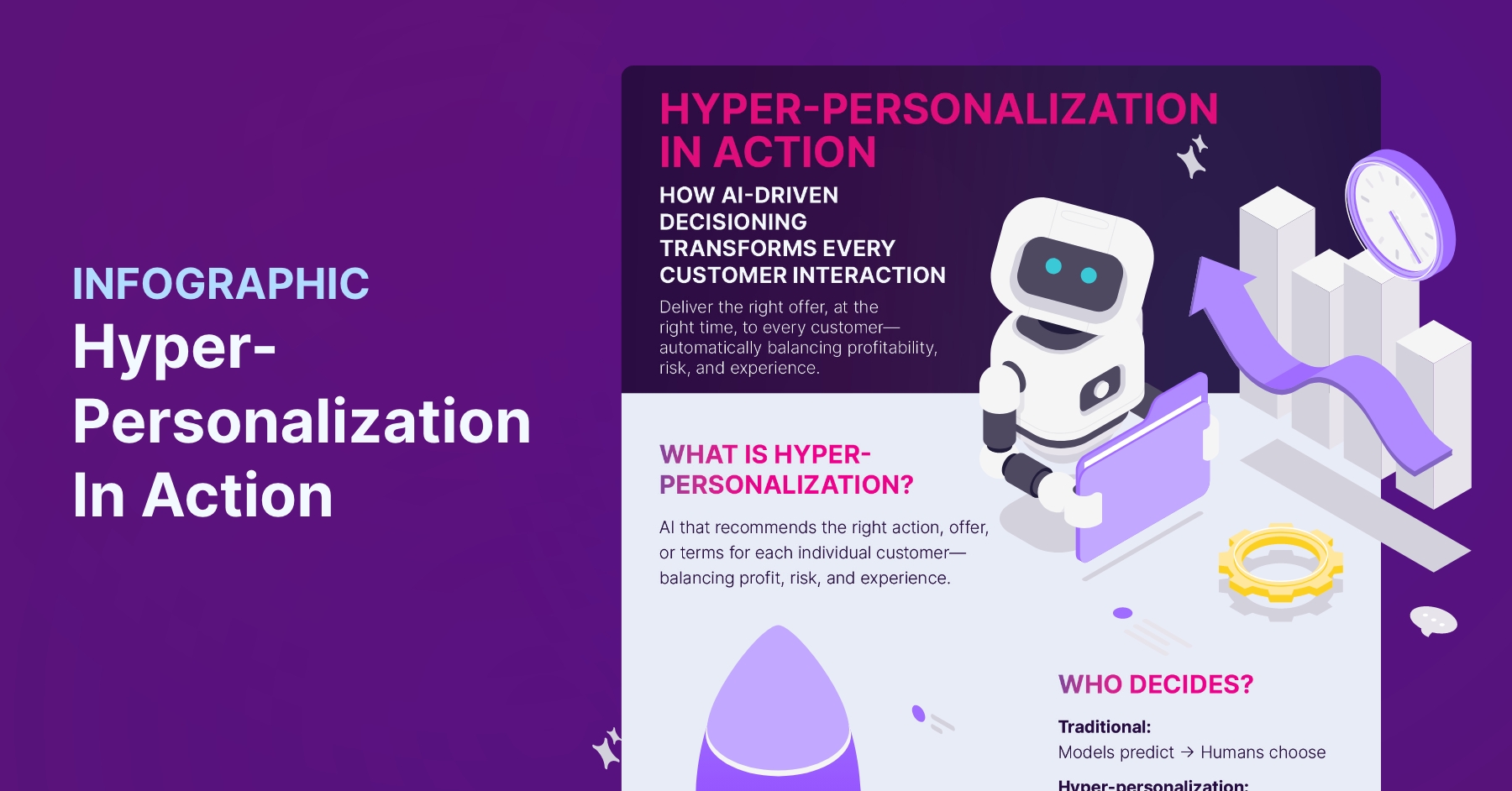
Hyper-Personalization in Action

Hyper-Personalization in Action: How AI-Driven Decisioning Transforms Every Customer Interaction

Most financial institutions still rely on humans to interpret model predictions and make the final call on offers, terms, and actions. The result? Slower decisions, inconsistent experiences, and missed revenue opportunities.

Hyper-personalization changes this. AI doesn’t just predict outcomes—it prescribes the best action for each individual customer, automatically balancing profitability, risk, and experience in real time.

What You’ll Discover
  • The difference between prediction and prescription in AI decisioning
  • How hyper-personalization delivers individual-level optimization—not segment-based targeting
  • Why prescriptive AI transforms every customer interaction across your lifecycle

Explore hyper-personalization in depth with insights from our experts:

ADDITIONAL RESOURCES

britcard blog
Blog, Fraud /

BritCard: Identity, Inclusion, and th...

BritCard: Identity, Inclusion, and the Fine Line Between Safety and Surveillance Let’s ... Read More →
ai perils
Blog, AI, Financial Services /

Navigating the Promise and Peril of G...

Navigating the Promise and Peril of Generative AI in Financial Services Financial ... Read More →
blog digital bank in APAC
Blog, Banking /

How Digital Banks in APAC Can Turn AI...

How Digital Banks in APAC Can Turn AI Governance Into Competitive Advantage ... Read More →
Jason Abbott, Fraud Solution Director at Provenir, explains how to fight First-Party Fraud.
Blog, Fraud /

First-Party Fraud: The Hidden Cost

BLOG First-Party Fraud: The Hidden Cost of "Good" Customers Unmasking Risk with ... Read More →
Jakarta-Ritz
Event, Digital Lending /

Bringing together visionary minds fro...

ProvenirNext Roundtable Enabling Responsible Growth and Customer Trust in Indonesia’s Digital Lending ... Read More →
ritz carlton dubai
Event, Fraud /

Customer Lifetime Value – Unlocking G...

Roundtable Customer Lifetime Value – Unlocking Growth Through Intelligent Customer Management 13th ... Read More →
london brdige
Event, Financial Services /

ProvenirNEXT London: Skyline Networki...

Logo-ProvenirNEXT-Brandmark-REV newday-WHT London: Skyline Networking Join us for an evening of connection, ... Read More →
ken lee blog post
Blog, Digital Banking /

Driving Intelligent Lending Beyond th...

Driving Intelligent Lending Beyond the LOS: A Leadership Perspective from Provenir As ... Read More →
sophia podcast
Podcast, Fraud /

Multi-Faceted Fraud Response Strategi...

Multi-Faceted Fraud ResponseStrategies for Financial Services Our VP of Product Management for ... Read More →
ryt bank PR
News, Banking, Decisioning /

Ryt Bank, The World’s First AI-Powere...

Ryt Bank, The World’s First AI-Powered Bank, Selects Provenir for AI Risk ... Read More →
Forrester
News, AI, Decisioning /

Provenir Named a Strong Performer in ...

REPORT Provenir Named a Strong Performer in Debut Inclusion in 2025 AI ... Read More →
Forrester
News, AI, Decisioning /

Forrester Wave 2025 PR

Provenir Named a Strong Performer in 2025 AI Decisioning Platforms Report by ... Read More →
Maslow
Event, Banking /

Navigating South Africa’s Debt Crisis...

Navigating South Africa’s Debt Crisis: Strategies for Recovery and Engagement in 2025 ... Read More →
fraud alert
Webinar, Fraud /

Stop Fraudsters in Their Tracks – Bef...

Stop Fraudsters in Their Tracks – Before They Strike Watch Our On-Demand ... Read More →
Enabling Responsible Growth and Customer Trust in Malaysia’s Digital Lending Landscape through Data-Driven Insights
Event, Financial Services, Fintech /

Enabling Responsible Growth and Custo...

ProvenirNext Roundtable Enabling Responsible Growth and Customer Trust in Malaysia’s Digital Lending ... Read More →

Continue reading