Language: EN

Event WFIS

WFIS Indonesia 2025

Event

WFIS Indonesia 2025

The Premier Financial Services Innovation Event

  • November 25–26, 2025
  • Booth P13

Provenir is proud to be a Gold Sponsor at WFIS Indonesia 2025 – The Premier Financial Services Innovation Event 

The two-day event will unite C-suite leaders, VPs, Directors, and decision-makers from over 200 banks, insurers, and fintechs across Indonesia. Together, they’ll explore how data, AI, and intelligent decisioning are reshaping the region’s financial ecosystem. 

Discover Intelligent Decisioning @ Booth P13 

Join us at Booth P13 on November 25–26, 2025, to experience how Provenir enables intelligent, data-driven decisions for financial services providers. 

As a global leader in AI decisioning, Provenir empowers organizations to automate, predict, and personalize every customer interaction – driving growth and trust across the financial lifecycle. 

Why Meet Us at WFIS Indonesia 2025? 

  • Smarter Risk Decisions – Automated in Real Time – Manage losses and approve more good customers with adaptive, AI-driven decisioning that learns continuously from data.
  • Predict Customer Needs with Behavioural Insights – Leverage contextual and behavioural data to anticipate customer intent and deliver proactive, relevant offers.
  • Hyper-Personalize Customer Experiences – Use AI-powered decisioning to personalize onboarding, engagement, and servicing at every touchpoint – driving loyalty and lifetime value.
  • End-to-End Financial Decisioning Solutions – Credit Risk Onboarding: Fast, accurate approvals with intelligent automation
    Application Fraud & Compliance: Detect, prevent, and stay compliant in real time
    Customer Management & Hyper-Personalization: Understand, engage, and retain with data-driven intelligence
    Collections Optimization: Recover smarter, faster, and more empathetically
  • Scalable, Cloud-Native Platform – Accelerate innovation with a configurable, low-code environment that scales effortlessly with your business.

Join our Session at 9.25 am | Day 2 – 26th Nov

Balancing Innovation and Trust: How AI Decisioning is Redefining Risk, Inclusion, and Customer Experience

  • How Provenir helps financial institutions embrace AI innovation responsibly by balancing automation, transparency, and compliance
  • Exploring how real-time decision intelligence detects social engineering and safeguards digital trust across customer interactions
  • Using Provenir’s AI and data marketplace to promote financial inclusiveness and expand access to underserved customer segments
  • Delivering hyper-personalized financial experiences that remain compliant, secure, and customer-centric
  • Uncovering how GenAI and agentic AI are shaping the next generation of intelligent, ethical, and inclusive financial ecosystems
Register your interest here

Speaker:

Wana Sedayu

Wana Sedayu

Senior Presales Consultant, APAC – Provenir

Wana is a Senior Presales Consultant at Provenir, supporting clients across the APAC region in driving digital transformation within the financial services sector. With over 15 years of experience in the industry, Wana brings deep expertise in loan origination, core leasing, credit decisioning, and customer management solutions.

Beginning his career as a software developer, Wana later transitioned into business consulting before dedicating the past decade to presales and value engineering roles. He has worked with prominent institutions such as Citibank, SMBC Indonesia, Bank Danamon, Bank of America, the Indonesia Stock Exchange, and the Ministry of Finance, contributing to numerous high-impact technology initiatives. OnlinePajak as Senior Manager Presales, and Fujitsu Indonesia as Presales Manager.

Combining his technical foundation with a strong business perspective, Wana is passionate about helping financial institutions accelerate innovation, optimize their decisioning processes, and achieve measurable business outcomes through data-driven solutions.

Why Provenir:

At Provenir, we help financial institutions automate smarter risk decisions, use behavioral insights to drive growth, and personalize every interaction with contextual intelligence all from a single, unified platform. 

Let’s Connect:

Meet our team at Raffles Jakarta to discover how Provenir’s AI Decisioning Platform can help your organization accelerate approvals, prevent fraud, and deliver personalized customer experiences that build trust and profitability. 

LATEST WEBINARS

Financial Inclusion:...

ON-DEMAND WEBINAR Financial Inclusion:How Data Can Expand Opportunities

Alternative Credit D...

ON-DEMAND WEBINAR Alternative Credit Datafor Better Customer Outcomes

Buy Now, Pay Later: ...

ON-DEMAND WEBINAR Buy Now, Pay Later:Automated Decisioning Technology

How to Power Rapid A...

ON-DEMAND WEBINAR How to Power Rapid Approvalsand Accelerate

BNPL: Delivering Sol...

ON-DEMAND WEBINAR BNPL:Delivering Solutions that Match the Speed

Driving Growth in an...

ON-DEMAND WEBINAR Driving Growthin an Economic Slowdown Book

Your Ticket to Decid...

ON-DEMAND WEBINAR Your Ticket to Decide –Tackle Risk

What’s Next for BNPL...

ON-DEMAND WEBINAR What’s Next for BNPLin North America

Continue reading

AI Campaign

Beyond Traditional Credit Scores

Beyond Traditional Credit Scores:
How Alternative Data is Revolutionizing Financial Inclusion

In financial services, the question isn’t whether you can lend responsibly, but whether you can identify creditworthy customers that traditional methods miss entirely. For millions of potential borrowers worldwide, thin credit files or complete absence from traditional credit bureaus creates an insurmountable barrier to financial services. AI-powered alternative data underwriting is changing that reality, one data point at a time.

The Hidden Market of the Credit Invisible

Nearly 26 million Americans are “credit invisible”, they have no credit history with nationwide credit reporting agencies. Globally, that number swells to over 1.7 billion adults who remain unbanked or underbanked. These aren’t necessarily high-risk borrowers; they’re simply invisible to traditional scoring methods that rely heavily on credit bureau data.

This represents both a massive untapped market and a profound opportunity for financial inclusion. The challenge lies in assessing creditworthiness without traditional markers and this is precisely where alternative data shines.

The AI Advantage in Alternative Underwriting

Alternative data underwriting leverages AI to analyze non-traditional data sources that reveal creditworthiness patterns invisible to conventional scoring. These data sources include:
  • Cash flow underwriting that analyzes real-time income and spending patterns, including:

    • Telco and utility payment histories demonstrating consistent payment behavior
    • Gig economy income flows that traditional employment verification might miss
    • Open banking transaction data providing comprehensive financial activity insights
  • Behavioral and psychometric data

    including mobile usage patterns and psychometric assessments that indicate financial responsibility
  • Social network analysis

    that can identify fraud rings while respecting privacy
Machine learning algorithms identify subtle patterns like consistent utility payments paired with stable mobile usage that strongly correlate with loan repayment likelihood. AI combines these diverse data streams into coherent risk profiles that traditional scoring cannot achieve.

The Real-World Impact

Financial institutions implementing AI-driven alternative data strategies report significant outcomes:
  • 15-54%

    Increased addressable market by 15-40% as previously “unscoreable” applicants become viable
  • 60%

    Reduced manual review processes by up to 60% through automated decision-making
  • Inclusion

    More responsible inclusion with default rates remaining stable or improving compared to traditional methods
For borrowers, alternative data underwriting means access to credit for education, business development, and financial emergencies that would otherwise remain out of reach.

The Data Integration Challenge

Successfully implementing alternative data underwriting requires intelligent synthesis across multiple data sources. The most effective approaches combine traditional bureau data (when available) with alternative sources to create comprehensive risk profiles.

AI excels at this integration challenge. Unlike rules-based systems that struggle with data inconsistencies, machine learning models can weight different data sources dynamically based on their predictive value for specific customer segments. A recent graduate with limited credit history featuring strong educational credentials and consistent digital payment patterns might receive favorable consideration that traditional scoring would miss.

Emerging Markets: The Ultimate Testing Ground

Alternative data underwriting finds its most dramatic applications in emerging markets, where traditional credit infrastructure remains underdeveloped. In these environments, AI models might analyze:
  • Mobile money transaction patterns indicating cash flow stability
  • Agricultural data for farmers seeking seasonal credit
  • Educational completion rates and professional certifications
  • Social community involvement and local reputation indicators
Financial institutions operating in these markets report that AI-powered alternative data models often outperform traditional credit scoring, even when both are available, because they capture more nuanced, real-time behavioral patterns.

Regulatory Considerations and Ethical AI

As alternative data adoption accelerates, regulatory frameworks are evolving to address fair lending concerns. Alternative data must enhance rather than undermine financial inclusion goals. This requires:
  • Transparent model governance

    that can explain decision factors
  • Bias monitoring

    to prevent discriminatory outcomes
  • Data privacy compliance

    that respects consumer information rights
  • Continuous model validation

    to ensure predictive accuracy across demographic groups

The Strategic Implementation Path

For financial institutions considering alternative data underwriting, the most successful approaches follow a structured progression:
  • Start with data partnerships that provide reliable, compliant alternative data sources
  • Pilot with specific segments where traditional scoring shows limitations
  • Implement robust model governance from day one to ensure regulatory compliance
  • Scale gradually while monitoring outcomes across customer cohorts
  • Continuously refine data sources and model performance based on results

Looking Forward: The Future of Inclusive Lending

Alternative data underwriting represents a fundamental shift toward more inclusive, accurate risk assessment. As AI capabilities continue advancing and data sources become richer, we can expect even more sophisticated approaches that combine traditional and alternative data streams seamlessly.

The institutions that master this integration will expand their addressable markets while creating competitive advantages in customer acquisition, risk management, and regulatory compliance. More importantly, they’ll contribute to a more inclusive financial system that serves previously underserved populations effectively.

The future of lending augments traditional methods with AI-powered insights that reveal creditworthiness in all its forms. For the millions of credit-invisible consumers worldwide, that future can’t arrive soon enough.

Where Are You on Your AI Journey?
Take the AI Readiness Quiz

Take the Quiz

LATEST BLOGS

260726 - BLOG eyeDP - FeatureIMG - 61058

Beyond Data: Why Dec...

Beyond Data:Why Decisioning Needs Document Intelligence Financial services providers
Fraud in Telco: Provenir Experts Answer Frequently Asked Questions

Fraud in Telco: Prov...

Fraud in Telco:Provenir Experts Answer Frequently Asked Questions 1.
260722 - ARTICLE Mike - FeatureIMG - 60958

AI governance in fin...

AI governance in financial services:What "governed" means in practice
Latam Compliance Challenge for Decisioning

LATAM Next Complianc...

From Data Protection to Decisioning Accountability:What LATAM Regulation Means
Banks Architecture Gap - Provenir

The Architecture Gap...

Decisioning ArchitectureThe Architecture Gap: Banking's Next Competitive Battleground Banks
BLOG Andy

The Real Cost of Ven...

The Real Cost of Vendor Dependency in Credit Decisioning
260617 - BLOG Matthew Nutt - FeatureIMG - 60431

What Does a Good Dat...

What Does a Good Data Provider Review Actually Look
Ebook CM

AI-Powered Customer ...

AI-Powered Customer Management:How Leading Institutions Turn Intelligence Into Revenue

Continue reading

model ecosystem

From Single Model to Enterprise AI Ecosystem

From Single Model to Enterprise AI Ecosystem:
Why Most Financial Services AI Initiatives Fail to Scale

Most AI projects in financial services begin with impressive proof-of-concepts. A fraud detection model catches 15% more suspicious transactions. A credit scoring algorithm approves 20% more qualified applicants. An onboarding optimization reduces drop-off rates by 12%. These wins generate excitement, secure budget approvals, and create momentum for expansion.

Then reality hits. The fraud model works brilliantly in isolation while creating conflicts with credit decisions downstream. The credit algorithm improves approvals while generating data inconsistencies that confuse collections teams. The onboarding optimization succeeds for one product line while failing when applied to others.

Welcome to the scaling paradox: individual AI successes that don’t translate into enterprise transformation.

The Fundamental Scaling Challenge

Most organizations approach AI scaling as a multiplication problem, if one model works, ten models should work ten times better. Enterprise AI requires orchestration rather than arithmetic. The difference between isolated AI wins and transformative AI ecosystems lies in how those models work together as an integrated intelligence layer.

Consider a typical financial services customer journey. At onboarding, AI assesses fraud risk and creditworthiness. During the relationship, AI monitors spending patterns and adjusts credit limits. When payments become irregular, AI determines collection strategies. Each decision point involves different teams, different data sources, and different objectives, they all involve the same customer.

In siloed AI implementations, each team optimizes for their specific metrics without visibility into upstream or downstream impacts. This might create conflicting decisions, inconsistent customer experiences, and suboptimal outcomes across the entire lifecycle.

The Architecture of Scalable AI

Successful AI scaling requires what we call “decisioning architecture”, a foundational approach that treats AI as a shared intelligence layer rather than departmental tools. This architecture has four critical components:
  • Unified Data Foundation:
    Scalable AI depends on consistent, real-time access to comprehensive customer data across all decision points. This means moving beyond departmental data silos toward integrated data platforms that provide a single source of truth. When the fraud team’s risk signals are immediately available to credit decisions and collection strategies, the entire system becomes more intelligent.
  • Shared Simulation Capabilities:
    Before any AI model goes live, successful organizations simulate its impact across the entire customer lifecycle. What happens to collection rates when fraud detection becomes more sensitive? How do credit limit increases affect payment behavior? Simulation capabilities allow teams to understand these interdependencies before deployment.
  • Decision Insight Loops:
    Scalable AI learns from every decision across every touchpoint. When a customer approved despite borderline fraud signals becomes a valuable long-term relationship, that outcome should inform future fraud decisions. When a collections strategy succeeds for one segment, those insights should be available to other segments. This requires systematic feedback loops that connect outcomes back to decision logic.
  • Consistent Logic and Measurement:
    Different teams can have different objectives while operating from consistent underlying logic about customer value, risk assessment, and relationship management. This means compatible models that share foundational assumptions and measurement frameworks.

Optimizing Intelligence and Cost

One of the most powerful patterns in scalable AI is progressive decisioning: a multi-stage approach where models evaluate customers at successive decision points, incorporating additional data only when needed.

Consider credit underwriting. A first-stage model evaluates applications using only internal data—existing relationships, identity verification, and basic bureau information—identifying clear approvals and declines quickly. Uncertain applications trigger a second stage incorporating alternative data sources like cash flow analysis or open banking data. Only the most ambiguous cases proceed to manual review.

This delivers multiple benefits:

  • Cost Optimization:

    Alternative data sources carry per-query costs. Reserving these for cases where they’ll impact decisions expands approval rates while controlling expenses.
  • Speed and Experience:

    Early-stage approvals using minimal data can be nearly instantaneous for straightforward cases while reserving processing time for complex situations.
  • Continuous Learning:

    Each stage generates insights that improve the entire system. Strong performance from stage-one approvals strengthens confidence in similar future decisions, while predictive alternative data insights can eventually inform earlier-stage logic.
The key is defining clear thresholds between stages that balance efficiency with accuracy. Simulation capabilities become essential, allowing you to model how different thresholds affect approval rates, risk levels, and data costs across the entire funnel.

Scaling Readiness and Governance

Technical architecture alone doesn’t ensure successful scaling. Organizations also need governance structures that support coordinated AI development and deployment. This includes:
  • Cross-functional AI centers of excellence that bring together fraud, credit, customer experience, and analytics teams to identify scaling opportunities and resolve conflicts.
  • Shared KPIs that balance departmental objectives with enterprise outcomes. When fraud prevention is measured on loss reduction plus customer experience impact, different optimization decisions emerge.
  • Interpretability and security frameworks that allow enterprises to evaluate and validate AI decisions rather than accepting them blindly. This includes explainability tools, security protocols for model integrity, and continuous monitoring systems that detect drift, bias, or anomalous behavior.
  • Model risk management that extends beyond individual model performance to consider system-wide risks and interactions. A perfectly performing fraud model that creates excessive friction for valuable customers represents a system-level risk that traditional model validation might miss.
  • Proven AI success that includes at least one successful use case that delivers measurable business value. Scaling requires demonstrated competency in AI development, deployment, and management.
  • Governance models to establish processes for resolving conflicts between different AI initiatives. As AI scales, competing objectives and resource constraints inevitably create tensions that require structured resolution.
  • Simulation Capabilities that ensure that you can model the impact of AI decisions before deployment. Scaling without simulation is like expanding a building without architectural plans, possible while dangerous.

Common Scaling Pitfalls

Even organizations with strong technical capabilities can struggle with AI scaling. The most common pitfalls include:
  • The Copy-Paste Trap:

    Assuming successful models in one domain will work identically in others. Fraud detection logic optimized for credit cards won’t necessarily work for personal loans or mortgages.
  • Tool Proliferation Problem:

    Implementing different AI platforms for different use cases creates integration nightmares and prevents the cross-pollination of insights that makes AI systems truly intelligent.
  • The Metrics Mismatch:

    Optimizing individual models for departmental KPIs without considering enterprise impacts leads to local optimization at the expense of global performance.
  • The Change Management Gap:

    Underestimating the organizational changes required to support scaled AI deployment. Successful scaling changes how teams work together, beyond the tools they use.

The Path Forward

Scaling AI across the financial services enterprise requires creating more intelligent decision-making systems. This means viewing AI as shared infrastructure rather than departmental applications.

Organizations that master this transition move from asking “How many AI models do we have?” to “How much smarter are our decisions?” They shift from celebrating individual model performance to measuring enterprise outcomes. They evolve from siloed AI initiatives to orchestrated intelligence ecosystems.

The transformation isn’t easy while being essential. In an environment where margins are shrinking and customer expectations are rising, financial services organizations can’t afford to leave AI value trapped in departmental silos. The future belongs to institutions that can turn isolated AI wins into coordinated intelligence systems that make every decision better than the last.

Are You Ready to Scale Your AI Ecosystem?

Explore AI

LATEST BLOGS

260726 - BLOG eyeDP - FeatureIMG - 61058

Beyond Data: Why Dec...

Beyond Data:Why Decisioning Needs Document Intelligence Financial services providers
Fraud in Telco: Provenir Experts Answer Frequently Asked Questions

Fraud in Telco: Prov...

Fraud in Telco:Provenir Experts Answer Frequently Asked Questions 1.
260722 - ARTICLE Mike - FeatureIMG - 60958

AI governance in fin...

AI governance in financial services:What "governed" means in practice
Latam Compliance Challenge for Decisioning

LATAM Next Complianc...

From Data Protection to Decisioning Accountability:What LATAM Regulation Means
Banks Architecture Gap - Provenir

The Architecture Gap...

Decisioning ArchitectureThe Architecture Gap: Banking's Next Competitive Battleground Banks
BLOG Andy

The Real Cost of Ven...

The Real Cost of Vendor Dependency in Credit Decisioning
260617 - BLOG Matthew Nutt - FeatureIMG - 60431

What Does a Good Dat...

What Does a Good Data Provider Review Actually Look
Ebook CM

AI-Powered Customer ...

AI-Powered Customer Management:How Leading Institutions Turn Intelligence Into Revenue

Continue reading

Columbia Credit Union

Customer Story: Columbia Credit Union

Columbia Credit Union is a member owned financial co-op serving over 100K members and managing over $2 billion in assets. Founded in 1952, CCU provides a full suite of personal & business financial services, including checking/savings, consumer + auto loans, credit cards, Home services, and SMB lending. CCU is known for their strong community focus & are recognized for their deep commitment to member services. Credit Unions like CCU are focus on strong member experiences and financial inclusion for the geography and members they serve.
  • Industry
  • Region
  • Countries

    United States

  • Line of Business
  • Solution
  • Module
  • Infrastructure
  • ROI
  • Competition

Customer Timeline
Land MRR: $13,200
Land PS: $170K
Land DS: $0
Expand MRR: ~$17.5K
Expand PS: $84K
Expand DS: $71K
  • Opportunity Created
    August 6, 2020
  • Opportunity Won
    June 24, 2021
  • Go-Live
    Late 2020, Technical Go-Live

    Unknown Full Go-Live

  • Customer Expansion
    • In Progress:
      • Deposits New Account Opening – Fraud Checks
      • Account Management
      • Deposits New Account Opening Cross-Sell Model (Data Science)
      • Indirect Auto loan portfolio analysis and optimization (Data Science)
    • Future:
      Collections, SMB Lending, HELOC, Case Management
Initial Opportunity Details

  • Customer Challenge

    • Digital transformation, move to automated underwriting to reduce cumbersome onboarding and loan process and create a more frictionless experience for Members
    • Auto, Personal Loans, and Credit Cards will be focus 1st.
    • 4,500 apps / month, where only 20% / 900 are auto approved. 40% approved, with around 425 approvals per month. Biggest channel is auto dealer indirect channel.
    • Improved and enhanced member communication
      • Ability to automatically send “notifications” and/or “text messages”
      • Ability for two way communication with applicant via text messages
  • Provenir Impact

    • Automated Underwriting Process By implementing Provenir solutions in conjunction with incumbent Meridian Link, CCU could greatly increase their automated approval rates. This improved customer satisfcation, removed unnecessary friction for good users, and streamlined the UW process.
    • Reporting The ability to Easily generate “out of policy” reports to include the reason the loan was approved/declined was a significant piece for CCU.Ingesting the decision information based on where loan failed in the auto decision process provided insights for future improvement within the workflow
    • Member Communication Utilizing decisioning and data insights from Provenir to communicate value to their member community. Ability to automatically send “notifications” and/or “text messages” Ability for two way communication with applicant via text messages​
  • Competitors

    Meridian Link, NCINO
  • Why We Won

    • Speed to change / time to market.
    • The ability to auto decision based on numerous “if-then” scenarios – Ease of updating auto decision criteria
    • Object-oriented solution design enabled more complex, multi-threaded decisioning strategies
    • Reporting:
      • Easily generate “out of policy” report to include reason the loan was approved/declined
      • Decision information based on where loan failed in the auto decision process
  • Pain Points

    • Current automated approval at 20%; wants to get to 70%.
    • Limited member communication
    • Incumbent vendor’s slow and friction-filled delivery experience
Customer Growth

Growth Opportunities

TBD

Expansion

TBD

OTHER CUSTOMER STORIES

No posts found.

Continue reading

Dotz

Customer Story: Dotz

Dotz was founded in 2000 with the goal of connecting consumers and retailers through a points-based loyalty program. Over the years, the company expanded its customer base and diversified its services, becoming a digital platform that delivers benefits directly to users.

In April 2022, Dotz announced the acquisition of 49% of the credit fintech Noverde, which specializes in credit solutions for individuals through B2B2C partnerships. This acquisition strengthened Dotz’s financial services strategy and expanded its product portfolio, including personal credit, cards and BNPL solutions.

  • Industry
  • Region
  • Countries

    São Paulo​ Brazil​

  • Line of Business
  • Solution
  • Module
  • Infrastructure
  • ROI
  • Competition

Customer Timeline
Land MRR: $16,289
Land PS: $137,905
Expand MRR: ~$21K
Expand PS: $70K
  • Opportunity Created
    July 6, 2024
  • Opportunity Won
    April 30, 2025
  • Go-Live
    Last week of October Technical Go-Live

    1st week of November Full Go-Live

  • Customer Expansion
    • In Progress: DS – Ongoing discussions (risk model, fraud and offer hyper-personalization)
    • Future: Case management for suspected and investigated fraud
    • Future: Credit recovery initiatives (collection)
Initial Opportunity Details

  • Customer Challenge

    The company currently operates with a legacy solution that requires significant effort from the technology team while providing minimal autonomy to business areas. This setup limits agility, hinders the achievement of strategic goals and reduces alignment with corporate directives.

    There is a need to enhance customer portfolio management by channeling clients into the Financial Services funnel to drive profitability. In addition, the company plans to expand its portfolio with the launch of new products, such as Personal Loan, BNPL (Buy Now, Pay Later) and a proprietary Credit Card, strengthening its growth strategy and revenue diversification.

  • Provenir Impact

    • Accelerating Customer Base Monetization Provenir enables the integration and orchestration of data from multiple sources, allowing greater personalization of financial product offers to Dotz customers. With faster and more accurate decision-making, Dotz can expand cross-sell and up-sell opportunities, increasing conversion into higher-margin products such as BNPL and proprietary credit cards. The platform becomes a cornerstone of Dotz’s strategy to transform into a Financial Services Hub, positioning the company as a leader in customer loyalty with strong monetization through financial services.
    • Risk Reduction and Improved Credit Quality The use of AI and machine learning enables more precise credit decisions, with greater ability to assess risk profiles in real time. This translates into lower delinquency rates, improved operational efficiency, and greater predictability of results. Dotz will strengthens its credibility with financial partners and investors, consolidating its position as a reliable and sustainable platform in the medium and long term.
    • Agility and Innovation in Product Launches Provenir’s low-code solution enables agile workflow development, providing autonomy for rapid adjustments without heavy reliance on IT. Dotz gains speed in testing, adapting, and launching new financial products, staying aligned with market trends and consumer needs. This positions Dotz as an innovative and competitive player, capable of scaling new business models and creating differentiation against traditional banks and emerging fintechs.
  • Competitors

    Oscilar
  • Why We Won

    • Strength and Strategic Alignment
      Provenir has distinguished itself through its robustness as a company, with extensive international experience and a comprehensive solution that is fully aligned with the client’s current needs and prepared to sustain long-term growth.
    • Robust Solution with AI
      Provenir’s decisioning platform is fully scalable, enabling the agile development of workflows, integrated orchestration with internal systems, databases, alternative data sources, and bureaus—ensuring greater efficiency, operational flexibility and agility in addressing new demands.
  • Pain Points

    • Pricing
    • Fast implementation
    • Flexibility in building strategies
    • Easy integration with other systems and databases
    • AI functionality
Customer Growth

Growth Opportunities

Case Management for Suspected Fraud

We are organizing a meeting with Dotz’s new Head of Fraud Prevention to explore the adoption of Provenir’s Case Management solution to support the investigation of suspected fraud cases. With this initiative, Dotz will benefit from faster and more automated processes, greater accuracy in risk identification, a significant reduction in financial losses and strengthened governance and customer trust, creating a stronger foundation for sustainable business growth.

Credit Recovery Initiatives (Collection)

Our expansion project includes the development of new debt collection use cases supported by Provenir’s decisioning platform. This initiative will enable greater automation and intelligence in credit recovery processes, with personalized strategies, dynamic customer prioritization, increased recovery rates, reduced operational costs and stronger customer relationships.

Expansion

Data Science Initiative

We are in discussions with Dotz regarding the development of customized models for credit, fraud and offer personalization. The Provenir Data Science team conducted preliminary studies using historical customer data to challenge the current model. The results were satisfactory and very promising.

This initiative aims to improve decision intelligence, automate insight extraction and drive smarter, data-driven strategies.

Example Decisioning Flows
  • Application

    Step 1

    • Portal/App
    • Core Systems and Data
    • Application Submission/Amendment
  • Eligibility

    Step 2

    • Blacklist Data
    • Fraud & ID Data
  • Credit Checks

    Step 3

    • History Data
    • Bureau Data
    • Alternative Data
  • Analytics

    Step 4

    • PD Model Analytics
  • Decisioning

    Step 5

    • Recommend & Highlight
    • Eligibility/Rules/Affordability
OTHER CUSTOMER STORIES

No posts found.

Continue reading

FNBO

Customer Story: FNBO

First National Bank of Omaha (FNBO) is a privately owned financial institution headquartered in Omaha, Nebraska. Founded in 1857 by brothers Herman and Augustus Kountze, it is the oldest national bank in the United States west of the Missouri River. FNBO operates as a subsidiary of First National of Nebraska, Inc., a bank holding company primarily owned by the Lauritzen family.

FNBO has over $32 billion in assets and employs approximately 4,500 people across eight states: Nebraska, Colorado, Illinois, Iowa, Kansas, South Dakota, Texas, and Wyoming.

  • Industry
  • Region
  • Countries

    United States

  • Line of Business
  • Solution
  • Module
  • Infrastructure
  • ROI
  • Competition

Customer Timeline
Land MRR: $61,341.90
Land PS: $400K
Expand MRR: $24,204
Expand PS: $360K
  • Opportunity Created
    October 2023
  • Opportunity Won
    May 2024
  • Go-Live
    Unsecured Consumer Loans, April 2025

    Consumer Credit Card, November 2025

  • Customer Expansion
    • NEXT: Small Business Credit Card,
      Customer Management
    • FUTURE:
      • Auto Loans
      • Home Equity Loans & Lines of Credit
      • Collections
      • Multi-bureau Waterfall
      • Application Re-decisioning
      • Fraud Risk Decisioning Waterfall
      • Document Verification
      • Zest Migration/ AI Model Support
      • Payment Verification
Initial Opportunity Details

  • Customer Challenge

    • Migrating from legacy platforms that required frequently updates, upgrades, patches and maintenance costs
    • Testing capabilities were very limited
    • Onboarding and testing new data sources difficult, time consuming and costly
    • Complex decisioning strategies were impractical given solution design, requiring inefficient workarounds that weighed on SLAs
  • Provenir Impact

    • Return to Growth: After the challenges brought on by COVD-19 and the inflationary and high-interest rate environments that resulted, FNBO can now invest for growth by more rapidly testing and deploying multi-faceted risk strategies for their high-growth unsecured credit card product lines that are sold through strong retail partnerships through the USA, optimizing price and controlling for credit and fraud risk
    • Improve Lending Efficiency: Limitations of legacy systems prevented FNBO from intelligently waterfalling through alternative bureau, fraud & other data sources, decisioning on multiple applicants, & re-processing applications upon receipt of new information. Now lending operations are streamlined, false positives reduced, & automation increased, leading to higher volumes that exceed pricing & lending standards.
    • Full 360º View of Lending Operations: The Provenir unified platform now allows administrative governance of risk strategies across lines of business, allowing shared components to be deployed for multiple products and enhanced in a more agile fashion, allowing FNBO to move faster than previously and re-deploy human resources to higher return activities vs. on maintenance of credit risk decisioning systems.
  • Competitors

    Experian
  • Why We Won

    • Cloud-native solution reduced / eliminated costly maintenance
    • Strong testing and deployment capabilities
    • Object-oriented solution design enabled more complex, multi-threaded decisioning strategies
    • Unified platform for all decisioning made customer management, collections and other lines of business easy to migrate onto the platform
  • Pain Points

    • Migrating from legacy platforms that required frequently updates, upgrades, patches and maintenance costs
    • Testing capabilities were very limited
    • Onboarding and testing new data sources difficult, time consuming and costly
    • Complex decisioning strategies were impractical given solution design, requiring inefficient workarounds that weighed on SLAs
Customer Growth

Growth Opportunities

FNBO plans to expand the platform into Account Management and Collections as its two near-term strategic initiatives, and will expand its use into new lines of business including small business credit card, auto lending, home equity and other lines of business.

Additionally, several areas of opportunity for optimization have arisen in re-evaluating certain business workflows and decisioning strategies, including but not limited to multi-bureau waterfalls that features a new primary bureau, fraud risk decisioning waterfalls to support stronger onboarding with less friction and more fraud assurances, migration from Zest for ML scoring to internal use of advanced analytics, document verification in new account opening processes for consumer and small business banking, and others.

Expansion

The collaborative, on-demand relationship developed between FNBO and Provenir to implement products and consult on a wide-range of topics necessitate a more flexible support model. As a result, Provenir is proposing a bespoke support subscription that includes implementation resources, training, data science and business consulting to both expand the product and maximize its impact on the bank’s top- and bottom lines.

The bespoke support subscription adds $24,000+ in MRR and allows FNBO to tap into up to 4,000 hours over 42 months to tackle a broad range initiatives that directors at the bank have indicated are its top priorities.

Example Decisioning Flows
  • Initialize Data

    Step 1

    • Initialize Data
    • Initial Trasnformation
    • Initial Calculations
  • Critical Field Check

    Step 2

    • Require field checks
    • Checking Missing or Null
  • Eligibility Check

    Step 3

    • Product Eligibiltiy Check
    • Knockout Rules
  • Fetch Acct Data

    Step 4

    • Call FNBO to get Acct Data
  • Duplicate Application Check

    Step 5

    • Check if duplicate app
  • Duplicate Account Check

    Step 6

    • Check for duplicate accounts
  • Delinquency Check

    Step 7

    • Check for delinquency
  • Aggregate Exposure Check

    Step 8

    • Calculate Aggregate Exposure
  • Internal Fraud Check

    Step 9

    • Run a check against internal fraud database
  • External Fraud Check

    Step 10

    • Call Iovation, Socure Fraud
    • Check for Fraud
  • KYC Check

    Step 11

    • Call Socure KYC
    • Verify Applicant
  • Final Decision

    Step 12

    • Final Decision
    • Final Trasnformation
  • Save Data Model to DB

    Step 13

    • Save Data Model to DB
  • Initialize Data

    Step 1

    • Initialize Data
    • Initial Trasnformation
    • Initial Calculations
OTHER CUSTOMER STORIES

No posts found.

Continue reading

Margin Eater

The Margin Eater: Why a Single Telco Fraud can Devour the Profit of Numerous Good Accounts

The Margin Eater Why a Single Telco Fraud can Devour the Profit of Numerous Good Accounts

In the highly competitive world of telecommunications, the relentless pursuit of new subscribers and the allure of cutting-edge devices often overshadows a silent, yet devastating, threat: application fraud. While the shiny new smartphones with their impressive price tags capture headlines and consumer attention, the true long-term profitability for Telcos predominantly lies in the ongoing revenue generated from SIM packages and monthly service subscriptions, not merely the initial device sale. Yet, when application fraud strikes, the financial fallout can be catastrophic. Each fraudulent account can easily lead to losses running into thousands of pounds, frequently involving the unrecovered cost of high-value devices, many of which retail for over £1,000 per unit. For large telecommunications providers, with the sheer volume of transactions and the constant demand for the latest, most expensive handsets, these individual losses quickly compound, escalating to millions, and even hundreds of millions annually. 

Globally, the scale of this problem is staggering. The Communications Fraud Control Association (CFCA) reported an estimated $38.95 billion USD lost to telecommunications fraud worldwide in 2023. This represents a significant 12% increase from 2021 and accounts for 2.5% of global telecommunications revenues. A substantial portion of this, with Subscription (Application) Fraud alone accounting for $5.46 billion USD in 2023, directly impacts the bottom line, demanding a fundamental shift in how Telcos approach risk. 

The perception that device sales are the primary profit driver is a dangerous misconception. Devices are frequently heavily subsidised to attract customers, with the real margins and sustained revenue streams stemming from the recurring monthly charges for calls, data, and value-added services. A churned customer or, worse, a fraudulent one, directly erodes these foundational profits. This makes every successfully activated SIM package a long-term asset, and every fraudulent application a substantial liability that can wipe out the profit from countless legitimate sales. 

The Evolving Landscape of Fraud: First-Party and Identity Theft

The threat landscape for Telcos is becoming increasingly sophisticated. Two particularly insidious forms of fraud are on the rise, contributing significantly to the global losses:
  • First-Party Fraud

    This occurs when a seemingly legitimate customer intentionally provides false information or manipulates their identity to obtain services or devices with no intention of paying. This isn’t about external criminals; it’s about individuals exploiting system vulnerabilities, often driven by financial distress or a perceived lack of consequences. Examples include falsely reporting a device as lost or stolen to claim insurance, or signing up for multiple contracts with no intention of fulfilling them. Recent data indicates a concerning surge in first-party fraud across various sectors in the UK, including telecommunications, leading to significant losses from unrecovered devices, unpaid bills, and the administrative burden of chasing bad debt. Indeed, some reports suggest first-party fraud now accounts for over half of all reported incidents in the UK.
  • Identity Fraud

    This is a broader category encompassing the use of stolen or synthetic identities to open new accounts, take over existing ones, or carry out other illicit activities. For Telcos, this often manifests as subscription fraud, where fraudsters use stolen personal details to acquire high-value devices and services with no intention of paying. The impact can be widespread, from the direct financial losses of unrecovered devices and unpaid bills to significant reputational damage and the erosion of customer trust. Alarmingly, industry data suggests that 1 in 9 applications in the telecom sector are believed to be fraudulent, with identity fraud being a main driver. The UK has seen a concerning surge in identity fraud within the telco sector, with Cifas reporting an 87% rise in identity fraud linked to mobile products and a dramatic 1,055% surge in unauthorised SIM swaps in recent periods.

Technology and High-Value Devices: A Double-Edged Sword

The very innovations driving growth in the telco sector also present significant fraud challenges:
  • Expensive Devices as Prime Targets

    The constant demand for the latest, most advanced smartphones with retail prices often exceeding £1,000 makes them incredibly attractive targets for fraudsters. Acquiring these devices through fraudulent applications allows criminals to quickly resell them for a substantial profit, leaving the Telco to bear the considerable cost. This direct financial incentive fuels a significant portion of the global fraud problem, contributing to the billions lost annually.
  • Rapid Application Processes

    To compete effectively and meet customer expectations, Telcos have streamlined their application processes, often enabling near-instant approvals. While beneficial for legitimate customers, this speed can inadvertently create windows of opportunity for fraudsters who leverage stolen or synthetic identities before robust checks can be completed.
  • Digital Transformation

    The shift towards digital channels for customer onboarding and service management, while offering convenience, also exposes Telcos to new avenues for cyber threats and sophisticated fraud techniques. Fraudsters are leveraging AI and advanced tools to create convincing fake identities and bypass traditional detection methods.
  • 5G Networks and IoT

    The rollout of 5G and the proliferation of IoT devices present new attack surfaces. With billions of connected devices, the sheer volume of potential targets and data makes comprehensive fraud detection more complex than ever.
These factors necessitate a proactive and adaptive approach to application fraud prevention. The traditional, siloed methods of fraud detection are no longer sufficient against an increasingly agile and technologically adept criminal underworld.

Strategic Imperatives for Telco Fraud Mitigation

Given the evolving nature of fraud and the significant financial stakes, Telcos must move beyond reactive fraud management to embrace a more strategic, intelligence-driven approach. Key considerations for Telco leaders looking to safeguard their revenues and reputation include:
  • Holistic Risk Visibility

    Fragmented data and siloed departments within a Telco often create blind spots that fraudsters exploit. A truly effective solution must aggregate data from across the customer lifecycle – from initial application to ongoing usage patterns – and integrate it with external data sources. This unified view is essential for understanding complex fraud typologies and making informed decisions.
  • Adaptive Intelligence, Not Static Rules

    Fraudsters are constantly innovating. Relying solely on static, rules-based systems for fraud detection is akin to fighting tomorrow’s battles with yesterday’s weapons. Telcos need dynamic, AI and machine learning models that can continuously learn from new patterns, identify emerging threats, and adapt their detection capabilities in real-time. This includes identifying nuanced behavioural anomalies that indicate first-party fraud.
  • Seamless Journeys with Risk-Based Step-Up

    In the race for customer acquisition, Telcos strive for seamless onboarding experiences. However, this cannot come at the expense of robust security. The challenge lies in utilising data in real-time to deliver a sophisticated risk-based approach. This allows Telcos to provide genuine customers with smooth, frictionless journeys, while simultaneously stepping up security measures and escalating for deeper scrutiny only when real-time risk signals are detected. This intelligent balance minimises unnecessary friction for good customers, preserving conversion rates, whilst effectively thwarting fraudsters.
  • Operational Efficiency in Investigation

    When suspicious activity is detected, swift and efficient investigation is paramount. This requires integrated case management tools that empower fraud analysts with comprehensive customer profiles, detailed risk scores, and streamlined workflows to accelerate decision-making and minimise operational overhead.
  • Proactive Monitoring Beyond Onboarding

    Fraud doesn’t end at activation. Telcos must establish continuous monitoring capabilities to detect suspicious activities post-application, such as unusual usage patterns, high-risk events like changes to customer details, account takeover risks indicated by suspicious login attempts or SIM swaps, or sudden, uncharacteristic changes in behaviour. This ongoing vigilance is crucial for identifying and mitigating evolving threats throughout the customer lifecycle.

In the constant battle against application fraud, simply selling more SIM packages won’t cover the immense costs of a single fraudulent account, let alone the compounding losses from unrecovered high-value devices that can cost large Telcos millions, or even hundreds of millions, annually. With global telecommunications fraud losses estimated at nearly $39 billion USD in 2023, and 1 in 9 applications believed to be fraudulent, the imperative for robust, intelligent solutions is undeniable. Telco leaders must recognise that investment in advanced fraud prevention is no longer a discretionary spend, but a critical strategic imperative to protect their bottom line and secure their future growth. 

Leading platforms deliver comprehensive fraud detection and prevention by integrating a wide array of data sources, applying advanced machine learning models, and enabling real-time decisioning. This empowers the platform to uncover anomalies in application data, monitor behavioural patterns, and identify suspicious activity across multiple fraud types—including first-party fraud, identity fraud, post-application monitoring, and the screening of high-risk events. With powerful data orchestration, a configurable decision engine, detailed customer profiling, and rich analytics with visual insights, such platforms enable businesses to make well-informed, timely decisions to effectively reduce fraud risk. They also feature fully integrated case management systems that streamline investigation workflows and enhance operational efficiency. 

To find out more about how Provenir is helping Telcos mitigate fraud, get in touch. 

Learn More on our fraud solution

Contact Us

LATEST BLOGS

260726 - BLOG eyeDP - FeatureIMG - 61058

Beyond Data: Why Dec...

Beyond Data:Why Decisioning Needs Document Intelligence Financial services providers
Fraud in Telco: Provenir Experts Answer Frequently Asked Questions

Fraud in Telco: Prov...

Fraud in Telco:Provenir Experts Answer Frequently Asked Questions 1.
260722 - ARTICLE Mike - FeatureIMG - 60958

AI governance in fin...

AI governance in financial services:What "governed" means in practice
Latam Compliance Challenge for Decisioning

LATAM Next Complianc...

From Data Protection to Decisioning Accountability:What LATAM Regulation Means
Banks Architecture Gap - Provenir

The Architecture Gap...

Decisioning ArchitectureThe Architecture Gap: Banking's Next Competitive Battleground Banks
BLOG Andy

The Real Cost of Ven...

The Real Cost of Vendor Dependency in Credit Decisioning
260617 - BLOG Matthew Nutt - FeatureIMG - 60431

What Does a Good Dat...

What Does a Good Data Provider Review Actually Look
Ebook CM

AI-Powered Customer ...

AI-Powered Customer Management:How Leading Institutions Turn Intelligence Into Revenue

Continue reading

AI infographic

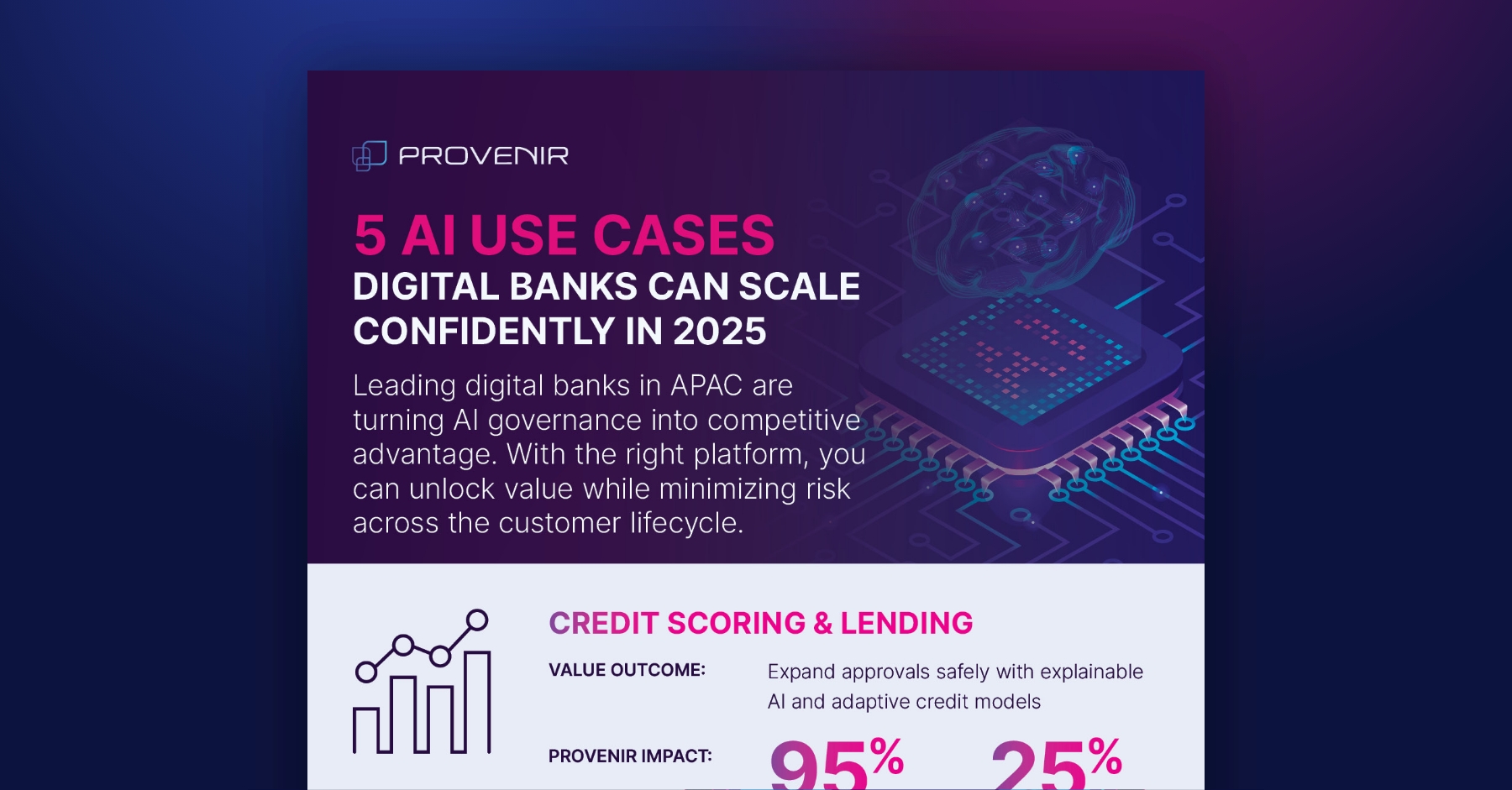
5 AI Use Cases Digital Banks Must Govern by 2025

5 AI Use Cases Digital Banks Must Govern by 2025

Digital banks across APAC are accelerating their AI adoption—but core use cases like credit scoring, fraud detection, AML/KYC, customer targeting, and compliance automation are now considered “high-risk” under evolving regulatory regimes. This infographic shows how to scale with confidence, balancing growth, compliance, and customer trust.
What You’ll Discover
  • The five critical AI use cases your digital bank must govern by 2025
  • Why regulators are classifying them as high-risk
  • Key governance controls and decisioning capabilities that turn risk into advantage
Want more in-depth info on how Provenir implements AI?

Learn More

ADDITIONAL RESOURCES

The State of AI, Risk, and Fraud in Financial Services
Blog, Survey, AI, Decisioning, Fraud /

The State of AI, Risk, and Fraud in F...

The State of AI, Risk, and Fraud in Financial Services 2025: A ... Read More →
europe mortgages
Blog, Mortgage /

Top Mortgage Lending Trends in the UK...

Top Mortgage Lending Trends in the UK and Europe: Smarter Decisioning for ... Read More →
provenir sponsored event
News, Decisioning /

NEWS: AI Risk Decisioning Leader Prov...

AI Risk Decisioning Leader Provenir to Sponsor Upcoming Banking and Financial Services ... Read More →
fraud for telco data sheet
Data Sheet, Fraud, Telco /

DATA SHEET: Fraud for Telco

Provenir: Application Fraud for Telcos Holistic Fraud Detection with Comprehensive Subscriber View ... Read More →
NEWS: 2025 New Global Survey
News, Credit Risk Mgmt, Fraud, Provenir /

NEWS: 2025 New Global Survey

New Global Survey Shows Nearly Half of Financial Services Executives Struggling to ... Read More →
Survey: 2025 Global Risk Decisioning Survey
eBook, Survey, AI /

Survey: 2025 Global Risk Decisioning ...

Survey: 2025 Global Risk Decisioning Survey What are the key challenges and ... Read More →
blog lending thumbnail
Blog, Loans, Mortgage /

BLOG: Unlocking Success in Poland’s L...

Thriving Through Change: Unlocking Success in Poland’s Lending Revolution Adapting to Rising ... Read More →
BLOG AI Round up
Blog, Decisioning /

BLOG: Shaping the Future of Decisioni...

Shaping the Future of Decisioning: How These Leading Financial Services Providers are ... Read More →
EBOOK: How Telcos Can Boost Revenue Without the Risk
eBook, Telco /

EBOOK: How Telcos Can Boost Revenue W...

Dial Into Profit: How Telcos Can Boost Revenue Without the Risk Harnessing ... Read More →
boss article
News, Onboarding, Provenir /

NEWS: It’s Dentistry’s Turn to Open W...

It’s Dentistry’s Turn to Open Wide: Provenir partners with dental service organization ... Read More →
finextra news
News, Fraud /

NEWS: Financial Services Trends for 2...

Financial Services Trends for 2025 Fraud Prevention, Customer Account Management, and More ... Read More →
News: Chartis Research Executive Brief Details Provenir ‘Best-in-Class’ Capabilities for Credit Risk and Fraud Mitigation
News, Decisioning, Fraud /

News: Chartis Research Executive Brie...

Chartis Research Executive Brief Details Provenir ‘Best-in-Class’ Capabilities for Credit Risk and ... Read More →
Vendor Report: Chartis Research Names Provenir a Global Leader
eBook, Decisioning, Fraud, Provenir /

Vendor Report: Chartis Research Names...

Chartis Research Names Provenir a Global Leader Credit and Fraud – A ... Read More →
Event, AI, Banking /

AI In Banking for Smarter Decisions B...

You’re Invited: AI In Banking for Smarter Decisions Business Lunch with Provenir ... Read More →
finextra with kathy stares
News, Embedded Finance /

News: Embracing the Soon-to-Be $228 B...

Embracing the Soon-to-Be $228 Billion Embedded Finance Revenue Opportunity The value of ... Read More →

Continue reading

britcard blog

BritCard: Identity, Inclusion, and the Fine Line Between Safety and Surveillance 

BritCard: Identity, Inclusion, and the Fine Line Between Safety and Surveillance

Let’s be honest. The first reaction to a new government-backed identity card like the proposed BritCard isn’t excitement — it’s suspicion.

Headlines and social media posts paint a picture of a tracking tool:

  • A way to log when you go abroad.
  • A database that can follow your every move.
  • Even fears that the government could dip directly into your bank account.

These stories get attention because they play to something real — our collective anxiety about privacy and control in the digital age.

The plan is to anchor BritCard within the existing Gov.UK One Login/Wallet infrastructure, enabling landlords, employers, banks, and public services to verify entitlements — such as right-to-work and right-to-rent — through a single secure verifier app.

This blog explores both sides of the BritCard conversation: the tangible benefits a universal digital ID could deliver and the concerns that need addressing if it’s to earn public trust. Whether you see it as a step toward inclusion or a step too far, the debate matters — because the way we design identity systems shapes how millions of people access services, prove who they are, and protect what’s theirs.

The Potential Benefits

  • Free ID for Everyone

    Passports and driving licences cost money — often over £80 — and not everyone can afford them. That’s why, even today, estimates suggest between 2 and 3.5 million adults in the UK do not have any form of recognised photo ID. For those people, everyday tasks like proving their identity for a job, rental, or bank account become unnecessarily difficult.

    A free, universal ID could change that by giving everyone the same basic proof of identity, regardless of income or background. Everyone should have the right to a free, recognised form of identification. For some, the BritCard could be their very first form of official ID — a tool that unlocks access, not just for the few, but for everyone.

  • “I Don’t Have My Document With Me — But I Have My Phone”

    We’ve all had that frustrating moment: halfway through an application, asked for a passport or licence that’s sitting in a drawer at home. With a reusable digital ID, that roadblock disappears. You carry it with you, ready to use in seconds, whether you’re applying for a loan, signing a tenancy, or verifying your age.
  • Fighting Deepfakes, Fake IDs, and Synthetic Identities

    Fraudsters thrive on weak ID checks. They exploit gaps by creating fake identities, using stolen details, or even building synthetic identities that blend real and fake information to appear legitimate. In 2024, UK victims reported over 100,000 cases of identity fraud, with losses running into the hundreds of millions.

    Criminals are already a step ahead. They’re using deepfake technology to generate highly convincing images and videos of passports, driving licences, and even live “selfie” checks. These fakes are often detected — but when they slip through the net, the results can be very costly for businesses in terms of direct losses, compliance fines, and reputational damage.

    Would the BritCard be a perfect, spoof-proof solution? Probably not. No system is. But by anchoring identity to a single, secure, government-issued credential, rather than fragmented checks across dozens of providers, it could raise the barrier significantly.

  • Inclusion for the “Thin File”

    Not everyone has a long credit history. Young people, newcomers to the UK, and international students often struggle to prove not that they exist, but where they live.

    Take Anna, a 19-year-old student from Spain arriving for university. She doesn’t have a UK credit record, isn’t on the electoral roll, and her rental agreement isn’t always accepted by banks. Today, opening a bank account might take weeks of back-and-forth. With a BritCard linked to her university enrolment and HMRC registration, her address could be confirmed instantly — letting her start life in the UK without delay.

    This kind of real-time verification would mean:

    • Faster access for genuine newcomers and young people.
    • Less frustration in everyday applications.
    • Stronger protection against fake documents, since address data would come only from verified sources.
  • One Solution Across Industries

    Today, every organisation has its own way of verifying identity. Banks, lenders, telcos, landlords, and employers all use different systems, which means customers face repeated checks, duplicated requests, and sometimes inconsistent outcomes.

    A universal digital ID like the BritCard could streamline this. Instead of juggling multiple verification systems, businesses could plug into a single, trusted credential.

  • Banks & lenders:
    Since the Immigration Act requires them to verify that customers have the right to live and work in the UK, a universal digital ID could make compliance far easier — reducing manual processes and ensuring consistency.
  • Telcos & utilities:
    Easier verification for new contracts, protecting against account fraud and “bust-out” scams.
  • Landlords & letting agents:
    Reliable right-to-rent checks without chasing paper documents.
  • Employers:
    Quicker right-to-work verification, reducing the cost and risk of manual checks.
  • E-commerce & digital services:
    Stronger age and identity checks at checkout, with less friction for genuine buyers.
  • Healthcare and public services:
    Faster onboarding with safeguards for sensitive data.
In short, the BritCard could become a common trust layer across industries, making life easier for genuine customers and raising the bar for criminals trying to exploit inconsistent processes.

What We Can Learn from Other Countries

The UK wouldn’t be the first to try a universal digital identity. Other countries have already rolled out similar schemes, with valuable lessons:
estonia flagEstonia has built one of the most advanced digital societies in the world on the back of its national ID. Citizens use it for healthcare, tax, banking, and even voting. A cryptographic flaw in 2017 forced an emergency response — a reminder that even strong systems must plan for cyber risks.
denmark flagDenmark’s MitID is used by almost all adults, proving that widespread adoption is possible. It has improved trust and convenience, though scams and social engineering remain ongoing challenges.
singapore flagSingapore’s Singpass shows how integration across public and private services can reduce friction for citizens, but also how critical it is to provide strong customer support against fraud attempts.
india flagIndia’s Aadhaar demonstrates scale and inclusion, giving hundreds of millions of people their first form of ID. But it has also highlighted the importance of legal guardrails and clear limits on how data can be used.
When designed well, digital ID systems can unlock access, improve security, and fight fraud. But every example also shows that inclusion, privacy, and resilience must be built in from day one.

The Concerns and Risks of BritCard

For the BritCard to work, public trust will be just as important as the technology itself. While the benefits are clear, there are also challenges that need to be addressed.
  • Inclusion and the Right to ID
    Every adult should have the right to a recognised identity. For some, the BritCard could be their very first form of official ID. But to live up to that promise, it must be accessible to everyone — not just those with smartphones, stable internet, or digital confidence. Without inclusive design and offline options, the very people who stand to benefit most could still be left out.
  • Privacy and Data Use
    People want to know how their data will be stored, who can access it, and for what purpose. Without clear guardrails, concerns about “too much information in one place” could undermine trust.
  • Cyber security
    Any centralised identity system will be a target for hackers. Even the most secure designs need robust contingency plans, rapid patching, and transparent communication in the event of an incident.
  • Consistency of Experience

    If the BritCard is adopted unevenly, with some industries using it fully and others sticking to older processes, users may end up facing the same frustrations as today. A smooth, consistent experience will be critical to delivering real value.

Walking the Fine Line

To some, BritCard feels like a step closer to monitoring; to others, it promises inclusion, protection, and simplicity. The truth is that it could be both — or neither — depending on how it is designed and delivered.

If the system is built with cyber security at its core, with ease of use for every citizen, and with a focus on adding real value for both consumers and businesses, then the BritCard could solve many of the frustrations we face today with passports, licences, and paper-based processes.

Get it wrong, and it risks being seen as another layer of control. Get it right, and it could be one of the most empowering tools of the digital age — tackling fraud, opening access, and proving that identity can be both secure and inclusive.

This isn’t about politics — it’s about tackling fraud, improving inclusion, and building a digital ID system that puts privacy and cyber security first.

Learn More About Provenir’s Fraud & Identity

Learn More

LATEST BLOGS

260726 - BLOG eyeDP - FeatureIMG - 61058

Beyond Data: Why Dec...

Beyond Data:Why Decisioning Needs Document Intelligence Financial services providers
Fraud in Telco: Provenir Experts Answer Frequently Asked Questions

Fraud in Telco: Prov...

Fraud in Telco:Provenir Experts Answer Frequently Asked Questions 1.
260722 - ARTICLE Mike - FeatureIMG - 60958

AI governance in fin...

AI governance in financial services:What "governed" means in practice
Latam Compliance Challenge for Decisioning

LATAM Next Complianc...

From Data Protection to Decisioning Accountability:What LATAM Regulation Means
Banks Architecture Gap - Provenir

The Architecture Gap...

Decisioning ArchitectureThe Architecture Gap: Banking's Next Competitive Battleground Banks
BLOG Andy

The Real Cost of Ven...

The Real Cost of Vendor Dependency in Credit Decisioning
260617 - BLOG Matthew Nutt - FeatureIMG - 60431

What Does a Good Dat...

What Does a Good Data Provider Review Actually Look
Ebook CM

AI-Powered Customer ...

AI-Powered Customer Management:How Leading Institutions Turn Intelligence Into Revenue

Continue reading

ai perils

Navigating the Promise and Peril of Generative AI in Financial Services

Navigating the Promise and Peril of Generative AI in Financial Services

Financial services leaders are being bombarded with AI pitches. Every vendor claims their solution will revolutionise decisioning, slash costs, and unlock untapped revenue. Meanwhile, your competitors are announcing AI initiatives, your board is asking questions, and your teams are already experimenting with ChatGPT and other tools—sometimes without your knowledge.

The pressure to “do something” with AI is intense. But the organisations that rush to deploy generative AI without understanding its limitations are setting themselves up for problems that may not become apparent until it’s too late.

At Provenir, we’ve built AI decisioning capabilities that process over 4 billion decisions annually for financial institutions in 60+ countries. We’ve seen what works, what doesn’t, and what keeps risk leaders up at night. More importantly, we’ve watched organisations make costly mistakes as they navigate AI adoption.

In this article you’ll find a practical assessment of where generative AI delivers real value in financial services, where it introduces unacceptable risk, and how to tell the difference.

Where AI Delivers Value

The efficiency benefits of AI in financial services are tangible and significant. Here’s where we’ve seen AI deliver measurable business impact:
  • Faster model development and market response:
    What once took months in model evaluation and data assessment can now happen in weeks, enabling lenders to respond to market changes and test new data sources with unprecedented speed.
  • Transaction data transformed into intelligence:
    Advanced machine learning processes enormous volumes of transaction data to generate personalised consumer insights and recommendations at scale—turning raw data into revenue opportunities.
  • Operational oversight streamlined:
    Generative AI helps business leaders cut through the noise by querying and summarising vast amounts of real-time operational data. Instead of manually reviewing dashboards and reports, leaders can quickly identify where to focus their attention—surfacing which workflows need intervention, which segments are underperforming, and where action is most likely to drive business value.
These aren’t future possibilities. Financial institutions are achieving these outcomes today: 95% automation rates in application processing, 135% increases in fraud detection, 25% faster underwriting cycles. While GenAI-powered assistants accelerate model building and rapidly surface strategic insights from complex decision data.

The Risks Nobody Talks About

However, our work with financial institutions has also revealed emerging risks that deserve serious consideration:
When AI-Generated Code Contradicts Itself

Perhaps the most concerning trend we’re observing is the use of large language models to generate business-critical code in isolation. When teams prompt an LLM to build decisioning logic without full knowledge of the existing decision landscape, they risk creating contradictory rules that undermine established risk strategies.

We’ve seen this play out: one business unit uses an LLM to create fraud rules that inadvertently conflict with credit policies developed by another team. The result? Approved customers getting blocked, or worse—high-risk applicants slipping through because competing logic created gaps in coverage. In regulated environments where consistency and auditability are paramount, this fragmentation poses significant operational and compliance risks.

When Confidence Masks Inaccuracy

LLMs are known to “hallucinate”—generating confident-sounding but factually incorrect responses. In financial services, where precision matters and mistakes can be costly, even occasional hallucinations represent an unacceptable risk. A single flawed credit decision or fraud rule based on hallucinated logic could cascade into significant losses.

This problem intensifies when you consider data integrity and security concerns. LLMs trained on broad, uncontrolled datasets risk inheriting biases, errors, or even malicious code. In an era of sophisticated fraud and state-sponsored cyber threats, the attack surface expands dramatically when organisations feed sensitive data into third-party AI systems or deploy AI-generated code without rigorous validation.

The Expertise Erosion

A more insidious risk is the gradual erosion of technical expertise within organisations that become overly dependent on AI-generated solutions. When teams stop developing deep domain knowledge and critical thinking skills—assuming AI will always have the answer—organisations become vulnerable in ways that may only become apparent during crisis moments when human judgment is most needed.

Combine this with LLMs that are only as good as the prompts they receive, and you have a compounding problem. When users lack deep understanding of what they’re truly asking—or worse, ask the wrong question entirely—even sophisticated AI will provide flawed guidance. This “garbage in, garbage out” problem is amplified when AI-generated recommendations inform high-stakes decisions around credit risk or fraud prevention.

Regulators Are Watching

The regulatory environment is evolving rapidly to address AI risks. The EU AI Act, upcoming guidance from financial regulators, and increasing scrutiny around algorithmic bias all point toward a future where AI deployment without proper governance carries substantial penalties. Beyond fines, reputational damage from AI-driven failures could be existential for financial institutions built on customer trust.

What Successful Institutions Are Doing Differently

Based on our work with financial institutions globally, the organisations getting AI right start with a fundamental recognition: AI is already being used across their organisation, whether they know it or not. Employees are experimenting with ChatGPT, using LLMs to generate code, and making AI-assisted decisions—often without formal approval or oversight. The successful institutions don’t pretend this isn’t happening. Instead, they establish clear AI governance frameworks, roll out comprehensive training programs, and implement mechanisms to monitor adherence. Without this governance layer, you’re operating blind to the AI risks already present in your organisation.

With governance established, these organisations focus on maintaining human oversight at critical decision points. AI augments rather than replaces human expertise. Business users configure decision strategies with intuitive tools, but data scientists maintain oversight of model development and deployment. This isn’t about slowing down innovation—it’s about ensuring AI recommendations get validated by people who understand the broader context.

Equally important, they refuse to accept black boxes. In regulated industries, explainability isn’t negotiable. Every decision needs to be traceable and understandable. This isn’t just about compliance—it’s about maintaining the ability to debug, optimize, and continuously improve decision strategies. When something goes wrong (and it will), you need to understand why.

Rather than accumulating point solutions, successful institutions build on unified architecture. They recognise that allowing fragmented, AI-generated code to proliferate creates more problems than it solves. Instead, they use platforms that provide consistent decision orchestration across the customer lifecycle. Whether handling onboarding, fraud detection, customer management, or collections, the architecture ensures that AI enhancements strengthen rather than undermine overall decision coherence.

These organisations also treat AI as a living system requiring continuous attention. AI models need ongoing observability and retraining. Continuous performance monitoring helps identify when models need refinement and surfaces optimisation opportunities before they impact business outcomes. The institutions that treat AI deployment as “set it and forget it” are the ones that end up with the costliest surprises.

Finally, they maintain control of their data. Rather than sending sensitive data to third-party LLMs, forward-thinking organisations deploy AI solutions within secure environments. This reduces both security risks and regulatory exposure while maintaining full control over proprietary information.

Why Inaction Isn’t an Option

The irony is that many leaders debating whether to “adopt AI” have already lost control of that decision. AI is already being used in their organisations—the only question is whether it’s governed or ungoverned, sanctioned or shadow IT.

Meanwhile, fintech disruptors are leveraging AI to deliver frictionless, personalised experiences that traditional institutions must match. The competitive gap isn’t just about technology—it’s about the ability to move quickly while maintaining control and compliance.

Organisations that succeed will be those that combine AI capabilities with strong governance frameworks, architectural discipline, and deep domain expertise. They’ll move beyond isolated experiments to implement AI in ways that deliver real business value while maintaining the trust and regulatory compliance that financial services demand.

The institutions making smart bets on AI aren’t the ones moving fastest—they’re the ones moving most thoughtfully, with equal attention to capability, transparency and governance.

Find out more about Provenir AI

Learn More

LATEST BLOGS

260726 - BLOG eyeDP - FeatureIMG - 61058

Beyond Data: Why Dec...

Beyond Data:Why Decisioning Needs Document Intelligence Financial services providers
Fraud in Telco: Provenir Experts Answer Frequently Asked Questions

Fraud in Telco: Prov...

Fraud in Telco:Provenir Experts Answer Frequently Asked Questions 1.
260722 - ARTICLE Mike - FeatureIMG - 60958

AI governance in fin...

AI governance in financial services:What "governed" means in practice
Latam Compliance Challenge for Decisioning

LATAM Next Complianc...

From Data Protection to Decisioning Accountability:What LATAM Regulation Means
Banks Architecture Gap - Provenir

The Architecture Gap...

Decisioning ArchitectureThe Architecture Gap: Banking's Next Competitive Battleground Banks
BLOG Andy

The Real Cost of Ven...

The Real Cost of Vendor Dependency in Credit Decisioning
260617 - BLOG Matthew Nutt - FeatureIMG - 60431

What Does a Good Dat...

What Does a Good Data Provider Review Actually Look
Ebook CM

AI-Powered Customer ...

AI-Powered Customer Management:How Leading Institutions Turn Intelligence Into Revenue

Continue reading