MKTplace-region: NA

260722 - ARTICLE Mike - FeatureIMG - 60958

AI governance in financial services

AI governance in financial services:
What “governed” means in practice

Artificial intelligence has reached the point where its presence is assumed. Every software platform is adding AI capabilities, established technology providers are layering intelligence onto products that have existed for decades, and entirely new companies are emerging with AI at their core. For financial institutions, however, this technological acceleration creates a different conversation. The question is no longer whether AI can be adopted; it is whether it can be adopted without losing control of the decisions that matter most.

Banking has always been built on trust. Every lending decision, fraud investigation, affordability assessment or customer interaction carries consequences that extend far beyond technology. They affect customers’ financial lives, an institution’s reputation, and confidence in the financial system itself. AI undoubtedly has the potential to improve these outcomes, but the same capability that creates value can just as easily amplify poor decisions if it is introduced without the discipline to govern it properly.

What Lies Beneath the Surface

At Provenir, we often think of AI adoption as an iceberg. Above the surface sit the capabilities that attract the headlines: automation, personalisation, natural language interfaces and dramatically faster decision-making. Beneath the surface lies the work that determines whether those capabilities create sustainable value or introduce new operational risks: bias that only emerges at scale, model drift, over-reliance on AI recommendations, and systems that perform well in pilots but struggle under the complexity of production. These are rarely failures of AI itself; they are failures of governance.

For Tier 1 financial institutions, this matters because they are not trying to become AI companies. They have spent decades building resilient decisioning infrastructure capable of supporting millions of customers under demanding regulatory standards. Their challenge is to strengthen that foundation with AI, not replace it. The objective is to improve customer outcomes without compromising the control, resilience and accountability that already exist.

Regulation as an Enabler

Regulation, including the EU AI Act, can be an enabler rather than a barrier. Good regulation defines the conditions under which innovation can scale responsibly. By requiring traceability, human oversight, documentation and accountability, it gives organisations a framework for deploying AI safely in the processes that matter most.

Ultimately, the conversation should never begin with the technology. It should begin with the outcome. Customers never experience a large language model. They experience whether a loan was approved fairly, whether fraud was detected quickly, whether a complaint was handled appropriately, or whether they were treated with empathy during financial difficulty. The technology only has value if those customer outcomes improve.

What “Governed AI” Really Means

Governance is not simply connecting an LLM into a workflow. It encompasses everything that surrounds it: how the solution was designed, how it was tested, how fairness was assessed, how performance is monitored, how drift is detected, whether every decision can be traced, explained and audited, and how long the supporting evidence is retained. These are the questions that compliance officers, auditors and regulators increasingly need institutions to answer with confidence.

Perhaps the most important principle is that accountability never transfers to the technology. AI may generate recommendations and automate increasingly sophisticated tasks, but it is never accountable for the outcomes it produces. That responsibility always remains with people. As AI becomes more capable, human accountability becomes more important, not less.

Balancing Value and Risk

Every AI decision is ultimately a balance between value and risk. Governance is what allows organisations to shift that balance, reducing risk while increasing the value that AI can safely deliver. It provides the confidence to introduce AI where it creates meaningful improvements while recognising that, in some situations, a more traditional approach may still be the better choice.

This is why it’s important to think of governance as a conscious series of design choices rather than a checklist of controls. There are situations where a human should remain directly involved in every decision, such as managing vulnerable customers, because judgement and accountability extend beyond what AI should provide independently. There are others, such as transaction monitoring, where automation can safely operate at scale, provided robust monitoring, alerting and escalation mechanisms remain in place.

The objective should never be to maximise automation for its own sake. It should be to maximise customer outcomes while managing risk appropriately. In some situations, AI should support a person in making the final decision, keeping a human firmly in the loop. In others, it can safely automate routine decisions, provided robust monitoring and governance remain in place. And there will always be situations where AI is not the right technology at all. The decision should always reflect the balance between value, risk and the controls available to manage that risk.

The Next Stage of AI Literacy

In many respects, this is simply the next stage of a journey that financial services has travelled before. Banks first developed risk literacy, then data literacy, and now AI literacy. The institutions that succeed will not necessarily be those deploying the most AI, but those that understand where it creates genuine value, where traditional approaches remain more appropriate, and how to combine both within a governance framework that customers, regulators and boards can trust.

Mike Holmes

Mike Holmes

Written By

Head of Data Science, Provenir

Latest Blogs

260817 - BLOG Closing Fraud Gap - FeatureIMG - EN 61409

Beyond Detection: Cl...

Beyond Detection:Closing the Fraud Prevention Gap Financial services providers
260726 - BLOG eyeDP - FeatureIMG - 61058

Beyond Data: Why Dec...

Beyond Data:Why Decisioning Needs Document Intelligence Financial services providers
Fraud in Telco: Provenir Experts Answer Frequently Asked Questions

Fraud in Telco: Prov...

Fraud in Telco:Provenir Experts Answer Frequently Asked Questions 1.
260722 - ARTICLE Mike - FeatureIMG - 60958

AI governance in fin...

AI governance in financial services:What "governed" means in practice
Latam Compliance Challenge for Decisioning

LATAM Next Complianc...
From Data Protection to Decisioning Accountability:What LATAM Regulation Means
Banks Architecture Gap - Provenir

The Architecture Gap...

Decisioning ArchitectureThe Architecture Gap: Banking's Next Competitive Battleground Banks
BLOG Andy

The Real Cost of Ven...

The Real Cost of Vendor Dependency in Credit Decisioning
260617 - BLOG Matthew Nutt - FeatureIMG - 60431

What Does a Good Dat...

What Does a Good Data Provider Review Actually Look

Continue reading

BLOG Survey01

Why 77% of Financial Institutions See Decision Intelligence as Their 2026 Priority

Why 77% of Financial Institutions See Decision Intelligence as Their 2026 Priority

The financial services industry is experiencing a fundamental shift. Organizations have spent years automating decisions. Now they need those decisions to get smarter.

Our 2026 Global Decisioning Survey reveals the scope of this transition: 77% of senior decision-makers see Decision Intelligence as very valuable for their strategy over the next 2-3 years.

What Decision Intelligence Actually Means

Decision Intelligence represents the evolution from automated decisioning to continuously optimized, AI-driven decision-making that learns and improves.

THE DIFFERENCE:

  • The Traditional Approach:

    Deploy AI models, measure results periodically, update quarterly, manage explainability and governance separately
  • Decision Intelligence Approach:

    Execute decisions at scale, measure outcomes continuously, learn from performance, optimize in real-time within unified platforms that provide transparency, governance, and integration
Organizations are moving quickly:
  • 75%

    are already collaborating on AI-driven decision intelligence
  • 18%

    are exploring partnerships
  • 66%

    are very interested in using AI for strategy implementation and optimization
  • 60%

    plan to invest in AI or embedded intelligence for decisioning in 2026 (making it the top investment priority)

What Organizations Value Most

When we asked which AI features provide the most value, organizations prioritized capabilities that go beyond basic automation:

51%

Ability to leverage generative AI for natural language queries
The democratization of AI insights through conversational interfaces transforms who can access and act on decisioning data. Business users, executives, operations teams, and compliance staff can all interact directly with AI systems using natural language.

92%

of organizations find it important to interact with data quickly using natural language queries.
(62% find it very important, 30% moderately important).
  • 49%

    Real-time decisioning across customer touchpoints:
    Speed and consistency across channels create better customer experiences and reduce operational complexity.
  • 50%

    Transparency and explainability of AI models:
    Organizations need AI they can understand and defend to regulators and stakeholders.
  • 47%

    Integration with existing systems and data sources:
    AI must work with existing infrastructure rather than requiring complete replacement.

The Business Impact

Organizations cite four primary benefits from improved Decision Intelligence:
  • 62%

    cite operational efficiency:

    Automated decision-making reduces manual review, accelerates processes, and lowers costs while improving consistency.
  • 52%

    cite better customer experience:

    Faster decisions, reduced friction, and personalized interactions create superior customer journeys.
  • 58%

    cite improved accuracy of models and strategies:

    Continuous learning and optimization improve predictive performance and business outcomes over time.
  • 56%

    cite faster deployment of new decision strategies:

    Rapid testing and iteration enable organizations to adapt quickly to market changes and competitive pressure.
These benefits compound over time. Organizations that deploy Decision Intelligence don’t just get better decisions today. They build systems that continuously improve.

The Intelligence Loop in Practice

Decision Intelligence creates a continuous cycle:
  • chess

    Shape Strategy

    Design and evolve decision strategy by learning from how decisions actually perform. Strategy is measured through outcomes and continuously refined to balance risk exposure and revenue opportunity.
  • rocket

    Execute Decisions

    Make real-time, data-driven decisions at every customer touchpoint using deep customer understanding, data, context, and decision history.
  • dashboard

    Measure Outcomes

    Connect decisions to business outcomes to see what actually drives risk, revenue, and profitability.
  • learning

    Learn and Optimize

    Get specific recommendations to improve performance based on actual results. Learn from the results over time and continuously refine strategies.
This loop transforms decisioning from a periodic batch process into a continuous optimization system.

The Natural Language Revolution

92% of organizations find it important to interact with data quickly using natural language queries. This represents a fundamental shift.

When business users can interact directly with AI systems using conversation, they build intuition about how these systems work. That understanding improves their ability to provide governance oversight and makes the entire organization more comfortable with AI-driven decisioning.

Natural language querying enables:

  • Business users to explore decisioning data without SQL knowledge
  • Executives to get instant answers to strategic questions
  • Operations teams to investigate anomalies in real-time
  • Compliance teams to audit decisions conversationally
This democratization helps address one of the top implementation barriers: explainability. When more people in the organization can interact with and understand AI systems, those systems become more transparent by design.

Addressing Implementation Barriers

Decision Intelligence approaches help address the barriers preventing AI adoption:
  • Explainability

    Platforms provide visibility into what decisions were made, how they perform, and why. This makes it easier to explain outcomes to regulators and stakeholders.
  • Governance

    Connecting decisions to business outcomes (risk, revenue, customer experience) makes governance more manageable. You measure results and learn from performance rather than monitoring models in isolation.
  • Integration

    Decision Intelligence platforms orchestrate data and decisions across existing infrastructure without requiring wholesale system replacement.
  • Speed

    Organizations can learn from every decision and optimize continuously, addressing the speed challenge that 50% cite as their biggest fraud detection obstacle.

Looking Ahead

The survey reveals clear momentum:
  • 77%

    see Decision Intelligence as very valuable
  • 75%

    are already implementing it
  • 66%

    want AI for strategy optimization
  • 60%

    are investing in 2026 (top priority)
Traditional decisioning optimizes for speed. Decision Intelligence optimizes for outcomes. Organizations that build systems capable of continuous learning will create advantages that compound over time.

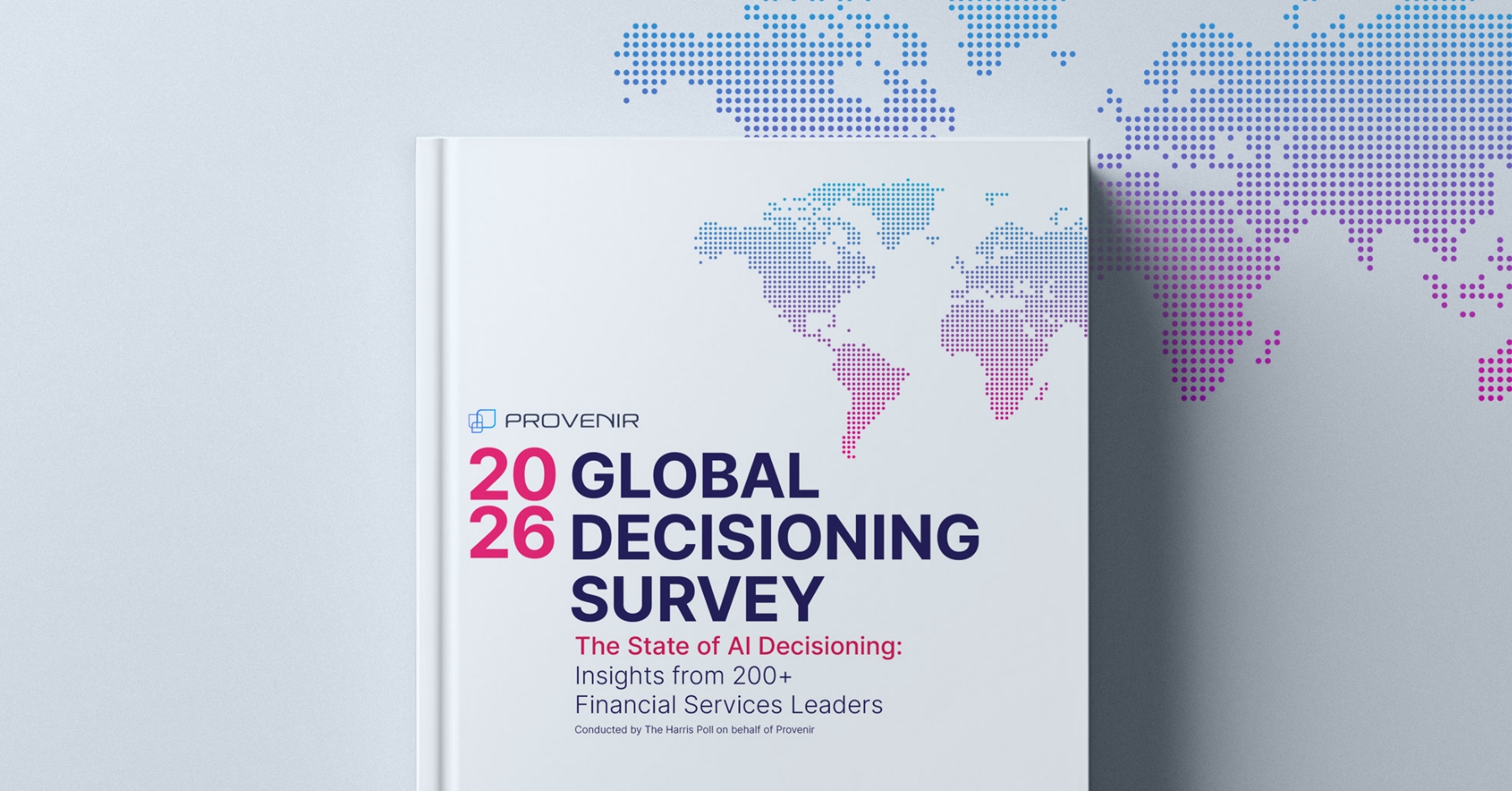
EBOOK Survey2026

Download the full 2026 Global Decisioning Survey:

Download Survey

LATEST RESOURCES

BLOG Survey02

The Fraud-AI Double ...

Financial institutions face a critical tension. They need AI to combat increasingly sophisticated fraud. Yet
BLOG Survey01

Why 77% of Financial...

The financial services industry is experiencing a fundamental shift. Organizations have spent years automating decisions.
EBOOK Survey2026

Survey: 2026 Global ...

The financial services industry stands at an inflection point in its adoption of artificial intelligence
The State of AI, Risk, and Fraud in Financial Services

The State of AI, Ris...

The State of AI, Risk, and Fraud in Financial Services 2025: A Year of Transformation

Continue reading

Rzolut

Partners

Rzolut

Leader in Global Risk & Compliance Datasets

Key Benefits

  • Tailored Risk and Compliance Solutions. Risk and compliance proprietary data provider.  Building and maintaining critical screening watchlists for the industry, driven by deep expertise in the Financial Crimes Compliance (FCC) space.
  • AI-powered Datasets and Adverse Media Screening. Comprehensive, watchlist datasets and adverse media, collated using proprietary, gold-standard name matching logic and maintained using AI-powered technology designed to cover all diligence and risk management use cases. It is built for easy integration with packaged software and customers’ internal platforms alike..

“RZOLUT’s services offer invaluable insights, guiding our strategies effectively with thoroughness, accuracy, and confidence, benefiting our investments. Highly recommended.”

PARTNER, LEADING PRIVATE EQUITY FIRM

Simplify Compliance, Amplify Success

AdviceRobo mission is to responsibly promote financial inclusion for the next generation, globally. Younger generations possess unique attributes such as digital fluency, strong entrepreneurial spirit, and a commitment to sustainability, often overlooked by traditional financial methods. To bridge this gap, we’ve crafted an advanced data collection tool tailored for next-gen traits and behaviors.

This tool serves as the foundation for our sophisticated analytical solutions, integrating cutting-edge AI, all while upholding ethical standards and respecting privacy within the regulatory framework. Our solutions empower you to exercise greater control with automated customer data enrichment and seamless data automation through our automatic data pipelines. We also offer innovative modeling and scorecards, in addition to assisting your team in developing customized scorecards. By embracing these solutions, you can embrace the future of financial inclusion and cater to the unique needs of the next generation.

About Rzolut

  • Services

    PEP Bridge: Our dataset profiles Politically Exposed Persons (PEPs), individuals in key public roles susceptible to corruption or financial crimes. It provides comprehensive information including names, positions, affiliations, and connections.

    Sanctions Bridge: Our dataset is a comprehensive compilation of sanctions imposed by governments or international organizations against individuals, entities, or countries.

    Watchlists: Our dataset is a structured repository of information about individuals, entities, or transactions flagged for monitoring due to potential risks or suspicious activities.

    Adverse Media: Our dataset aggregates information from various sources, including media outlets and public records, documenting negative events or controversies involving individuals, entities, or organizations.

  • Regions Supported

    • Global

Continue reading

RiskSeal

Partners

RiskSeal

Smart Credit Decisions Through Digital Footprints

Key Benefits

  • Approval Rate Increase. RiskSeal identifies creditworthy borrowers who have no prior credit history. We help fintech companies expand into emerging markets, increasing approval rates by up to 50%.
  • Default Prevention in the Early Stage. RiskSeal reduces default rates by up to 25% by providing actionable insights derived from over 140 social and digital platforms, utilizing more than 300 data points per applicant.

“RiskSeal provides a detailed profile for each applicant, covering their social media and online activities. They also return a very accurate Digital Credit Score. This helps us make informed decisions. Our approval rates increaed by 2x, with a 17% reduction in default rates and a 26% reduction in KYC spending.”

TYMUR BUGAEVSKIY, HEAD OF DATA SCIENCE AT ONCREDIT

Credit Scoring and Risk Assessment Through Digital Footprints

Tailored financial solution. RiskSeal is an exclusive digital credit scoring solution tailored specifically for the financial industry.

Scoring and decision system. Our solution goes beyond simple data enrichment – it’s a complete user scoring and decision-making system.

In-depth digital profile analysis. Using just a user email, phone number, and IP address data, RiskSeal analyzes a customer’s digital footprint and provides their detailed digital profile.

About RiskSeal

  • Services

    • Alternative Data for Credit Scoring
    • Digital Credit Scoring
    • Digital Footprint Analysis
    • Face Recognition
    • Name Intelligence
    • Geolocation Insights
  • Regions Supported

    • Global

Continue reading

LexisNexis Risk Solutions

Partners

LexisNexis Risk Solutions

Digital Identity Intelligence

Key Benefits

  • Maximize trusted consumer experience and mitigate risk. Powered by digital intelligence gathered from billions of global transactions, we provide insights with advanced analytics to help you make more informed and automated risk-based decisions.
  • Enrich credit decisions across the customer life cycle. Access robust insight into consumer life events, not just at loan origination but throughout the relationship life cycle. From initial customer targeting to credit risk management to ongoing account management, we can help you grow your business while managing risk exposure.

Capture More Revenue While Delivering Excellent Customer Experiences

LexisNexis® Risk Solutions is a trusted leader in providing organizations with actionable insights to manage risks, find opportunities and improve results. We understand what it takes to navigate the evolving world of risk management and deliver targeted solutions that empower well-informed decisions. 

At the core of our vision is the integration of two of the most polarized, yet crucial strategic initiatives: meeting increasingly high expectations regarding customer experience while remaining vigilant to risk, escalating fraud and compliance. Our solutions help businesses make more confident trust and identity decisions across the entire customer journey. Partner with us to confidently capture more revenue while delivering excellent customer experiences.

Resources

About LexisNexis Risk Solutions

  • Services

    • LexisNexis® ThreatMetrix® – Real-time digital identity intelligence and risk assessment to safeguard online transactions and interactions against fraudulent activities
    • LexisNexis® Emailage® – Fraud risk scoring solution that uses global email intelligence to assess risk and approve transactions
    • LexisNexis® RiskViewTM – Credit risk assessment solution providing insight into key risk factors that traditional credit data alone may miss
  • Regions Supported

    • Global

Continue reading

AdviceRobo

Partners

AdviceRobo

Dynamic Personality Data for BNPL and SME Credit Decisioning

Key Benefits

  • Increase your acceptance rate up to 40%. Incorporating personality data will enhance your scorecards with insights on customer segments like next-gen consumers, newcomers to the country, and small businesses, enabling more accurate predictions and access to previously untapped customer segments.
  • Seamless customer journey, low-tech integration, real-time insights. Our JavaScript plugin, integrated into your customer onboarding process, gathers data from various touchpoints and provides information, profiles, and decisions. A 24/7 dashboard offers real-time insights into the funnel, comprehensive customer data, alerts, and model performance.

“AdviceRobo is an innovative partner supporting us with their psychometric credit scoring. Our cooperation really adds value to our business. They are a great bunch of people. We are happy to team up with them and benefit from their knowledge.”

SME PLATFORM LENDER IN EUROPE

AI-Driven Solutions to Improve Your Underwriting

AdviceRobo mission is to responsibly promote financial inclusion for the next generation, globally. Younger generations possess unique attributes such as digital fluency, strong entrepreneurial spirit, and a commitment to sustainability, often overlooked by traditional financial methods. To bridge this gap, we’ve crafted an advanced data collection tool tailored for next-gen traits and behaviors.

This tool serves as the foundation for our sophisticated analytical solutions, integrating cutting-edge AI, all while upholding ethical standards and respecting privacy within the regulatory framework. Our solutions empower you to exercise greater control with automated customer data enrichment and seamless data automation through our automatic data pipelines. We also offer innovative modeling and scorecards, in addition to assisting your team in developing customized scorecards. By embracing these solutions, you can embrace the future of financial inclusion and cater to the unique needs of the next generation.

Resources

About AdviceRobo Services

  • Proprietary Personality Data

    Psychometric data

    Digital footprint data

    Biometric data

    Demographic data

  • Profiles and Scores

    Life-centric profile

    Financial health profile

    Life-centric credit score

    Other risk scores

  • Custom Solutions

    Score card development

    Model development

    Design AI strategies and roadmaps for and with boards and management

    Education and training on AI for co-workers

  • Regions Supported

    Global

Continue reading