CS-lineofbusiness: Business Solutions

Compliance and Decisioning in North America - Claire Hartley

From Regulatory Complexity to Competitive Confidence: How Provenir Supports Responsible Decisioning Across North America

FFrom Regulatory Complexity to Competitive Confidence:
How Provenir Supports Responsible Decisioning Across North America

Across North America, financial services providers must make faster, more accurate decisions while meeting increasingly complex regulatory expectations. In the United States, federal obligations sit alongside a growing patchwork of state privacy, cybersecurity and artificial intelligence laws. In Canada, organizations must address PIPEDA, provincial privacy requirements and guidance from the Office of the Superintendent of Financial Institutions.

For organizations using data and AI in credit, fraud and identity decisions, compliance cannot be a final check. It must be built into the way technology is governed, operated and monitored.

Governed and Explainable Decisioning

Provenir brings data, AI models, analytics and automated decisioning together within a single, governed environment. Customers retain control over their decision strategies, rules and compliance guardrails, with the ability to test, approve, monitor and adjust them through controlled processes.

This matters most in US credit decisioning. The Equal Credit Opportunity Act requires lenders to provide specific and accurate reasons for adverse decisions, even when AI or complex models are used. Provenir supports transparent decision logic, configurable reason codes and accessible decision information, helping customers explain outcomes and maintain an effective audit trail.

The customer remains responsible for its lending decisions and legal obligations. Provenir provides the governed technology and control capabilities that help it meet them.

Strong Privacy, Security and Assurance

Provenir operates a mature privacy and data protection framework covering data-processing agreements, controller and processor responsibilities, international transfers, retention, data subject rights, subprocessor oversight and privacy risk assessments. These controls help customers understand how and where personal information is processed, and provide evidence of the safeguards applied throughout the processing chain.

Independent assurance carries equal weight. Provenir maintains ISO/IEC 27001 certification for its Information Security Management System and has completed a SOC 2 Type II assessment covering security, availability and confidentiality. Enterprise customers can also access appropriate assurance evidence, subject to scope and confidentiality requirements, including security and privacy information, penetration-testing summaries, business continuity information and AI governance documentation.

This evidence supports vendor due diligence and helps customers demonstrate effective third-party oversight. It is particularly relevant to the US Gramm-Leach-Bliley Act Safeguards Rule and to Canadian expectations under OSFI Guidelines B-10 and B-13 concerning third-party, technology, cybersecurity and operational resilience risk.

Responsible AI With Practical Controls

Responsible AI requires more than a policy. It needs defined accountability, risk assessment, testing, documentation, human oversight, performance monitoring and controlled change management. Provenir is developing its AI governance framework in alignment with ISO/IEC 42001 and emerging regulatory requirements, building on its established compliance, privacy, risk and information security controls.

Compliance as a Customer Advantage

Provenir does not claim to make customers automatically compliant. It gives financial services providers across North America a controlled and transparent decisioning environment, backed by mature governance and independent assurance.

This helps customers manage regulatory scrutiny, complete enterprise due diligence more efficiently and innovate without losing control. In a market where trust increasingly determines which technology providers can support critical financial processes, Provenir’s Compliance, Regulatory and Data Protection capabilities do more than support the business. They turn assurance into advantage, and that is a genuine competitive differentiator.

Claire Hartley, Chief Compliance Officer Group DPO, Provenir

Claire Hartley

Written By

Chief Compliance Officer & Group DPO, Provenir

Latest Resources

5 Questions Your Decisioning Platform Can't Answer (But Should)

5 Questions Your Dec...

5 Questions Your Decisioning Platform Can't Answer(But Should) Most
Brendan Deakin, Executive Vice President at Provenir

Confidence at Speed:...

Confidence at Speed:What Risk Leaders Are Actually Missing Most
BLOG Bharati Fernando

How to Change a Deci...

How to Change a Decisioning Model Without Raising a
Verifying the Invisible Subscriber

Verifying the Invisi...

Verifying the Invisible Subscriber How Accessing 1datapipe on the
FAQ

Decision Management ...

Decision Management Implementation FAQs for Enterprise Banks Implementing a
260817 - BLOG Closing Fraud Gap - FeatureIMG - EN 61409

Beyond Detection: Cl...
Beyond Detection:Closing the Fraud Prevention Gap Financial services providers
260726 - BLOG eyeDP - FeatureIMG - 61058

Beyond Data: Why Dec...

Beyond Data:Why Decisioning Needs Document Intelligence Financial services providers
Fraud in Telco: Provenir Experts Answer Frequently Asked Questions

Fraud in Telco: Prov...

Fraud in Telco:Provenir Experts Answer Frequently Asked Questions 1.

Continue reading

BLOG Survey01

Why 77% of Financial Institutions See Decision Intelligence as Their 2026 Priority

Why 77% of Financial Institutions See Decision Intelligence as Their 2026 Priority

The financial services industry is experiencing a fundamental shift. Organizations have spent years automating decisions. Now they need those decisions to get smarter.

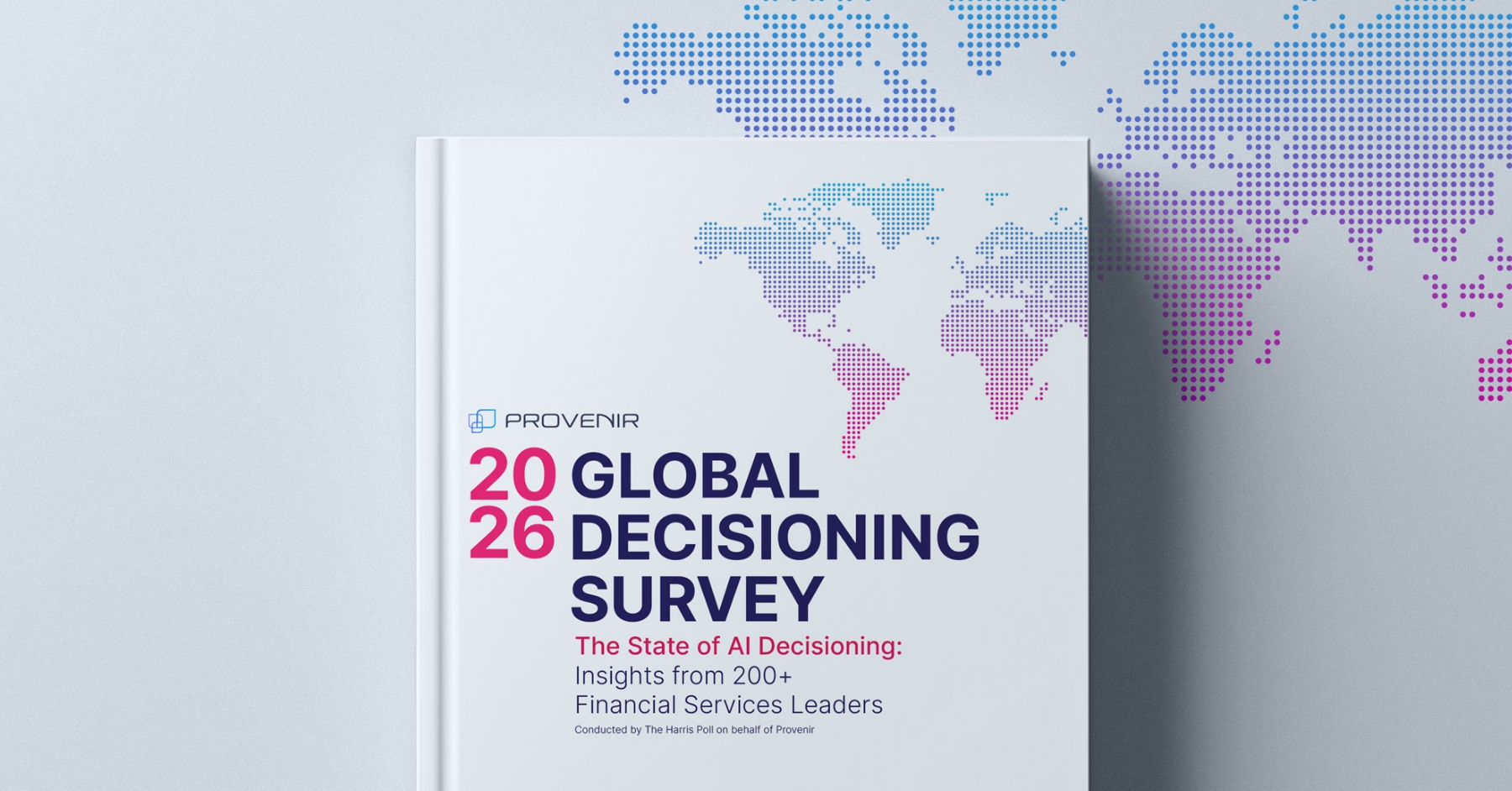
Our 2026 Global Decisioning Survey reveals the scope of this transition: 77% of senior decision-makers see Decision Intelligence as very valuable for their strategy over the next 2-3 years.

What Decision Intelligence Actually Means

Decision Intelligence represents the evolution from automated decisioning to continuously optimized, AI-driven decision-making that learns and improves.

THE DIFFERENCE:

  • The Traditional Approach:

    Deploy AI models, measure results periodically, update quarterly, manage explainability and governance separately
  • Decision Intelligence Approach:

    Execute decisions at scale, measure outcomes continuously, learn from performance, optimize in real-time within unified platforms that provide transparency, governance, and integration
Organizations are moving quickly:
  • 75%

    are already collaborating on AI-driven decision intelligence
  • 18%

    are exploring partnerships
  • 66%

    are very interested in using AI for strategy implementation and optimization
  • 60%

    plan to invest in AI or embedded intelligence for decisioning in 2026 (making it the top investment priority)

What Organizations Value Most

When we asked which AI features provide the most value, organizations prioritized capabilities that go beyond basic automation:

51%

Ability to leverage generative AI for natural language queries
The democratization of AI insights through conversational interfaces transforms who can access and act on decisioning data. Business users, executives, operations teams, and compliance staff can all interact directly with AI systems using natural language.

92%

of organizations find it important to interact with data quickly using natural language queries.
(62% find it very important, 30% moderately important).
  • 49%

    Real-time decisioning across customer touchpoints:
    Speed and consistency across channels create better customer experiences and reduce operational complexity.
  • 50%

    Transparency and explainability of AI models:
    Organizations need AI they can understand and defend to regulators and stakeholders.
  • 47%

    Integration with existing systems and data sources:
    AI must work with existing infrastructure rather than requiring complete replacement.

The Business Impact

Organizations cite four primary benefits from improved Decision Intelligence:
  • 62%

    cite operational efficiency:

    Automated decision-making reduces manual review, accelerates processes, and lowers costs while improving consistency.
  • 52%

    cite better customer experience:

    Faster decisions, reduced friction, and personalized interactions create superior customer journeys.
  • 58%

    cite improved accuracy of models and strategies:

    Continuous learning and optimization improve predictive performance and business outcomes over time.
  • 56%

    cite faster deployment of new decision strategies:

    Rapid testing and iteration enable organizations to adapt quickly to market changes and competitive pressure.
These benefits compound over time. Organizations that deploy Decision Intelligence don’t just get better decisions today. They build systems that continuously improve.

The Intelligence Loop in Practice

Decision Intelligence creates a continuous cycle:
  • chess

    Shape Strategy

    Design and evolve decision strategy by learning from how decisions actually perform. Strategy is measured through outcomes and continuously refined to balance risk exposure and revenue opportunity.
  • rocket

    Execute Decisions

    Make real-time, data-driven decisions at every customer touchpoint using deep customer understanding, data, context, and decision history.
  • dashboard

    Measure Outcomes

    Connect decisions to business outcomes to see what actually drives risk, revenue, and profitability.
  • learning

    Learn and Optimize

    Get specific recommendations to improve performance based on actual results. Learn from the results over time and continuously refine strategies.
This loop transforms decisioning from a periodic batch process into a continuous optimization system.

The Natural Language Revolution

92% of organizations find it important to interact with data quickly using natural language queries. This represents a fundamental shift.

When business users can interact directly with AI systems using conversation, they build intuition about how these systems work. That understanding improves their ability to provide governance oversight and makes the entire organization more comfortable with AI-driven decisioning.

Natural language querying enables:

  • Business users to explore decisioning data without SQL knowledge
  • Executives to get instant answers to strategic questions
  • Operations teams to investigate anomalies in real-time
  • Compliance teams to audit decisions conversationally
This democratization helps address one of the top implementation barriers: explainability. When more people in the organization can interact with and understand AI systems, those systems become more transparent by design.

Addressing Implementation Barriers

Decision Intelligence approaches help address the barriers preventing AI adoption:
  • Explainability

    Platforms provide visibility into what decisions were made, how they perform, and why. This makes it easier to explain outcomes to regulators and stakeholders.
  • Governance

    Connecting decisions to business outcomes (risk, revenue, customer experience) makes governance more manageable. You measure results and learn from performance rather than monitoring models in isolation.
  • Integration

    Decision Intelligence platforms orchestrate data and decisions across existing infrastructure without requiring wholesale system replacement.
  • Speed

    Organizations can learn from every decision and optimize continuously, addressing the speed challenge that 50% cite as their biggest fraud detection obstacle.

Looking Ahead

The survey reveals clear momentum:
  • 77%

    see Decision Intelligence as very valuable
  • 75%

    are already implementing it
  • 66%

    want AI for strategy optimization
  • 60%

    are investing in 2026 (top priority)
Traditional decisioning optimizes for speed. Decision Intelligence optimizes for outcomes. Organizations that build systems capable of continuous learning will create advantages that compound over time.

EBOOK Survey2026

Download the full 2026 Global Decisioning Survey:

Download Survey

LATEST RESOURCES

BLOG Survey02

The Fraud-AI Double ...

Financial institutions face a critical tension. They need AI to combat increasingly sophisticated fraud. Yet
BLOG Survey01

Why 77% of Financial...

The financial services industry is experiencing a fundamental shift. Organizations have spent years automating decisions.
EBOOK Survey2026

Survey: 2026 Global ...

The financial services industry stands at an inflection point in its adoption of artificial intelligence
The State of AI, Risk, and Fraud in Financial Services

The State of AI, Ris...

The State of AI, Risk, and Fraud in Financial Services 2025: A Year of Transformation

Continue reading

BBVA

Customer Story: BBVA

BBVA (Banco Bilbao Vizcaya Argentaria) is a leading Spanish multinational banking group and #3 bank in Spain by total assets,founded in 1857. It is headquartered in Madrid, offering a broad range of financial services including retail, commercial, corporate, and investment banking, as well as asset management and digital banking. The bank operates in more than 25 countries with major markets in Spain, Mexico, Turkey, South America. For those countries where it does not have physical presence, it has created “BBVA Digital Banking” , the idea it is to grow globally, the first countries in which it has been launched are Italy and Germany. It is widely recognized for its strong focus on digital innovation, data and AI capabilities, and commitment to sustainability and ESG-driven finance.
  • Industry
  • Region
  • Countries

    Spain, Colombia, Mexico, Peru, Argentina, Turkey

  • Line of Business
  • Solution
  • Module
  • Infrastructure
  • ROI
  • Competition

Customer Timeline
MRRPS
Land$160KTBC
Expand$117KTBC
  • OPPORTUNITY CREATED
    • Pilot Opp created: 02.10.17
    • Pilot Opp Won: 31.10.17
    • Opp Created: 17.03.17
  • OPPORTUNITY WON
    30.06.2018

    • Mexico expansion: 12.07.19
    • Spain expansion: 27.07.20
    • Peru expansion: 22.11.21
    • Client Analysis Corporate: 24.05.22
    • Renewal uplift: 18.07.23
    • Client Analysis Colombia: 12.10.23
    • EWS Colombia: 12.02.24
    • Enterprise agreement: 30.06.24
  • GO-LIVE
    No Information Available
  • EXPANSION
    IN PROGRESS:

    • Cloud Migration all countries
    • App Fraud Retail Banking

    FUTURE:

    • Decisioning platform BBVA Digital Banking: 1 country
    • Decisioning Platform BBVA Digital Banking: 1 country expansion
    • Retail Banking – Global ML models platform deployment & execution
Initial Opportunity Details

Customer Challenge

BBVA wanted to deliver a standardized, world-class digital experience across its global footprint and needed flexible, scalable risk decisioning technology to support consistent processes across thousands of branches and enhance risk decisioning for its commercial and Wholesale business lines. ​

Provenir Impact

  • Standardized Global Decisioning​
    BBVA now deploys a single best-practice process worldwide using Provenir’s platform, able to adjust automatically to local rules and customer variations.
  • Scalable & Automated Risk Processes​
    Provenir supports automated risk decisioning for Wholesale and commercial lending – including analysis, rating, early warning system, limit setting, early warning system and underwriting – replacing manual or inconsistent processes.
  • Operational Efficiency & Flexibility​
    The platform’s microservices architecture gives BBVA autonomy and flexibility to adapt data, models, and processes independently, improving speed and control over decision logic.

Competitors


Existing internal/legacy decisioning systems- lacking flexibility and scalability.

Experian PCO for Retail Banking Globally

Why We Won

BBVA chose Provenir for its flexible, scalable microservices-based decisioning platform that allows BBVA to build standardized global processes that automatically adjust by location, customer type, and business rules, and empowers BBVA to automate client analysis, early warning systems, rating, limit setting, and underwriting. ​

Pain Points

  • Lack of standardized decisioning experience globally
  • Need scalable, flexible technology for risk processes
  • Need automation of decisioning across markets and customer segments
  • Difficulty maintaining consistent customer experience across branches
  • Difficulty to deploy and execute ML models
Customer Growth
  • Current

    BBVA has implemented Provenir’s decisioning engine in all its markets – Spain, Turkey, Mexico, Argentina, Peru & Colombia


    Use cases under current contract in use:

    • Client Analysis
    • Early Warning System
    • Underwriting

    Use cases under current contract not in use:

    • Collections
    • Recovery
  • Expansion

    • Migrate current Provenir Platform to Cloud 2.0 for all countries: We have had several workshops regarding Cloud 2.0 with all the different areas, architecture, engineering, business. We are working internally in a ROI scenario to share with them as per request form the business and engineering. We have done a test along with the engineering team on how to deploy a Python Model in Cloud 2.0 and also form the 12th of Jan they will conduct a POC with access to our sandbox for cloud 2.0. With the results of these POC and ROI we will have all the evidence for the migration. PS Team is actively engaged with the engineering team for BAU, Pythin Model execution testing and POC
    • App Fraud – Retail Business: Current solution at BBVA Feature Space for transactional and app fraud. Information form architecture team that this solution for app fraud is not robust or mature, not enough so they would like to explore different alternatives around this current solution as satellite solution
  • Growth Opportunities

    • Provenir Global Platform for BBVA Digital Banking: We had a meeting with CRO for Digital Banking and a Workshop has already been scheduled for the 2nd of February
    • Provenir Platform – Retail Business ML models deployment & execution. This is a pain that BBVA has shared with us, but we are having difficulties to get to the stakeholders at Retail. We need to get support from the Engineering team after they conduct the POC for Wholesale Business
OTHER CUSTOMER STORIES

Continue reading

femsa

Customer Story: Femsa

Spin, FEMSA’s digital business unit launched in 2024, is focused on delivering accessible financial and digital solutions throughout Mexico. The platform has experienced rapid growth, reaching 7.6 million users, It currently processes an average of 36.2 million transactions per month.

Its loyalty program, Spin Premia, has also expanded significantly, with 32.7 million users and 48.3% active engagement.

This year, Spin aims to obtain a banking license in Mexico, a key milestone that will enable it to operate as a bank and further expand its financial services offering.

  • Industry
  • Region
  • Countries

    Mexico

  • Line of Business
  • Solution
  • Module
  • Infrastructure
  • ROI
  • Competition

Customer Timeline
Land MRR: $26.5K
Land PS: $74.6K
Expand MRR:

$7.2K SS | ~$20K Fraud | ~$20K Hyper-personalization & Financial Inclusion, Delinquency Risk Predictions
Expand PS:$60K, $200K
  • Opportunity Created
    19th December 2022
  • Opportunity Won
    30th June 2023
  • Go-Live
    15th Dec 2024
    Friends & Family Go-Live

    15th August 2025
    Full Go-Live

  • Customer Expansion
    • In Progress:
      Customer Management: Collections
    • Support Subscription
    • Application Fraud:
      Decisioning
    • Initial Discussions
      Future:

      DS – Hyper personalization
Initial Opportunity Details

  • Customer Challenge

    FEMSA Spin, currently a digital wallet, needed a scalable, secure decisioning platform to streamline digital onboarding and manage credit portfolios in real-time and batch – starting with individuals and expanding to SMEs once authorized to operate as a bank.

    As they transition into a regulated financial institution, they required seamless integration with internal and external data, fast model deployment, and certified security standards. Provenir was selected to support this evolution and enable scalable, data-driven decisioning across their growing financial services.

  • Provenir Impact

    • A Single & Scalable Platform
      Provenir provides Spin by Oxxo with a single, scalable platform that streamlines customer acquisition, strengthens risk and fraud defenses, and delivers significant operational savings. It also future-proofs their growth by ensuring seamless scalability and market adaptability.
    • Faster Time to Market & Value
      The Provenir Platform empowers Femsa Spin to achieve a significantly Faster Time to Market & Value for its financial products and services, they can rapidly configure, test, and deploy new offerings, swiftly responding to market demands and competitive pressures.
    • Ensuring Compliance
      The Provenir Platform is critical for Femsa Spin in ensuring robust Compliance & Regulations, especially as they secure a license to operate as a bank in the near future. Provenir provides the necessary auditability, transparency, and configurability to adapt to evolving regulatory requirements, including stringent banking standards.
  • Competitors

    Experian, FICO & In-House
  • Why We Won

    • Strong Relationships: We cultivated a robust relationship with the client well in advance of the RPF/RFI process, establishing trust and understanding
    • Flexible Pricing: Our team developed a highly creative and flexible pricing model that effectively accommodated all customer requirements
    • Scalability: Our solution offers inherent scalability, ensuring it can grow seamlessly with the client’s evolving needs.
    • Comprehensive Functionality: We provide a fully functional SaaS solution that meets and exceeds expectations.
  • Pain Points

    • Limited Platform Flexibility: The current platform suffers from a significant lack of adaptability, hindering operations and innovation
    • Slow Time to Market/Value: Delays in bringing products or services to market and realizing their value are a critical concern.
    • Integration Challenges: Difficulty establishing seamless connections with both third-party and internal systems creates operational silos.
    • Scalability Limitations: The existing infrastructure lacks the necessary scalability to support growth and future demands.
    • Excessive Dependence on Internal IT: There’s an unhealthily high reliance on internal IT resources, leading to potential bottlenecks and increased operational costs
Customer Growth

Growth Opportunities

Application Fraud: Decisioning
Initial conversations

Spin has initiated early discussions with the Sales Team to evaluate the implementation of Application Fraud solution. The focus is on identifying how the platform can strengthen fraud detection capabilities, streamline decision-making processes, and support scalable, data-driven risk strategies. This collaboration represents an important step in enhancing Spin’s fraud prevention framework while aligning with its goals of innovation, efficiency, and long-term value.

Data Science Services Engagement
Initial Conversations

Spin has initiated discussions with our Sales team to explore a Hyper personalization Data Science Services engagement. As Spin prepares to operate as a bank, this initiative aims to support tailored decisioning across a broader product portfolio. The collaboration reflects a shared focus on scalable, data-driven solutions to drive growth and innovation.

Expansion

Support Subscription

Anticipating the rapid expansion of Spin’s operations and customer base, the dedicated sales and Professional Services (PS) teams proactively collaborated. They strategically addressed the escalating need for robust support by introducing a support subscription model. This forward-thinking solution ensures that Spin will have ample, consistent resources to effectively manage both their current operational demands and seamlessly scale to meet all future customer and technical requirements, minimizing potential disruptions and maximizing continuous service delivery

Customer Management Collections

As part of Spin’s current contract, we are actively engaging with the team to plan the next phase. Once the full implementation is complete and Spin begins offering credit products later this year, we anticipate initiating the rollout of the collection’s solution

OTHER CUSTOMER STORIES

Continue reading