Consumer Duty, a set of rules aimed at enhancing consumer protection in the UK financial services sector, came into force in July 2023. The Financial Conduct Authority’s (FCA’s) new rules mean that firms selling financial products now have to meet much higher standards.
In this Fintech Times article, Carol Hamilton, Chief Product Officer at Provenir, joins other experts across the fintech industry in sharing predictions for 2024, includinga collective focus on collaboration between fintech firms and traditional banks, driven by a commitment to enhance customer benefits, transparency and personalisation.
What will digital transformation look like in 2024?
In this exclusive Fintech Magazine interview, Frode Berg, Managing Director for EMEA at Provenir, outlines his expectations for 2024 when it comes to digital transformation in the financial services sector and how much he believes Gen AI will impact the industry.
2024 Global Risk Decisioning Survey: North America Special Edition
What’s top of mind for financial services providers heading into 2024?
Provenir surveyed more than 300 decision makers from a variety of financial services providers and fintechs around the globe in order to understand their:
Risk decisioning challenges
Customer management priorities
Confidence in the accuracy and flexibility of their risk models and anti-fraud measures
This special North America edition includes 2024 opportunities for providers in the region from Provenir’s Executive Vice President of North America, Kathy Stares. She covers:
For decades, customer acquisition and onboarding have been the primary focus of banks’ investments.
This made perfect sense. Competition for prime banking customers was fierce, and banks spent a lot of money trying to capture their business. When fintech came on the scene, banks rightly concluded that investments in digital account opening were critical for fending off these new competitors and maintaining their market share, especially with Millennial and Gen Z customers.
It made perfect sense … until it didn’t.
The nature of competition in financial services has changed. The digitization of banking products, the emergence of lead aggregators, and, most importantly, open banking have made it easier for bank customers to shop around and to switch financial service providers than it has ever been.
Today, the biggest challenge facing banks isn’t how to acquire new customers. It’s how to retain the valuable customers that they already have.
In this webinar, Alex Johnson (Founder, Fintech Takes) and Kathy Mitchell-Stares (EVP North America, Provenir) will:
Explain why customer management has traditionally been underinvested in by banks and the implications of this underinvestment in today’s financial services ecosystem.
Explore how open banking and other fintech innovations have fundamentally altered the competitive dynamics within financial services and placed a premium on customer retention.
Provide actionable advice for how banks can improve their customer management decisions and business processes in order to strengthen their most important customer relationships and turn customer retention into a superpower.
As we make the leap into a new year, the banking sector continues its transformation. From evolving lending practices to new competition, and changing fraud risks and compliance needs, banks are constantly adapting to a shifting landscape. We’re looking ahead to 10 trends and challenges to watch for in the coming year.
Increased Regulatory Scrutiny:With global financial regulations becoming more stringent, banks will also face increased compliance demands. Effectively adhering to these evolving regulations, especially in areas like Anti-Money Laundering (AML) and Know Your Customer (KYC), remains a top priority.
AI and Machine Learning in Fraud Detection:Artificial Intelligence (AI) and Machine Learning (ML) are becoming indispensable in fraud screening. Banks who are able to successfully leverage these technologies can better anticipate and mitigate fraud risks.
Changing Landscape of Lending:The lending market is constantly shifting, with new types of financial services regularly emerging, including things like Banking as a Service (BaaS) and peer-to-peer lending platforms gaining traction. According to Acumen, theglobal P2P lending market size is set to grow to over $800 Billion USD by 2030, with a CAGR of 29.1%.
Digital Banking Adoption:Digital banking is no longer a luxury but a necessity. Over90% of consumers view digital banking as an important factorin their choice of bank. Convenience, lower fees, ease-of-access and use, streamlining all of your financial services – the advantages are practically endless.
Onboarding Innovations:Streamlining customer and merchant onboarding processes is crucial. Integrating advanced technologies (for example, biometric verification) can significantly reduce onboarding time and reduce friction in the customer experience.
Sustainable andEthical BankingPractices:Sustainability and ethical practices are increasingly influencing consumer choices. Banks adopting green policies and transparent operations are likely to gain customer trust and loyalty.
Effective Collections Strategies:With economic uncertainties, effective collections strategies are vital. Employing empathetic and customer-centric approaches in collections can improve recovery rates and customer relationships, and using a holistic risk decisioning solution can help you identify the best treatment strategies and most effective communication channels. But it can also help your pre-collections strategy, with embedded intelligence enabling you to be proactive in predicting potential defaults and minimizing loss.
Emergence of New Competitors:The banking sector is witnessing the continued growth of non-traditional players like fintechs and tech giants. Banks need to innovate continuously (and explore more inventive partnerships) to stay competitive in this evolving market.
The Continued Rise of Buy Now, Pay Later:Last but certainly not least, our favorite industry-disruptor, BNPL, comes to play. While widely popular because of its simplicity and convenience, BNPL is also a way to tap into some of the more underserved market segments. Banks that can integrate BNPL into existing banking services can help ensure a more comprehensive (and competitive) financial solution to customers – and enable penetration into a wider customer base.
2024 could be a pivotal junction for the banking industry – and the financial services industry as a whole – where embracing change and innovating risk management strategies will be key to staying relevant and successful. Understanding these trends and adapting to the challenges at hand will be crucial for banks to thrive in this dynamic landscape.
Check out our 2024 Global Risk Decisioning Survey.
Harnessing Open Banking to Revolutionize Credit Decisioning
Key Benefits
Better decisions across the lifecycle. Our data insights improve decision consistency, speed and accuracy from customer onboarding to account management. We harness the power of Open Banking to transform credit and lending processes that power instant, responsible, and ethical decisions.
Quick and easy to integrate. Use our developer-friendly APIs to integrate directly with your own platforms and customer journeys, unlocking all the efficiencies of data consistency and automation. Also available as a stand-alone product for your users.
“For marginal cases, traditional credit bureau data doesn’t provide sufficient information to make decisions. Using AperiData, around 90% are now approved because of the accuracy of their data.”
The Real Time Credit Reference Agency
AperiData is an FCA authorized Credit Reference Agency and Open Banking provider that uses banking data to provide real time risk insights.
We see a world where businesses can access comprehensive financial insights at their fingertips, where consumers have control over their financial data, and where data-driven decisions lead to better financial outcomes for everyone.
Our founding team bring over 100 years of combined experience gained in senior roles at organizations across financial services, software, and data service providers. This experience is embedded not only in our technology solutions but also in our proprietary delivery methodology, which enables us to efficiently implement the right solution for every client.
Transaction Categorization: Our machine learning models help you better understand your customer’s income and spending patterns by accurately classifying incoming and outgoing transactions into specific categories. Use this data to make more informed risk decisions and help your customers understand where they’re spending to stay on top of their finances.
Affordability: A complete, accurate snapshot of your customer’s financial position in real time. Our affordability engine uses income and expenditure categorization to accurately calculate customer affordability. Harness rich insights and trends across income, expenditure, assets and liabilities. Understand your customer’s true disposable income and affordability, including detailed breakdown of any benefits received.
Credit Console®: The Credit Console® provides you with a high-impact, high-resolution view of our rich data insights, allowing users to quickly assess your customer’s financial profile. Available as an integrated or standalone solution to be deployed for your business quickly and easily.
Credit Scoring and Risk Indicators: Access our suite of risk flags and identifiers that highlight potential high-risk activities, or areas requiring further investigation.
Identity: Improve KYC and verify customer identity with each linked bank.
Divorcing your bank, debunking long-standing myths, advancing emerging tech, and approaching data ethically…
What do these topics all have in common? They’re innovative ideas our thought leaders have shared with us in our very first season of The Disruptor Sessions.
We’ve loved having fascinating conversations with our brilliant guests, so for our final episode of 2023, we’re looking back at some of the hot topics we couldn’t stop talking about. Tune in for global insights on financial inclusion, artificial intelligence, alternative data and open banking, and – our bread and butter – innovation across financial services.
We hope you’ve enjoyed season 1 and we can’t wait to see you again next year for season 2!
Listen Now
Tune into our Podcast on Apple or Spotify by clicking the icons below.
Apple Podcast
Spotify Podcast
The Panelists:
Aaron Webster
SoFi’s Aaron Webster Wants to Make It Easier to Divorce Your Bank
What’s SoFi’s secret to differentiation in a crowded fintech ecosystem? Where should we look to find the next big disruption for American financial services? North America host Kathy Stares sits down with SoFi’s Chief Risk Officer, Aaron Webster, to answer these questions and more in our very first episode of The Disruptor Sessions.
Though they used to be invisible, today they might be the future of the credit market. On this episode of The Disruptor Sessions, we’re exploring the new-to-credit (NTC) population. Though they used to be invisible, today they might be the future of the credit market.
North America host Kathy Stares (Provenir’s EVP, Americas) and TransUnion’s VP of International Research and Consulting, Nidhi Verma, discuss the immense opportunities in engaging this powerful group. Drawing from TU’s recent report on NTCs, they debunk the myths around risk, define the business case for financial inclusion, and develop a vision of what the future of financial inclusion could look like globally.
Kike Fashola & Ceci López
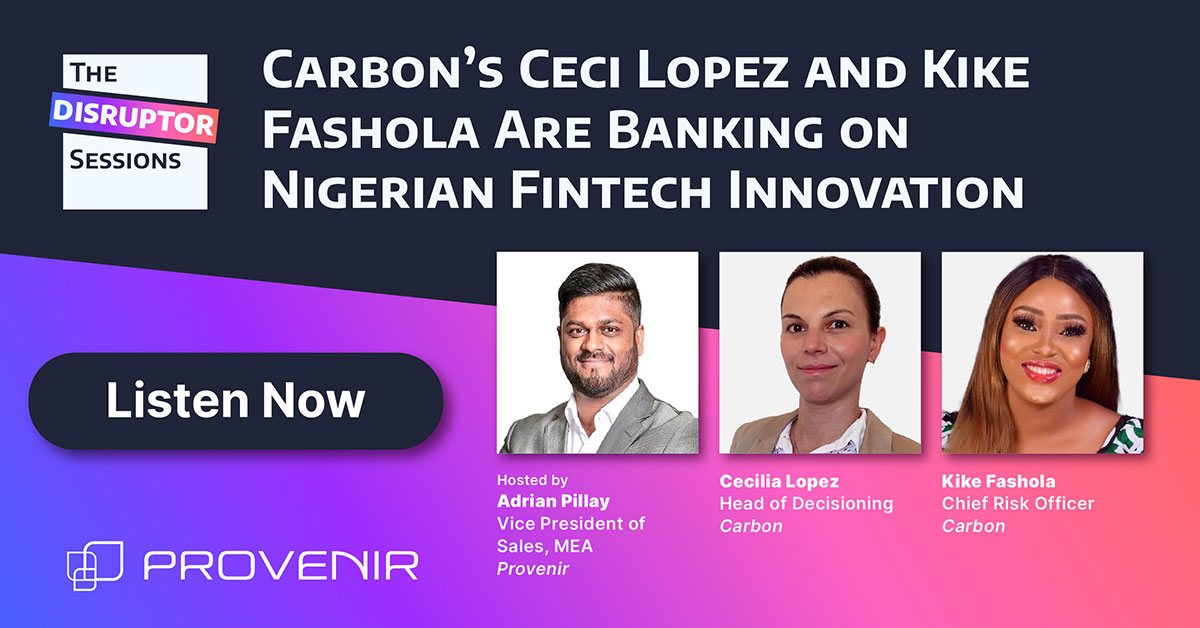
Carbon’s Ceci López and Kike Fashola Are Banking on Nigerian Fintech Innovation
These risk leaders are disrupting the status quo across Africa’s fintech landscape. In our first MEA-focused episode, host Adrian Pillay sits down with digital bank Carbon’s Ceci López (Head of Decisioning) and Kike Fashola (Chief Risk Officer) to take a look at the relationship between risk and reward and the future of fintech in Nigeria.
They dig into topics like using data science to support innovation, how to drive adoption of emerging tech in an emerging market, and some of the implications we may not always think of when we talk about AI in risk management.
Costin Mincovici
tbi Bank’s Costin Mincovici Wants to See More ‘Aha’ Moments in Digital Banking
Costin Mincovici, tbi Bank’s Chief Credit Officer, is a risk leader that likes to say yes. Yes to mobile-first financial services, yes to digital banking disruption, and yes to multi-country risk strategies that offer the accessible experiences that can make or break a provider.
He shares his insights with our EMEA host and Provenir’s regional leader, Frode Berg. They explore everything from the ethical implications of data usage, to market approaches that protect the interests of both the customer and bank, to the “aha” moments Costin hopes to see more of across fintech.
Aaron Webster
SoFi’s Aaron Webster Wants to Make It Easier to Divorce Your Bank
What’s SoFi’s secret to differentiation in a crowded fintech ecosystem? Where should we look to find the next big disruption for American financial services? North America host Kathy Stares sits down with SoFi’s Chief Risk Officer, Aaron Webster, to answer these questions and more in our very first episode of The Disruptor Sessions.
Though they used to be invisible, today they might be the future of the credit market. On this episode of The Disruptor Sessions, we’re exploring the new-to-credit (NTC) population. Though they used to be invisible, today they might be the future of the credit market.
North America host Kathy Stares (Provenir’s EVP, Americas) and TransUnion’s VP of International Research and Consulting, Nidhi Verma, discuss the immense opportunities in engaging this powerful group. Drawing from TU’s recent report on NTCs, they debunk the myths around risk, define the business case for financial inclusion, and develop a vision of what the future of financial inclusion could look like globally.
Kike is a graduate of Covenant University, where she majored in Industrial Mathematics.
Kike is a positive and proactive individual who is always looking for ways to improve. She is not afraid to challenge the status quo and is always looking for the silver lining.
Kike Fashola & Ceci López
Carbon’s Ceci López and Kike Fashola Are Banking on Nigerian Fintech Innovation
These risk leaders are disrupting the status quo across Africa’s fintech landscape. In our first MEA-focused episode, host Adrian Pillay sits down with digital bank Carbon’s Ceci López (Head of Decisioning) and Kike Fashola (Chief Risk Officer) to take a look at the relationship between risk and reward and the future of fintech in Nigeria.
They dig into topics like using data science to support innovation, how to drive adoption of emerging tech in an emerging market, and some of the implications we may not always think of when we talk about AI in risk management.
He has held various leadership roles at leading Credit Risk companies such as TransUnion, Dun & Bradstreet, Experian and FICO. He is Vice President of Sales at Provenir, and is responsible for its business in Middle East and Africa.
Costin Mincovici
tbi Bank’s Costin Mincovici Wants to See More ‘Aha’ Moments in Digital Banking
Costin Mincovici, tbi Bank’s Chief Credit Officer, is a risk leader that likes to say yes. Yes to mobile-first financial services, yes to digital banking disruption, and yes to multi-country risk strategies that offer the accessible experiences that can make or break a provider.
He shares his insights with our EMEA host and Provenir’s regional leader, Frode Berg. They explore everything from the ethical implications of data usage, to market approaches that protect the interests of both the customer and bank, to the “aha” moments Costin hopes to see more of across fintech.
Enabling Better Customer Experiences and Driving Smarter Revenue
Key Benefits
Credit Risk. Make more confident lending decisions and expand access to credit with alternative data and robust analytics only Equifax can deliver.
Identity, Fraud, and Compliance. Equifax Digital Solutions can help protect your business, your bottom line, and your customers at every stage of the lending journey.
Equifax – Powering the USA with Knowledge™
At Equifax (NYSE: EFX), we believe knowledge drives progress. As a data, analytics, and technology company, we play an essential role in the economy by helping financial institutions, companies, employers, and government agencies make critical decisions with greater confidence. Our unique blend of differentiated data, analytics, and cloud technology drives insights to power decisions to move people forward. For more information, visit Equifax.com.
What’s top of mind for financial services providers heading into 2024?
Provenir surveyed more than 300 decision makers from a variety of financial services providers and fintechs around the globe in order to understand their:
Risk decisioning challenges
Customer management priorities
Confidence in the accuracy and flexibility of their risk models and anti-fraud measures
Fintech helping to drive access to finance for Philippines’ MSMEs
MSMEs make up 99.58% of over a million businesses in the Philippines, half of which are in trades, according to data from its Department of Trade and Industry. In total, these entities generate 65.1% of total employment in the Philippines.
However, like many Asian markets, traditional financial institutions in the Philippines have long preferred wholesale lending over retail lending, leaving MSMEs’ funding needs underserved.
The Corporate Treasurer tapped industry experts, including Kim Minor, Senior Vice President of Global Marketing at Provenir, to share insights into the infrastructure and technology investments and collaboration needed to power the country’s digital transformation efforts.
This article was originally published on the Corporate Treasurer, Ryan Li, Author