Language: EN

provenir logo

Datasheet: Provenir for Banking

DATA SHEET

Provenir for Banking

Make risk decisions faster than the competition without sacrificing your risk strategy.
The way consumers interact with financial services products is changing, rapidly – consumers expect more instant decisions, personalized offers, and automated, digital experiences. With the rapid increase in financial services competition, banks need to think about upgrading their decisioning technology to become more agile, innovative, and flexible in order to win more business.

Are you struggling to stay ahead of the competition? Discover how to take your credit risk strategy to the next level with Provenir’s AI-Powered Data and Decisioning Platform. From the agile, business-user-friendly, low-code user interface to powerful automation and data integration technology, Provenir gives your team the tools it needs to get ahead, and stay ahead, of the competition.

Want more info on upgrading your decisioning?

Get in Touch

ADDITIONAL RESOURCES

provenir logo
Blog ::

When Were Credit Scores Invented

BLOG When were credit scores invented and how does credit ...
The Ultimate Guide to Credit Risk Analytics: Benefits and Pitfalls of Microservices
Blog ::

The Ultimate Guide to Credit Risk Ana...

Credit risk analytics assesses the probability of borrower default and ...
Webinar ::

The Decisioning Imperative for Open B...

ON-DEMAND WEBINAR The Decisioning Imperativefor Open Banking Book a Meeting ...
Provenir appoints Andrea Fassari as Country Manager in Italy
News ::

Provenir appoints Andrea Fassari as C...

NEWS Provenir appoints Andrea Fassarias Country Manager in Italy Sales ...
Provenir Garners Finalist Honors in the Banking Tech Awards USA 2023
News ::

Provenir Garners Finalist Honors in t...

NEWS Provenir Garners Finalist Honors in the Banking Tech Awards ...
Episode 1: SoFi’s Aaron Webster Wants to Make It Easier to Divorce Your Bank
Podcast ::

Episode 1: SoFi’s Aaron Webster Wants...

PODCAST Episode 1:SoFi’s Aaron Webster Wants to Make It Easier ...
AI Strategies to Mitigate Banking and FinTech Fraud
News ::

AI Strategies to Mitigate Banking and...

NEWS AI Strategies to Mitigate Banking and FinTech Fraud As ...
Provenir Recognized as Finalist for ‘Best Technology Provider’ in the 2023 Credit Awards
News ::

Provenir Recognized as Finalist for ‘...

NEWS Provenir Recognized as Finalistfor ‘Best Technology Provider’ in the ...

Continue reading

Canadian Lenders Association Risk Roundtable

ON-DEMAND WEBINAR

Canadian Lenders Association
Risk Roundtable

Book a Meeting

Featuring Cheryl Woodburn, Country Manager of Canada, Provenir

At the Canadian Lenders Association’s recent Risk Roundtable, Provenir’s Country Manager of Canada, Cheryl Woodburn, had the opportunity to discuss current challenges in growing your lending business, the ever-growing issue of fraud, and why accessing the right data is more important than ever.

Despite ongoing macroeconomic challenges putting significant stress on lenders, there are opportunities for growth in Canada. But to effectively take advantage of those growth opportunities, lenders need to look carefully at their data.

Watch now and hear from Cheryl on how data can improve your business agility, how to overcome common obstacles on leveraging data, and tips to more successfully action it.


RESOURCES

Continue reading

Digital Loan Origination in Banking: Competing with Challenger Banks

BLOG

Digital Loan Origination in Banking:
Competing with Challenger Banks

The financial industry has seen a dramatic shift in recent years with the rise of challenger banks. These digital-first establishments have emerged as serious competition to traditional banks, offering more personalized and innovative services that resonate with consumers. To compete with these new players, traditional banks must improve their digital capabilities and offer more streamlined services that provide customers with a better experience.

One area where banks can focus their efforts is digital loan origination. By automating this process and integrating it into their digital platforms, banks can provide customers with faster, more efficient loan processing. This is a crucial component in building a more competitive and innovative financial institution.

Digital loan origination allows banks to gather customer information and evaluate creditworthiness quickly and accurately. By leveraging data analytics and machine learning, banks can make better lending decisions while reducing the risk of defaults. This technology also makes it possible to offer more personalized loan products, which can increase customer satisfaction and loyalty.

Traditional banks can compete by improving their digital capabilities, and digital loan origination is a key area where they can focus their efforts. By automating loan processing and leveraging data analytics and machine learning, banks can make better lending decisions and provide customers with a better experience.

The End of the Level Playing Field

After the 2009 financial crisis, trust in traditional financial institutions took a hard hit with up to 80-90% of the public viewing them as untrustworthy, according to past studies. This led to an opportunity for challenger banks to enter the market with a clean slate and build their brand without the negative sentiment experienced by traditional banks.

Challenger banks also had a technological advantage over their established counterparts. Without the burden of legacy IT systems, challenger banks were able to adopt modern technology and offer digital services with greater efficiency and agility. As a result, challenger banks are quickly gaining ground, and the traditional banks are being forced to adapt or risk being left behind.

Challenger Banks: Reshaping the Future of Banking?

As the banking industry undergoes a transformation, many experts suggest that Challenger Banks will play a significant role in shaping the future of banking and money, despite the challenges that come with innovation. Unlike traditional banks, Challenger Banks tend to embrace a start-up mentality, leveraging a minimum viable product (MVP) approach to continually refine their product portfolio until they achieve the optimal balance.

While larger banks may struggle with operating in product silos and stretching their resources too thinly, Challenger Banks can prioritize quality and customer experience, giving them a competitive edge. But how can traditional banks compete with these innovative newcomers who are leveraging cutting-edge technology and a hyper-focus on innovative products and services?

Also, read: What is Banking as a Service?

Building Consumer Trust in Banking

Traditional financial institutions may have struggled with their reputations post financial crises, but a 2019 survey by Accenture showed extremely positive results for banks when it came to customer trust:

  • An average of 77.75% of consumers (across all persona groups) trust banks to care for their long-term financial wellbeing

Results were not so strong for non-traditional financial institutions:

  • Only 35.5% of consumers (across all persona groups) trust non-traditional institutions to care for their long-term financial wellbeing

So, while banks may be lagging behind when it comes to technology, they still outperform fintechs and challenger banks when it comes to consumer trust. Financial institutions trying to compete with their challenger competition should bank on the inherent trust that consumers still hold for brick and mortar institutions as a foundation to secure long-term loyalty with customers. Is this an obvious point to make?

Absolutely. But it’s how this trust can be used to build stronger bonds and expand product offerings that offers a huge opportunity for traditional financial institutions.

Dealing with Data: Customer Trust Expands Opportunities

In a time when data breaches are common, billions of records were stolen in 2018 alone, consumers are on high alert when it comes to sharing their information.

So perhaps one of the most fascinating results of Accenture’s study is that customer trust in traditional financial institutions extends to trusting banks to keep their data secure. 80% of consumers surveyed trusted their banks enough to share additional data to receive more relevant offers.

This gives banks an incredible opportunity to create truly personalized services using data gleaned directly from customers. But banks can go further, with many consumers sticking with the same financial institution for many years, banks have been gathering an immense amount of data on customers that can be used to personalize and pre-approve offers for individuals.

Wouldn’t it be nice if your customer’s felt like you truly understood their needs by offering the right products at the right times?

As a bank there’s a lot that can be learned from how challenger banks have approached disrupting the industry. Let’s consider a standard financial category that you may offer, and how the use of technology and data can improve that experience for your customers.

Mobile Loan Origination

Customers have an increasingly strong preference for the loan origination process to be mobile-friendly and fast.

  • Accenture found that on average 81% of consumers would share more information to get faster services and approvals

Challenger banks have greatly improved the loan origination process for consumers. They’ve removed the once long, paper-filled process and made approvals almost instant – all the while accepting nothing less than improved compliance and mitigated risk.

The smart pairing of data access and automation powers much of this process. And, while the idea of a loan being commenced and approved during an afternoon at work would be laughable 20-30 years ago, now it’s expected.

Offering this type of capability can seem daunting for both a startup with 25 employees and traditional banks, but launching a mobile or web app that can collect your customer’s application details, integrates with your systems and third-party data sources, decisions that loan, and provides an approval instantly is only a matter of starting with the right technology.

Building Data into Your Loan Origination Process: Using Data to Level the Playing Field

A common challenge banks face is being able to access, orchestrate, and use data. To get the most out of their historical data and gain access to new data, banks need to find a way to draw their data into one location as a foundation for decisioning and customer personalization.

Connecting disparate systems and data silos can provide banks with a huge advantage over their competitors as they’re able to gain much deeper insights into their customers and more easily assess associated risk. But legacy technology makes this almost impossible in many organizations.

To solve these issues, banks need to look for a solution that allows them to create a decisioning ecosystem. Technology that connects the dots between their CRM, historical data, new customer data, and their loan origination processes.

It’s only by using data to predict customer needs, pre-approve products, and personalize offerings that banks will compete with the challenger banks nipping at their heels. And, if banks can match this personalization across both physical and digital channels, banks could well disrupt the disrupters!

“Our entire approach is built on simplifying banking. One of the ways we do this is by making the customer experience fast and effortless; from the initial on-boarding process through to every subsequent interaction. The Provenir Platform gives us speed and flexibility in our lending operations, which enables a customer to apply for a loan at lunchtime, receive immediate approval, and have the money available in their account later that day.”

– CEO, Instabank

Deliver compliant, personalized digital banking experiences while keeping risk low with intelligent decisioning.

Digital Banking


LATEST BLOGS

Continue reading

Infographic: Discover the Secret to Consumer Lending Success

INFOGRAPHIC

Discover the Secret
to Consumer Lending Success

The consumer credit market reached a staggering $11 billion market size in 2022. As a consumer lender up against variable economic conditions, market shifts, and evolving technology, prioritizing growth often moves customer happiness and risk management to the back burner. 

How can you improve the customer experience for consumers while managing risk and growing your business? Read the infographic to discover how smarter risk decisioning is the secret to consumer lending success.

Uncover More Secrets to Consumer Lending Success:

Get the Guide

RESOURCE LIBRARY

provenir logo
Blog ::

When Were Credit Scores Invented

BLOG When were credit scores invented and how does credit ...
The Ultimate Guide to Credit Risk Analytics: Benefits and Pitfalls of Microservices
Blog ::

The Ultimate Guide to Credit Risk Ana...

Credit risk analytics assesses the probability of borrower default and ...
Webinar ::

The Decisioning Imperative for Open B...

ON-DEMAND WEBINAR The Decisioning Imperativefor Open Banking Book a Meeting ...
Provenir appoints Andrea Fassari as Country Manager in Italy
News ::

Provenir appoints Andrea Fassari as C...

NEWS Provenir appoints Andrea Fassarias Country Manager in Italy Sales ...
Provenir Garners Finalist Honors in the Banking Tech Awards USA 2023
News ::

Provenir Garners Finalist Honors in t...

NEWS Provenir Garners Finalist Honors in the Banking Tech Awards ...
Episode 1: SoFi’s Aaron Webster Wants to Make It Easier to Divorce Your Bank
Podcast ::

Episode 1: SoFi’s Aaron Webster Wants...

PODCAST Episode 1:SoFi’s Aaron Webster Wants to Make It Easier ...
AI Strategies to Mitigate Banking and FinTech Fraud
News ::

AI Strategies to Mitigate Banking and...

NEWS AI Strategies to Mitigate Banking and FinTech Fraud As ...
Provenir Recognized as Finalist for ‘Best Technology Provider’ in the 2023 Credit Awards
News ::

Provenir Recognized as Finalist for ‘...

NEWS Provenir Recognized as Finalistfor ‘Best Technology Provider’ in the ...

Continue reading

KYC Compliance and Merchant Onboarding

GUIDE

The Ultimate Guide to
KYC Compliance and Faster Merchant Onboarding

Why KYC Compliance is Crucial for Faster Merchant Onboarding

The merchant onboarding process sits at the crux of the payments segment, its efficacy the basis for or deterrent of growth for organizations in this soon-to-be $2-trillion industry. Rapidly evolving, the global payments industry faces challenges and opportunities brought on by regulatory changes, macroeconomic trends, and fintech’s foray into the payments business.

As payments organizations navigate the circumstances of the industry none are immune from the digital transformation that is sweeping financial services as a whole. Customers and merchants grow accustomed to speedier, more convenient service, turning payments providers to digital infrastructure improvements to gain advantages in speed and flexibility. Meanwhile, up and coming startups are bursting onto the scene with unprecedented agility.

“The transformation and disruption of the merchant services business is playing out right in front of our eyes – and in real time. I would characterize it as co-opetition on steroids right now as hardware, software, payments, processing services and new platforms all converge, consolidate and collide to reshape the merchant services supply chain in entirely new ways.”

– Karen Webster, President of PYMNTS.com

Merchant Onboarding: Key Topics

This guide to faster merchant onboarding explores foundational themes within merchant onboarding while offering the resources to dive deeper into topics of interest such as:

Winning at Merchant Acquisition

Merchant acquisition is plagued by the same age-old challenges around regulations, trends, and competition that reflect the payments industry at large. However, where the industry dynamic once danced between the competitive margins negotiated by large retailers and the compliance headaches brought on by smaller merchants, the spectrum has spread to include the burgeoning marketplace economy. This is a world where everyone is a merchant, rendering merchant onboarding volume and transactional volume simultaneously opportunistic and challenging. A segment of innovative payments firms is navigating the risk and compliance gap that the marketplace economy has introduced.

As the payments industry evolves to serve ever growing commercial channels, organizations strive to improve around two major advantages: speed and compliance.

Some of the biggest disruptors in the payments segment have excelled with five-minute onboarding times in the face of an industry that traditionally accepted a 3-5 day, even up to weeks-long, merchant onboarding process. Shrinking onboarding cycles that automate compliance coupled with advanced analytical capabilities are contributing to simpler-than-ever merchant experience as processors and facilitators are able to handle the astounding volume.
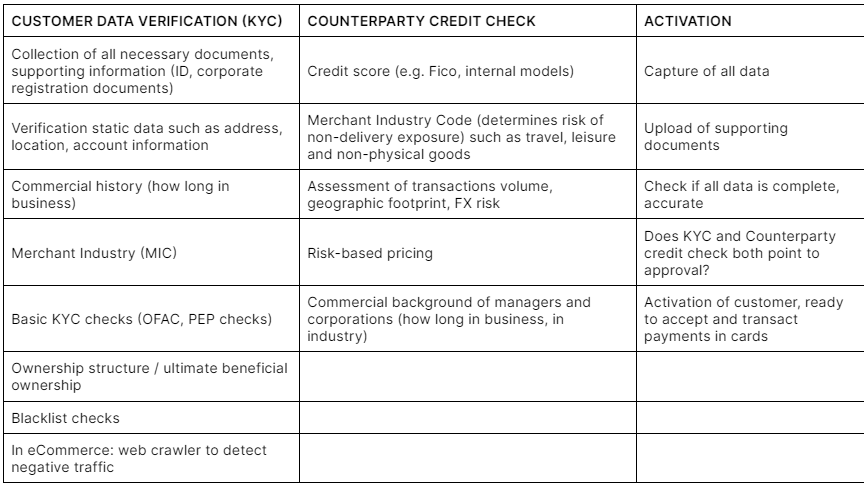
KYC Compliance

The nature of each transaction and associated risk will determine its responsibility with regard to various global KYC statutes. For example, payments facilitators face regulatory requirements on either side of the decoupled transaction. They are subject to regulations as they charge customers, and again when they disburse funds to merchants. In some scenarios, payments providers are assuming additional risk on behalf of merchants and so KYC processes are integrated into complex credit risk workflows. Intricacy only increases when companies are engaging in cross-border activity or operating in particularly regulated industries.

While the KYC/AML component of the merchant onboarding process used to be highly manual, today’s foremost payments firms are adopting advanced automation technologies to support:

  • The integration and standardization of structured and unstructured data in support of OFAC and PEP checks, blacklist checks, and other due diligence resources.
  • Business rules and process workflows that automate cross-border or regional specialization, intelligently applying appropriate rules to ensure compliance in every case.
  • Implementation of traditional and machine learning techniques in the creation and native operationalization of analytical models.

Transaction Monitoring AML

Like every corner of the payments universe, transaction monitoring and AML/CFT compliance are being propelled forward by technological progression. In fact, three movements have most significantly impacted AML/CFT monitoring:

  • Proliferation and accessibility of data.
  • Enhanced processing power that supports unprecedented speed and volume.
  • Widespread acceptance of advanced data analysis techniques.

Proliferation and Accessibility of Data

Historically, AML exposure data has been centralized to a select group of firms – packaged and commercialized for global use. However, around the time we gained the ‘Big Data’ buzzword, payments firms gained accessibility to a whole slew of untapped data. Pair the variety and volume of data that has become available with enhanced analytical capabilities, and compliance professionals now hold the reigns when it comes to powerful, data-centric AML/CFT insight.

In this era of automation, transaction monitoring strategies have to acknowledge the need for efficient data aggregation — the ability to analyze data is no longer enough. Web crawling technologies and copious APIs have opened up the world of data, and forward-thinking companies are capitalizing on its availability.

“Data! Data! Data! … I can’t make bricks with clay!

Sir Arthur Conan Doyle, Adventures of Sherlock Holmes

Enhanced Processing Power

In the meta-story, processing power has seen exponential uplift since the day we put an abacus in a museum. Let’s be precise: We have seen a 1-trillionfold increase in processing power over the course of 60 years.

In parallel to improved computing performance, we have also experienced a shift from primarily bare metal environments to cloud or hybrid infrastructures which introduce new opportunities.

Widespread Acceptance of Advanced Data Analysis Techniques

Machine learning is the future. Machine learning is here. It’s everywhere and for good reason. But, it’s not new. Machine learning in theory and application has a long history in academia and computer science. Now, it’s making its way into the mainstream of, well, everything – financial services notwithstanding.

Payments firms are familiar with machine learning techniques in transaction monitoring and data sciences are only becoming more predictive with time. Many firms are exploring ensemble models like Random Forest and Gradient Boosting to increase stability and accuracy in predictive analytics.

Merchant Onboarding Solutions

Provenir’s unified risk analytics and decisioning Platform can automatically gather data from multiple systems and bureaus, standardize and analyze it to drive a decision. With Provenir, you can complete KYC, AML and other compliance processes in minutes, offering clients quick onboarding while improving compliance at lower cost.

  • Easily configured adapters facilitate fast integration with internal and external systems and bureaus to automatically aggregate all of the data required.
  • Dynamic business rules ensure only the right data is aggregated, eliminating expensive, unnecessary calls to bureaus and third-party systems.
  • Automated standardization creates data uniformity across multiple data formats, countries and currencies.
  • Automated workflow identifies, verifies and validates the customer, performs checks and flags areas of potential risk.
  • Adapters extend the value of current compliance systems as you can easily use Provenir to aggregate, standardize and pass data to existing systems.
  • Business-friendly configuration tools let users quickly create, test, modify and deploy rules, processes, user interfaces and integrations to increase business-level control and agility.


Explore our resources (blogs, videos, case studies) to accelerate your innovation journey.

Resources

RESOURCE LIBRARY

provenir logo
Blog ::

When Were Credit Scores Invented

BLOG When were credit scores invented and how does credit ...
The Ultimate Guide to Credit Risk Analytics: Benefits and Pitfalls of Microservices
Blog ::

The Ultimate Guide to Credit Risk Ana...

Credit risk analytics assesses the probability of borrower default and ...
Webinar ::

The Decisioning Imperative for Open B...

ON-DEMAND WEBINAR The Decisioning Imperativefor Open Banking Book a Meeting ...
Provenir appoints Andrea Fassari as Country Manager in Italy
News ::

Provenir appoints Andrea Fassari as C...

NEWS Provenir appoints Andrea Fassarias Country Manager in Italy Sales ...
Provenir Garners Finalist Honors in the Banking Tech Awards USA 2023
News ::

Provenir Garners Finalist Honors in t...

NEWS Provenir Garners Finalist Honors in the Banking Tech Awards ...
Episode 1: SoFi’s Aaron Webster Wants to Make It Easier to Divorce Your Bank
Podcast ::

Episode 1: SoFi’s Aaron Webster Wants...

PODCAST Episode 1:SoFi’s Aaron Webster Wants to Make It Easier ...
AI Strategies to Mitigate Banking and FinTech Fraud
News ::

AI Strategies to Mitigate Banking and...

NEWS AI Strategies to Mitigate Banking and FinTech Fraud As ...
Provenir Recognized as Finalist for ‘Best Technology Provider’ in the 2023 Credit Awards
News ::

Provenir Recognized as Finalist for ‘...

NEWS Provenir Recognized as Finalistfor ‘Best Technology Provider’ in the ...

Continue reading

10 Fintechs Accelerating SME Lending

BLOG

10 Fintechs Accelerating SME Lending

Championing SME Survival and Growth

A new wave of fintechs and neobanks has been sweeping the world of SME Lending off its feet by embracing digital technology, data, and advanced analytics like machine learning and AI. And there’s never been a better time for it. The landscape has changed dramatically for SMEs, not necessarily for the better. The potential of a global recession has consistently lowered margins and hurt SME scaling and expansion efforts. According to a recent report by the World Economic Forum, nearly two-thirds of small to mid-sized businesses (SMBs) said survival and expansion are their primary challenge.

Unlike consumer payments, the B2B variety remain mired in legacy systems and manual practices. And unlike larger, established companies who have long and secure relations with their financial institutions, SMEs have a larger need of help in accessing working capital, which remains their critical pain point.

The result? As access to working capital from traditional lenders dries up, SMEs are increasingly looking to digital-first and alternative channels. A surprising 75% of SMEs report being more likely to use a digital-only bank as their primary provider of working capital. We revisit our list of SME lending innovators, as they go from trend setters to “the new digital normal” in SME financing.

  1. OakNorth – UK-based fintech OakNorth delivers instant credit analysis and real-time portfolio insights focused on transforming commercial lending. The co-founders of OakNorth were rejected for the credit needed to grow their business numerous times, prompting them to create their Credit Intelligence platform. Their goal was to build a robust, sustainable bank but also to create software that would enable other banks to lend to SMEs that were previously underserved.
  2. NeoGrowth – Founded in 2011, India-based NeoGrowth Credit is a tech-enabled business that offers unsecured loans to small retailers in India. Combining traditional and alternate data for more accurate credit scoring, NeoGrowth also offers dynamic repayment terms and automated collections processes to help identify the most creditworthy customers. Calling themselves pioneers in SME lending based on the underwriting of digital payments data, their mission is to help small business owners drive growth that matches their ambitions. Also read: What is credit underwriting?
  3. Kabbage – Selected for the 2019 Forbes FinTech 50 startups list, Kabbage (now owned by American Express) provides SMBs with credit by evaluating business-focused alternative data like accounting info, online sales and shipping. With this more nuanced view of data to better understand performance, Kabbage is able to offer flexible credit options in real time.
  4. Banco Pichincha – In 2016, Banco Pichincha received a credit line of $55 million from the International Finance Corporation (IFC) to finance loans to women-owned SMEs in an effort to fuel the growth of female Ecuadorian entrepreneurs. Ecuador’s largest bank, they doubled down on their mission in 2019 when they signed an alliance with the Overseas Private Investment Corporation (OPIC) and Wells Fargo for a combined loan of $108 million to support loans to MSMEs in the region that are owned, led by or support women.
  5. Allica Bank – Claiming that SMEs have often been left behind by the ‘big banks,’ Allica Bank combines modern technology with local relationships to ensure SMEs have the tools and the funding they need to operate. Based in the UK, Allica Bank offers SMEs asset financing, with up to £1 million worth of flexible financing options.
  6. Judo Bank – Australia’s only challenger bank built specifically for lending to SMEs, this innovative organization seeks to bring back the lost art of relationships in business banking. Created by experienced business banking professionals, they brand themselves as a ‘genuine alternative’ for SMEs who want quick access to not only funds, but the superior customer experience they deserve.
  7. First Circle – Based in the Philippines, First Circle’s mission is to enable SMEs to achieve their full potential through fast and flexible financial partnership. Their customers often have no credit data or fixed collateral and as a result are excluded from the traditional banking sector (and therefore often forced to work with predatory lenders). First Circle allows these SMEs to secure funding in as little as a day through an automated, digitized application process.
  8. Lulalend – Sixty percent of South African businesses find it difficult to access the capital necessary to grow their business, due to long wait times, painful paperwork requirements and the necessity of high collateral. Lulalend uses AI to score creditworthiness instantly, ensuring small business owners are able to receive funding within 24 hours of applying. To date, they’ve processed over 70,000 applications and secured funding for thousands of small businesses across South Africa.
  9. Siembro – Argentinian organization Siembro uses AI to power their in-house loan algorithm, providing them the ability to offer instant loan approvals for small businesses in the area of agricultural and machinery. With over 1.5 million small and medium farm businesses in the country who have limited access to credit (and limited cash flows), Siembro focuses on ensuring corn, wheat and soy farmers obtain the funding they need to survive.
  10. Iwoca – A start-up that began when its founders noticed that small businesses were getting shut out of access to much-needed credit, iwoca is now one of the fastest-growing business lenders in Europe. Working towards a goal of funding one million small businesses, iwoca wants to ensure that SMEs have more time to run and grow their business instead of being forced to fill out endless paperwork and wait for approvals. Recently, their B2B financing solution iwocaPay integrated with Quickbooks to help small businesses with their cash flow, increasing businesses’ customer base and revenue.

Faster Loan Approvals

By embracing the use of digital technology, data, and advanced analytics like machine learning and AI, these companies have been able to simplify, and in many cases completely transform application processes. They are able to automate credit decisioning to provide accurate, real-time approvals, allowing SMEs to gain access to funds quicker than ever before. By automating data collection, risk decisioning and pricing, lenders can automate approvals and ensure funding is in hand within a matter of only days – or even hours!

The capabilities these lenders are offering are not just a critical lifeline. Their products tend to be more flexible and more personalized to each SMEs unique needs, allowing them to go from mere survival, to full-blown adaptation to a changing, uncertain environment. That is the unique power of AI-fueled, data-led tech innovation.

Also, read: What is Banking as a Service (BaaS)?

Meet the lending demand of SMEs without slow and costly manual processing.

Learn More


LATEST BLOGS

Continue reading

Unlocking Africa’s Credit Potential

NEWS

Unlocking Africa’s Credit Potential

According to KPMG data, there was a record $1.6 billion in fintech investment in 2021. At the same time, consumer spending in Africa is $1.4 trillion yet a significant percentage of the population has poor or no access to financial services.

In this Africa Business article, Adrian Pillay, VP of Middle East & Africa at Provenir, shares his insights on Africa’s financial landscape and how lenders can use fintechs’ innovative solutions to serve individuals with little or no credit history while improving risk assessment and increasing access to credit.

He also outlines the importance of using of alternative data, automation and real-time risk analytics to quickly evaluate SMEs creditworthiness to eliminate lengthy delays in funding approval, which can be the difference between a business flourishing or floundering.

Read Now

The Ultimate Guide to Decision Engines

What is a decision engine and how does it help your business processes?

Learn More


LATEST NEWS

Continue reading

Infrastructure Talents are Some of the Challenges Finance Industry Faces in Adopting AI: Provenir

NEWS

Infrastructure Talents are Some of the Challenges Finance Industry Faces in Adopting AI: Provenir

Bharath Vellore, Provenir’s General Manager of APAC, recently spoke to e27 about the increasing number of case studies for AI in the financial industry such as fraud identification, credit scoring and risk management. He also outlined key considerations organizations should consider to implement AI successfully.

Read Now

The Ultimate Guide to Decision Engines

What is a decision engine and how does it help your business processes?

Learn More


LATEST NEWS

Continue reading

provenir logo

APACs Top Fintech Trends to Watch

BLOG

APAC’s Top Fintech Trends to Watch

Asia Pacific (APAC) is home to diverse markets with different levels of maturation. But whether the market is emerging or mature, fintech innovation is booming across the region. Fintechs had their strongest year yet in 2022, with a record-breaking $50.5 billion invested into the industry – this level of investment is propelling APAC’s continued growth even when other regions are seeing slowdowns.

So what are the ideas driving this growth? Where is disruption happening now and where can we expect to see it develop as technology progresses? Provenir’s Bharath Vellore shares his insights on APAC’s hottest trends to watch for Indonesia, Malaysia, Singapore, the Philippines, and Australia.

Indonesia: Buy Now, Pay Later (BNPL)

Despite the recent negative press around BNPL, there’s good news for the industry in Indonesia, where it grew by 70% to reach almost $4.5 billion in 2022. The outlook for medium to long-term growth remains very strong, with projected growth of 32.5% to reach an expected market size of $25 billion by 2028.

Why has BNPL had such success in Indonesia? It has helped the country to fill a significant lending gap. Nearly 65% of the population is unbanked and credit card penetration is in the low single digits – the need for financially inclusive credit is broad. And the ways BNPL is being used are broad as well. Similar to usage around the world, the payment option is now breaking up the lowest value grocery runs and other everyday transactions to expensive luxury retail purchases.

Some fintechs pushing forward Indonesian BNPL include:

Malaysia: Digital Banking

In 2022, Malaysia’s Central Bank awarded 5 digital banking licenses for the first time, with the intent to drive financial inclusion in the country. With digital banks now in play, consumers can access convenient and flexible financial products. A dynamic space to watch will be how these digital banking entrants will grow, given the position of the traditional lenders and banks that have been entrenched in the space for a significant period of time with large customer bases.

Provenir partner Credolab agrees, also pointing out the importance of fraud mitigation:

“A digital banking transformation is accelerating in Malaysia, amid stiff competition from other countries in the region. To manage the associated fraud risks, banks offering digital services will have to take appropriate measures and collaborate with best-of-breed Fintechs to help fight fraud.”

Steve Thurley, Managing Director – APAC, Credolab

We believe that the digital banks that find success will create a path to profitable growth by finding low cost customer acquisition models and delivering new products to market rapidly. The best way to do this is find customers through partnerships and networks, and develop financial products on a low-code/no-code platform that allows business users to be agile and responsive to market needs. The fintech difference? These products should be highly personalized and feature-rich to offer consumers elevated digital banking experiences they can’t get from traditional banks.

The financial groups launching banks are:

Singapore: Embedded Finance
Unlike Indonesia, Singapore has a very mature financial ecosystem. Banks are quite well entrenched in the economy and have even proactively adopted digital services, making room for digital banks, embedded finance, and hyper-personalized financial products. Adopting embedded finance helps organizations that aren’t traditionally financial service providers to provide financial products, reaching new market segments and simplifying the customer experience.

The biggest opportunities for innovation in embedded finance include instant payments, cross-border transactions, and micro lending. Embedded finance products for SMEs are also gaining traction, helping small businesses with accounting and managing ledgers, while providing working capital loans. Micro credit loans, such as retail financing for e-commerce, merchant loan offers based on sales volumes, and embedded payment options in apps are streamlining financial products into everyday processes and changing the way consumers are engaging with money.

These fintechs are embedding themselves as top embedded finance providers in Singapore:

The Philippines: SME Lending

Micro, small, and medium-sized businesses are the lifeblood of the Philippine economy. Almost 36% of the GDP is generated by the SME sector and 63% of workers in the country work at one. Despite the enormous presence in the country, SMEs remain largely underfinanced, which limits their – and the economy’s – ability to grow. Enter: fintechs.

As digital loans are becoming a more viable and attractive option, fintechs are extending credit to SMEs through online platforms that small business owners can access from anywhere in the country. As big data becomes more available, SME lenders are able to tap into that ecosystem to build alternative credit scoring models. There is not great coverage from the bureau point of view, as the majority of SMEs have thin files or no credit report at all, so the lack of financial data is a huge gap for traditional lenders who don’t have enough information to make accurate decisions. Big data is providing access to alternative data such as customer reviews, income flows, and more to make lending decisions – this area is primed for significant growth.

Companies driving SME lending innovation include:

Australia: Open Banking
Consumer Data Right (CDR) legislation was introduced in Australia in 2020. Phase one mandated the country’s four biggest banks to share access to consumer data; phase two did the same for small banks; last year’s phase extended to energy and utility companies; and next year’s final phase brings non-bank lenders under CDR. What happens when you’re combining datasets across banking, energy, and nonbanking? Consumers access lending products across the ecosystem and are able to take advantage of the best deals on financial products.

Provenir partner SEON highlights the importance of payment speed as well:

“Open banking allows innovation in multiple areas, including payments, credit checks, loan applications, and more. The most exciting is open banking payment initiation, which provides instant access to cash flow on a faster payment rail (funds sent and received in 2-10s) at a fraction of the cost of credit cards.”

Daniel Sebes, Strategic Director, SEON

Currently, Australia has 115 data holders of consumer data and 24 active data recipients who can receive consumer data. The number of data recipients will grow tremendously, catalyzing fintechs to build innovative financial products that push one another ahead through competition while empowering consumers to find the best products available. For this reason, CDR and open banking will be a very interesting space to keep an eye on.

Active data recipients in Australia include:

It’s clear that fintechs have disrupted almost every aspect of financial services across the APAC region. Many of these trends will continue to inspire new ways to disrupt the way we manage and access credit, whether it’s through new ways to pay for goods, the data that paints financial health, or how the small businesses driving economic growth stay afloat. Whether the trends have staying power or will evolve as technology and regulation develops, only time will tell. What we do know is we’ll be watching.

Looking for a technology partner to help you jump on one of these trends?

Learn how a unified credit risk decisioning and data platform can help you go to market faster.

Explore

Back to the Future: 8 Features of Fast and Future-Proof BNPL Technology

Get the eBook

LATEST BLOGS

No posts found.

Continue reading

“Don’t wait to be approached”: IWD Spotlight with Mei Ye

NEWS

“Don’t wait to be approached”:
IWD Spotlight with Mei Ye

Being told she wouldn’t be promoted because “senior positions are for men” incentivized Mei Ye, Head of Pre-Sales (APAC) at Provenir, to change careers. Mei shares her journey and perspective on the importance of mentors and mistakes.

Read Now

The Ultimate Guide to Decision Engines

What is a decision engine and how does it help your business processes?

Learn More


LATEST NEWS

Continue reading