Language: EN

maslow

Intelligent Response to the Changing Face of Fraud Johannesburg

ProvenirNEXT: Roundtable

Intelligent Response to the Changing Face of Fraud

29th May, 2025
8:00 am – 11:00 am
The Maslow Hotel, Sandton, Johannesburg

Fraudsters are evolving faster than ever, using AI-driven tools, synthetic identities, and social engineering to bypass traditional controls. As financial institutions and businesses across EMEA adapt to this growing threat, fraud prevention strategies must evolve beyond static rule-based models to embrace real-time decisioning, advanced analytics, and automation. This exclusive roundtable brings together industry leaders to explore how organisations can strengthen fraud defences, leverage AI-driven decisioning, and balance security with seamless customer experiences.

Key Discussion Points:

  • Inside the Fraudster’s Toolkit – A demonstration of AI-powered tools used by criminals to bypass ID&V controls, exposing the latest fraud techniques and their impact on financial institutions.
  • Building a Robust Defence Against Application Fraud – Best practices and cutting-edge technologies for real-time fraud detection and prevention, including how financial institutions can harness data, analytics, and automation to stay ahead of emerging threats.
  • Optimising Customer Experience – How streamlining real-time decisions and leveraging intelligent data orchestration can reduce fraud risk while improving onboarding and customer retention.
Format:
  • 8:00 am – Keynote from Frédéric Dubout – Fraud Specialist, Provenir

  • 8:30 am – Roundtable discussion and breakfast
  • 11:00 am – Official close and summary

Register your interest here

Frédéric Dubout

Frédéric Dubout

Frédéric is an experienced Risk and Fraud Prevention Specialist with 25 years of expertise across diverse roles and industries. His career spans both client-side and solution-provider perspectives, beginning with hands-on operational positions and progressing to strategic and governance-level responsibilities. This journey has allowed him to develop both a deep and broad understanding of risk and fraud management across various sectors, including telecommunications, e-commerce, banking and finance. His expertise includes fraud prevention, telecommunications, and credit risk management.
The Provenir Thought Leadership Roundtable Series brings together industry visionaries, C-level executives, and thought leaders for insightful discussions on redefining risk decisioning strategies. The series fosters a collaborative environment for sharing forward-thinking perspectives, exploring innovative approaches, and shaping the future of fraud prevention in an era of rapid technological evolution and increasing digital risk.

LATEST WEBINARS

No posts found.

Continue reading

Charlotte Street Hotel, London

Intelligent Response to the Changing Face of Fraud

ProvenirNEXT: Roundtable

Intelligent Response to the Changing Face of Fraud

Wednesday 14th May, 2025
11:45 am – 3:00 pm
Charlotte Street Hotel, London

Fraudsters are evolving faster than ever, using AI-driven tools, synthetic identities, and social engineering to bypass traditional controls. As financial institutions and businesses across EMEA adapt to this growing threat, fraud prevention strategies must evolve beyond static rule-based models to embrace real-time decisioning, advanced analytics, and automation. This exclusive roundtable brings together industry leaders to explore how organisations can strengthen fraud defences, leverage AI-driven decisioning, and balance security with seamless customer experiences.

Key Discussion Points:

  • Inside the Fraudster’s Toolkit – A demonstration of AI-powered tools used by criminals to bypass ID&V controls, exposing the latest fraud techniques and their impact on financial institutions.
  • Building a Robust Defence Against Application Fraud – Best practices and cutting-edge technologies for real-time fraud detection and prevention, including how financial institutions can harness data, analytics, and automation to stay ahead of emerging threats.
  • Optimising Customer Experience – How streamlining real-time decisions and leveraging intelligent data orchestration can reduce fraud risk while improving onboarding and customer retention.
Format:
  • 11:45 am – Arrival and welcome drink

  • 12:00 pm – Live ‘fraudster in action demo’ from Jason Abbott – Fraud Specialist, Provenir
  • 12:30 pm – Roundtable discussion and three-course lunch
  • 3:00 pm – Official close and summary

Register your interest here

Jason Abbott

Jason Abbott

Fraud Specialist, Provenir

Jason Abbott is a fraud prevention specialist with extensive experience in AI-driven risk decisioning, fraud analytics, and financial crime strategy. With a background in working with financial institutions to combat application fraud, identity theft, and digital fraud trends, Jason provides practical insights and strategic frameworks to help organisations mitigate fraud while maintaining a seamless customer experience.
The Provenir Thought Leadership Roundtable Series brings together industry visionaries, C-level executives, and thought leaders for insightful discussions on redefining risk decisioning strategies. The series fosters a collaborative environment for sharing forward-thinking perspectives, exploring innovative approaches, and shaping the future of fraud prevention in an era of rapid technological evolution and increasing digital risk.

LATEST WEBINARS

No posts found.

Continue reading

The State of AI, Risk, and Fraud in Financial Services

The State of AI, Risk, and Fraud in Financial Services

2025: A Year of Transformation in Risk Decisioning

The financial services industry is facing an inflection point. In 2025 (and beyond), staying ahead isn’t just about managing credit risk and preventing fraud – it’s about leveraging AI, unifying data, and modernizing decisioning systems to unlock new growth opportunities.

To better understand the challenges and priorities shaping the industry worldwide, we surveyed nearly 200 key decision-makers among financial services providers globally. The results highlight a pressing need for AI-driven insights, better data orchestration, and an end to fragmented decisioning strategies. This blog breaks down the key takeaways from the survey results and what they mean for the future of decisioning and your business.

Credit Risk and Fraud Prevention:
The Industry’s Top Concerns

The ability to manage credit risk and prevent fraud effectively remains a top priority, especially in an increasingly complex, digital economy. Forty-nine percent of our respondents identified managing credit risk as their biggest issue, and 48% cited detecting and preventing fraud as a primary concern, a noticeable increase from last year’s survey (43%).

While these issues aren’t new, their growing intensity underscores the fact that traditional approaches to risk decisioning just aren’t sufficient any more. Financial services providers are facing more sophisticated fraud threats, rising economic uncertainty, and increasing regulatory scrutiny – making real-time, AI-driven decisioning more critical than ever.

The escalation of fraud in particular is not shocking. While the industry leverages AI and automation for smarter decisioning, fraudsters are also utilizing advanced tech for more complex schemes, creating a never-ending loop. Identity fraud, deepfake technology, synthetic identities, and account takeovers are evolving – quickly. But at the same time, demanding consumers are pushing for seamless digital experiences, with instant approvals and frictionless onboarding becoming the bare minimum. This sort of demand creates a delicate balancing act – how do you ensure the proper security without adding unnecessary friction to the customer journey?

Providers relying on rule-based fraud detection alone will struggle to keep up. Fraud patterns shift in real-time, and static rules can’t adapt quickly enough. This showcases the urgent need for AI-powered fraud prevention solutions that can analyze behavioral data, detect anomalies, and predict fraud with greater accuracy. And AI-powered fraud detection doesn’t just stop fraud – it can also help reduce false positives, ensuring that legitimate customers aren’t caught in security roadblocks.

On the other side of the coin, managing credit risk has always been central to financial services providers. But economic volatility, including rising interest rates, inflation concerns, and shifting regulatory policies, means lenders must be more accurate than ever when assessing creditworthiness. Traditional credit scoring models often fail to provide a complete picture of a borrower’s risk profile, and without real-time insights, you may be missing out on prime opportunities for upsell/cross-sell and other revenue gains across the customer lifecycle. Not to mention the very real, very present risk of delinquencies and credit losses.

Over 30% of respondents in our survey cited limited data access as a challenge in risk
decisioning. Without access to real-time financial data, alternative credit signals, and behavioral analytics, making inaccurate credit decisions could either expose you to bad debt or cause you to reject creditworthy customers. Or both.

The Need for a Holistic Approach:
Moving Beyond Reactive Risk Management

To effectively combat fraud and manage credit risk, a reactive approach is no longer enough. Instead, you need to embrace a proactive, AI-driven strategy that integrates risk decisioning across the entire customer lifecycle. A successful approach includes:
  • Real-time AI-powered decisioning:

    Instead of relying on static models, consider AI-driven models that continuously learn and adapt to new fraud patterns and credit risks.
  • Integrated fraud and credit risk teams:

    Fraud and credit risk are often managed in separate silos, leading to inefficiencies and missed insights. A unified decisioning approach enables better risk assessment, faster response times, and enhanced customer experiences.
  • Expanding data access and alternative data integration:

    The ability to incorporate real-time transactional data, open banking insights, and behavioral analytics is critical for both fraud prevention and credit risk assessment.
  • Real-time AI-powered decisioning:

    Instead of relying on static models, consider AI-driven models that continuously learn and adapt to new fraud patterns and credit risks.
  • Integrated fraud and credit risk teams:

    Fraud and credit risk are often managed in separate silos, leading to inefficiencies and missed insights. A unified decisioning approach enables better risk assessment, faster response times, and enhanced customer experiences.
  • Expanding data access and alternative data integration:

    The ability to incorporate real-time transactional data, open banking insights, and behavioral analytics is critical for both fraud prevention and credit risk assessment.

The Urgent Need for AI:
Investment Priorities in 2025 and Beyond

Our survey found that 63% of financial services providers plan to invest in AI/embedded intelligence for risk decisioning, making it the top investment priority for 2025. Other key areas include:
  • 52%
    Risk decisioning solutions
  • 42%
    New data sources and orchestration
  • 33%
    Integrated fraud and decisioning solutions

The growing emphasis on AI decisioning reflects a shift from reactive risk management to proactive, real-time decisioning. Financial services providers recognize that AI can enhance credit risk assessments, strengthen fraud detection, and improve operational efficiency—but only if it’s powered by high-quality, integrated data.

While AI adoption is accelerating, poor data integration remains a significant barrier. Without seamless data orchestration, AI models risk being ineffective, leading to missed opportunities and inaccurate decisioning. If you’re investing in AI, you must prioritize data quality and accessibility to ensure these solutions deliver measurable impact.

In 2025, success in AI-driven risk decisioning (and maximizing ROI in AI investments) will depend on not just adopting AI, but implementing it with the right data strategy — one that fuels better insights, faster decisions, and a more seamless customer experience.

The AI Hurdles:
Why Adoption Isn’t as Simple as It Sounds

AI investment may be surging, but nearly 60% of financial services providers still struggle with deploying and maintaining AI risk models. The biggest roadblocks include:
  • 52%
    Data quality and availability
  • 48%
    Initial costs and unclear ROI
  • 47%
    Integration challenges
  • 42%
    Infrastructure requirements
  • 40%
    Regulatory compliance concerns

Implementing AI requires a solid foundation of clean, integrated data, robust infrastructure, and clear governance. The significant data challenge highlights the need for the seamless orchestration of new and alternative data sources (which can be easily integrated into decisioning) to truly unlock AI’s full potential.

One way to ensure success is to start small and scale smartly. To mitigate risk and ensure measurable impact, consider starting with AI projects that offer quick ROI (credit scoring, automated customer decisioning) or may be slightly less regulated (fraud detection). Try a phased approach, focused on early wins, continuous optimization, and scalable infrastructure, in order to build confidence in AI-driven strategies while demonstrating tangible business value.

Breaking Down Silos:
The Shift Towards Unified Decisioning

Disjointed decisioning systems are a major roadblock to efficiency. More than half (59%) of our respondents cited a lack of seamless data flow and unified insights as their biggest challenge. Other key issues include:
  • 52%
    Operational inefficiencies
  • 40%
    Added costs
  • 35%
    Disparate, siloed technology

Slower risk assessments, challenging fraud detection and inconsistent customer experiences are other outcomes from operational inefficiencies – when risk, fraud, and credit teams operate in silos, financial institutions miss out on better collaboration, faster approvals, more accurate risk mitigation, and growth opportunities.

But by consolidating risk decisioning into a single, end-to-end platform, you can:

  • Improve cross-team collaboration between fraud, credit risk, and compliance teams
  • Enable real-time, AI decisioning for faster and more accurate risk assessments
  • Enhance the customer experience by reducing friction and improving approval times
  • Maximize value across the customer lifecycle
  • Optimize growth for long-term success

Real-Time Decisioning and Personalization:
The New Frontier

Instant, frictionless experiences – this is what today’s consumers expect, whether applying for credit, disputing a charge, or managing their accounts. And providers are taking note, with 65% prioritizing real-time, event-driven decisioning as a key focus area. Other top priorities include:
  • 44%
    Eliminating friction across the customer lifecycle
  • 44%
    Increasing customer lifetime value
  • 36%
    Hyper-personalization

Traditional, batch-based decisioning models aren’t enough in an era where customer expectations are shaped by instant approvals and personalized digital interactions. AI-driven decisioning can improve risk assessments, but also enables proactive engagement and tailored offers that drive loyalty and maximize customer value.

To meet evolving consumer demands, adopt real-time, AI-powered decisioning models that ensure a more customer-centric approach, and which can:

  • Adapt dynamically to customer behavior in real time
  • Eliminate unnecessary friction while maintaining strong risk controls
  • Leverage hyper-personalization to increase engagement and lifetime value
Being able to deliver smarter, faster, and more customer-centric experiences with AI and real-time data and insights allows you to strike the right balance between effective risk mitigation and growth and customer retention.

A Call to Action for Financial Institutions

A more modern approach to risk management and fraud prevention is key. With fraud becoming more sophisticated, credit risk remaining a top concern, and AI adoption accelerating, financial services providers must rethink how they assess risk, optimize decisioning, and enhance customer experiences. To stay competitive and resilient in 2025 and beyond, focus on three key areas:
  • Invest in unified decisioning platforms

    to eliminate silos, reduce inefficiencies, and improve risk assessment accuracy
  • Leverage AI strategically

    by focusing on solutions that offer clear ROI and operational impact
  • Prioritize data integration and quality,

    ensuring seamless orchestration of diverse data sources to power more intelligent decisioning

The future of risk decisioning isn’t about isolated fixes—it’s about a holistic, AI-powered approach that aligns data, automation, and decisioning processes to maximize impact. Those that embrace this transformation will be better positioned to mitigate risks, drive growth, and deliver superior customer experiences.

Check out the full survey report for detailed responses.

Ready to shape the future of your decisioning with AI?

Contact Us

LATEST BLOGS

15 Companies Setting the Trends in Buy Now, Pay Later

15 Companies Setting...

The Buy Now, Pay Later (BNPL) industry has rapidly

The Essential Guide to Credit Underwriting

The Essential Guide ...

BLOG The Essential Guideto Credit Underwriting What is Credit

The Reinvention of Banking

The Reinvention of B...

In an ever-changing financial landscape, banks must prioritize resiliency
Top Three Mortgage Lending Trends: How to Make Smarter Credit Decisions Today to Thrive Tomorrow

Top Three Mortgage L...

The mortgage lending market is evolving rapidly, driven by

The Lending Revolution: Building World-Class Digital Lending Experiences in Southeast Asia

The Lending Revoluti...

Digital lending is transforming financial inclusion in Asia’s emerging
Shaking Up Consumer Lending in the UK

Shaking Up Consumer ...

As consumer lending becomes more accessible and efficient due
5 Ways Credit Risk Analytics Can Help Your Business Make Better Decisions

5 Ways Credit Risk A...

Credit risk analytics is a powerful tool for businesses

Unlocking the Power of Credit Cards: Three Innovative Trends Driving Change in the Industry

Unlocking the Power ...

BLOG Unlocking the Power of Credit Cards:Three Innovative Trends

Continue reading

europe mortgages

Top Mortgage Lending Trends in the UK and Europe

Top Mortgage Lending Trends in the UK and Europe: Smarter Decisioning for a Changing Market

Navigating evolving market conditions, affordability challenges, and AI-driven risk management

The UK mortgage market is poised for a notable rebound in the coming year, with mortgage lending growth projected to double compared to 2023, according to EY. While this signals renewed optimism, lenders are still navigating complex challenges — rising interest rates, affordability constraints, evolving regulatory pressures, and shifting borrower expectations.

Across Europe, mortgage markets are experiencing varying levels of volatility. Some countries, like Germany and the Netherlands, are facing demand fluctuations due to interest rate adjustments, while others, such as France and Spain, are seeing pockets of resilience amid broader economic uncertainty.

So, how can lenders capitalize on growth while managing risk? By embracing advanced credit and fraud risk decisioning, leveraging alternative data, and integrating AI-driven automation, mortgage providers can ensure they remain competitive in a rapidly changing landscape. Here’s what you need to know.

1. Mortgage Market Rebound: Will Growth Be Sustainable?

After recent turbulence, the UK mortgage market is showing early signs of recovery. The latest data from EY forecasts that net mortgage lending will grow from £11bn in 2023 to £22bn — a significant shift fueled by economic stabilization and a potential slowdown in interest rate hikes. However, growth comes with some challenges:

  • Interest rates remain high compared to pre-pandemic levels, affecting affordability.
  • Consumer confidence is still fragile, with borrowers cautious about long-term financial commitments.
  • Regulatory scrutiny is increasing, with the Financial Conduct Authority (FCA) pushing for fair lending practices and enhanced risk oversight.
Across Europe, trends vary widely:
  • Germany is experiencing weaker housing demand due to tightening credit conditions.
  • France is navigating a slowdown in new mortgage approvals amid regulatory adjustments.
  • Spain and Portugal are seeing a rise in international buyers, stabilizing demand despite domestic affordability challenges.
What do you need to do? To thrive in this landscape, mortgage providers must improve risk assessment capabilities and adopt more dynamic credit and fraud risk decisioning frameworks that can adjust to market shifts in real time.
2. The Affordability Dilemma: Why Traditional Credit Scoring Isn’t Enough
Affordability remains one of the biggest challenges in the UK mortgage market. While lending volumes are set to increase, many borrowers are still struggling with:
  • High living costs and wage stagnation, which impact disposable income.
  • Stringent mortgage stress tests, making it harder for first-time buyers to qualify.
  • Variable rate mortgages, which are exposing homeowners to fluctuating monthly payments.
Traditional credit scoring models (which are heavily reliant on credit history and debt-to-income ratios) often fail to provide a full picture of a borrower’s financial health. That’s why leading lenders are increasingly turning to alternative data like the following to refine their risk assessments:
  • Open banking data: Real-time income and spending patterns can help assess affordability more accurately.
  • Rental payment history: Demonstrates financial discipline, especially for first-time buyers.
  • Utility and telecom payments: Provides additional insights into payment behaviors and financial stability.

By integrating AI-powered risk decisioning, you can analyze alternative data at scale, leading to more inclusive lending decisions and better default risk prediction.

What do you need to do? Move beyond traditional credit scores by adopting AI-driven analytics and alternative data sources to expand lending opportunities without increasing risk.

3. AI and Automation: The Future of Mortgage Decisioning

With mortgage competition increasing and regulatory expectations rising, you can no longer afford slow, manual credit decisioning processes. AI and automation are becoming essential tools for enhancing speed, accuracy, and compliance.

AI is transforming mortgage lending with:

  • Instant Decisioning – AI models process vast amounts of data in real time, reducing approval times from weeks to minutes.
  • Advanced Fraud Detection – AI-powered anomaly detection helps identify fraudulent applications before loans are approved.
  • Improved Regulatory Compliance – AI ensures fair lending practices by providing explainable decisioning frameworks and reducing bias.

But what’s the competitive advantage to AI Decisioning?

  • Higher Approval Rates: More borrowers qualify for mortgages through personalized risk assessment.
  • Reduced Risk Exposure: Predictive analytics detect high-risk applicants before issues arise.
  • Operational Efficiency: Automating credit checks and underwriting reduces costs and processing times.
What do you need to do? Future-proof your mortgage operations by implementing AI-driven decisioning platforms that enhance efficiency while maintaining compliance with FCA and EU regulatory guidelines.
Building a Smarter Mortgage Lending Strategy

With UK mortgage lending growth set to double and European markets shifting, mortgage providers must evolve their decisioning strategies to remain competitive.

By embracing AI, alternative data, and automated decisioning, you can:

  • Expand access to credit while minimizing default risk.
  • Deliver faster, more seamless customer experiences.
  • Ensure compliance with evolving regulatory standards.

As the mortgage landscape continues to change, the lenders that invest in innovation today will be the market leaders of tomorrow.

Ready to future-proof your mortgage lending strategy? Discover how AI-driven decisioning can help you boost approvals, manage risk, and streamline compliance.

Shape the future of your mortgage strategy with AI.

Learn More

LATEST BLOGS

15 Companies Setting the Trends in Buy Now, Pay Later

15 Companies Setting...

The Buy Now, Pay Later (BNPL) industry has rapidly
The Essential Guide to Credit Underwriting

The Essential Guide ...

BLOG The Essential Guideto Credit Underwriting What is Credit
The Reinvention of Banking

The Reinvention of B...

In an ever-changing financial landscape, banks must prioritize resiliency
Top Three Mortgage Lending Trends: How to Make Smarter Credit Decisions Today to Thrive Tomorrow

Top Three Mortgage L...

The mortgage lending market is evolving rapidly, driven by
The Lending Revolution: Building World-Class Digital Lending Experiences in Southeast Asia

The Lending Revoluti...

Digital lending is transforming financial inclusion in Asia’s emerging
Shaking Up Consumer Lending in the UK

Shaking Up Consumer ...

As consumer lending becomes more accessible and efficient due
5 Ways Credit Risk Analytics Can Help Your Business Make Better Decisions

5 Ways Credit Risk A...

Credit risk analytics is a powerful tool for businesses
Unlocking the Power of Credit Cards: Three Innovative Trends Driving Change in the Industry

Unlocking the Power ...

BLOG Unlocking the Power of Credit Cards:Three Innovative Trends

Continue reading

provenir sponsored event

NEWS: AI Risk Decisioning Leader Provenir to Sponsor Financial Services Events

AI Risk Decisioning Leader Provenir to Sponsor Upcoming Banking and Financial Services Events

Parsippany, NJ – February 19, 2025 – Provenir, a global leader in AI risk decisioning software, today announced its participation and sponsorship of three upcoming banking and fintech events focusing on key topics, including digital banking, banking trends, and policy and regulatory issues.

The events provide Provenir an opportunity to meet with financial services leaders to better understand the challenges they face amidst rising consumer debt, evolving digital banking platforms, and fraud mitigation. According to a recent survey by Provenir, nearly half of all financial services executives are struggling with managing credit risk and detecting and preventing fraud.

Details of the events include:

future digital finance connectFuture Digital Finance Connect 2025

Future Digital Finance Connect 2025
(Feb. 24-25, New Orleans)
The inaugural Future Digital Finance Connect is an exclusive, invitation-only gathering for senior digital and innovation leaders from top big banks, community banks, credit unions, credit cards and insurers. Provenir is a sponsor.

fintech meetupFintech Meetup

Fintech Meetup
(March 10-13, Las Vegas)
Fintech Meetup is the largest and most productive event for networking in the industry, bringing together fintech leaders to network, collaborate, and discuss industry issues. Provenir is a bronze sponsor and will be located at stand #2326.

cba liveCBA Live 2025

CBA Live 2025
(March 17-19, Orlando)
At CBA LIVE, retail banking professionals come to explore regulatory and policy issues, learn new trends, and share ideas that will improve their business strategies and better serve their customers. Provenir is a silver sponsor.

Provenir’s AI Decisioning Platform brings together the power of decisioning, data, and decision intelligence to drive smarter decisions. This unique offering gives organizations the ability to power decisioning innovation across the full customer lifecycle, driving improvements in the customer experience, best-in-class fraud prevention, access to financial services, business agility, and more.
LATEST NEWS

Continue reading

charter logo

Customer Story: Charter

charter logo

Charter Communications is a leading broadband connectivity company and cable operator, headquartered in Stamford, Connecticut. With an annual revenue of $55 billion, Charter provides high-speed internet, video, mobile, and voice services to millions of customers across 41 U.S. states.

As a trusted provider, Charter serves 57 million homes and connects 500 million IP devices to its robust network. The company also powers businesses with 300,000 fiber-lit commercial office buildings, ensuring seamless connectivity and innovation. Recognized for excellence, Charter has been ranked #1 in customer satisfaction by JD Power within its peer group, reflecting its commitment to delivering high-quality service and superior customer experience.

  • Industry
  • Region
  • Countries

    United States

  • Line of Business
  • Solution
  • Module
  • Infrastructure
  • ROI
  • Competition

Customer Timeline
Land MRR: $62K
Land PS: $462K
Expand MRR: $100K
Expand PS: $250K
  • Opportunity Created
    June 28, 2024
  • Opportunity Won
    January 21, 2025
  • Go-Live
    Estimated July 2025
  • Customer Expansion
    • Collections/Delinquency Mitigation
    • Portfolio Management (upsell/cross sell)
    • TRMA Sponsorship
    • Case Study
Initial Opportunity Details

  • Customer Challenge

    • Charter has seen application fraud rates spike significantly over the past three years.
    • Antiquated systems prevented Charter from effectively mitigating application fraud
    • Experian FraudNet Solution cost over $1M a year to support and was ineffective.
    • New senior executive team hired to rebuild Charter fraud onboarding infrastructure
    • Charter Data Science team was handcuffed by poor analytics, testing capabilities, and decentralized workflow tools.
  • Provenir Approach

    Profiling Engine

    Aggregation of specific values over a time period.

    • “Grouping of Activity” / “Buckets of Behavior”
    Examples:
    • IP Address 168.192.1.1 has been on 10 transactions over the past 6 hours
    • Location 123 has had a median order amount of $5,222 over the past 180 days
    Python Model Deployment

    Provenir provides the Charter Data Science team a platform to deploy, execute, test, monitor models they build to detect Fraud and Risk.

  • Provenir Impact

    • Reduced customer friction and losses, while optimizing operations through a stable, reliable, and scalable platform to support analytics and reporting needs.
    • Fraud and credit abuse controls prior to order submission will enable more accurate real-time decisioning.
    • $1M immediate annual cost reduction with the elimination of the Experian FraudNet tool.
    • The platform will enable risk assessment functionalities like testing rule performance and fraud decisioning through advanced ML models
    • Centralized Rule and Model Governance
  • Competitors

    Experian (incumbent), FICO, DataVisor, Socure, Visa (risk product) and Pega
  • Why We Won

    • Provenir Solution: Provenir Profiling Engine provided the most compelling/complete solution for Charter
    • Our Team: Fraud Expertise + Implementation Certainty
    • Decision Intelligence and Advanced AI/ML
      Centralized Rules and Model Governance
  • Pain Points

    • Decentralized fraud controls
    • Poor Analytics and Reporting
    • Infrastructure Downtime
    • Inability to leverage AI and Advanced Learning models
Customer Growth

Growth Opportunities

Organic Volume Growth – Charter’s expecting significant geographic expansion over next 3-5 years.

Expansion

  • Portfolio Management/Account Management
  • Collections – Charter has seen a rise in delinquencies and customer churn
Example Decisioning Flows
  • New Application

    Decisioning

    Orders received for two channels:

    1.Ship to Home
    or
    2.In Store

  • Internal/external Data Calls

    Decisioning

    Data Vendors

    • Ekata
    • SentiLink
    • Datafiniti
    • Nuance
    • RevSprings
    • UPS/FedEx
    • Citrix
    • Authentic ID
  • Real-Time Fraud Checks

    Decisioning

    Rules and Lookups

    • Negative List
    • Velocity Checks
    • Email, Billing, Device, Attempts, etc.
    • Feature Aggregation
    • Blacklist
    • Valid/Deceased SSN
    • Fraud Prevention Scenarios
    • SMB Orders
    • Positive Lists
  • Scoring and Risk Models

    Decisioning

    Analytical Models

    • Models built by Charter Data Scientists in KC
    • Champion / Challenge
    • Ongoing Feature Engineering
  • Manual Review Exceptions

    Decisioning

    Alert Review

    • Red / Yellow / Green Risk Assignment
    • Fraud, Credit, Sanctions, Affordability Analyst and Underwriter Reviews
OTHER CUSTOMER STORIES

No posts found.

Continue reading

fraud for telco data sheet

DATA SHEET: Fraud for Telco

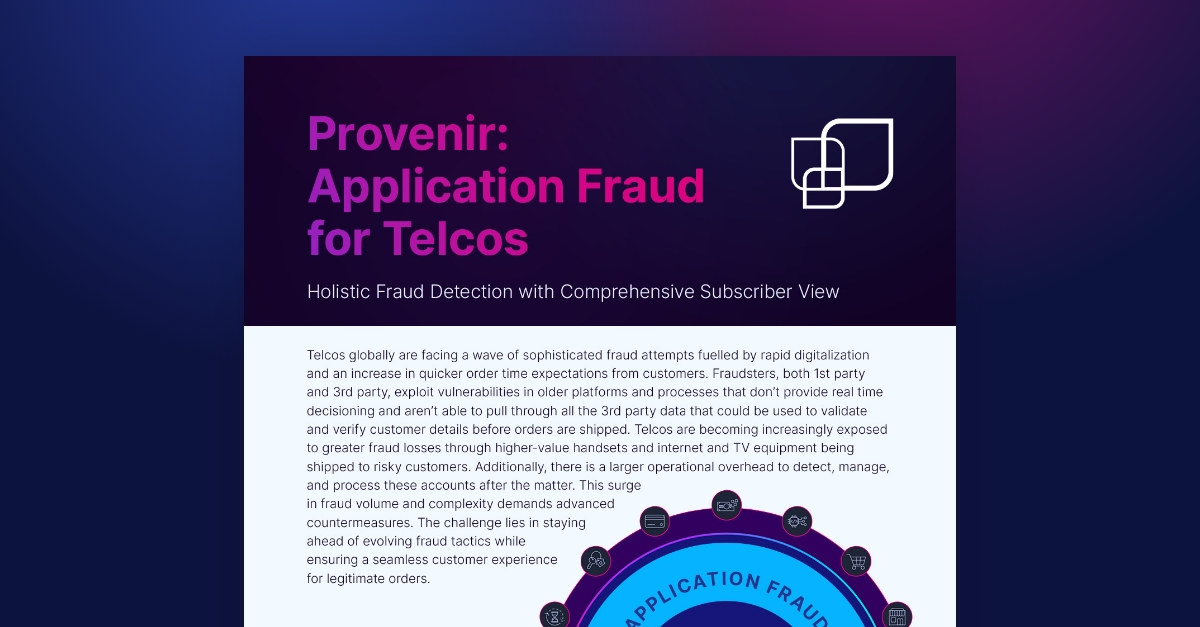
Provenir: Application Fraud for Telcos

Holistic Fraud Detection with Comprehensive Subscriber View
Telcos globally are struggling with increasingly sophisticated fraud attempts fuelled in part by rapid digital transformation and exacting subscriber demands. But how can you stay ahead of evolving fraud tactics while ensuring a seamless customer experience for legitimate subscribers? Discover how Provenir’s Application Fraud solution enables you to detect fraud risk more accurately with a holistic, comprehensive view of your subscribers.
Discover how Provenir’s AI Decisioning can transform your telco business.

Learn More

ADDITIONAL RESOURCES

europe mortgages
Blog ::

Top Mortgage Lending Trends in the UK...

Top Mortgage Lending Trends in the UK and Europe: Smarter ...
provenir sponsored event
News ::

NEWS: AI Risk Decisioning Leader Prov...

AI Risk Decisioning Leader Provenir to Sponsor Upcoming Banking and ...
fraud for telco data sheet
Data Sheet ::

DATA SHEET: Fraud for Telco

Provenir: Application Fraud for Telcos Holistic Fraud Detection with Comprehensive ...
NEWS: 2025 New Global Survey
News ::

NEWS: 2025 New Global Survey

New Global Survey Shows Nearly Half of Financial Services Executives ...
Survey: 2025 Global Risk Decisioning Survey
eBook, Survey ::

Survey: 2025 Global Risk Decisioning ...

Survey: 2025 Global Risk Decisioning Survey What are the key ...
blog lending thumbnail
Blog ::

BLOG: Unlocking Success in Poland’s L...

Thriving Through Change: Unlocking Success in Poland’s Lending Revolution Adapting ...
BLOG AI Round up
Blog ::

BLOG: Shaping the Future of Decisioni...

Shaping the Future of Decisioning: How These Leading Financial Services ...
EBOOK: How Telcos Can Boost Revenue Without the Risk
eBook ::

EBOOK: How Telcos Can Boost Revenue W...

Dial Into Profit: How Telcos Can Boost Revenue Without the ...

Continue reading

NEWS: 2025 New Global Survey

New Global Survey Shows Nearly Half of Financial Services Executives Struggling to Manage Credit Risk and Detect and Prevent Fraud

AI is playing a prominent role in the revamp of credit risk decisioning
and fraud prevention strategies in 2025

Parsippany, NJ – February 12, 2025 – A new survey shows nearly half of all financial services executives are struggling with managing credit risk and detecting and preventing fraud. The survey also shows many are revamping their credit risk decisioning and fraud prevention strategies in 2025, with AI playing a prominent role.

These are among the key findings from the survey of nearly 200 key decision makers at financial services providers globally to understand their risk decisioning and fraud challenges across the customer lifecycle, decisioning investment priorities, and AI opportunities. The survey was conducted by Provenir, a global leader in AI Decisioning solutions.

Over half of all respondents plan to invest in risk decisioning solutions and AI/embedded intelligence in 2025 and beyond. At present, nearly 60% of respondents say they find it difficult to deploy and maintain risk decisioning models. 55% of executives recognize the value of AI to make streamlined strategy decisions, and in its ability to provide AI-powered performance improvement recommendations, and 53% see the value in the ability to automatically tune models to make better, more accurate decisions.

Key priorities for customer and account management are real-time, event-driven decisioning (65%), eliminating friction across the customer lifecycle (44%), and increasing customer lifetime value (44%).

Over half of respondents agree the biggest data challenge they face is being able to easily integrate data sources into decisioning processes.

Survey insights also reveal the pitfalls of operating multiple decisioning systems across the customer lifecycle. 59% of respondents say this is causing a lack of seamless data flow and unified insights, while 52% say it creates operational inefficiencies. Additionally, 28% said it contributes to an inconsistent customer experience.

When asked about data and fraud, 37% say they struggle with effective data orchestration for application fraud prevention, specifically in not being able to easily ingest and integrate new data sources, while 36% are challenged in using AI and machine learning for fraud prevention. Nearly one-third of respondents agree that the most important aspect for comprehensive fraud strategies is the ability to break down data silos between fraud and credit risk teams.

“Financial institutions are keenly aware of today’s increasingly complex threat landscape and must adopt new approaches for improved risk decisioning and fraud prevention across the customer lifecycle while providing frictionless and personalized customer experiences,” said Carol Hamilton, Chief Product Officer, Provenir. “With an AI decisioning platform more closely aligning credit and fraud risk teams, financial services executives can ensure holistic, end-to-end decisioning with a complete view of customers across the entire lifecycle.”

The survey was conducted November-December 2024; respondents were based in North America, EMEA, Latin America and Asia Pacific, holding the titles of manager, director, vice president, or above.

The full report of the survey findings can be found here.

LATEST NEWS

Continue reading

Survey: 2025 Global Risk Decisioning Survey

Survey: 2025 Global Risk Decisioning Survey

What are the key challenges and priorities for financial services providers in 2025 and beyond?
Provenir surveyed nearly 200 key decision makers at financial services providers globally, including Chief Risk Officers, CEOs, VPs, Senior Directors, Managing Directors, Decision Scientists, Heads of Risk, IT, Fraud and more.

The results highlight:

  • Their risk decisioning and fraud challenges across the customer lifecycle
  • Decisioning investment priorities
  • AI opportunities
Get the insights now.
Ready to shape the future of your decisioning with AI?

Contact Us

Latest Ebooks

No posts found.

Continue reading