Language: EN

Buy the Engine. Build the Advantage

Buy the Engine. Build the Advantage.

  • Blog

  • Industry

  • Date

Buy the Engine.
Build the Advantage.

christian-ball

Christian Ball

Enterprise Account Executive

Why the smartest capital allocation decision in financial services risk infrastructure isn’t build vs. buy, it’s knowing what’s actually worth building. 

The competitive environment in financial services has fundamentally changed. Margins are compressed. Regulatory complexity is accelerating. Customer acquisition costs are at historic highs. And the fintechs gaining ground aren’t necessarily the ones with the most sophisticated technology, they’re the ones deploying it fastest. 

That context matters when you’re evaluating whether to build proprietary risk decisioning infrastructure from scratch. 

The Real Cost of Building

The true cost of building a decisioning platform compounds over time. 

The upfront capex is significant: architecture design, engineering resources, data integration across bureau and alternative data providers, security infrastructure, compliance frameworks. Organisations that have gone through this report 18 to 36 months before a production-ready system is operational. In a market where a competitor can launch a new credit product in weeks, that gap carries direct revenue implications. 

The ongoing opex picture is frequently underestimated at approval stage. Maintaining data integrations as providers update APIs. Rebuilding model deployment pipelines as cloud infrastructure evolves. Keeping pace with regulatory change across markets. Resourcing the support function so the decisioning engine doesn’t become a bottleneck to every product iteration. These aren’t exceptional costs. They’re structural, recurring, and they scale with complexity. 

McKinsey research consistently shows that large-scale internal technology builds in financial services exceed budget in many cases, with five-year total cost of ownership frequently running 40–60% above initial projections. The resource drag on engineering teams is harder to quantify but equally real. Senior talent allocated to infrastructure maintenance is senior talent not working on competitive differentiation. 

Speed is Now a Strategic Variable

Digital-native lenders are entering established segments with lower cost bases and faster decisioning cycles. Embedded finance is putting credit products inside customer journeys that traditional institutions don’t own. Open banking and alternative data are changing what good underwriting looks like. Regulators are demanding more explainability and auditability. 

The organisations gaining ground can test, launch, and iterate on new products in weeks, not quarters. That agility is very difficult to sustain when the decisioning infrastructure itself requires lengthy development cycles every time the business wants to change something. 

What Provenir Changes in the Capital Equation

Provenir’s Decision Intelligence Platform is built for exactly this trade-off. The infrastructure is already built, maintained, and continuously updated: cloud-native deployment, a marketplace of integrated data providers, model management, compliance and auditability frameworks. What organisations configure on top of it is entirely their own. 

Rather than funding a multi-year infrastructure build, capital goes into configuration, integration, and the proprietary decisioning logic that actually differentiates the business. Time to production is measured in weeks, not years. 

The opex shift is equally significant. Data provider integrations, infrastructure scaling, security patching, regulatory update cycles all move from internal cost centres to the platform’s responsibility. Engineering resource shifts from maintaining infrastructure to building product. The ongoing cost base is predictable, subscription-based, and scales with usage rather than requiring constant reinvestment just to stand still. 

BBVA, Atom Bank, and SoFi each deployed Provenir to run fundamentally different business models: global commercial lending, retail digital banking, consumer refinancing, at different scales and in different regulatory environments. The underlying platform is common. The decisioning logic, risk models, and customer strategies are not. 

The IP Question

The executive concern about IP is legitimate and worth addressing directly. Competitive advantage in financial services credit sits in the credit policy, the data strategy, the risk appetite calibration, and the customer relationships built on top of the engine. On Provenir’s platform, all of that remains entirely proprietary. Scoring models are deployed inside the platform, not exposed. Decision logic is configured by your team to reflect your underwriting philosophy. Two organisations on the same infrastructure share no more of their competitive advantage than two companies hosting on AWS share their code. 

What Provenir removes is the infrastructure layer: the part that costs the most, delivers the least competitive differentiation, and consumes the most ongoing resource to maintain. 

There’s also value that’s difficult to replicate internally. The R&D investment across Provenir’s global client base creates platform capabilities that no single organisation, building in isolation, could justify on its own. 

The Bottom Line

The build option carries significant upfront commitment, multi-year timelines, and a structural opex burden that compounds over time. In a market where speed and adaptability are increasingly decisive, it also means slower product iteration and delayed competitive response. 

Provenir reframes the question from build vs. buy to where you deploy your capital and your talent. The platform provides the infrastructure. Your team builds the advantage. Your IP, your models, your risk strategy are fully proprietary, executing faster and at materially lower total cost than the build alternative. 

That’s a strategic decision, not just a procurement one. 

LATEST BLOGS

Buy the Engine. Build the Advantage

Buy the Engine. Buil...

Blog Industry Date Buy the Engine.Build the Advantage. Christian
The Growing Threat of Fraud in UK Auto Lending

The Growing Threat o...

The Growing Threat of Fraud in UK Auto Lending
BLOG Christian Ball

Smarter Acquisition ...

Smarter Acquisition and Customer Management:How Provenir Drives Growth and
carol blog

The Generational Shi...

The Generational Shift:Why Banks Are Replacing Their Decisioning Infrastructure
Frederic blog

Why AI Requires Ente...

Why AI Requires Enterprise Platforms to Deliver Business Value
HyperPersonalization

From Risk Manager to...

From Risk Manager to Revenue Generator:How CROs Are Becoming
Hyper-personalization Myth2

The Hyper-personaliz...

The Hyper-personalization Myth Series #2:The Scorecard Trap: How Traditional
Hyper-personalization Myth1

The Hyper-personaliz...

The Hyper-personalization Myth Series #1:Why Banks Think They're Doing

Continue reading

BLOG Fraud

Why Nordic Banks Must Balance Fraud Control and Frictionless Onboarding to Protect Trust and Growth 

  • Blog

  • Industry

  • Date

Why Nordic Banks Must Balance Fraud Control and Frictionless Onboarding to Protect Trust and Growth

jason abbott headshot

Jason Abbott

Director, Fraud Solutions

In the digital banking era, customer expectations are measured in milliseconds, not days. Even small amounts of friction during onboarding can push potential customers to abandon the process entirely. For Nordic banks operating in some of the world’s most digitally advanced economies, protecting against increasingly sophisticated application fraud while delivering seamless experiences has become a defining challenge.

Risk decisions are no longer back-office functions. They’re part of the customer experience itself. The most successful banks are unifying fraud detection and onboarding through Decision Intelligence that reveals what’s working and what needs to change.

Application Fraud: Beyond Individual Bad Actors

Application fraud in the Nordic region has evolved significantly. While fraud losses across Nordic banks reached $2.8 billion in 2023, with Sweden and Norway among the larger contributors, the nature of these losses reveals something more concerning than the numbers alone suggest.

Today’s application fraud exploits legitimate-looking structures. Criminal networks orchestrate synthetic identity schemes, mule account networks, and first-party fraud that traditional point-in-time checks struggle to detect. A single application might appear completely clean when viewed in isolation, yet be part of a coordinated network submitting hundreds of variations with slight modifications to evade detection rules.

These organized networks use social engineering, identity theft, and increasingly AI-powered tactics to create applications that pass surface-level verification. Prevention requires more than isolated controls checking identity documents or credit scores at a single moment. Banks need continuous monitoring, behavioral profiling, and modern analytics capable of detecting patterns that didn’t exist six months ago.

The Trust Equation Has Changed

Trust has always been the foundation of banking, yet it’s no longer assumed. According to the 2024 Telesign Trust Index Report, nearly two-thirds of consumers say fraud damages brand trust and loyalty. Perhaps more concerning: 38% will completely sever ties with a brand after a security breach, and 92% believe companies are responsible for protecting their digital privacy.

In the Nordic context, where banks have historically enjoyed high levels of public confidence, this erosion of trust represents more than lost customers. It threatens the stability of the entire financial ecosystem. When a bank fails to protect customers from application fraud or creates friction that suggests insecurity, the damage extends beyond individual relationships to the institution’s reputation in the market.

The Hidden Cost of False Positives

While application fraud demands stronger controls, customer tolerance for poor experiences is at an all-time low. Research shows that 68% of consumers abandon digital financial applications because the process is too long, too confusing, or too intrusive.

Most banks miss a critical dynamic: formal declines represent only part of the abandonment problem. False positives create unnecessary friction that causes silent abandonment. These customers never complete an application, never receive a formal rejection, and never appear in declined application metrics. They simply disappear.

Studies across European markets indicate that only 15-35% of users complete financial onboarding once started, with frustration and complexity cited as primary reasons. Each abandoned application represents wasted acquisition costs and lost lifetime value. The traditional approach of applying heavy-handed, reactive fraud controls to every customer creates a vicious cycle: fraud controls increase false positives, false positives create friction, friction drives silent abandonment, and abandoned applications become invisible losses.

Unnecessary friction also diminishes trust by signaling that the bank lacks confidence in its own security measures. When legitimate customers face slow identity checks, repeated verification requests, or unexplained delays, they begin to question whether their information is truly secure.

From Point-in-Time Checks to Continuous Decisioning

Leading Nordic banks are recognizing that the old model no longer works. Point-in-time checks (verifying identity documents at submission, pulling a credit score, running basic rules) can’t detect application fraud networks or distinguish between legitimate customers who need fast service and coordinated fraud patterns that require deeper scrutiny.

The shift is toward continuous decisioning: real-time analytics and monitoring that detect suspicious activity without creating manual backlogs or customer-facing delays. According to regional fraud surveys, many Nordic banks are already investing in AI-driven monitoring systems designed to reduce both fraud and false positives.

Continuous decisioning alone, however, falls short. What separates the most sophisticated banks is their approach to Decision Intelligence: the layer that executes decisions, reveals what’s working, and provides insights into what to change.

Decision Intelligence: The Strategic Answer

Decision Intelligence transforms the fraud-versus-friction problem from an unsolvable tradeoff into an integrated optimization challenge. Instead of treating application fraud controls and onboarding experience as separate problems managed by separate teams, Decision Intelligence creates a unified system that connects decisions to outcomes and recommends what to change.

Banks using Decision Intelligence can see beyond approval rates and fraud losses to understand the relationship between specific fraud signals and both true fraud detection and false positive rates. They can identify which verification steps are catching actual fraud networks versus which are simply adding friction that drives legitimate customers away. They can simulate the impact of policy changes before implementation, testing whether adjusting a specific threshold will reduce silent abandonment without increasing fraud exposure.

This approach enables dynamic friction that adapts to risk in real-time. Low-risk customers (those with behavioral patterns, device signals, and identity markers consistent with legitimate applications) enjoy fast onboarding. High-risk applications that match network fraud patterns trigger targeted, justifiable controls. The system continuously learns from outcomes. Every decision feeds a learning loop that improves both fraud detection accuracy and false positive reduction.

The most sophisticated banks are using Decision Intelligence to create streaming data feeds that enable instant identity verification, behavioral risk scoring, and graph intelligence that detects connections between applications that appear unrelated at first glance. They add intelligent friction only where needed and remove unnecessary friction where it’s only slowing down legitimate customers.

Making Application Fraud Detection a Competitive Advantage

Customer-centric risk design, powered by Decision Intelligence, is becoming a differentiator. Dynamic checks ask for additional context only when specific risk signals appear. Identity signals like device behavior, biometrics, and historical patterns help lower friction for trusted customers. Predictive models and network detection deter organized application fraud without blocking legitimate users.

This intelligent approach demonstrates transparency and fairness in risk decisions, which enhances trust rather than eroding it. Customers understand that security measures exist for their protection. What they reject is blanket friction that treats everyone as a potential fraudster.

Building Infrastructure for Tomorrow’s Threats

Investment cases should reflect today’s known application fraud tactics and the capability to adapt to tomorrow’s unknowns. Legacy systems (slow, brittle, and fragmented) cannot support the kind of real-time, intelligent risk management that modern banking requires.

Banks that view fraud detection and onboarding as separate problems will continue to struggle with the false choice between security and speed. Those that recognize them as two sides of the same integrated decision problem will find competitive advantage through Decision Intelligence that reveals performance gaps and enables continuous optimization.

The path forward requires building infrastructure that delivers both protection and experience through adaptive, data-driven decisioning where every decision is executed, measured, learned from, and improved. For Nordic banks, this represents an opportunity to transform application fraud management from a cost center into a strategic differentiator that protects customers, preserves trust, and enables growth in an increasingly digital world.

LATEST BLOGS

Buy the Engine. Build the Advantage

Buy the Engine. Buil...

Blog Industry Date Buy the Engine.Build the Advantage. Christian
The Growing Threat of Fraud in UK Auto Lending

The Growing Threat o...

The Growing Threat of Fraud in UK Auto Lending
BLOG Christian Ball

Smarter Acquisition ...

Smarter Acquisition and Customer Management:How Provenir Drives Growth and
carol blog

The Generational Shi...

The Generational Shift:Why Banks Are Replacing Their Decisioning Infrastructure
Frederic blog

Why AI Requires Ente...

Why AI Requires Enterprise Platforms to Deliver Business Value
HyperPersonalization

From Risk Manager to...

From Risk Manager to Revenue Generator:How CROs Are Becoming
Hyper-personalization Myth2

The Hyper-personaliz...

The Hyper-personalization Myth Series #2:The Scorecard Trap: How Traditional
Hyper-personalization Myth1

The Hyper-personaliz...

The Hyper-personalization Myth Series #1:Why Banks Think They're Doing

Continue reading

The Growing Threat of Fraud in UK Auto Lending

The Growing Threat of Fraud in UK Auto Lending 

The Growing Threat of Fraud in UK Auto Lending
Why better fraud outcomes now depend on decisions that learn

Fraud in UK auto lending continues to rise in both scale and sophistication. As vehicle finance becomes increasingly digital and broker-led, lenders are being asked to make faster decisions on higher-value applications, often with limited certainty at the point of application. For fraudsters, that creates opportunity. For lenders, it creates material risk. 

Auto lenders face competing pressures. Customers expect instant approvals and low friction. Regulators expect strong controls, fairness and auditability. Commercial teams expect growth without rising losses or operating cost. Traditional, siloed fraud approaches are struggling to balance all three. 

The challenge is no longer simply how to detect fraud. It is how to make better fraud decisions, at speed, and at scale. 

Why fraud risk is increasing in UK auto finance

Several structural factors continue to drive fraud exposure. 

Vehicle finance decisions are high value and increasingly expected in real time, leaving little room for manual intervention. Digital and broker-led journeys have expanded the attack surface, reducing face-to-face verification and fragmenting visibility across channels. Economic pressure has blurred the line between credit risk and fraud, with more misrepresentation and opportunistic abuse appearing within otherwise legitimate applications. 

At the same time, many lenders still operate fragmented decisioning across identity, fraud and credit. This leads to inconsistent outcomes, duplicated checks and unnecessary customer friction, while making it harder to spot emerging risk patterns. 

The result is a faster, more complex decision environment with less margin for error. 

Modern fraud is adaptive and channel-specific

Fraud in auto lending is no longer static or predictable. It adapts to controls and exploits differences between channels.

UK lenders are increasingly seeing: 

  • AI-assisted application manipulation, where income, employment and personal details are tailored to pass common checks 
  • Deepfake AI enabling criminals to impersonate innocent victims with strong financial profiles in digital journeys, making fraud harder to spot at the point of application 
  • Early-stage synthetic identities that appear low risk at origination but deteriorate post-approval 
  • Coordinated behaviour across lenders and brokers, exploiting timing gaps and fragmented visibility 

Crucially, fraud risk is not uniform by channel. Direct digital journeys, broker submissions and assisted channels each introduce different risks. Applying the same controls everywhere increases friction without materially reducing fraud. 

Effective strategies segment decisions by channel and context, applying stronger scrutiny where risk is higher and reducing friction where confidence is greater. 

The cost of poor fraud decisions

The impact of fraud extends well beyond direct losses. 

Overly cautious or poorly targeted controls create a significant resource burden, driving unnecessary referrals, manual reviews and investigation queues. Skilled teams spend time reviewing low-risk applications, increasing operating cost and slowing decision turnaround where speed matters most. 

At the same time, genuine buyers are increasingly caught in unnecessary friction. Additional checks, delays or challenges in digital journeys lead to abandonment, lost conversion and missed revenue, particularly for customers who expect fast, seamless approvals. In many cases, these losses are invisible, recorded as drop-off rather than fraud impact. 

Inconsistent decisions across channels further erode trust with customers, brokers and regulators. 

Over time, these effects compound. Costs rise, profit leaks through lost approvals, and the customer experience suffers. 

The strongest fraud programmes focus on decision quality, not just detection rates. Better decisions reduce losses, free up operational capacity, and protect revenue by allowing genuine customers to complete their journey without unnecessary interruption. 

From fraud tools to fraud decisions

To achieve this, UK auto lenders are moving away from isolated fraud tools towards a decision intelligence approach. 

Decision intelligence brings data, signals, models and policies together into a single decision layer, operating in real time at the point of application. Fraud, identity and affordability signals are assessed together, allowing risk to be understood in context rather than in isolation.

This enables:  

  • More consistent, proportionate decisions 
  • Fewer false positives and less unnecessary friction 
  • Greater confidence when adapting strategy 

The focus shifts from what controls are used to how decisions are made. 

Learning from outcomes: why feedback matters

Fraud prevention cannot be static. Fraudsters adapt quickly, often in response to the controls designed to stop them.

Many lenders focus heavily on the application decision, but the most valuable insight often comes later. Was an approved application later confirmed as fraud? Did a declined customer appeal successfully? Did friction cause a genuine applicant to abandon the journey?

A decision intelligence approach closes this loop. Final outcomes feed back into strategies and machine learning models, allowing decisions to improve over time rather than degrade.

By analysing behavioural signals, channel context and deviations from normal patterns, adaptive models can surface anomalies that fall outside known fraud types, often identifying emerging threats before losses scale.

Decisions that learn win in uncertain markets

In today’s UK auto lending market, resilience comes from adaptability.

The most effective lenders are not those with the most controls, but those that make the best decisions and learn from every outcome. By connecting real-time decisioning, channel-aware strategies and continuous feedback, lenders can reduce fraud losses, protect growth and deliver fast, fair customer experiences. 

Fraud will continue to evolve. The question is whether your decisions evolve with it.

For lenders reassessing their approach to fraud in auto finance, that question is often the start of a much bigger conversation. 

Learn More on our fraud solution

Contact Us

LATEST BLOGS
Buy the Engine. Build the Advantage

Buy the Engine. Buil...

Blog Industry Date Buy the Engine.Build the Advantage. Christian

The Growing Threat of Fraud in UK Auto Lending
The Growing Threat o...

The Growing Threat of Fraud in UK Auto Lending
BLOG Christian Ball

Smarter Acquisition ...

Smarter Acquisition and Customer Management:How Provenir Drives Growth and
carol blog

The Generational Shi...

The Generational Shift:Why Banks Are Replacing Their Decisioning Infrastructure
Frederic blog

Why AI Requires Ente...

Why AI Requires Enterprise Platforms to Deliver Business Value
HyperPersonalization

From Risk Manager to...

From Risk Manager to Revenue Generator:How CROs Are Becoming

Hyper-personalization Myth2

The Hyper-personaliz...

The Hyper-personalization Myth Series #2:The Scorecard Trap: How Traditional

Hyper-personalization Myth1

The Hyper-personaliz...

The Hyper-personalization Myth Series #1:Why Banks Think They're Doing

Continue reading

BLOG Mark

Why Telcos Can’t Afford to Think Like Banks

  • Blog

  • Industry

  • Date

Why Telcos Can’t Afford to Think Like Banks –
And Why That’s Their Advantage

mark-jackson

Mark Jackson

Director of Telco

Most telcos are barely growing faster than inflation. They’re trapped in saturated markets where customers churn over minor price differences or the promise of a newer handset. The conventional wisdom says they should adopt the same risk-averse, compliance-heavy decision-making frameworks that banks use. 

But banks and telcos operate in completely different contexts. Unlike banks, telcos are technology companies that built the networks powering global communication. Their teams already understand AI, real-time systems, and technical complexity. The operators winning today—Verizon in the US, Deutsche Telekom in Germany, Etisalat in the Middle East—compete on coverage and reliability, not price. They’ve moved from “cheapest unlimited data plan” to “best customer experience,” and that requires intelligent, real-time decisioning about which customers to serve, how to serve them, and what to offer. 

The advantage belongs to telcos willing to think like telcos, not like banks. 

Not All Churn Is Bad (And Treating It That Way Destroys Margins)

Most operators treat customer retention as a binary success metric, measuring every lost customer as failure. This approach ignores a more sophisticated reality: some customers should leave. 

Consider the different types of churn from the operator’s perspective. Voluntary churn happens when customers leave for better deals, which most operators want to prevent. Involuntary churn occurs when operators cut off customers who don’t pay. Decisioning becomes critical here by identifying at-risk customers before they owe money, potentially downsizing their package to keep them profitable rather than losing them entirely. 

Sophisticated operators diverge from the pack with planned churn, deliberately choosing not to intervene to retain low-value or negative-margin accounts. Others embrace constructive churn, letting high-cost customers leave because they complain constantly, demand credits, or pay late. Losing them actually improves portfolio profitability. 

The real opportunity is profit-optimizing your churn: using data and models to selectively target retention offers to customers you genuinely want—high customer lifetime value, low cost to serve—while letting low or negative CLV customers churn without incentives. This is decisioning at its most strategic, preventing the wrong churn rather than all churn. 

A related opportunity exists in serving customers other operators reject. Better creditworthiness assessment enables profitable service to “riskier” customers. Someone might want the latest iPhone, but traditional credit checks suggest they can’t afford it. Instead of rejecting them outright, offer an older model or lower-spec Android device. You’ve still acquired a customer and you’re still generating revenue. 

Alternative data sources for decisioning beyond financial history – that telcos already have – reveal signals traditional scoring misses: device usage patterns, top-up behavior, payment consistency on other services. This opens entirely new market segments competitors may be ignoring. 

The Build Trap: When Time-to-Value Beats “Not Invented Here”

Telcos are technology companies that built their networks. Their teams include engineers and technologists who’ve already experimented with AI and machine learning, creating both opportunity and risk. 

  • The opportunity:Telcos are more AI-literate and risk-tolerant than banks. They understand technical complexity, they are comfortable with rapid iteration, and they want to see under the hood of any technology they are evaluating.
  • The risk: They often believe they can build decisioning solutions themselves, which stretches delivery cycles as internal IT teams advocate for internally built projects. But business strategies in telecom change constantly based on competitor moves. By the time an 18-month internal build is complete, the strategic context has shifted.

The calculation comes down to time-to-value and core competency. Telcos should focus on what they do best: creating reliable networks for calls and data transmission. Decisioning expertise should come from specialists who do nothing else, because the ability to adapt quickly, test new approaches, and optimize in real-time determines who wins. When your competitor launches a new retention offer, you need to respond in days or hours, not quarters. 

When Scale Makes Small Problems Catastrophic

At 50 million customers, a 1% false positive rate means 500,000 angry customers, which means everything must be automated, explainable, and reversible. But even for a 5 million customer telco, 50,000 angry customers is 1,000 issues per week!

The complexity is twofold. First, system complexity. Very few large telcos are new. Most are legacy operators that have existed for 20-30 years with multiple systems in each domain. They might have separate billing systems for mobile, fixed line, and broadband, or multiple systems from merger and acquisition history. Verizon is the result of 30+ company mergers, each bringing different systems, different customer data structures, and different business rules.

Second, product complexity. Those mergers mean customers are on thousands of different plans with different rates for calls and data, different included features. Most telcos won’t force customers to change plans, but they sometimes have to in order to shut down old systems and networks. This triggers churn, which intelligent decisioning can mitigate by identifying the right migration timing and offers for each customer.

Also at scale, governance becomes non-negotiable: Who approved this model? When was it last validated? What are the rollback procedures? Infrastructure costs don’t scale linearly, and instead of 5 stakeholders, you’re managing alignment across 20+ groups.

The Technical Conversation That Banks Never Have

When telcos evaluate platforms, their questions differ fundamentally from banks.

Banks ask about accuracy, compliance frameworks, and regulatory alignment. Telcos ask about integrations to telco-specific systems, particularly billing data, because access to usage patterns enables better real-time personalization of decisions and offers.

The technical depth telcos demand actually works in favor of platforms with solid architecture. When you can demonstrate real-time performance, clean integrations, and robust data handling, it builds credibility faster than any deck.

But that technical literacy creates a trap. Operations teams want to understand how the technology works, while C-suite executives want to know what it delivers. The right approach anchors to business goals first: Which KPIs actually matter? Then quantify the impact and frame everything in terms of ROI and outcomes. Senior leaders need to hear financial impact, implementation timelines, and risk reduction.

What Separates Winners from Survivors

Three years from now, the winning telcos will have moved from connectivity providers to intelligent service platforms. They’ll have embedded AI decisioning across the entire customer lifecycle and made those decisions in real-time with hyper-personalization. 

More importantly, they’ll have focused on doing right by the customer. Their actions will be customer centric, not operator centric. If a customer has an issue, winning operators will focus everything on fixing it before trying to upsell. Once the issue is resolved, they’ve earned the right to offer additional services. This approach extends customer lifetime, increases total revenue across that lifetime, and reduces price-driven churn because customers are treated as individuals with specific needs. 

The telcos still competing on “unlimited data for $X per month” will continue fighting margin-eroding price wars – if they even still exist! The ones delivering seamless, personalized experiences will capture disproportionate value. 

The data is already flowing through telco systems. The decisioning platforms are mature. The technical talent exists. The only variable is speed: how quickly telcos move from evaluation to implementation, from pilot to production, from feature parity to competitive advantage. 

The operators who win will be the ones who recognize that their engineering culture and risk tolerance are assets, not liabilities. They just need to point them in the right direction. 

LATEST BLOGS

Buy the Engine. Build the Advantage

Buy the Engine. Buil...

Blog Industry Date Buy the Engine.Build the Advantage. Christian
The Growing Threat of Fraud in UK Auto Lending

The Growing Threat o...

The Growing Threat of Fraud in UK Auto Lending
BLOG Christian Ball

Smarter Acquisition ...

Smarter Acquisition and Customer Management:How Provenir Drives Growth and
carol blog

The Generational Shi...

The Generational Shift:Why Banks Are Replacing Their Decisioning Infrastructure
Frederic blog

Why AI Requires Ente...

Why AI Requires Enterprise Platforms to Deliver Business Value
HyperPersonalization

From Risk Manager to...

From Risk Manager to Revenue Generator:How CROs Are Becoming
Hyper-personalization Myth2

The Hyper-personaliz...

The Hyper-personalization Myth Series #2:The Scorecard Trap: How Traditional
Hyper-personalization Myth1

The Hyper-personaliz...

The Hyper-personalization Myth Series #1:Why Banks Think They're Doing

Continue reading

BLOG Survey02

The Fraud-AI Double Bind

The Fraud-AI Double Bind: New Survey Reveals the Fraud-AI Paradox Facing Financial Institutions

Financial institutions face a critical tension. They need AI to combat increasingly sophisticated fraud. Yet 77% are concerned about AI-enabled fraud threats.

Our 2026 Global Decisioning Survey, conducted by The Harris Poll across 203 senior decision-makers in 22 countries, reveals the scope of this challenge and the strategies organizations are using to address it.

The Numbers

  • The adoption of AI for fraud prevention is strong:

  • Yet the concern is equally widespread:

    • 77% worry about AI-enabled fraud threats
    • 50% struggle to detect and react quickly to new fraud trends
One Chief Risk Officer we surveyed described the compliance challenge as “trying to get certified for a standard that hasn’t been written yet.”

The Speed Problem

When we asked about their biggest application fraud challenge, 50% identified detecting and reacting quickly to new fraud trends.

Bad actors use AI to evolve their tactics in real-time, testing thousands of attack vectors simultaneously. Traditional monthly or quarterly model updates can’t keep pace. Organizations need real-time, adaptive AI systems to combat fraud, but deploying those systems runs directly into implementation barriers around governance and explainability.

What Comprehensive Fraud Strategy Requires

When we asked what’s most important for delivering comprehensive fraud prevention, organizations prioritized four capabilities:

33%

rank as most important

Comprehensive fraud risk review of customer data:
Organizations need complete visibility across customer interactions and behavior patterns. Siloed views by channel or product line leave blind spots.

23%

Reducing friction in customer experience

Security cannot come at the cost of customer experience. Organizations that create too much friction lose legitimate customers to competitors.

22%

Aligning data at customer level vs. by channel

Breaking down silos to create unified customer views enables better fraud detection without false positives that frustrate good customers.

19%

Breaking down data silos between fraud and credit teams

Traditional organizational separation between fraud and credit creates blind spots. Integrated views improve both fraud prevention and credit decisioning.

How Organizations Measure Success

The variety in primary metrics reflects different organizational priorities:
  • 54%

    track enhancing operational efficiency and automation (16% say this is their primary metric)
  • 54%

    track improving accuracy of AI and ML models (25% say this is their primary metric)
  • 52%

    track reducing fraud loss (15% say this is their primary metric)
Operational efficiency and model accuracy rank equally with fraud loss reduction. Organizations recognize that sustainable fraud prevention requires systematic operational excellence beyond just loss minimization.
  • Breaking Free from the Double Bind:

    Organizations successfully navigating this tension balance aggressive AI adoption with comprehensive risk management.
  • Deploy explainable AI architectures from the start:

    They don’t sacrifice interpretability for performance. Modern approaches enable both.
  • Maintain human-in-the-loop oversight for high-risk decisions:

    AI handles volume and speed, but humans make final calls on edge cases and high-stakes scenarios.
  • Implement continuous monitoring for model drift and bias:

    They don’t deploy and forget. Models require ongoing governance.
  • Build governance as an ongoing product, not a one-time project:

    Governance evolves alongside AI capabilities and regulatory requirements.

The Implementation Reality

You can’t sacrifice governance for speed. But you also can’t sacrifice speed for governance. The most successful organizations find ways to achieve both.

They leverage platforms designed to orchestrate decisions across existing systems rather than requiring wholesale system replacement. This approach accelerates time-to-value and reduces technical risk.

Rather than ripping out decades of infrastructure, they deploy decisioning layers that orchestrate data from multiple sources and deliver decisions back to existing platforms in milliseconds.

Looking Ahead

The fraud landscape will continue to evolve faster than most organizations can currently respond. Organizations that successfully deploy explainable, governed AI at speed will protect revenue, preserve customer experience, and build sustainable advantages.

EBOOK Survey2026

Download the full 2026 Global Decisioning Survey:

Download Survey

LATEST BLOGS

Buy the Engine. Build the Advantage

Buy the Engine. Buil...

Blog Industry Date Buy the Engine.Build the Advantage. Christian
The Growing Threat of Fraud in UK Auto Lending

The Growing Threat o...

The Growing Threat of Fraud in UK Auto Lending
BLOG Christian Ball

Smarter Acquisition ...

Smarter Acquisition and Customer Management:How Provenir Drives Growth and
carol blog

The Generational Shi...

The Generational Shift:Why Banks Are Replacing Their Decisioning Infrastructure
Frederic blog

Why AI Requires Ente...

Why AI Requires Enterprise Platforms to Deliver Business Value
HyperPersonalization

From Risk Manager to...

From Risk Manager to Revenue Generator:How CROs Are Becoming
Hyper-personalization Myth2

The Hyper-personaliz...

The Hyper-personalization Myth Series #2:The Scorecard Trap: How Traditional
Hyper-personalization Myth1

The Hyper-personaliz...

The Hyper-personalization Myth Series #1:Why Banks Think They're Doing

Continue reading

BLOG Survey01

Why 77% of Financial Institutions See Decision Intelligence as Their 2026 Priority

Why 77% of Financial Institutions See Decision Intelligence as Their 2026 Priority

The financial services industry is experiencing a fundamental shift. Organizations have spent years automating decisions. Now they need those decisions to get smarter.

Our 2026 Global Decisioning Survey reveals the scope of this transition: 77% of senior decision-makers see Decision Intelligence as very valuable for their strategy over the next 2-3 years.

What Decision Intelligence Actually Means

Decision Intelligence represents the evolution from automated decisioning to continuously optimized, AI-driven decision-making that learns and improves.

THE DIFFERENCE:

  • The Traditional Approach:

    Deploy AI models, measure results periodically, update quarterly, manage explainability and governance separately
  • Decision Intelligence Approach:

    Execute decisions at scale, measure outcomes continuously, learn from performance, optimize in real-time within unified platforms that provide transparency, governance, and integration
Organizations are moving quickly:
  • 75%

    are already collaborating on AI-driven decision intelligence
  • 18%

    are exploring partnerships
  • 66%

    are very interested in using AI for strategy implementation and optimization
  • 60%

    plan to invest in AI or embedded intelligence for decisioning in 2026 (making it the top investment priority)

What Organizations Value Most

When we asked which AI features provide the most value, organizations prioritized capabilities that go beyond basic automation:

51%

Ability to leverage generative AI for natural language queries
The democratization of AI insights through conversational interfaces transforms who can access and act on decisioning data. Business users, executives, operations teams, and compliance staff can all interact directly with AI systems using natural language.

92%

of organizations find it important to interact with data quickly using natural language queries.
(62% find it very important, 30% moderately important).
  • 49%

    Real-time decisioning across customer touchpoints:
    Speed and consistency across channels create better customer experiences and reduce operational complexity.
  • 50%

    Transparency and explainability of AI models:
    Organizations need AI they can understand and defend to regulators and stakeholders.
  • 47%

    Integration with existing systems and data sources:
    AI must work with existing infrastructure rather than requiring complete replacement.

The Business Impact

Organizations cite four primary benefits from improved Decision Intelligence:
  • 62%

    cite operational efficiency:

    Automated decision-making reduces manual review, accelerates processes, and lowers costs while improving consistency.
  • 52%

    cite better customer experience:

    Faster decisions, reduced friction, and personalized interactions create superior customer journeys.
  • 58%

    cite improved accuracy of models and strategies:

    Continuous learning and optimization improve predictive performance and business outcomes over time.
  • 56%

    cite faster deployment of new decision strategies:

    Rapid testing and iteration enable organizations to adapt quickly to market changes and competitive pressure.
These benefits compound over time. Organizations that deploy Decision Intelligence don’t just get better decisions today. They build systems that continuously improve.

The Intelligence Loop in Practice

Decision Intelligence creates a continuous cycle:
  • chess

    Shape Strategy

    Design and evolve decision strategy by learning from how decisions actually perform. Strategy is measured through outcomes and continuously refined to balance risk exposure and revenue opportunity.
  • rocket

    Execute Decisions

    Make real-time, data-driven decisions at every customer touchpoint using deep customer understanding, data, context, and decision history.
  • dashboard

    Measure Outcomes

    Connect decisions to business outcomes to see what actually drives risk, revenue, and profitability.
  • learning

    Learn and Optimize

    Get specific recommendations to improve performance based on actual results. Learn from the results over time and continuously refine strategies.
This loop transforms decisioning from a periodic batch process into a continuous optimization system.

The Natural Language Revolution

92% of organizations find it important to interact with data quickly using natural language queries. This represents a fundamental shift.

When business users can interact directly with AI systems using conversation, they build intuition about how these systems work. That understanding improves their ability to provide governance oversight and makes the entire organization more comfortable with AI-driven decisioning.

Natural language querying enables:

  • Business users to explore decisioning data without SQL knowledge
  • Executives to get instant answers to strategic questions
  • Operations teams to investigate anomalies in real-time
  • Compliance teams to audit decisions conversationally
This democratization helps address one of the top implementation barriers: explainability. When more people in the organization can interact with and understand AI systems, those systems become more transparent by design.

Addressing Implementation Barriers

Decision Intelligence approaches help address the barriers preventing AI adoption:
  • Explainability

    Platforms provide visibility into what decisions were made, how they perform, and why. This makes it easier to explain outcomes to regulators and stakeholders.
  • Governance

    Connecting decisions to business outcomes (risk, revenue, customer experience) makes governance more manageable. You measure results and learn from performance rather than monitoring models in isolation.
  • Integration

    Decision Intelligence platforms orchestrate data and decisions across existing infrastructure without requiring wholesale system replacement.
  • Speed

    Organizations can learn from every decision and optimize continuously, addressing the speed challenge that 50% cite as their biggest fraud detection obstacle.

Looking Ahead

The survey reveals clear momentum:
  • 77%

    see Decision Intelligence as very valuable
  • 75%

    are already implementing it
  • 66%

    want AI for strategy optimization
  • 60%

    are investing in 2026 (top priority)
Traditional decisioning optimizes for speed. Decision Intelligence optimizes for outcomes. Organizations that build systems capable of continuous learning will create advantages that compound over time.

EBOOK Survey2026

Download the full 2026 Global Decisioning Survey:

Download Survey

LATEST BLOGS

Buy the Engine. Build the Advantage

Buy the Engine. Buil...

Blog Industry Date Buy the Engine.Build the Advantage. Christian
The Growing Threat of Fraud in UK Auto Lending

The Growing Threat o...

The Growing Threat of Fraud in UK Auto Lending
BLOG Christian Ball

Smarter Acquisition ...

Smarter Acquisition and Customer Management:How Provenir Drives Growth and
carol blog

The Generational Shi...

The Generational Shift:Why Banks Are Replacing Their Decisioning Infrastructure
Frederic blog

Why AI Requires Ente...

Why AI Requires Enterprise Platforms to Deliver Business Value
HyperPersonalization

From Risk Manager to...

From Risk Manager to Revenue Generator:How CROs Are Becoming
Hyper-personalization Myth2

The Hyper-personaliz...

The Hyper-personalization Myth Series #2:The Scorecard Trap: How Traditional
Hyper-personalization Myth1

The Hyper-personaliz...

The Hyper-personalization Myth Series #1:Why Banks Think They're Doing

Continue reading

BLOG Christian Ball

Smarter Acquisition and Customer Management

Smarter Acquisition and Customer Management:
How Provenir Drives Growth and Reduces Risk

  • christian-ball

    Christian Ball
    Enterprise Account Exec

Financial institutions face a straightforward challenge: acquire profitable customers and manage those relationships effectively over time. The organizations winning this game have figured out how to turn their data into intelligent, real-time decisions. According to a 2024 Deloitte survey of IT and line-of-business executives, 86% of financial services AI adopters said that AI would be very or critically important to their business’s success in the next two years. This brings us to today, where AI adoption continues to increase.

Provenir’s decision engine connects data, AI, and decisioning in a unified, no-code platform. Financial institutions use it to make faster, more accurate credit decisions while continuously optimizing customer relationships beyond the initial onboarding. The platform integrates multiple data sources and allows teams to refine models as new performance insights emerge.

The impact shows up across the customer lifecycle:

Faster decisions, higher conversion

Speed directly affects conversion rates, especially in point-of-sale financing where customers are waiting in-store. Rent-a-Center processes complex lease-to-own approvals—evaluating creditworthiness, rental history, and affordability—in under 10 seconds at the point of sale, while tbi Bank makes decisions in milliseconds. When MTN Group implemented Provenir’s decisioning platform, they saw pre-approvals increase by 130% and conversions jump by 135%.

Reduced risk, protected portfolios:

AI-powered analytics continuously monitor portfolio performance, enabling early detection of credit deterioration. Jeitto achieved a 20% reduction in defaults while simultaneously increasing approval rates by 10%. MTN Group stopped an additional 135% of high-risk transactions through Provenir’s fraud solutions.

Stronger customer relationships:

Data-driven insights enable tailored offers, credit limits, and retention strategies in real time. Jeitto increased their average ticket size by 8% while improving their approval speed by 67%. The result: they achieved ROI on their Provenir investment in less than 12 months.

Operational agility:

A configurable, no-code environment lets teams adapt quickly. NewDay improved their speed of change by 80% and achieved 2.5x faster quote responses while maintaining sub-1 second decision processing times and 99.95% SLA for availability. Provenir helps organizations build a continuous decisioning ecosystem where acquisition, engagement, and retention connect intelligently.

Provenir helps organizations build a continuous decisioning ecosystem where acquisition, engagement, and retention connect intelligently.

In essence, Provenir helps organizations build a continuous decisioning ecosystem—where acquisition, engagement, and retention are intelligently connected. It’s not just smarter decisioning; it’s smarter customer growth.

LATEST BLOGS

Buy the Engine. Build the Advantage

Buy the Engine. Buil...

Blog Industry Date Buy the Engine.Build the Advantage. Christian
The Growing Threat of Fraud in UK Auto Lending

The Growing Threat o...

The Growing Threat of Fraud in UK Auto Lending
BLOG Christian Ball

Smarter Acquisition ...

Smarter Acquisition and Customer Management:How Provenir Drives Growth and
carol blog

The Generational Shi...

The Generational Shift:Why Banks Are Replacing Their Decisioning Infrastructure
Frederic blog

Why AI Requires Ente...

Why AI Requires Enterprise Platforms to Deliver Business Value
HyperPersonalization

From Risk Manager to...

From Risk Manager to Revenue Generator:How CROs Are Becoming
Hyper-personalization Myth2

The Hyper-personaliz...

The Hyper-personalization Myth Series #2:The Scorecard Trap: How Traditional
Hyper-personalization Myth1

The Hyper-personaliz...

The Hyper-personalization Myth Series #1:Why Banks Think They're Doing

Continue reading

Open Banking Expo Toronto

Open Banking Expo

Join Provenir at The Open Banking Expo in Toronto
We’re excited to sponsor The Open Banking Expo in Toronto on March 5 at the Metro Toronto Convention Centre. Stop by Booth G1 to meet our team. We’ll be showcasing how Provenir’s Decision Intelligence platform helps financial institutions turn insights into action. We enable our customers to process billions of decisions annually while maintaining the agility to adapt to market changes in real time. Whether you’re focused on streamlining onboarding, managing risk more effectively, or creating personalized customer experiences, let’s talk about what’s possible when you combine intelligence with execution.
Attend our Main Stage Presentation

“AI meets Consumer-Driven Banking: From intelligent access to agentic finance” at 2:15pm with

Sam Rohde

Sam Rohde

VP Solutions Consulting

Provenir
Book a Meeting with Our Experts

Reserve dedicated 1:1 time with the Provenir team to take a test drive of our platform and explore how we can support your specific initiatives.

Cenker Ozhelvaci

Cenker Ozhelvaci

Country Manager – Canada, Provenir

Ryan Mason

Ryan Mason

Vice President of Sales for East and Canada, Provenir

Alicia Huff

Alicia Huff

Head of Business Development North America & Latin America, Provenir

brendan deakin

Brendan Deakin

Executive Vice President – North America, Provenir

Sam Rohde

Sam Rohde

VP Solutions Consulting, Provenir

Michaela Caizzi

Michaela Caizzi

Senior Field Marketing Manager, North America, Provenir

Meet with us onsite!

LATEST WEBINARS

fraud alert

Stop Fraudsters in T...

Stop Fraudsters in Their Tracks – Before They
fraud

Rethinking Fraud Pre...

On-Demand Webinar Rethinking Fraud Prevention in the Middle
webinar collections

Webinar: Optimizing ...

On-Demand Webinar Optimizing Collections with Advanced Decisioning Solutions
AFN webinar

Webinar: Mitigating ...

Mitigating Application Fraud in Africa: A Holistic Approach
the fullerton hotel singapore

Striking the Balance...

Provenir Financial Services Club: Strategies for Excellence in
Embedded Lending is Inevitable: How Banks Can Compete and Win in a New Environment

Embedded Lending is ...

ON-DEMAND WEBINAR Embedded Lending is Inevitable: How Banks
Roundtable: Navigating Regulatory Challenges and Affordability with Foresight in Financial Services

Roundtable: Navigati...

Provenir Financial Executive Club: Strategies for Excellence in

Leveraging Technolog...

In today's fast-paced and competitive financial landscape, both

Continue reading

Zero Trust in Digital Banking

Zero Trust in Digital Banking

Zero Trust in Digital Banking: Why Risk Leaders Need a Bridge Between Legacy and Next-Gen Systems

Digital banking has firmly established itself across APAC From the sophisticated, interconnected financial hubs of Singapore and Australia to the rapidly expanding, mobile-first markets of Indonesia and Malaysia, financial institutions are reinventing how consumers engage with their money. Yet, beneath the sleek apps and instant transfers lies a complex and often contradictory challenge: how to operate at lightning speed without inviting catastrophic risk. 

The prevailing mindset, often rooted in traditional banking, is “trust but verify.” But as cyber threats escalate and financial fraud becomes more sophisticated, a new paradigm is emerging from the cybersecurity world that risk leaders must adopt: Zero Trust. 

What “Zero Trust” Means for Digital Banking Risk

In cybersecurity, Zero Trust dictates: never trust, always verify. Applied to financial risk, it means moving beyond static rules and blanket assumptions. It’s about:
  • Continuous Verification

    Every transaction, every application, every customer interaction is assessed in real-time, regardless of past approvals.
  • Contextual Decisioning

    Decisions aren’t just based on who the customer is, but what they are doing, where, and how.
  • Micro-segmentation of Risk

    Isolating and evaluating each risk factor independently, preventing a single point of failure or an assumed “safe” interaction from becoming a vulnerability.
This is a profound shift from traditional “gatekeeper” approaches. But here’s the challenge, most digital banks are built on a patchwork of legacy infrastructure and shiny new AI tools, creating a chasm between ambition and execution.

The Chasm: Legacy vs. Next-Gen

Many digital banks, even the “challengers,” find themselves in a precarious position:
  • Legacy Constraints

    Core banking systems, built for a different era, struggle to ingest diverse, real-time data streams essential for a Zero Trust approach. Updating them is costly, slow, and disruptive.
  • Data Silos

    Customer data, fraud intelligence, and credit history often reside in disparate systems, making a holistic, continuous view impossible. How can you “verify everything” if you can’t see everything?
  • Rigid Rules Engines

    Traditional decisioning systems are often hard-coded with static rules, incapable of adapting to emerging fraud patterns or rapidly changing market conditions (like new regulatory directives in Malaysia or evolving credit needs in Indonesia).
  • “Black Box” AI

    While next-gen AI/ML models offer unparalleled predictive power, their lack of transparency can be a non-starter in highly regulated environments like Singapore and Australia, where “Explainable AI” isn’t just a buzzword—it’s a compliance mandate.
This chasm doesn’t just slow down innovation; it creates vulnerabilities. A “Zero Trust” vision cannot be achieved if your decisioning systems inherently “trust” data that’s old, isolated, or incomprehensible.

Building the Bridge: Unified Decisioning Platforms

The solution lies in creating a strategic bridge: a unified, agile decisioning platform that sits between your legacy systems and your customer-facing innovations. This bridge allows risk leaders to implement a true Zero Trust framework without a rip-and-replace overhaul of their core infrastructure.

Such a platform must offer: 

  • Real-time Data Orchestration

    The ability to seamlessly ingest, cleanse, and unify data from all sources  traditional credit bureaus, alternative data (e.g., telco, utility), internal transaction histories, and third-party fraud signals  in real-time. This is the foundation for continuous verification.

  • Agile AI/ML and Rules Engines

    A low-code/no-code environment where risk teams can build, test, and deploy sophisticated AI models and dynamic business rules independently, adapting to new threats and opportunities within minutes, not months. This empowers contextual decisioning.

  • Explainable AI (XAI)

    Critically, the platform must provide clear, auditable insights into why an AI model made a particular decision. This satisfies regulatory scrutiny (MAS, APRA) and builds confidence in automated decisions, supporting the “always verify” principle.

  • Unified Risk View

    Consolidating credit risk, fraud prevention, and compliance on a single platform creates a 360-degree view of each customer interaction, enabling holistic risk assessment and micro-segmentation.

The APAC Imperative

For digital banks across Singapore, Malaysia, Indonesia, and Australia, adopting a Zero Trust approach to risk isn’t merely about preventing losses; it’s about unlocking growth. It enables: 

  • Faster, Smarter Onboarding

    Instantly verify new applicants, reducing abandonment rates.

  • Personalized Lending

    Offer tailored products to underserved segments (especially critical in Indonesia and Malaysia) with confidence.

  • Proactive Fraud Prevention

    Detect and mitigate emerging threats before they impact customers or capital.

  • Regulatory Confidence

    Demonstrate robust, auditable risk management to meet increasingly stringent local requirements.

The digital banking revolution in APAC demands more than just speed; it demands intelligent speed grounded in unwavering trust. By building a robust bridge with a unified decisioning platform, risk leaders can truly embrace the Zero Trust paradigm, transforming risk from a barrier into a powerful catalyst for sustainable growth. 

  • Analogy for the Whole Blog:

  • If a digital bank is a high-speed rail network, your legacy systems are the old tracks and the Zero Trust model is the advanced safety protocol. You don’t need to rebuild every mile of track to increase speed; you need a unified signaling and control center (the decisioning platform). This center monitors every train’s position and speed in real-time, allowing them to travel faster and closer together than ever before, because the system never assumes the track is clear – it verifies it every second.

Discover Provenir for Digital Banking

Contact Us

LATEST BLOGS

Buy the Engine. Build the Advantage

Buy the Engine. Buil...

Blog Industry Date Buy the Engine.Build the Advantage. Christian
The Growing Threat of Fraud in UK Auto Lending

The Growing Threat o...

The Growing Threat of Fraud in UK Auto Lending
BLOG Christian Ball

Smarter Acquisition ...

Smarter Acquisition and Customer Management:How Provenir Drives Growth and
carol blog

The Generational Shi...

The Generational Shift:Why Banks Are Replacing Their Decisioning Infrastructure
Frederic blog

Why AI Requires Ente...

Why AI Requires Enterprise Platforms to Deliver Business Value
HyperPersonalization

From Risk Manager to...

From Risk Manager to Revenue Generator:How CROs Are Becoming
Hyper-personalization Myth2

The Hyper-personaliz...

The Hyper-personalization Myth Series #2:The Scorecard Trap: How Traditional
Hyper-personalization Myth1

The Hyper-personaliz...

The Hyper-personalization Myth Series #1:Why Banks Think They're Doing

Continue reading
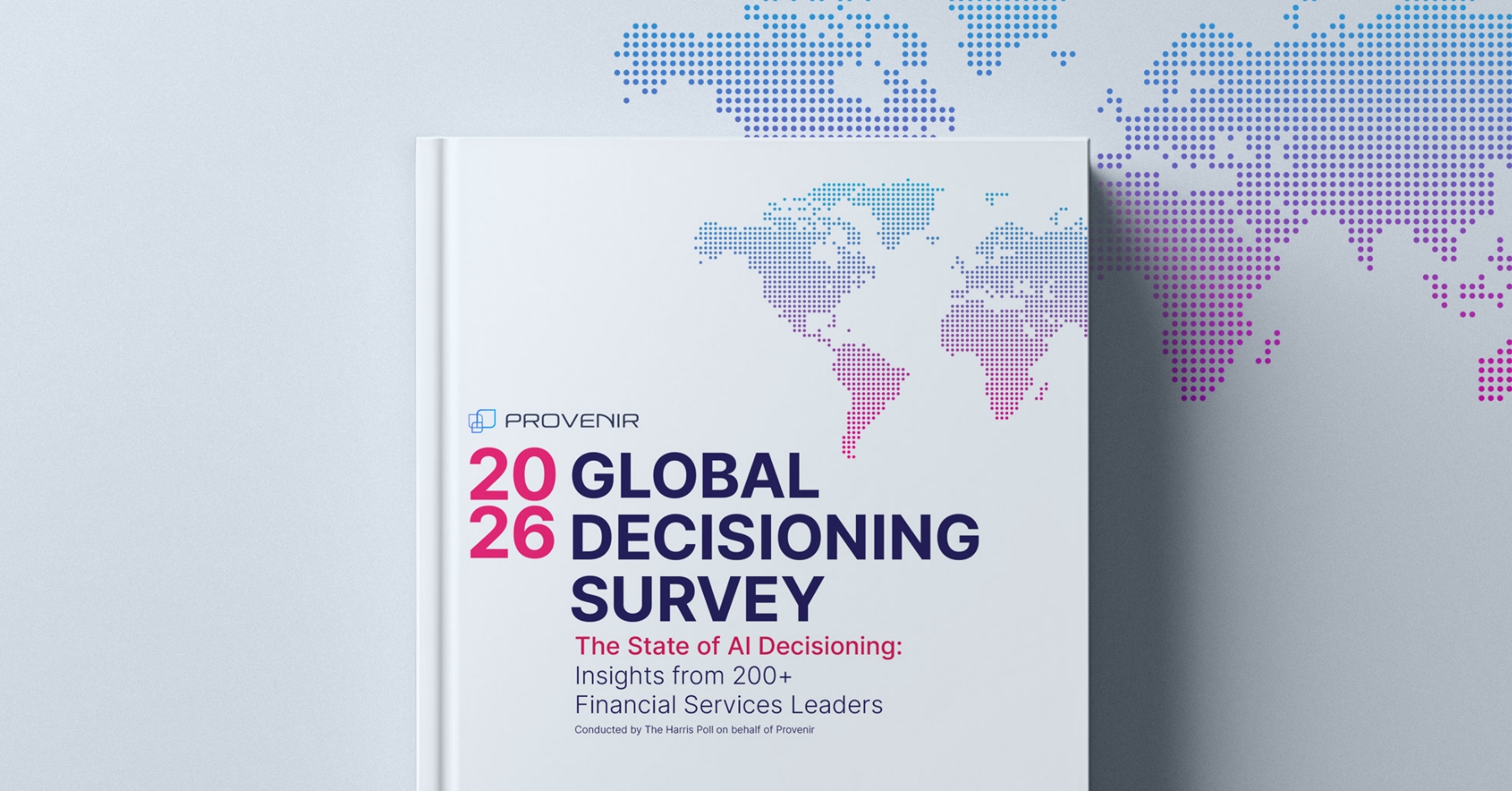
EBOOK Survey2026

Survey: 2026 Global Decisioning Survey

What are the key challenges and priorities for financial services leaders in 2026 and beyond?

The financial services industry stands at an inflection point in its adoption of artificial intelligence for decisioning. Our 2026 Global Decisioning Survey reveals a sector that recognizes AI’s transformative potential yet struggles with universal implementation challenges.

We surveyed 203 senior decision-makers—including Chief Risk Officers, CEOs, CFOs, and Heads of Risk—across 22 countries spanning banking, fintech, insurance, telecommunications, and other financial services sectors. The findings paint a nuanced picture of an industry in transition.

KEY FINDINGS AT A GLANCE
  • The AI Paradox:

    87% trust AI-driven decisioning outcomes, yet 97% face implementation barriers
  • The Fraud Challenge:

    77% are concerned about AI-enabled fraud threats while needing AI to combat fraud
  • Real-Time Momentum:

    91% have moved beyond static-only models; 52% use hybrid approaches
  • Decision Intelligence:

    77% see it as very valuable for their strategy over the next 2-3 years
  • Investment Priority:

    60% plan to invest in AI or embedded intelligence for decisioning in 2026
  • Governance Gap:

    Only 33% have fully implemented responsible AI frameworks

These findings reveal an industry that knows where it needs to go but faces significant challenges getting there. The organizations that successfully navigate implementation barriers—around compliance, explainability, and integration—will build sustainable competitive advantages through faster, more accurate, and more adaptive decisioning.

ADDITIONAL RESOURCES

Buy the Engine. Build the Advantage
Blog ::

Buy the Engine. Build the Advantage.

Blog Industry Date Buy the Engine.Build the Advantage. Christian Ball ...
BLOG Fraud
Blog ::

Why Nordic Banks Must Balance Fraud C...

Blog Industry Date Why Nordic Banks Must Balance Fraud Control ...
The Growing Threat of Fraud in UK Auto Lending
Blog ::

The Growing Threat of Fraud in UK Aut...

The Growing Threat of Fraud in UK Auto Lending Why ...
BLOG Mark
Blog ::

Why Telcos Can’t Afford to Think Like...

Blog Industry Date Why Telcos Can't Afford to Think Like ...
BLOG Survey02
Survey ::

The Fraud-AI Double Bind

The Fraud-AI Double Bind: New Survey Reveals the Fraud-AI Paradox ...
BLOG Survey01
Survey ::

Why 77% of Financial Institutions See...

Why 77% of Financial Institutions See Decision Intelligence as Their ...
BLOG Christian Ball
Blog ::

Smarter Acquisition and Customer Mana...

Smarter Acquisition and Customer Management:How Provenir Drives Growth and Reduces ...
Open Banking Expo Toronto
Event ::

Open Banking Expo Toronto

Open Banking Expo Join Provenir at The Open Banking Expo ...

Continue reading