Industry: AI

The Algorithm Challenge – Using AI for Risk Decisioning

BLOG

The Algorithm Challenge –
Using AI for Risk Decisioning

  • Giampaolo Levorato, Senior Data Scientist, Provenir

How to implement advanced AI algorithms for improvements across the modeling lifecycle

We’ve all heard the term Big Data, and the world of financial services is no exception. Big data refers to large, structured and unstructured sets of information growing at ever increasing rates. Data drives key decisions made by fintechs and financial services organizations – everything from helping determine identity and approving a car loan or a mortgage to optimizing pricing and deciding when to upsell a current customer. The surge in volume, variety and velocity of data has led financial institutions to use advanced machine learning algorithms to make smarter, faster decisions. But using AI is not without challenges. There can be several obstacles to successful deployment, including choosing the right algorithms, interpreting and explaining complex models, deploying the models, ensuring the infrastructure is sufficient, and managing bias.

AI Challenges

  1. Choosing the right algorithm: not all algorithms perform equally well on the same dataset. Depending on the nature of the data, organizations must be able to choose and configure the best algorithm to fit their data.
  2. Model complexity, interpretability and explainability: the intricacy of AI algorithms can make them “black boxes” in the sense that often even the developers don’t know why and how the algorithms make the decisions they do.
  3. Model deployment: deploying a model into production requires coordination between data scientists, software developers and business users, posing a challenge with regards to the different programming languages and approaches that need to be unified into one solution.
  4. Infrastructure requirements: many organizations lack the infrastructure required for data modeling and reusability. Being able to quickly develop and test different tools, across different, large datasets, is essential to producing more accurate, manageable results.
  5. Exclusion bias: many consumers globally remain ‘credit invisible’ or thin-filed, meaning that little-to-no credit scores are available for them.

Overcoming the AI hurdles

What’s the best way to tackle these challenges? Financial services organizations should transition from traditional Generalized Linear Models (GLM) to explainable AI algorithms to improve the speed and accuracy of their decisions. According to a recent survey conducted by Pulse and Provenir, 69% of companies plan to invest in AI-enabled credit decisioning in 2022.  AI algorithms can also help to more easily identify fraud and creates opportunities for improvement of the customer experience across the entire lifecycle.

Benefits of AI

  • Algorithm Optimization: choose the most appropriate algorithms from a wide variety of options, including Gradient Boosting Decision Trees, Random Forests and Deep Neural Networks, depending on the nature of the dataset.
  • Interpretability and Explainability: through a careful adoption of SHAP and LIME explanation methods it is possible to explain how and why your model has made a prediction.
  • Ease of Deployment: use of a unified platform enables seamless deployment, allowing businesses to take fast, effective action.
  • Scalability: reduce the development time from months to days by automatically training, testing, monitoring and managing your model.
  • Diverse Data: by leveraging traditional and alternative data, improve your model accuracy, while managing bias and promoting financial inclusion.

Moving to AI algorithms has numerous benefits – including higher accuracy, improved compliance and superior scalability – all of which have tremendous impact on your overall business stability and growth. Using AI algorithms means more predictive, more accurate models, resulting in increased profits, reduced losses and more up-to-date risk assessments. After conducting internal research, Provenir has observed that AI algorithms can improve a model’s accuracy by up to 7%, while automated model development and deployment can reduce time and effort by up to 90%. This automation ensures faster speed-to-market with more accurate models and the ability to quickly respond to consumer needs and market trends, for true scalability. And the effects of this go beyond an individual business when you consider the further-reaching implications on the economy as a whole – The Wall Street Journal forecasted a 14% increase in the global GDP by 2030 thanks to the advancements of AI.

More legislation is now in play that requires full explainability of models. Fully interpretable and explainable models meet these requirements by clearly demonstrating how and why models make the decisions they do. In addition to compliance, model governance can be incredibly difficult with traditionally siloed environments. Separate environments for data collection, model development, deployment and monitoring require an immense amount of time and resources to integrate.  With a cohesive, all-in-one environment you eliminate that integration time and effort, enabling live, real-time results and helping reduce human error from manual processes.

The Value of a Unified Platform

Further to the siloed environments of data collection, model development, deployment and monitoring, models are also often built separately from decision engines and unnecessarily moving data between them increases time, effort and the probability of errors. With a unified platform that incorporates data, AI and decisioning, models are built and implemented in the same platform, ensuring seamless data and model integration, eliminating recoding delays and ensuring maximum performance of your models. In Provenir’s experience, models implemented in a unified platform can save up to 30% of a modeling project’s overall time and effort.

But what makes AI so powerful and capable? It’s all about the data. The more data your AI models have, the better your advanced algorithms will perform. A data-agnostic platform that can integrate and enrich your existing data sets with any other type of data set (i.e. various forms of alternative data) is critical. This seamless integration to a wide variety of data sources helps to encourage financial inclusion, manage bias and improves the predictive power of your models. And it’s not a one-and-done deal – true value comes from the continuous improvement that happens when you bring data, AI and decisioning together. Model monitoring and a constant feedback loop helps you fine-tune your decisions for continual optimization.

Being able to increase your predictive power and make more accurate decisions has impacts across the entire customer lifecycle. Real-time dashboards and reports help you stay up-to-date on changes with your customers, your portfolio and all of your models – allowing you to automatically generate updated predictive models, with everything available for live monitoring. This helps to enable better relationships with your customers, increases your agility in responding to market needs, and better predicts (and prevents!) fraud and loss.

According to The Economist, 86% of financial services executives are planning to increase their investment in AI – but most AI projects never make it out of the concept/planning stage. Despite how daunting moving from linear models to advanced AI models can seem, it is possible to implement AI and see results in under 60 days.

Provenir helps you maximize value, minimize risk, and accelerate ROI — all on a single platform.

Provenir AI


LATEST BLOGS

260817 - BLOG Closing Fraud Gap - FeatureIMG - EN 61409

Beyond Detection: Cl...
Beyond Detection:Closing the Fraud Prevention Gap Financial services providers
260726 - BLOG eyeDP - FeatureIMG - 61058

Beyond Data: Why Dec...

Beyond Data:Why Decisioning Needs Document Intelligence Financial services providers
Fraud in Telco: Provenir Experts Answer Frequently Asked Questions

Fraud in Telco: Prov...

Fraud in Telco:Provenir Experts Answer Frequently Asked Questions 1.
260722 - ARTICLE Mike - FeatureIMG - 60958

AI governance in fin...

AI governance in financial services:What "governed" means in practice
Latam Compliance Challenge for Decisioning

LATAM Next Complianc...

From Data Protection to Decisioning Accountability:What LATAM Regulation Means
Banks Architecture Gap - Provenir

The Architecture Gap...

Decisioning ArchitectureThe Architecture Gap: Banking's Next Competitive Battleground Banks
BLOG Andy

The Real Cost of Ven...

The Real Cost of Vendor Dependency in Credit Decisioning
260617 - BLOG Matthew Nutt - FeatureIMG - 60431

What Does a Good Dat...

What Does a Good Data Provider Review Actually Look

Continue reading

Risk Management is the Next Frontier for AI Adoption

NEWS

Risk Management is the Next Frontier
for AI Adoption

AI investments in finance continue to gather steam in 2022, as more firms win the management buy in to automate processes with machine learning, implement near-autonomous trading algorithms, and deploy predictive analytics on the end-user side.

In an interview article in bobsguide, Carol Hamilton, SVP, Global Solutions at Provenir, shares her insights on the main factors required for AI to deliver ROI quickly and how AI and automation are blurring the lines of fraud and risk management in organizations.

Read Now

The Ultimate Guide to Decision Engines

What is a decision engine and how does it help your business processes?

Learn More


LATEST NEWS

Continue reading

AI in Fintech: Driving Innovation, Inclusion and Impact (in collaboration with Finovate)

ON-DEMAND WEBINAR

AI in Fintech:
Driving Innovation, Inclusion and Impact 

(in collaboration with Finovate)

Book a Meeting

Artificial intelligence is more than just the latest buzzword – using AI has a meaningful impact on decisions across the entire customer lifecycle. From improving fraud detection and decisioning accuracy to optimizing pricing and managing bias, AI has a key role to play in changing the way financial services products are developed and offered to customers.

In this panel discussion, we’ll cover how AI can:

  • Improve fraud detection and identify pre-delinquency patterns
  • Power financial inclusion with alternative data
  • Enable business growth with faster onboarding and optimized pricing for a personalized, superior customer experience
  • Expand your customer base without increasing your risk

Speakers:

  • Carol Hamilton

    Senior Vice President, Global Solutions, Provenir

  • Hakan Yilmaz

    EVP, Chief Data & Analytics Officer, Yapi Kredi

  • David Penn

    Research Analyst, Finovate


RESOURCES

Continue reading

Webinar: Tackling Industry Priorities With a Different Approach to Data and AI

ON-DEMAND WEBINAR

Tackling Industry Priorities
With a Different Approach to Data and AI

Book a Meeting

Struggling with data integration and AI adoption?

There are vast amounts of data available to the financial services industry, yet many organizations struggle with data integration and AI adoption that delivers value to their customers. Join us as Carol Hamilton, Provenir’s Chief Product Officer, sits down with Holly Hughes, CMO of BAI, for a discussion on data and AI trends influencing the industry.

Discover:

  • How many providers plan to deliver a high level of responsiveness and superior customer experiences with new sources of data and the right predictive models
  • The ways simplified access to alternative and non-traditional data can reshape your business
  • How organizations of all sizes can accelerate AI/ML adoption while removing the typical barriers to implementation

Speakers:

  • Holly Hughes

    CMO, BAI

  • Carol Hamilton

    Chief Product Officer, Provenir


RESOURCES

Continue reading

Harnessing AI and Machine Learning to Improve Credit Risk Decision-Making

NEWS

Harnessing AI and Machine Learning
to Improve Credit Risk Decision-Making

In a global study conducted with 400 decision makers in fintech and financial services organizations, we uncovered a high degree of uncertainty in credit risk modeling accuracy and a growing appetite for AI predictive analytics and machine learning, data integration and the use of alternative data.

Listen in as Robin Amlôt of IBS Intelligence, and Carol Hamilton, SVP Global Solutions at Provenir, discuss the findings revealed in this research and how organizations plan to use data, AI, and decisioning to improve credit risk decisioning and support the key imperatives of fraud detection/prevention and financial inclusion.

Tune In

The Ultimate Guide to Decision Engines

What is a decision engine and how does it help your business processes?

Learn More


LATEST NEWS

Continue reading

Event: Transforming Credit Decisioning with AI

ON-DEMAND WEBINAR

Transforming Credit Decisioning
With Artificial Intelligence

Book a Meeting

How can AI-powered risk decisioning play a part in transforming the entire credit risk decisioning process? Technology continues to evolve and advances in big data, digital transformation, and AI/ML are creating new opportunities for financial services and fintechs to improve their credit decisioning processes.

Join us for this exciting panel discussion moderated by FinTech Magazine and hear from industry experts on using AI/ML to transform credit risk decisioning.

You’ll learn:

  • Opportunities and challenges in using AI for risk decisioning
  • How to set up AI projects for success
  • Ways that AI can impact the entire customer lifecycle
  • How to power financial inclusion with alternative data and advanced analytics

Speakers:

  • Bharath Vellore

    General Manager, APAC, Provenir

  • Thai Dinh

    Head of Data Science and AI, PayMaya

  • Tom Donlea

    Vice President, APAC, Ekata

Moderator:

Scott Birch

Chief Content Officer, FinTech Magazine


RESOURCES

Continue reading

Machine Learning in Banks: The Solution to the Data Scientist Talent Gap

BLOG

Machine Learning in Banks:
The Solution to the Data Scientist Talent Gap

In 2023, the shortage of skilled data scientists is still a challenge for financial institutions. According to Indeed.com, the popular recruiting site, searching for “Data Scientist Financial Services” returns 1745 results. McKinsey & Company studied over a dozen banks in Europe that have replaced older statistical-modeling approaches with machine-learning techniques and saw significant improvements in their business metrics.

The Talent Gap Challenge:

With the increasing importance of data analytics in banking, the shortage of skilled data scientists is becoming increasingly serious. Tools for collecting, sifting, and sorting data become faster, cheaper, and better, but people with the skills to make use of the results are harder and harder to find.

Cloud-Based Machine Learning Services:

Cloud-based machine learning services can help fill the talent gap by opening up opportunities for junior or internal hires to augment risk analytics teams, provide immediate value, and grow into more advanced roles. Machine Learning can train and deploy a credit risk model in about 20 minutes, even by someone with little to no experience.

Benefits of Machine Learning:

Machine learning is not just a temporary solution to a talent problem. McKinsey & Company’s study of European banks revealed increases in sales of new products, savings in capital expenditures, increases in cash collections, and declines in churn after replacing older statistical-modeling approaches with machine-learning techniques.

Automated Risk Decisioning:

Combining machine learning with automated risk decisioning can prove invaluable to a financial institution’s bottom line. Automated risk decisioning helps make better credit decisions and improves overall portfolio performance.

Machine learning is the solution to the data scientist talent gap in the banking industry. Cloud-based machine learning services can provide immediate value and help junior or internal hires grow into more advanced roles. The benefits of machine learning are significant and can positively impact a financial institution’s bottom line.


LATEST BLOGS

260817 - BLOG Closing Fraud Gap - FeatureIMG - EN 61409

Beyond Detection: Cl...
Beyond Detection:Closing the Fraud Prevention Gap Financial services providers
260726 - BLOG eyeDP - FeatureIMG - 61058

Beyond Data: Why Dec...

Beyond Data:Why Decisioning Needs Document Intelligence Financial services providers
Fraud in Telco: Provenir Experts Answer Frequently Asked Questions

Fraud in Telco: Prov...

Fraud in Telco:Provenir Experts Answer Frequently Asked Questions 1.
260722 - ARTICLE Mike - FeatureIMG - 60958

AI governance in fin...

AI governance in financial services:What "governed" means in practice
Latam Compliance Challenge for Decisioning

LATAM Next Complianc...

From Data Protection to Decisioning Accountability:What LATAM Regulation Means
Banks Architecture Gap - Provenir

The Architecture Gap...

Decisioning ArchitectureThe Architecture Gap: Banking's Next Competitive Battleground Banks
BLOG Andy

The Real Cost of Ven...

The Real Cost of Vendor Dependency in Credit Decisioning
260617 - BLOG Matthew Nutt - FeatureIMG - 60431

What Does a Good Dat...

What Does a Good Data Provider Review Actually Look

Continue reading

2022 Global Fintech Agenda

INFOGRAPHIC

2022 Global Fintech Agenda

What’s driving the agenda for fintechs and financial services in 2022?

Pulse and Provenir surveyed 400 decision-makers in fintechs and financial services organizations globally to find out what they believe will be the biggest challenges, opportunities and trends of 2022 and how they plan to address them with data, AI and decisioning.

The Ultimate Guide to Decision Engines

What is a decision engine and how does it help your business processes?

Read the Blog

RESOURCE LIBRARY

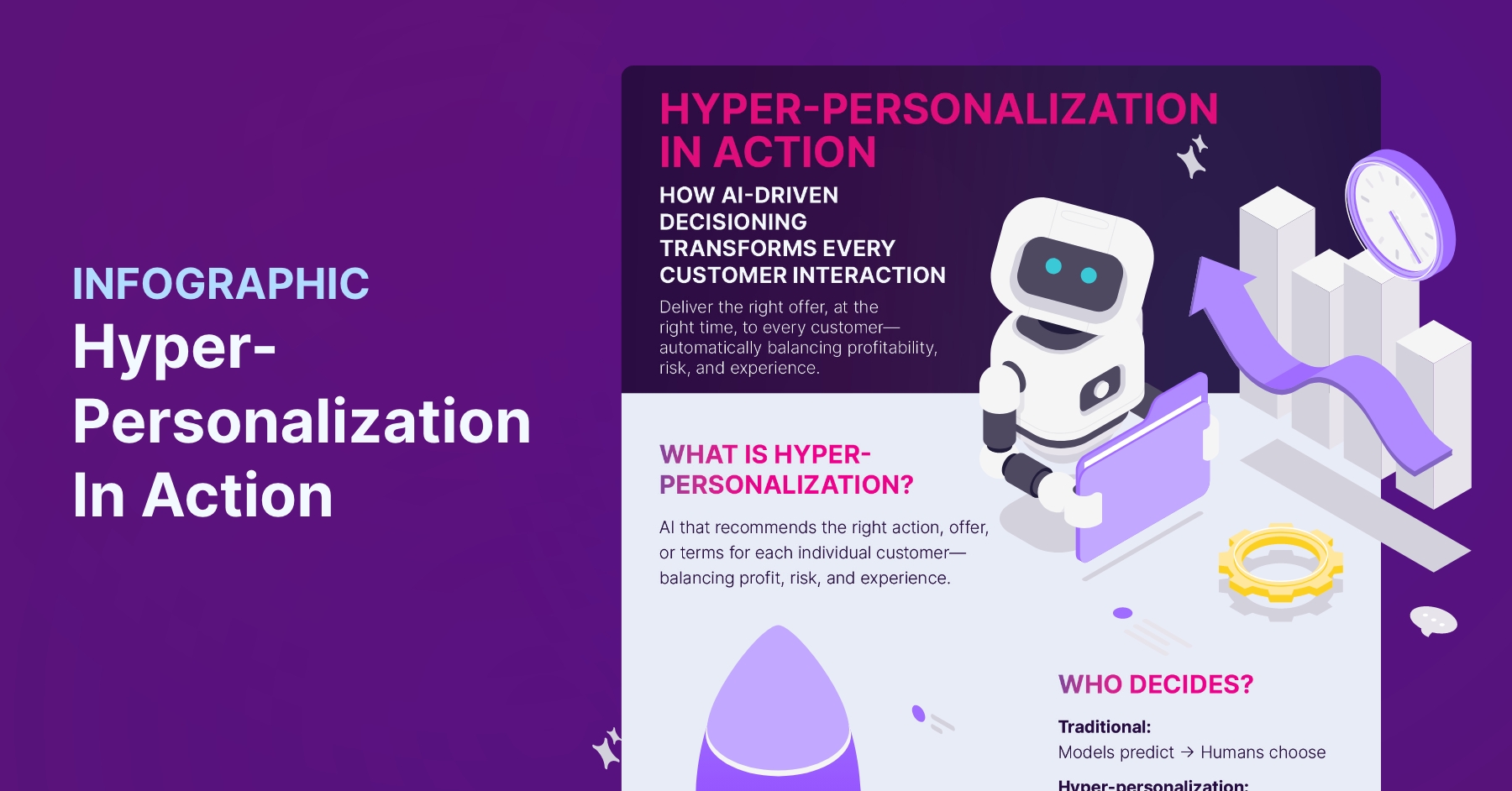
INFOGRAPHIC Hyper-personalization

Hyper-Personalizatio...

Most financial institutions still rely on humans to interpret model predictions and make the final
AI infographic

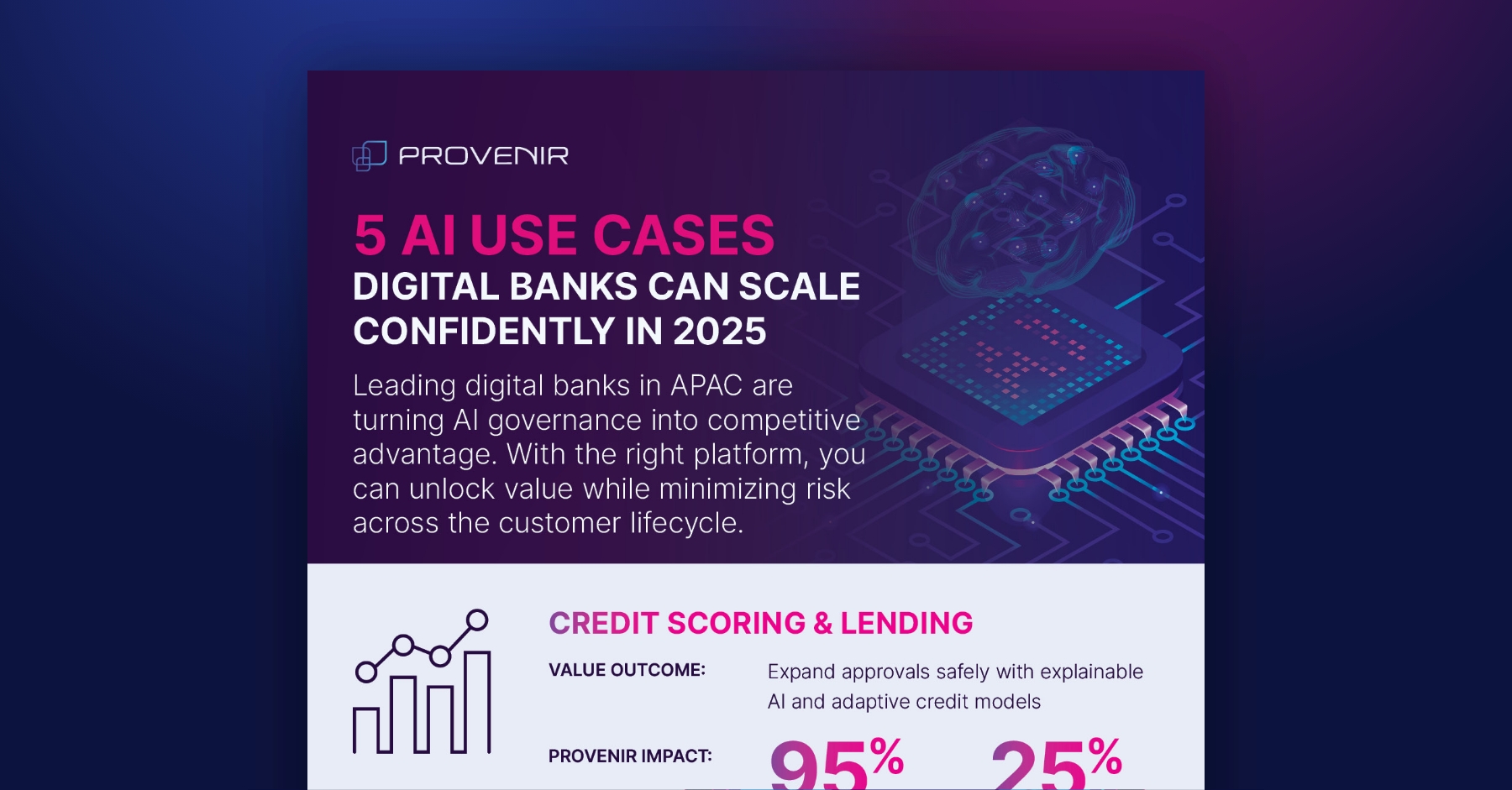
5 AI Use Cases Digit...

5 AI Use Cases Digital Banks Must Govern by 2025 Digital banks across APAC are
telco fraud thumbnail

Infographic: How to ...

INFOGRAPHIC Navigating the High-Stakes World of Telco Decisioning How to Maximize Revenue Without Risk Increasing
Infographic: Unlocking the Embedded Finance Advantage

Infographic: Unlocki...

Infographic Unlocking the Embedded Finance Advantage How to Harness Embedded Finance for Enhanced Customer Experiences
Infographic: One decisioning platform for every customer touchpoint

Infographic: One dec...

Balancing risk with opportunity can be a challenge - especially when you need to offer
Navigating Your Legacy System Upgrade

Navigating Your Lega...

Do you struggle to maintain your legacy decisioning systems? A lack of support from current
provenir logo

Infographic: The Evo...

With extraordinary growth over the past twenty years, the financial services sector has seen incredible
Elevating Customer Experiences: Headless Banking and Banking-as-a-Service (BaaS)

Elevating Customer E...

INFOGRAPHIC Elevating Customer Experiences: Headless Banking and Banking-as-a-Service (BaaS) How to enhance engagement and streamline

Continue reading

Artificial Intelligence, Simplified.

EBOOK

Artificial Intelligence, Simplified.

How to Level Up Your Risk Decisioning in Under 60 Days

Artificial intelligence in financial services is a $450 billion opportunity – but most AI projects never even get off the ground. Using AI in combination with the right data and the right decisioning tools means you can take a bite out of those billions of dollars of opportunity – and you can get there in less than two months.

Discover why you should implement AI in your risk decisioning, and how to do it.

The Ultimate Guide to Decision Engines

What is a decision engine and how does it help your business processes?

Read the Blog

RESOURCE LIBRARY

Data Providers Blog

Practical Guide to Reviewing Your Data Providers

Ebook What’s Missing from Your Decision Stack? Smarter decisions ...
EBOOK KShape

One Portfolio, Two Economies

One Portfolio, Two Economies: Model Drift, Consumer Divergence, and ...
EBOOK Survey2026

Survey: 2026 Global Decisioning Survey

What are the key challenges and priorities for financial ...
Survey: 2025 Global Risk Decisioning Survey

Survey: 2025 Global Risk Decisioning Survey

Survey: 2025 Global Risk Decisioning Survey What are the ...
EBOOK: How Telcos Can Boost Revenue Without the Risk

EBOOK: How Telcos Can Boost Revenue Without the Risk

Dial Into Profit: How Telcos Can Boost Revenue Without ...
Vendor Report: Chartis Research Names Provenir a Global Leader

Vendor Report: Chartis Research Names Provenir a Global Leader

Chartis Research Names Provenir a Global Leader Credit and ...
Mind the Gap: The Need for Speedy, Accessible SME Lending in EMEA

Mind the Gap: The Need for Speedy, Accessible SME Lending in EMEA

EBOOK Mind the Gap: The Need for Speedy, Accessible ...

Continue reading

The Promise of AI: Level Up Decisioning Across The Entire Customer Lifecycle

BLOG

The Promise of AI:
Level Up Decisioning Across The Entire Customer Lifecycle

  • Brendan Deakin, SVP Sales, North America

If there are kids in your life (or even some adults – we don’t judge), you may have heard of Minecraft. You start with nothing – gathering some basic raw materials and finding food and shelter – but in order to really get ahead in your worlds you need to level up your game. You have to figure out which elements to put together to create the things you need to not only survive but thrive.

Today’s risk decisioning is also about evolving beyond the basics. When you start out making credit risk decisions you may just have the essentials – some data, some workflow tools, some basic automation. But to really level-up your decisioning you need more. More data, more automation, more sophisticated processes, more forward-looking predictions. And to do that, you need AI.

We’ve all seen the end-of-year roundups, predictions for 2022 and ongoing fintech trend reports. (Sidenote: we’ve even conducted our own proprietary survey of 400 leaders in financial services and banking – want to see what’s in and what’s out?  And they all agree – artificial intelligence and machine learning are here to stay. 64% of those we surveyed said AI is currently an important feature of their risk decisioning or consider it one of the most important features when selecting a system, and 86% of financial services executives plan to increase their investment in AI.

Much of the discussion around AI centers around cost and time – as in, it takes a long time to develop and implement AI, and it can be prohibitively expensive. And if you do manage to implement a successful AI project, it can take months (or longer) to see any tangible ROI results. “56% of global CEOs expect it to take 3-5 years to see any real ROI on their AI investment.” Who has time for that??

But there’s more to it. AI-powered risk decisioning is about more than just more accurate decisions and better predictability. What’s talked about less is how it impacts the entire credit risk lifecycle.

Currently, only a small amount of AI projects are perceived as a success. Those that are successful create tangible benefits across the credit risk lifecycle that drive growth, increase agility, and make your business more competitive. For example, Provenir customer Pinjam Modal, saw a huge performance lift in their decisioning accuracy, with bad rate reduced by 60%. AI, implemented and used correctly, has the ability to power performance improvements in multiple ways.

Expand Your Customer Base

AI empowers you to confidently say yes to customers you haven’t been able to approve before, driving business growth without sacrificing performance. How? AI flips your traditional risk analytics on its head. Rather than starting with a set of clear rules and decisioning based on those rules, AI models don’t need rules. Instead, they can identify patterns within data and then decision using those patterns. So, instead of needing to know the story data tells before you start decisioning, AI identifies those stories for you!

What does this mean for your customer base and in turn your business? With AI you are no longer confined to pursuing customers with the attributes of your existing lending base. Instead, you can use AI models to discover new patterns in the data that empower you to lend to a much wider base of people. It’s a quick way to drive business growth without increasing costs or risks – like getting special powers in a video game that immediately boost you over the finish line.

Support Financial Inclusion

We can’t talk about the benefits of AI without mentioning financial inclusion. In the US alone, 24% of the population are underbanked with a further 10% completely unbanked. Approximately 3.6 billion people in Asia have no access to formal credit and there are about 200 million unbanked individuals in Latin America. Globally, up to one-third of all adults (1.7 billion at last count, according to the Global Findex database) lack any type of bank account, meaning that access to financial services is difficult for a significant number of consumers. Financial services organizations typically struggle to support these consumers because they don’t come with a history of data that is understandable by traditional decisioning methods. However, because AI can identify patterns in a wide variety of alternative, traditional, linear, and non-linear data, it can power highly accurate decisioning, even for no-file or thin-file consumers. It’s like finding a secret shortcut – the data was there, you just needed the right tools to uncover it. In a recent report, PWC reported that banks launching AI initiatives were able to increase their lending approvals by 15-30% with no change in loss rates. These figures include loans to previously overlooked borrowers. AI gives your organization the opportunity to support unbanked and underbanked consumers on their financial journeys. 

Identify Fraud + Say Yes More

Did you know that identity fraud losses hit $56 billion in 2020? In today’s digital world, where all types of fraud attacks, not just identity fraud, are getting more sophisticated and widespread, how do you really know who’s legitimate and who’s not?

If you’re struggling to manage high fraud rates and false positives using rule-based detection, AI could have an immediate and significant impact on your fraud management performance. A key benefit of using AI for fraud detection is its ability to get smarter with each transaction it processes. So, even when fraudsters evolve their methods, your AI models can use real-time data to identify new patterns, learn, and adapt decisioning to maximize the right fraud alerts and minimize false positives. Financial institutions who had already adopted AI were surveyed in a recent PMYNTS study on the benefits of AI – 81% cited being alerted to fraud before it happens, 75% said the reduction of false positives and 56% said the reduction of payment fraud were key outcomes of their AI systems. 

Be More Competitive With Optimized Pricing

Increasing competition means that you need to make the right offer at the right price. Using AI for pricing optimization not only makes your products more attractive, it lets you maximize profitability. How does it do this? AI empowers you to be more confident about the risk a credit application poses, so you can more accurately assess how to price the credit you offer. Instead of lumping applications into price buckets you can get closer than ever to personalized pricing. Innovative lenders are also using AI to measure an applicant’s propensity to buy and combining this information with credit worthiness to determine the most attractive rate.

And more accurate decisioning means lower loss reserves, enabling you to have more capital available for lending activities. AI empowers you to make your lending portfolio work harder.

Expand Your Relationship With Personalized Upsell and Cross-sell Offers

What was the most frustrating part of playing video games in the 90s? Finding out the Princess was in another castle. Why? Because you’d done all of the work without the satisfying ending. Your customers have already gone through the work of onboarding with you for a specific product, but what happens when you don’t offer them other products they need at exactly the right time? They find it in another castle. These days, loyalty to particular financial institutions is waning, quickly – 31% of consumers surveyed will switch primary providers over everything from fee levels and rewards to security issues and convenience. According to the Financial Brand, “while 66% of customers expect companies to understand their unique needs and expectations, only 32% of executives say they have the full ability to turn data into personalized prices, offers and products in real time across channels and touch points.”

What advantage do you have over your competitors when it comes to existing customers? Data. Lots of it. But finding the patterns in that data to show how, when and what offers to give your customers has traditionally been expensive, time consuming and difficult. Enter AI.

With the right AI models and automated decisioning you can analyze your customer data and automatically make the upsell and cross-sell offers when they are most likely to convert. Big brands we all know and love do this extremely well – according to McKinsey, “35% of what consumers purchase on Amazon and 75% of what they watch on Netflix come from product recommendations” based on AI algorithms. Become the only castle your customers need for all of their financial services needs by showing that you truly understand and anticipate their needs.

Predict and Prevent Losses Through Better Customer Management

Is your technology and analytics reacting to delinquent accounts, instead of predicting which customers will face financial challenges? Does it use a set of defined rules to predict delinquencies? Are predictions based on historical data? If so, you could be missing out on the opportunity to both better support your customers and reduce losses.

More traditional analytics approaches to predicting which accounts will go into collections rely heavily on historical data and predefined rules. But, in today’s digital, fast-moving world, the data you need to make accurate collections predictions is often produced in real-time. Put simply, traditional risk decisioning looks for delinquency patterns that we already know. AI on the other hand, ingests real-time data and uses that data to identify new patterns, enabling you to make more accurate delinquency predictions. This, in turn, empowers you to work with customers to help them manage their finances. It’s a win-win situation: you get to reduce the number of customers being pushed to collections and you get to build stronger relationships with your customers. Kind of like the advent of online gaming – working with a partner in real-time produces better results, and a higher win rate. As Forbes puts it, “Machine learning can also be used to determine the probability of delinquency for specific borrowers. This early warning system allows lenders to focus their energies on at-risk clients to prevent their accounts from becoming delinquent in the first place.” 

Organize Your Resources

In any endeavor, it’s critical to be organized. Implementing an AI project is no different. It may seem daunting, but it’s clearly worth it. Particularly if you work with a technology partner to implement AI quickly and efficiently – and see the returns faster than you thought possible. Talk about a winning strategy.

Explore our resources to accelerate your innovation journey. Browse our articles, videos, webinars and podcasts.

Resources


LATEST BLOGS

260817 - BLOG Closing Fraud Gap - FeatureIMG - EN 61409

Beyond Detection: Cl...

Beyond Detection:Closing the Fraud Prevention Gap Financial services providers
260726 - BLOG eyeDP - FeatureIMG - 61058

Beyond Data: Why Dec...

Beyond Data:Why Decisioning Needs Document Intelligence Financial services providers
Fraud in Telco: Provenir Experts Answer Frequently Asked Questions

Fraud in Telco: Prov...

Fraud in Telco:Provenir Experts Answer Frequently Asked Questions 1.
260722 - ARTICLE Mike - FeatureIMG - 60958

AI governance in fin...

AI governance in financial services:What "governed" means in practice
Latam Compliance Challenge for Decisioning

LATAM Next Complianc...

From Data Protection to Decisioning Accountability:What LATAM Regulation Means
Banks Architecture Gap - Provenir

The Architecture Gap...

Decisioning ArchitectureThe Architecture Gap: Banking's Next Competitive Battleground Banks
BLOG Andy

The Real Cost of Ven...

The Real Cost of Vendor Dependency in Credit Decisioning
260617 - BLOG Matthew Nutt - FeatureIMG - 60431

What Does a Good Dat...

What Does a Good Data Provider Review Actually Look

Continue reading