Industry: Fraud

Maximizing AI/ML for Fraud and Risk Mitigation

Blog

Maximizing AI/ML
for Fraud and Risk Mitigation

  • Jason Abbott, Senior Product Manager, Fraud Solutions
  • May 6, 2024

How to Harness Artificial Intelligence and Machine Learning for Comprehensive Fraud Protection

The battle against fraud and risk in financial institutions is complex, and it’s always changing. And fraud doesn’t start and end with the onboarding of applicants – it’s a continuous challenge that demands evolving strategies. This is why it’s critical to look at risk decisioning solutions, including artificial intelligence and machine learning, that can access real-time data across the journey – tackling fraud screening not just at the application stage, but throughout the entire customer lifecycle.

Real-time data for real-time decision making

Artificial intelligence and machine learning (AI/ML) play a pivotal role in detecting and preventing fraudulent activities. With financial fraud methods becoming more and more sophisticated, one key way to stay ahead of fraudsters is accessing real-time data, integrating it into your risk decisioning solutions, and automating the use of that data with AI/ML. In this way, you can react swiftly (and accurately) to ever-evolving fraud threats. 

But it’s critical to balance fraud mitigation with the customer experience. While admittedly powerful technology, AI/ML requires more than just advanced algorithms and risk models – it needs a comprehensive understanding of the overall decisioning operations, customer experience, and the regulatory and compliance landscape of financial services organizations in the regions you operate. An effective fraud decisioning model needs to not only intercept fraudsters, but it needs to be sure that it doesn’t introduce more friction for legitimate customers. Tightening the net on fraudsters isn’t the most optimal answer – we need to ensure that embedded intelligence is working efficiently to keep out the bad actors while still extending the right products and offers to a growing number of creditworthy customers.

Intelligent use of data throughout the customer journey

A common challenge that financial institutions face is the underutilization of valuable customer data that gets collected during the application process. Rather than discarding this data, it should be integrated into ongoing monitoring programs and used to enhance risk mitigation strategies, especially during high-risk events. For example, take the case of mule account detection, where initial application data contains the right indicators that help approve an applicant. But with ongoing monitoring as new data becomes available, financial institutions could intervene later if new suspicious activity is tracked. With a set-it-and-forget-it mindset and the lack of ongoing monitoring, fraudsters can more easily slip through the cracks. As fraud methods become more evolved, the risk models needed to prevent fraud need to evolve as well. Many times, actors with ill-intent will use legitimate credentials to gain access to products and services and then pull a bait-and-switch when onboarded. Without the use of ongoing monitoring and the continuous intelligent, optimized use of risk data across the journey, these sorts of situations become difficult to catch until it’s too late. 

This is why adapting quickly to new threats is so critical. Flexibility and responsiveness are key things to look for in a fraud/risk decisioning solution, because with the adaptability to add new data sources, optimize risk models based on intelligence, and change decisioning processes easily, you are able to respond to threats more effectively. AI/ML models act like the central nervous system of a modern sports car, where every component must communicate and function in unison to effectively respond to changing conditions – in the case of a car it’s road conditions, weather conditions, engine temperature, etc. In the case of fraud mitigation, you need to ensure that you can adapt quickly without being bogged down by manual processes or IT backlogs to make changes.

Efficient data integration

Not all financial institutions have the ability to integrate extensive datasets into a smart, unified model or data lake. Whether it’s technical restrictions, resource issues, IT backlogs, or the challenges of merging disparate systems, there are many factors that can hinder efficient data integration. What’s needed is an effective fraud orchestration layer, combined with low-code or no-code capabilities, allowing you to adapt and innovate as quickly as threats do, giving you a significant competitive advantage (and again, helping to maintain a positive customer experience with limited friction). 

So what are the key things to consider when it comes to enhancing your fraud mitigation strategy by harnessing AI/ML? Think of the following:

    • Does your AI/ML model for application fraud provide reliable scoring and clear explainability?

    • Can you integrate fraud-rich data into your application fraud infrastructure?

    • How easily can you integrate new data sources in response to emerging fraud trends?

    • Are you able to leverage available data to address potential post-application fraud?

    With cutting-edge technology designed to empower financial institutions to not only respond to threats in real time, but also anticipate them before they can cause harm, decisioning technology that incorporates robust AI/ML solutions will ensure your organization (and your customers) remain secure and satisfied.

    LATEST BLOGS
    5 Questions Your Decisioning Platform Can't Answer (But Should)

    5 Questions Your Dec...

    5 Questions Your Decisioning Platform Can't Answer(But Should) Most
    Brendan Deakin, Executive Vice President at Provenir

    Confidence at Speed:...

    Confidence at Speed:What Risk Leaders Are Actually Missing Most
    BLOG Bharati Fernando

    How to Change a Deci...

    How to Change a Decisioning Model Without Raising a
    Verifying the Invisible Subscriber

    Verifying the Invisi...

    Verifying the Invisible Subscriber How Accessing 1datapipe on the
    FAQ

    Decision Management ...

    Decision Management Implementation FAQs for Enterprise Banks Implementing a
    260817 - BLOG Closing Fraud Gap - FeatureIMG - EN 61409

    Beyond Detection: Cl...

    Beyond Detection:Closing the Fraud Prevention Gap Financial services providers
    260726 - BLOG eyeDP - FeatureIMG - 61058

    Beyond Data: Why Dec...

    Beyond Data:Why Decisioning Needs Document Intelligence Financial services providers
    Fraud in Telco: Provenir Experts Answer Frequently Asked Questions

    Fraud in Telco: Prov...

    Fraud in Telco:Provenir Experts Answer Frequently Asked Questions 1.

    Continue reading

    On-Demand: Decisioning Advanced: Integrating Intelligent Credit and Fraud Decisioning to Maximize Customer Lifetime Value

    ON-DEMAND WEBINAR

    Decisioning Advanced:
    Integrating Intelligent Credit and Fraud Decisioning to Maximize Customer Lifetime Value

    Book a Meeting

    Featuring Jim Marous of The Financial Brand

    Discover this dynamic on-demand webinar crafted for financial industry professionals seeking to enhance their approach to credit risk and fraud prevention while optimizing customer value.

    In this session, The Financial Brand’s Jim Marous and Provenir’s Chief Product Officer Carol Hamilton delve into how these smart technologies not only protect your organization from potential risks but also open doors to deeper customer engagement and retention strategies, ultimately boosting the lifetime value of your customers. 

    Key takeaways:

    • The strategic benefits of implementing intelligent decisioning systems that use advanced analytics like AI/ML to refine credit risk and fraud management
    • Insights and best practices needed to achieve a more agile, customer-centric business model
    • How to transform your financial institution into a forward-thinking powerhouse in today’s competitive landscape
    • How to integrate intelligent systems into existing operations and navigate the challenges of legacy systems

    Speakers:

    • Jim Marous

      The Financial Brand

    • Carol Hamilton

      Chief Product Officer, Provenir


    RESOURCES

    Continue reading

    Optimizing Data Orchestration for Application Fraud Prevention

    BLOG

    Optimizing Data Orchestration
    for Application Fraud Prevention

    Why more data isn’t always the answer – but a more holistic approach is.

    The Growing Threat of Application Fraud

    The world continues to become more and more digital – and fraudsters are taking advantage by consistently finding new ways to exploit any weaknesses in technology and financial services systems. Application fraud in particular has emerged as a significant threat in financial services, with attempts (and the various types) increasing steadily. According to TransUnion’s 2023 State of Omnichannel Fraud Report, nearly 5% of digital transactions globally in 2022 were found to be possibly fraudulent (4.2% for financial services specifically), and there were over $4.5 billion in outstanding balances in the U.S. for auto loans, credit/retail cards, and unsecured personal loans, thanks to synthetic identities (which incidentally marks a 27% increase since 2020, and the highest level ever recorded). Additionally there was an increase of 39% from 2019-2022 in cases of fraud attempts in financial services, with the top type being identity fraud.

    So what does this mean for financial institutions, payment providers, lenders, fintechs, etc.? It means that as fraudsters and their methods evolve, so too must the ways in which we as an industry detect and prevent it. But how? One key is data orchestration. Because with a more holistic, comprehensive view of your customers you can:

    • More accurately detect and prevent fraud, at onboarding and beyond, and;
    • Ensure that genuine, creditworthy customers don’t feel the pain while you do so

    Fraud Attempts on the Rise

    Fraud attempts are increasing. Rapidly. Which makes it more imperative than ever that the financial services industry gets prevention right. According to TransUnion, these are the top fraud types and their growth this year:
    Fraud TypeDigital Fraud in 2022Volume Change 2019-22
    Credit Card6.5%76%
    Account Takeover6.3%81%
    True Identity Theft6.2%81%
    ACH/Debit6.0%122%
    Synthetic Identity5.3%132%
    ** TransUnion’s 2023 State of Omnichannel Fraud Report
    To prevent application fraud, financial services institutions must use various detection mechanisms, typically curated from data partners/sources, including identity verification, screening, and scoring. Identity verification involves verifying that the applicant is who they claim to be, while screening involves checking the applicant’s information against various databases, including credit bureaus and watchlists, to identify red flags. Scoring involves assessing the risk associated with the applicant based on various data points, including credit history, employment, and financial data. Looking at various data sources, including open banking, bureau data, email and social media, device information, KYC, and sanction screening can all be used to check whether a) a person is legitimately who they claim to be and b) whether they really intend to actually use the financial product in a responsible way (i.e. will they pay you back??).

    More Data To Combat Fraud? Or BETTER Data?

    So it’s clear that fraud prevention is critical. But if your immediate reaction is to buy all the data… think again.

    From TransUnion again, “the knee-jerk response to rising data breaches and persistent digital fraud might be to increase identity verification and authentication checks. However, the transition to an always-on, digital-first customer experience, evidenced by the dramatic increase in digital transactions over the past few years, means fraud leaders must be aware of customer experience and enable the business to drive top-line growth while reducing fraud risk.”

    So despite how tempting it is to just use more and more data, you need to balance that with a) the consumer experience (are you ready to add more friction to the journey?) and b) the unnecessary cost and inefficiency of buying more data than you need. Because the better you get at accessing and integrating the right fraud data, at the right time in the customer journey, the better results you’ll see:

    • Less friction in the consumer experience
    • More accurate fraud risk models
    • Increased ability to assess fraudulent activity and the intent to pay
    • More growth – because ultimately, the more adept you get at preventing fraud, the more confident you can be in your decisions, enabling sustainable business improvements across the customer lifecycle

    SIDENOTE: Predictive analytics, like embedded machine learning and artificial intelligence, also helps, by automatically analyzing vast amounts of data and offering insights into patterns of behavior that may indicate fraud.

    Eliminate Decisioning Silos

    Traditional fraud detection methods often result in siloed environments between fraud and risk teams, leading to an incomplete view of the customer and their creditworthiness. To overcome this challenge, financial institutions need to think about adopting a holistic, end-to-end risk decisioning solution that integrates fraud and risk management. This approach enables a more comprehensive view of your customers and their creditworthiness while accurately detecting fraud by eliminating the siloed environment between your fraud and risk teams.

    A more holistic, integrated view of your customers enables you to stay ahead of threats, and an end-to-end risk decisioning platform ensures you can continually improve your fraud risk models and optimize decisions as threats evolve – all right alongside your credit risk decisions. Eliminating these siloed environments offers maximum flexibility and agility at every step of your risk decisioning processes. Reduce the complexity of managing multiple online fraud detection tools and disparate decisioning systems with one unified, end-to-end solution for fraud, credit, and compliance across the customer journey. And watch your business grow as a result.

    Discover more accurate fraud risk detection with a more holistic, comprehensive view of your customers.

    Learn More

    Did You Know?

    • KYC – 67% of corporate treasurers limit the banks they work with because of KYC-related challenges
    • AML – between $800 billion (2%) and $2 trillion (5%) of the world’s GDP is laundered globally each year
    • Mule Accounts – 34% increase in mule accounts belonging to 40-60 year olds since 2017
    • KYB – it can take anywhere from 90-120 days to onboard a corporate banking customer
    • Identity Theft – there’s a new victim of identity theft every 2 seconds
    • Account Takeover – 41,857 account credentials stolen per minute
    • SIM Swap – SIM swap fraud reports have increased by 400% in the past five years
    LATEST BLOGS

    5 Questions Your Decisioning Platform Can't Answer (But Should)

    5 Questions Your Dec...

    5 Questions Your Decisioning Platform Can't Answer(But Should) Most
    Brendan Deakin, Executive Vice President at Provenir

    Confidence at Speed:...

    Confidence at Speed:What Risk Leaders Are Actually Missing Most
    BLOG Bharati Fernando

    How to Change a Deci...

    How to Change a Decisioning Model Without Raising a
    Verifying the Invisible Subscriber

    Verifying the Invisi...

    Verifying the Invisible Subscriber How Accessing 1datapipe on the
    FAQ

    Decision Management ...

    Decision Management Implementation FAQs for Enterprise Banks Implementing a
    260817 - BLOG Closing Fraud Gap - FeatureIMG - EN 61409

    Beyond Detection: Cl...

    Beyond Detection:Closing the Fraud Prevention Gap Financial services providers
    260726 - BLOG eyeDP - FeatureIMG - 61058

    Beyond Data: Why Dec...

    Beyond Data:Why Decisioning Needs Document Intelligence Financial services providers
    Fraud in Telco: Provenir Experts Answer Frequently Asked Questions

    Fraud in Telco: Prov...

    Fraud in Telco:Provenir Experts Answer Frequently Asked Questions 1.

    Continue reading

    Provenir for Fraud

    DATA SHEET

    Provenir for Fraud

    Optimized Data Orchestration. One Holistic Platform for Fraud and Credit Risk.

    In 2022, 4.6% of all global digital transactions were potentially fraudulent. And there was an increase of nearly 40% in cases of true identity fraud in financial services (from 2019-2022). What can you do to keep up with increasingly sophisticated fraudsters and their continually evolving threats? Invest in sophisticated decisioning solutions that enable you to consolidate disparate data sources into a single stream of usable data that can ensure more accurate fraud risk decisions. See how Provenir’s AI-Powered Decisioning Platform offers you optimized data orchestration in one truly holistic solution.  

    Discover how we can help you more accurately fight fraud

    Book a Meeting

    RESOURCE LIBRARY

    datos report

    Datos

    Report Beyond Point Solutions: Orchestrating the Future of Fraud Prevention Fraud is evolving fast—and financial
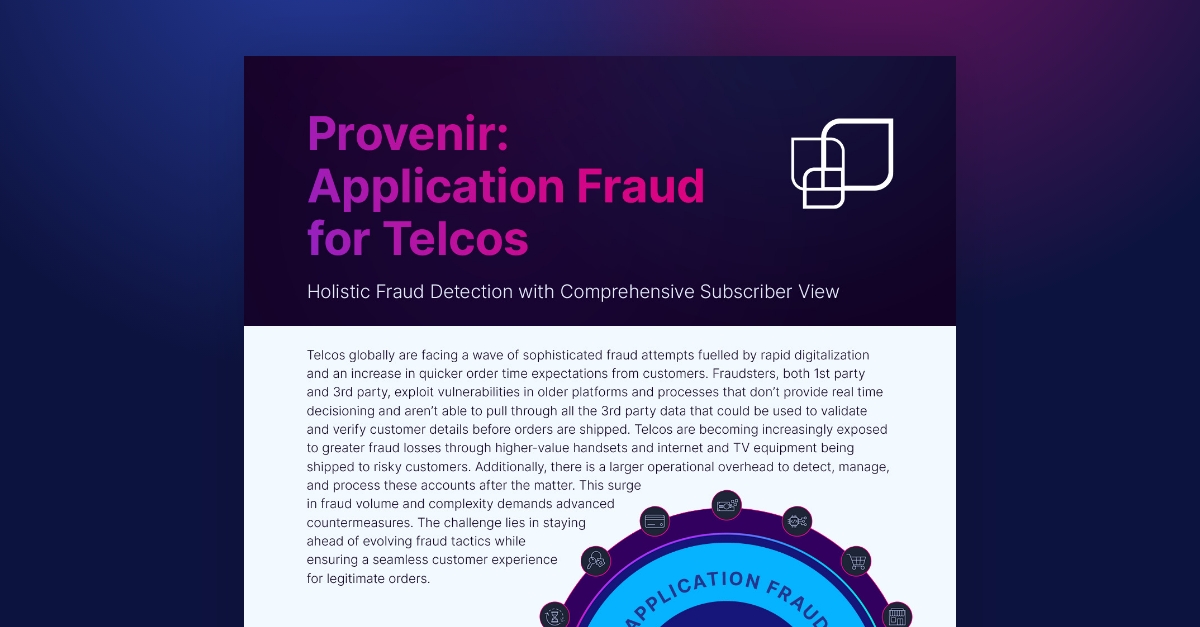
    fraud for telco data sheet

    DATA SHEET: Fraud fo...

    Provenir: Application Fraud for Telcos Holistic Fraud Detection with Comprehensive Subscriber View Telcos globally are
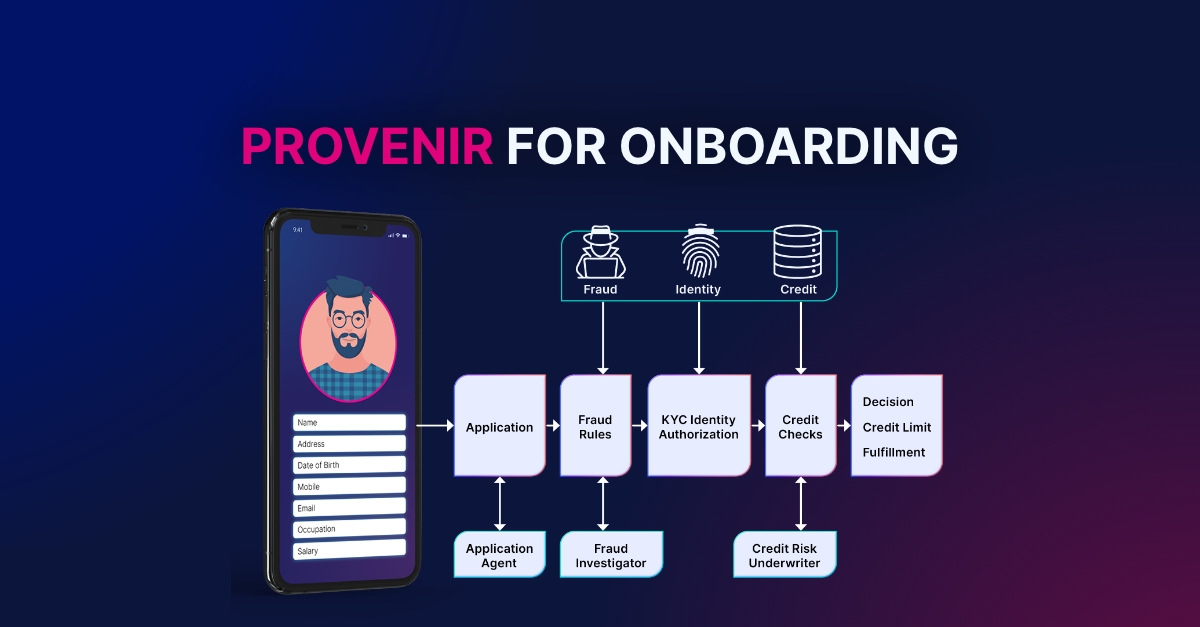
    Provenir for Onboarding

    Provenir for Onboard...

    Provenir for Onboarding Minimize Credit and Fraud Risk, Maximize Opportunity Discover Provenir’s single, scalable software
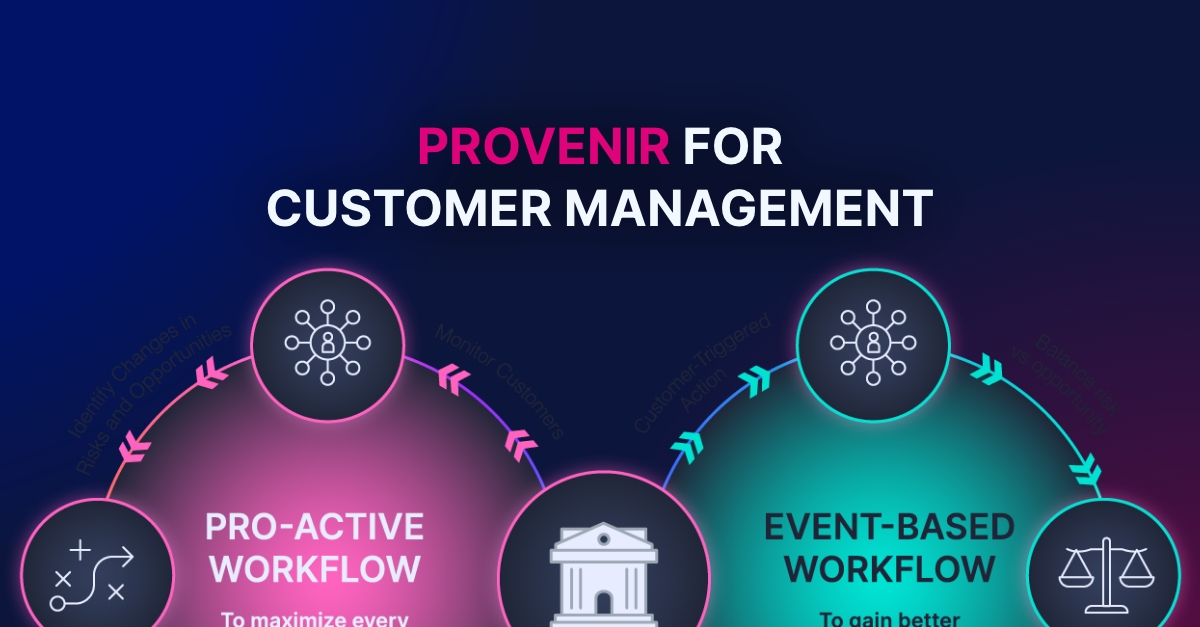
    Provenir for Customer Management

    Provenir for Custome...

    Provenir for Customer Management Maximize Value Across the Entire Customer LIfecycle. Take your customer management
    Provenir for Embedded Finance

    Provenir for Embedde...

    Provenir for Embedded Finance Maximize Value Through Seamless Financial Services Integration Integrating financial services into
    provenir logo

    Provenir Redefining ...

    Provenir Redefining Risk Decisioning for the World's Leading Financial Services Providers Flexible. Smart. Strategic. Instant
    Provenir: Intelligent Decisioning for Acquiring Customers and Optimizing Lifetime Value

    Provenir: Intelligen...

    DATA SHEET Provenir: Intelligent Decisioningfor Acquiring Customers and Optimizing Lifetime Value Flexible. Smart. Strategic. Decisioning
    Provenir for Fraud

    Provenir for Fraud

    DATA SHEET Provenir for Fraud Optimized Data Orchestration. One Holistic Platform for Fraud and Credit

    Continue reading

    fraud thumbnail

    Stop Fraudsters in Their Tracks

    INFOGRAPHIC

    Stop Fraudsters
    in Their Tracks

    How an AI-Powered Decisioning Platform Can Optimize Your Fraud Data Orchestration

    Did you know? 

    • There are over 41,000 account credentials stolen per minute
    • There is a new victim of identity theft every two seconds
    • SIM swap fraud reports have increased by 400% in the past five years

    And that’s just a handful of scary stats. As fraud threats evolve, so too must the fraud detection/prevention methods used by financial services providers. The key is data. Because the better you get at optimizing your fraud data orchestration, the more confidently you can say yes and sustainably grow your business. See how an AI-powered risk decisioning platform can help.

    Discover more accurate fraud risk detection with a more holistic view of your customers

    Get the Datasheet

    LATEST INFOGRAPHICS

    INFOGRAPHIC Hyper-personalization

    Hyper-Personalizatio...

    Most financial institutions still rely on humans to interpret model predictions and make the final
    AI infographic

    5 AI Use Cases Digit...

    5 AI Use Cases Digital Banks Must Govern by 2025 Digital banks across APAC are
    telco fraud thumbnail

    Infographic: How to ...

    INFOGRAPHIC Navigating the High-Stakes World of Telco Decisioning How to Maximize Revenue Without Risk Increasing
    Infographic: Unlocking the Embedded Finance Advantage

    Infographic: Unlocki...

    Infographic Unlocking the Embedded Finance Advantage How to Harness Embedded Finance for Enhanced Customer Experiences
    Infographic: One decisioning platform for every customer touchpoint

    Infographic: One dec...

    Balancing risk with opportunity can be a challenge - especially when you need to offer
    Navigating Your Legacy System Upgrade

    Navigating Your Lega...

    Do you struggle to maintain your legacy decisioning systems? A lack of support from current
    provenir logo

    Infographic: The Evo...

    With extraordinary growth over the past twenty years, the financial services sector has seen incredible
    Elevating Customer Experiences: Headless Banking and Banking-as-a-Service (BaaS)

    Elevating Customer E...

    INFOGRAPHIC Elevating Customer Experiences: Headless Banking and Banking-as-a-Service (BaaS) How to enhance engagement and streamline

    Continue reading

    Achieving Frictionless Fraud Prevention: Striking the Perfect Balance of Risk & User Experience

    ON-DEMAND WEBINAR

    Achieving Frictionless Fraud Prevention:
    Striking the Perfect Balance of Risk & User Experience

    Book a Meeting

    In today’s digital landscape, any form of friction can deter quality customers, while a lack of it can attract fraudsters. To maintain a competitive edge, businesses need to find the ideal line that ensures a seamless experience for genuine customers while effectively protecting against fraudulent activities. 

    In this session, industry leaders Provenir and Socure will discuss:

    • The core principles of frictionless fraud prevention
    • Valuable insights and practical strategies to help you navigate challenges.
    • How advanced technologies and data analytics can be leveraged to assess risks in real-time.
    • Through engaging case studies and success stories, gain inspiration and actionable takeaways to build a robust fraud prevention strategy that safeguards your business while creating a seamless experience for your customers


    RESOURCES

    Continue reading

    AI Strategies to Mitigate Banking and FinTech Fraud

    NEWS

    AI Strategies to Mitigate Banking and FinTech Fraud

    As financial fraud and risk vectors constantly evolve, artificial intelligence (AI) is well-positioned to stay one step ahead of nefarious activity by accessing real-time data and applying it to the latest defensive measures in a fully automated manner.

    In this IBS Intelligence podcast, Carol Hamilton, Chief Commercial Officer with Provenir AI, explains the current challenges financial institutions face when it comes to fraud prevention, why AI is “fit for the fraud fight,” and the key advantages of an AI-infused approach to fraud prevention.

    Listen to the Podcast

    The Ultimate Guide to Decision Engines

    What is a decision engine and how does it help your business processes?

    Learn More


    LATEST NEWS

    Continue reading

    Attacking Banking and Fintech Fraud Head-On Through AI-Infused Strategies

    NEWS

    Attacking Banking and Fintech Fraud Head-On
    Through AI-Infused Strategies

    New research shows that 43 percent of financial services organizations expect the cost-of-living crisis to increase the risk of financial crime and fraud over the next 12 months, as scammers target vulnerable consumers struggling with rising bills.

    In this Finance Digest article, Carol Hamilton, Chief Growth Officer for Provenir, shares why traditional policy-based approaches to identifying fraud often fail. A more enlightened approach involves leveraging optimized contextual scorecards, machine learning algorithms and outlier detection — all types of AI-infused strategies to improve fraud detection and accuracy.

    Read Now

    The Ultimate Guide to Decision Engines

    What is a decision engine and how does it help your business processes?

    Learn More


    LATEST NEWS

    Continue reading

    Guest Blog: Three Best Practices for Implementing Digital ID Verification

    GUEST BLOG

    Three Best Practices
    for Implementing Digital ID Verification

    • Christina Luttrell, Chief Executive Officer at GBG Americas

    A recent report showed that 86% of businesses view identity verification as a strategic differentiator, allowing them to capitalize on digital adoption while delivering a seamless customer experience. Consumers who don’t trust the digital identity verification process are more likely to use guest checkout (54%) and less likely to keep a payment card on file (43%), thereby creating a drag on profits while compromising the end-user experience.

    The following best practices can help fintechs locate, verify and approve new customers without friction or fraud while streamlining the customer journey.

    Onboarding in The Digital Landscape

    Being successful in a digital environment means being able to onboard and verify users in a purely digital way. This means doing all the required elements, such as KYC, AML, checking against sanctions lists, etc., in a digital-only environment, which can be challenging.

    This means needing to design a UX that is inclusive of digital identity verification at its core, with access to multiple verification layers that can be deployed in each required scenario. Fintechs make money by people utilizing their service. Providing a digital experience that opens the door to more good customers—while also meeting regulatory requirements—is a goal for all fintech providers.

    A robust ID verification solution gives fintechs the confidence to onboard more legitimate customers faster, with nominal friction, while staying compliant.

    Data Diversity & Consortium Networks

    Central to the requirement for effective digital identity verification is data diversity. Incorporating other identity verification data sources is essential, as the more indicators are used, the more robust the system is compared to a traditional system reliant on credit checks, which can be breached.

    The other consideration is data transparency – data must be sourced and explained, as a critical requirement for ongoing regulatory compliance, and justify decisions to customers.

    This is where the idea of consortium networks, where data is shared between a large network of interconnected parties, becomes highly important, as they enable new account openings at different institutions to benefit from fraud data and learnings elsewhere in the ecosystem, securing the whole market more effectively.

    Ongoing Verification

    Onboarding is an important element of fraud prevention, but ongoing verification is necessary, which is the authentication part of the equation. Opening a fraudulent account is a risk, but account takeover of an existing account is also a significant risk, as payment account fraudsters have access to make payments and view transaction history and payment details.

    The requirement is for fintechs to design strategies that ensure that verification is carried out continuously. This could be when an unusual transaction is made, or when a new payment method is set up, or in any number of given scenarios. 

    Given what’s at stake, if fintechs fail to implement robust systems based on more than just point solutions for ID document scanning, they will struggle to deal with evolving fraudster tactics. For this reason, the industry could see the continued fusing of physical and digital attributes for verification, such as taking name, address, date of birth, etc. Only by taking a multi-layered, customizable approach will banks achieve the best anti-fraud and customer experience outcomes.

    Visit IDology.com to discover innovative solutions that streamline customer acquisition, deter fraud, and drive revenue.

    Ten Companies Using Alternative Data for the Greater Good

    Read the Blog


    LATEST BLOGS

    5 Questions Your Decisioning Platform Can't Answer (But Should)

    5 Questions Your Dec...

    5 Questions Your Decisioning Platform Can't Answer(But Should) Most
    Brendan Deakin, Executive Vice President at Provenir

    Confidence at Speed:...

    Confidence at Speed:What Risk Leaders Are Actually Missing Most
    BLOG Bharati Fernando

    How to Change a Deci...

    How to Change a Decisioning Model Without Raising a
    Verifying the Invisible Subscriber

    Verifying the Invisi...

    Verifying the Invisible Subscriber How Accessing 1datapipe on the
    FAQ

    Decision Management ...

    Decision Management Implementation FAQs for Enterprise Banks Implementing a
    260817 - BLOG Closing Fraud Gap - FeatureIMG - EN 61409

    Beyond Detection: Cl...
    Beyond Detection:Closing the Fraud Prevention Gap Financial services providers
    260726 - BLOG eyeDP - FeatureIMG - 61058

    Beyond Data: Why Dec...

    Beyond Data:Why Decisioning Needs Document Intelligence Financial services providers
    Fraud in Telco: Provenir Experts Answer Frequently Asked Questions

    Fraud in Telco: Prov...

    Fraud in Telco:Provenir Experts Answer Frequently Asked Questions 1.

    Continue reading

    Sekura and Provenir Partner to Fortify Fraud Protection for the Financial Services Industry via Mobile Intelligence

    NEWS

    Sekura and Provenir Partner
    to Fortify Fraud Protection for the Financial Services Industry via Mobile Intelligence

    The combined solution is ideal to support BNPL, SME lending, retail and POS, new customer onboarding, auto financing, and banking and loan origination

    Parsippany, NJ — Oct. 27, 2022 — Provenir, a global leader in AI-powered risk decisioning software, today announced it has entered into a global partnership with Sekura Mobile Intelligence, a global provider of mobile data solutions. This partnership enables Provenir to provide customers access to trusted mobile data, direct from mobile operators through the Provenir Marketplace.

    Sekura provides real-time mobile identity data signals direct from global mobile operators, providing trusted, secure and easy to consume solutions for identity (ID) verification, anti-fraud and secure online authentication use cases.

    The Sekura ‘SAFr’ API, built to deliver industry-leading data, performance and reliability, enables Provenir customers to consume a suite of ID verification and fraud protection data attributes in real time. Sekura’s mobile solutions are available across five continents, spanning key global markets such as the U.K., France, Germany, Spain, Netherlands, Brazil, Canada, U.S., India and South Africa.

    The combination of Sekura and Provenir is ideal to support customer use cases including BNPL, SME lending, retail and POS, new customer onboarding, auto financing, and banking and loan origination, delivering world-class user experiences and secure fraud protection for existing and new user workflows.

    “With fraud incidents escalating, all organizations must be laser focused on preventing fraud,” said Carol Hamilton, Senior Vice President, Global Solutions at Provenir. “Sekura provides a comprehensive suite of mobile intelligence and identity data services that help Provenir customers identify fraudsters faster and protect their organizations from threatening activity.”

    “The Sekura team is delighted to partner with Provenir and excited about the opportunities to combine the industry-leading skills and knowledge on both sides to create significant value for Provenir’s customers and their end users,” said Jim Small, Chief Operations Officer at Sekura.

    Ten Fintechs Using Alternative Data for Financial Inclusion

    Read the Blog


    LATEST NEWS

    Continue reading