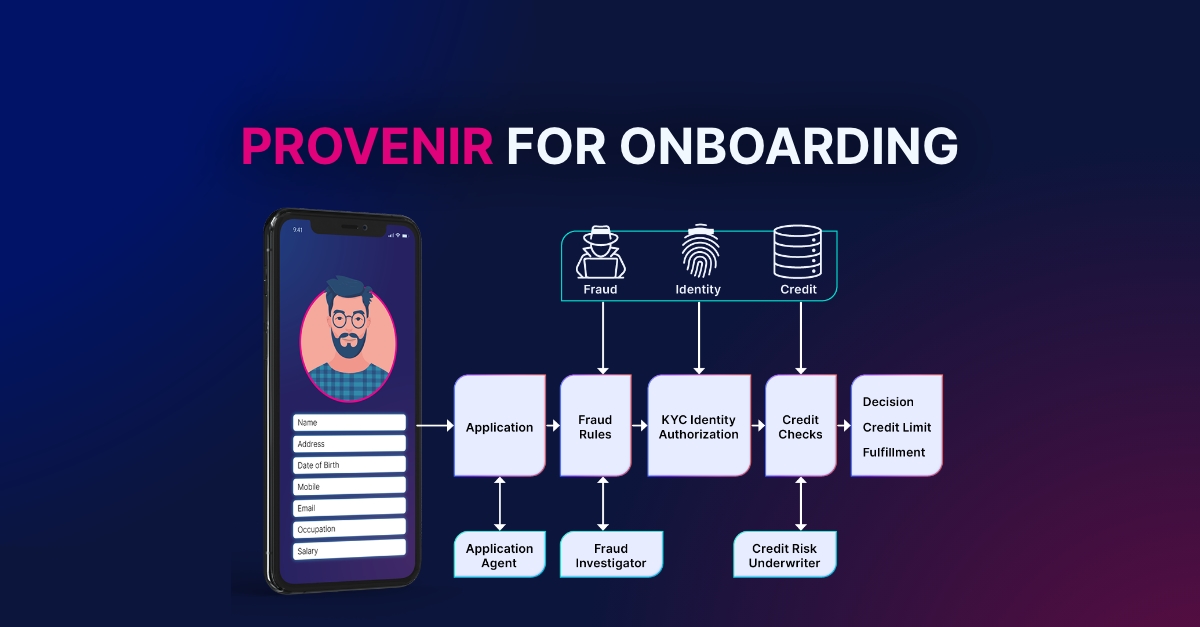
Consumer lending is a broad market with a wide range of use cases to choose from, but the secret to success remains the same for each: provide world-class customer experience to your customers and do it in an instant, all while minimizing risk and mitigating fraud.
See how you can simplify application processes, automate decisions, and approve customers for personalized offers in real-time with Provenir’s AI-powered data and decisioning ecosystem. Serve your customers, outperform competition and grow your business with our powerful, future-proof technology.
Consumer lending continues to move forward with innovation in all areas. While BNPL grabs a lot of the headlines the personal loan is more popular than ever with AI-based automated underwriting becoming the norm. And credit cards have seen more innovation in the last two years than in the previous twenty as it becomes easier to embed cards into the lending stack.
Even with a recession looming lenders continue to provide the next iteration of products across the credit spectrum. This panel of experts will discuss where the market is today, how they serve more borrowers than ever before, and why data is more important now than ever before.
Key Themes:
The proliferation of new data sources
Balancing new versus existing products in a challenging environment
Forty-four percent of SMEs look to funding to meet operating expenses, with this number expected to grow considerably during times of economic uncertainty. Fifty-six percent of SMEs seek funds to expand business operations or pursue new market opportunities. But waiting months or even weeks for credit approval and funding can mean the difference between innovation and business closure.
It has always been a challenge for traditional financial service providers to make SME decisions profitable, balancing the relatively small monetary amounts requested, the high volume of demand and the complexity of the decision required. How can financial services organizations and fintechs more efficiently manage the risk of lending to SMEs? The answer is leveraging both traditional and alternative data to drive automation.
Watch our on-demand webinar and discover how data is key to driving risk strategy innovation, and how it enables rapid approvals and more accurate risk decisions.
Key Highlights:
Discover how alternative data can minimize risk while accelerating growth
Explore unified data and decisioning solutions that drive risk strategy innovation
Learn how to deploy more accurate credit risk models by accessing the right data at the right time
Gain insights on identifying and mitigating fraud risk with data-driven decisioning
In a consumer-driven world, fintech lenders must put the customer at the center of their business to help them achieve their financial objectives and avoid potential harm.
But how prepared are you for the new regulations?
How will you integrate data within risk decisioning and analytics technology to keep ahead while protecting consumers at the same time?
What You’ll Learn:
How fintechs and banks have previously struggled with customer centricity.
How data insights can help the financial executives of fintechs and banks to meet Consumer Duty regulations.
The BNPL potholes & financial products that have impacted Consumer Duty.
How fintechs can help consumers use short-term finance responsibly.
Speakers:
Desmond McNamara
Chief Risk Officer at Zilch, a direct-to-consumer payments technology company, which is FCA authorised for consumer lending. Des has worked for over 30 years in risk management at large banks, as CRO for global credit card business and has also built a bank for scratch which was granted a full banking licence in 2020.
Chris Kneen
Managing Director UK & Ireland at Provenir, is a global leader in risk decisioning and data analytics software. Chris is responsible for expanding Provenir’s customer base in the UK and Ireland, working closely with the company’s regional and global teams to accelerate growth and support clients. Chris oversees operations, sales, customer success, and pre-sales consulting teams.
Empowering Smarter Credit Risk Decisioning with Real-Time Data Access
Currently about 50% of India’s population is credit unserved and another 20% underserved. But it’s difficult to make accurate credit decisions without easy access to the right kinds of data. And while there is no shortage of data available to the industry, many financial institutions struggle with data access and integration. Harnessing the power of real-time data, from a variety of sources, is an immense opportunity for financial institutions to offer targeted products that enable greater access to credit for those who need it.
Watch the webinar where we’ll show you how real-time, simplified data access can improve risk decisioning accuracy and improve financial inclusion.
During this in-depth discussion you’ll learn:
How simplified data access to alternative and non-traditional data can reshape your business
The ways integrating real-time data, including alternative data sources, can help you manage risk, explore new opportunities, and respond to market changes faster
How to utilize advanced analytics to optimize pricing and make more personalized offers
Why a unified solution for data, AI and decisioning drives the agility and flexibility needed to power exceptional consumer experiences
How to power financial inclusion with alternative data and advanced analytics
Addressing financial inclusion is a priority for many fintechs and financial services providers: there are almost 6 million unbanked households in the US alone.
This large population of unbanked individuals represents significant growth for innovative organizations, but the reliance on traditional financial data makes it difficult to evaluate creditworthiness for those with thin or nonexistent files.
To make financial services available to the unbanked and underbanked populations, alternative data provides new insights to support credit decisions while also detecting fraud.
Join this panel of experts for a discussion on how to harness the power of alternative data to catalyze financial inclusion and expand your customer base, without increasing risk.
Topics include:
The gaps using only traditional data leaves in determining credit risk
How alternative data can catalyze financial inclusion while reducing risk and fraud
The role of alternative data in the larger picture of tech-enabled financial inclusion
How alternative data opens opportunities for market expansion
Actionable steps you can take to incorporate alternative data into your decisioning
A Geek’s Guide to Machine Learning (AI), Risk Analytics and Decisioning
Introduction
Artificial Intelligence (AI), Machine Learning (ML) – whatever you want to call it, these buzzwords are appearing more and more throughout the business and social world. So what are they and what do they mean?
Despite the growing interest, AI/ML isn’t new at all. In fact, the models themselves have been around since the 1970s and ‘80s. In the financial sector, banks have been using ML to mitigate fraud and detect irregular buyer behaviors and patterns for the last decade or more.
Fraud is a growing concern and is costing the financial sector millions of dollars in losses each year. A 2015 research note from Barclays stated that the United States is responsible for 47 percent of the world’s card fraud despite accounting for only 24 percent of total worldwide card volume. A 2014 Federal Trade Commission report shows that credit cards and other consumer payment methods produced the greatest losses over other types of fraud.
One of the ways in which UK financial firms have tried to reduce fraud is with the implementation of the Chip and Pin system. It was seen as an effective means to prevent and reduce card fraud. But a research paper by Murdoch et al (2010) showed how fundamentally flawed Chip and Pin is.
As technology evolves, so do the cunning methods for perpetrating a fraudulent crime. Financial firms are now relying on sophisticated artificial intelligence software to evolve, adapt and learn in line with the behavior patterns of fraudsters in order to track, detect and prevent fraud far more quickly than traditional methods. The use of AI has also been implemented in industries outside financial services including insurance, retail and telecommunications.
Obviously, it is in the interest of the card issuer or bank to implement strategies to reduce the risk of fraud. Unfortunately, this often requires a compromise between expense and inconvenience to the merchant and the customer. Merchants are at far more risk than the end credit card user as they are ultimately responsible for incurring the cost of a fraudulent purchase and the potential loss of the customer resulting from the bad experience. Other costs to the merchant include direct fraud costs, cost of manual order review, cost of reviewing tools and cost of rejecting orders.
This Provenir report describes the use of AI tools in credit card fraud to mitigate risk. We will be looking at various AI detection methods including Artificial Neural Networks (ANN), Fuzzy Neural Networks (FNN), Bayesian Neural Networks (BNN) and Expert Systems.
An Overview of Fraud Prevention and Detection Techniques
The modern information age is flooded with a rapidly growing and astonishingly huge amount of data. In the U.S alone, the total number of credit card transactions totaled 26.2 billion in 2012. The processing of these data sets by banks and credit card issuers requires complex statistical algorithms to extract the raw quantitative data.
These systems work by comparing the observed and collected data with expected values. Expected values can be calculated in a number of ways. For example, a behavior model would look at the way a customer’s bank account has been used in the past, and any deviance from usual purchasing habits would return a suspicion score. This method works by flagging a transaction with a typical score, usually between 1 and 999. The higher the score, the more suspicious the transaction is likely to be, or, the more similarities it shares between other fraudulent values.
Typically, the measures taken to combat fraud can be distinguished into two categories – Prevention and Detection.
Fraud Prevention constitutes the necessary steps to prevent fraud from occurring in the first place, with various preventative methods used to deter fraudsters, such as MasterCard SecureCode and Verified by Visa.
Fraud Detection, the focus of this report, comes into play once fraud prevention fails. Detection consists of identifying and detecting the fraudulent activity as quickly as possible and implementing the necessary methods to block and prevent the card from being used by the perpetrator again. Issues arise when criminals adapt and change their tactics once they are aware that a prevention method is in place, therefore the need for more intelligent and sophisticated technology which ‘learns’ is essential for the detection of fraud.
The techniques used to detect fraud also fall into two primary classes – Statistical techniques (clustering, algorithms) and Artificial Intelligence (ANN, FNN, Data Mining). Both of these methods still involve mining through the available data and highlighting any anomalies (which can be defined by a set of rules) from the purchasing and transaction data of the customer. The difference is that where we used human analysts to manually search useable knowledge in the past, today we make use by machine learning.
Artificial Intelligence Models
Artificial Neural Networks Also known as connectionism, parallel distributed processing, neuro-computing and machine learning algorithms, Artificial Neural Networks (ANNs) were first developed during the late 1980s and have since become a fundamental tool in combating fraud. ANNs work by imitating the way the human brain learns, using complex input, hidden, and output layers.
Diagram representing a feed-forward multilayer perceptron (the most common type of ANN). (Source: www. oscarkilo.net)
The input nodes retrieve information from an outside source (for credit card fraud detection, this would be the transactional data of a customer’s account) and the output nodes send the results from the neural networks back to the external source. The hidden nodes in-between the input and output nodes have no interaction with the external source and become more complex in their configuration and nature depending on the complexity of the problem at hand.
The various nodes in each layer of the neural network are connected by edges where each edge represents a particular weight between two connected nodes. (In the human brain, these are called synapses.) The information that the neural network learns through supervised or unsupervised learning is stored in these weights.
An example of the way neural networks learn is similar to the way children learn to recognize animals. After seeing a dog, the child can then generalize on various other breeds of dogs, categorizing and defining them as ‘dogs’ without having seen them before. An important feature of neural networks is that when they learn, they have the option to be supervised or unsupervised.
For unsupervised neural network learning, the system makes use of clustering, which groups patterns based on similarity. The two main unsupervised learning methods are Hebbian and Kohonen. Hebbian learning takes place by association, meaning that if two neurons which are on either side of a synapse are activated simultaneously, the strength of that synapse will be increased. Kohonen (also called Self-Organizing Maps) learning takes place by learning the categorization of the input space.
For supervised neural network learning (back-propagation), the correct output values for certain input data are determined before starting the algorithm, and the system then learns the function between the paired input and output nodes.
A user can train a neural network by running through examples of past data. The learning process occurs when the output data is compared to that of the ANN’s predicted output. The weights for each connection are then adjusted based on the exampled data, allowing the system to learn new patterns and behavior and improve accuracy without having to be taught or shown it.
Fuzzy Neural Networks
Fuzzy Neural Networks (FNNs) are a branch of hybrid intelligence systems which make use of fuzzy logic together with ANNs to detect fraudulent activity. The idea was first developed and proposed by Zadeh and has since been used and implemented successfully in a variety of industries. The core framework for fuzzy logic is to provide an accurate method for describing human perceptions. Some experts believe that the use of fuzzy rules can provide a more natural estimate as to the amount of deviation from the normal.
FNNs, like Expert Systems, make use of IF-THEN-ELSE statements and heuristic rules to handle uncertainty in applications, resulting in better approximate reasoning without the need for analytical precision. The use of traditional IF-THEN-ELSE statements and heuristic rules (see Expert Systems below) has been controversial, and therefore has not been as widely implemented as some of the other AI fraud detection systems.
Expert Systems
Expert Systems saw increased usability and growth during the 1980s with the expansion of computer processing power, programming and AI. It was used in credit card fraud detection by using a rule-based system which proved to be fairly popular when no other intelligent systems were around. These systems were used to imitate and replicate the knowledge of an ‘expert’ person and can be defined into two classes – facts and heuristic.
Facts are classified as a quantity of information, such as the credit card transaction history or an individual’s credit rating.
Heuristic is where a person of ‘expert’ knowledge defines a set of rules that they would usually follow by protocol as a result of their ‘expert’ experience, education, observation and training.
Expert systems work by taking this human knowledge and transferring it into a logical language that a computer can understand and follow in order to solve a problem. A fundamental part of expert systems is their extensive database of stored rules which are defined by a typical IF-THEN-ELSE format. For example, a rule based system using IF-THEN-ELSE may look like the following:
IF the amount of purchase is greater (>) than $1000 and the card acceptance authorization is through ‘eBay’, THEN raise a suspicion score and require further verification, ELSE approve transaction.
Limitations of Expert Systems however are that they require considerable storage space and rely heavily on extensive programming of expert human knowledge in order to make decisions. Some experts b
Bayesian Neural Networks
These types of networks take a slightly different approach to the general guidelines and rules of learning that are commonly seen in ANNs and FNNs. Typically, Bayesian Neural Networks use Naive Bayesian Classifiers, a simple method of classification, to classify transaction activity.
Bayesian learning can be trained very efficiently in a supervised learning setting and uses probability to represent uncertainty about relationships that have been learnt as opposed to variations on maximum likelihood estimation. Where neural networks try to find a set of weights for each node (process of learning) to best fit the data inputted, Bayesian learning makes prior predictions by means of probability distribution over the network weights as to what the true relationship might be. One study looked at the comparison of using both ANNs and Bayesian Belief Network algorithms in fraud detection, and found that the use of Bayesian Neural Networks, although slower, were in fact more accurate than the use of ANNs alone.
In fact, many believe the use of Bayesian methods to be highly effective in real world data sets as they offer better predictive accuracy. This is supported by research which concluded that the use of Bayesian Neural Networks were far superior and accurate in detecting credit card transactional fraud than Naive Bayesian Classifier.
The Data
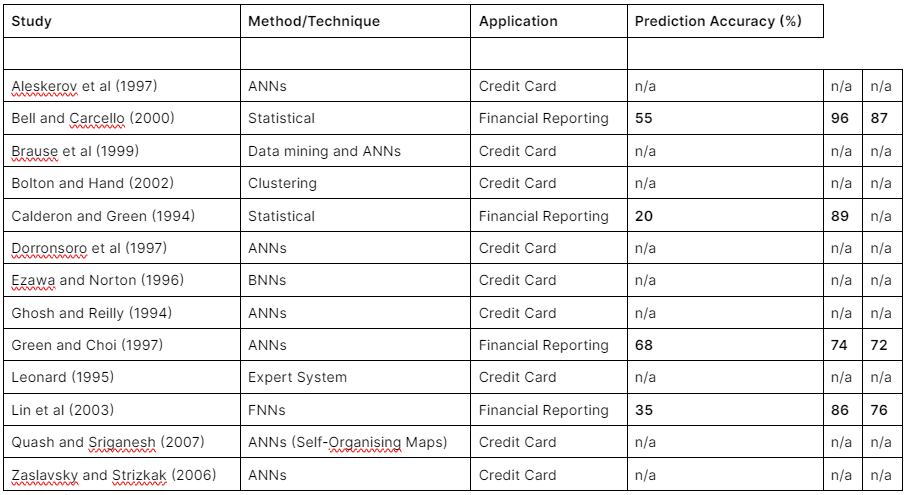
The following table compares the research findings to highlight which combination of models provides the highest prediction accuracy.
Summary of the most notable investigations into the use of Artificial Intelligence at mitigating fraud.
The greatest challenge when talking about artificial intelligence/machine learning is actually in understanding what data sets we are looking at, and what model/combination of models to apply. Amazon’s Machine Learning offering is one example of an automated process which analyses the data and automatically selects the best model to use in the scenario. Other big players who have similar offerings are IBM Watson, Google and Microsoft.
Conclusion
Provenir’s clients are continually looking at new and innovative ways to improve their risk decisioning. Traditional banks offering consumer, SME and commercial loans and credit, auto lenders, payment providers and fintech companies are using Provenir technology to help them make faster and better decisions about potential fraud. Integrating artificial intelligence/machine learning capabilities into the risk decisioning process can increase the organization’s ability to accurately assess the level of risk in order to detect and prevent fraud.
Provenir provides model integration adaptors for machine learning models, including Amazon Machine Learning (AML) that can automatically listen for and label business-defined events, calculate attributes and update machine learning models. By combining Provenir technology with machine learning, organizations can increase both the efficiency and predictive accuracy of their risk decisioning.
From advanced machine learning to generative intelligence and model governance, Provenir helps you maximize value, minimize risk, and accelerate ROI — all on a single platform.
Did you know that the earliest form of Buy Now, Pay Later dates back to the 19th century, when consumers were able to purchase expensive goods (like furniture and farm equipment) on installment plans? While modern lending is often thought of as, well, modern, some of the technologies that impact our current financial services landscape have much older roots. Check out the infographic for some interesting factoids on the history of lending, the rise of modern technology, and just how far we’ve come in the world of lending.
The Ultimate Guide to Decision Engines
What is a decision engine and how does it help your business processes?
Whether you’re a product manager or part of the wider risk team, you know that access to the right data at the right time is vital to product—and business—success.
To launch new products and optimize existing ones you need a streamlined data supply chain that gives you the power to make smarter decisions across identity, fraud, and credit decisioning.
If you struggle with:
Sourcing the right data
Managing multiple vendors
Building out your data supply chain
Integrating data into your decisioning technology
Lacking the agility to adjust your data strategy on your timeline
Then watch our on-demand webinar as we cover the steps needed to ensure data strategy success across any financial services product offering.
Our team of data specialists covers:
Developing your data strategy to optimize decisioning for financial products
Streamlining your data supply chain to drive increased agility and faster speed to market
An exclusive demo showing how Provenir Data solves your data challenges and puts the power of data in your hands
The Changing Economic Landscape & Its Impact on Financial Services
Provenir Perspectives from Around the World
The economy is a hot topic, with signs of uncertainty in almost all regions globally. And this economic uncertainty has a noticeable impact on the way financial institutions make decisions and offer products and services to their customers.
Read the eBook to see what Provenir experts from around the world see happening with the economy now, what lies ahead, and the impact this will have on financial services and lending.
Knowledge is power
Do you have the right data to make informed risk decisions, even in the face of economic uncertainty?